


The Tyrrhenian side of Italy is a dream for families who love clear water and Mediterranean scenery, but it is very different from the flat, endlessly sandy Adriatic. Here cliffs, coves and rocky headlands mean that choosing the right resort is critical if you are traveling with young children who need easy, sandy access to the sea. This guide compares four of the most family-friendly stretches of the Tyrrhenian coast – Versilia in northern Tuscany, southern Lazio around Sperlonga and Gaeta, selected Cilento beaches in Campania, and the big family resorts around Scalea, Tropea and Capo Vaticano in Calabria – with concrete examples of where to stay and what to expect.
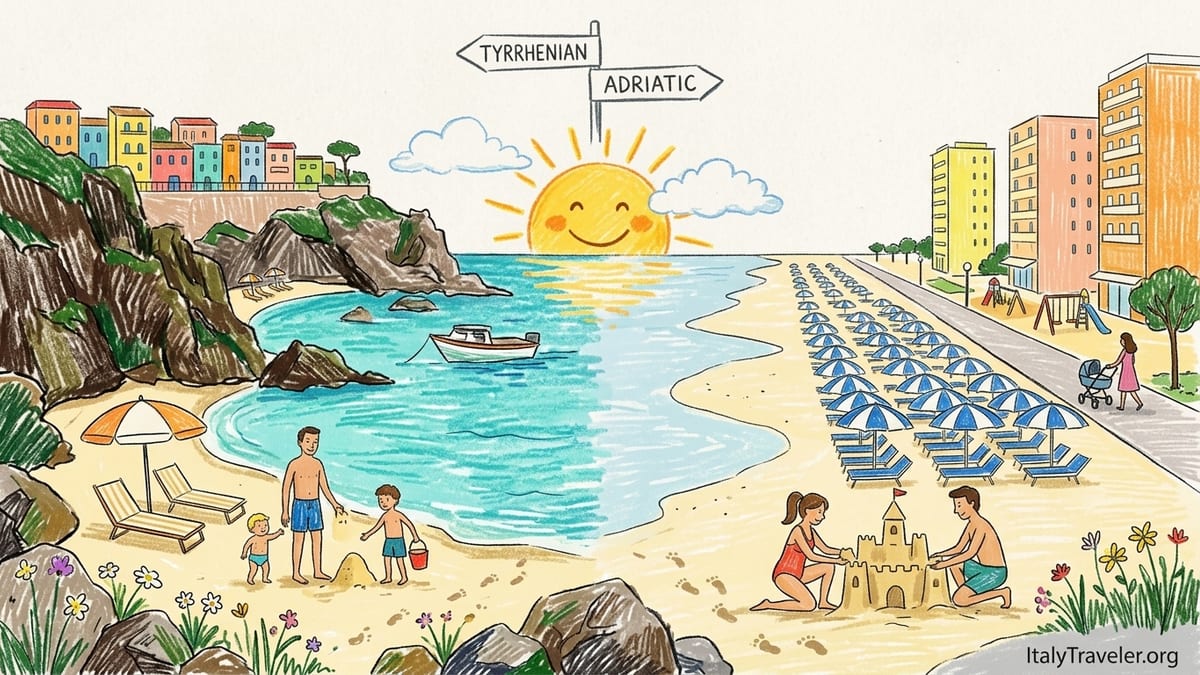
Tyrrhenian vs Adriatic: What Families Need to Know First
The classic Italian family beach holiday often brings to mind the Adriatic: long, straight ribbons of sand, shallow water and rows of umbrellas. On the Tyrrhenian, you still find plenty of family-ready strands, but they are broken up by rocky points and small coves. That makes destination selection more important. A hotel a few coves away can mean a steep staircase to the sea or pebbly shore instead of soft sand and shallow entry.
For families with toddlers and preschoolers, the priorities are usually a gently shelving sandy beach, on-site or nearby pool, rooms that can sleep three or four without feeling cramped, and simple things like a reserved umbrella, parking and the possibility of half board or full board so you are not hunting for restaurants with kids in tow. All four areas covered here provide those, but in different styles and at different price points.
Compared with similar accommodation on the Adriatic, resorts on the Tyrrhenian often have more dramatic scenery and clearer water, with many stretches awarded Blue Flag status in recent years, especially in Cilento and Calabria. In practice, that can mean your child’s first snorkeling experience right off the hotel beach, but it can also mean waves that get deeper more quickly if you do not pick your bay carefully. The examples below highlight properties and towns where the combination of beach profile and family services is especially suitable for younger children.
Another important distinction is how resort “villaggi” and family hotels on the Tyrrhenian package their services. Many operate with a “tessera club,” a weekly club card that covers kids’ activities, use of pools and sports facilities, and one umbrella and two loungers on a reserved stretch of sand. Understanding what is included and what incurs an extra charge helps you compare regions in a realistic way, especially if you are traveling in peak season between late June and late August.
Versilia: Tuscan Style with Wide Sandy Beaches
Versilia, stretching roughly from Viareggio up to Forte dei Marmi and Marina di Pietrasanta, is one of the easiest Tyrrhenian areas for families used to the Adriatic model. The beaches here are broad, sandy and mostly flat, with long-established stabilimenti that include playgrounds, kids’ pools and restaurants. You are not dealing with cliff paths or coves. For younger children, that immediately lowers the stress level, as you can push a stroller along the promenade and roll it straight onto the sand via wooden walkways.
Typical family hotels in Versilia sit just across the seafront road from their contracted beach clubs. Many three and four star properties offer family rooms that sleep up to four and simple half board packages covering breakfast and dinner. In high season, a standard family room in a midrange hotel in Viareggio or Marina di Pietrasanta might start around the mid three figures per night for two adults and two children, including beach service at a partner lido with one umbrella and two loungers. Compared to other Tyrrhenian regions, the per-night cost can be higher, but you are paying for the combination of services, flat sandy beach and easy access by train or motorway.
Versilia also works well for multi-generational trips because the towns have level promenades ideal for walking with grandparents and buggies, and there is plenty to do away from the sea. Day trips to Pisa and Lucca are feasible in under an hour by car or train from Viareggio, and Forte dei Marmi has a compact center with gelato bars, weekly markets and bikes to rent with child seats. Parking can be tight in July and August in the more upscale towns, so choosing a hotel with its own small car park or guaranteed space behind the building can save both money and stress.
The trade-off in Versilia is that while many seaside establishments run simple kids’ activities in Italian, you will not always find the full “village” concept with large animation teams and organized mini clubs that is common further south. Families that value independence, walkability and Tuscan food often accept the higher price and lighter animation in exchange for the convenience of those big, easy beaches.
Sperlonga and Gaeta: Lazio’s Family-Friendly Bays
South of Rome, the stretch of Lazio coast around Sperlonga, Gaeta and the long Fondi shoreline combines sandy, shallow bays with a more relaxed atmosphere than Versilia. Sperlonga’s main beach is a gently curving arc of fine sand, with lidos that offer rows of umbrellas, beach bars and play areas. Here the accommodation stock is smaller-scale: family-run hotels, apartments and a few modern resorts that directly front the sand or sit just behind the dunes.
A concrete example between Sperlonga and Terracina is Hotel Martino, which puts families right on a private sandy strip with over 100 meters of beach reserved for guests, shallow water access via steps with handrails and a focus on activities for children aged roughly 4 to 14. The convenience of accessing the sea directly from the property, without crossing busy roads, is a major plus if you have little ones who run ahead. In summer, similar beachfront three and four star hotels in this area typically bundle one umbrella and two loungers per room plus use of a small pool, with half board rates often coming in below high-end Versilia, making Lazio’s coast good value for central Italy.
In Gaeta, the long Serapo beach is another good option for families, with a shallow entry that stays manageable for younger swimmers on calm days and a backdrop of cafes, pizzerias and gelato shops. While there are fewer self-contained “villaggi” here than in Calabria, some holiday villages and campsites on the outskirts offer bungalows or mobile homes, kids’ pools and animation programs in high season. Parking is the main practical challenge, especially in Sperlonga’s old town where spaces are scarce. Many family travelers therefore book properties that explicitly mention private parking or an allocated space, even if it is a short walk away.
As a base, Sperlonga and Gaeta score highly on nearby activities. Boat trips along the coast to see sea caves, half-day excursions to the Pontine Islands, and visits to the Roman Villa of Tiberius at Sperlonga or the medieval quarter of Gaeta mean that older children and teens are less likely to be bored after a few days on the sand. For parents, this central location between Rome and Naples also keeps travel time manageable if you are flying into either city with young children.
Cilento: Soft Sand and Clear Water in Southern Campania
Further south, the Cilento coast in Campania offers some of the most family-friendly beach profiles on the Tyrrhenian, combined with often lower prices than Tuscany and Lazio. Around Ascea Marina, Acciaroli and Palinuro, the main family-oriented resorts are set on or just behind long beaches of fine sand where the water usually shelves gradually. Several of these areas, including Marina di Ascea and the beaches of Palinuro, have received Blue Flag recognition in recent seasons, reflecting clean water and good services.
In Ascea Marina, Villaggio Elea is a case study in Cilento’s simple, family-focused “villaggio” model. Guests stay in small bungalows among olive trees a short walk from the sandy beach. The emphasis is on community meals in a central restaurant, daily activities for children and shows in the evening. There is typically a basic pool or paddling area for smaller kids, but the main playground is the beach itself. Everything is contained within a car-free space, which can be reassuring if your children are roaming between the mini club, sports courts and the sand.
On a more hotel-style level, properties such as Hotel Saline near Palinuro combine a traditional four star hotel with a private sandy beach that stretches for several kilometers, backed by dunes and Mediterranean scrub. The hotel focuses strongly on families, offering shallow water directly in front of the property, sun loungers, a pool and organized children’s activities in high season. In practice, this means you can alternate mornings at the kids’ club and the pool with afternoons building sandcastles along a quiet stretch of coast, without needing to move the car.
Cilento also features several newer club-style resorts, such as modern complexes near Acciaroli with contemporary family rooms and kids’ clubs divided by age ranges, typically Mini Club from about 3 to 6 years and Kids Club from roughly 7 to 11. These resorts generally sell packages that include full board, soft drinks at meals, a club card and beach service on a reserved strip of sand 100 to 200 meters away. For a family of four in July, weekly rates can compare favorably to a shorter stay in northern Tuscany, especially if you factor in that you may not need to eat out, since the on-site buffet usually includes child-friendly options like pasta, grilled chicken and pizza every day.
Calabria: Big Resorts between Scalea, Tropea and Capo Vaticano
On the southern Tyrrhenian, Calabria offers some of the most complete family-focused villages in Italy, especially along the Riviera dei Cedri around Scalea and on the Costa degli Dei around Tropea and Capo Vaticano. Here the sea is famously transparent and often a luminous turquoise, with a mix of sandy sections and small coves beneath white cliffs and rocky headlands. Choosing a property with a genuinely sandy or gently mixed beach is crucial for smaller children, as some picture-perfect coves are better suited to confident swimmers.
In Scalea, Santa Caterina Village is an example of a large family resort with private access to the sea, four pools including separate children’s pools with small slides, and a full entertainment program. The resort has around 380 rooms and offers a private beach area, kids’ clubs, sports courts and evening shows. Families here effectively get the all-in-one Adriatic-style village on the Tyrrhenian, with the bonus of Calabrian scenery and often more competitive pricing. A similar concept in the same town is the Apulia Hotel complex, which specifically highlights services for very young children, including a baby club for under 3-year-olds, shallow kids’ pool and organized excursions to nearby attractions such as the island of Dino and coastal caves.
A short way south, around Tropea and Capo Vaticano, the coastline becomes more rugged and scenic. Resorts such as Baia del Sole sit in gardens directly on sandy or mixed sand-and-pebble coves, with a private beach, a main pool plus smaller children’s section, and a dedicated mini club. Here the family product often includes spacious family rooms that can accommodate two adults, two children and a crib, as well as practical baby equipment like bottle warmers available on request. Some resorts operate with full board plus drinks at meals, which simplifies budgeting, while others add an all-inclusive “open bar” formula for snacks and beverages.
Traditional village-style properties, including long-running resorts that stretch along the shore between Tropea and Capo Vaticano, typically feature a central pool with separate shallow section, buffet restaurant, bar, amphitheater for evening shows and a miniclub or superminiclub running from mid-June to early September. A club card purchased on arrival usually covers one beach umbrella and two loungers per room, use of the pools and participation in kids’ and junior clubs. For families, that means you can arrive, park the car in the on-site lot and effectively not move it for a week, as most daytime and evening activities take place within the grounds.
In this region, pay attention to how you reach the sea. Some resorts sit directly at water level; others occupy terraces on a slope above the beach, with lifts, stepped paths or shuttle trains taking guests down to the sand. While older children might enjoy the ride, families with strollers or anyone with limited mobility should check in advance whether there is level access or whether the beach is reached by a steep staircase. When in doubt, properties that emphasize “directly on the beach” or “accesso diretto” without mentioning lifts or shuttles are usually the easiest for small children.
Beaches, Pools and Kids’ Clubs: Comparing the Regions
For toddlers and early swimmers, the safest choice is often a wide, sandy beach with a gentle slope and limited rocks in the shallows. Versilia delivers this almost everywhere. Sperlonga and Gaeta have it on their main bays, as do the long beaches around Ascea and parts of Palinuro. In Calabria, the profile depends heavily on the specific cove. Resorts on Scalea’s main seafront tend to front broad beaches where the entry is manageable, while some sections of the Costa degli Dei mix sand with pebbles and drop more quickly into deeper water a few meters from shore.
If pool time is as important as the sea, Calabria generally comes out ahead, with several resorts offering two or more large pools plus smaller kids’ pools with shallow water and small slides, all included in the club card. Santa Caterina Village, for example, has multiple pools, including one dedicated to smaller children who prefer splashing rather than waves. In Cilento, most midrange family resorts provide at least one main pool with a shallow edge or kiddie area. Versilia and southern Lazio hotels often have a single medium-sized pool, but in many cases families spend most of their water time on the beach, since the sand is so convenient.
Kids’ clubs and animation are strongest in Calabria and at purpose-built “villaggi” in Cilento. Resorts around Scalea, Tropea and Capo Vaticano routinely offer separate age brackets such as baby club, mini club and junior club, with Italian-speaking staff leading beach games, art workshops and evening mini disco. The Cilento villages around Ascea Marina and Acciaroli follow a similar model, albeit on a smaller scale, often focusing more on outdoor games and simple shows than on character branding or elaborate indoor playrooms. In Versilia and Lazio, you are more likely to find lighter daytime activities on the sand, small playgrounds and ad hoc evening events than a fully structured club program.
Language can be a consideration if your children do not understand Italian. While many animation teams, especially in larger Calabrian and Cilentan resorts, include some staff who speak basic English, the songs, games and stage shows are primarily in Italian. For some families that is part of the cultural experience; others with shy children may prefer the more informal, self-directed days in places like Versilia, where you can tailor your own program of beach time, bike rides and gelato without relying on organized clubs.
Family Rooms, Meal Plans, Parking and Practicalities
Across all four regions, family rooms that can legally and comfortably sleep two adults and two children are key. In Versilia and Lazio, these are often simply larger double rooms with bunk beds or a sofa bed added, with around 20 to 25 square meters of space. In Cilento and Calabria, many village-style resorts offer specifically labeled “Family” or “Suite” options that comprise two connecting rooms or a bedroom plus small living area, sometimes marketed with supplements per week. For example, some Calabrian packages quote a modest weekly surcharge for a dedicated family room with sea view compared with a standard double.
Meal plans also differ slightly by coast. In the north, especially Versilia, half board is common: you eat breakfast and dinner at the hotel and arrange lunch on the beach or in town. In Lazio, a mix of bed and breakfast and half board allows families to explore local pizzerias and trattorie in Sperlonga or Gaeta. In Cilento and Calabria, full board or all-inclusive formulas are widespread in the “villaggi,” making it easier to control the budget. Buffets tend to be informal and child-friendly, with a daily rotation of pasta, grilled meats, salads and local specialties, plus occasional themed dinners featuring regional dishes or street-food style snacks.
Beach service is usually a core part of the package in all four regions, but how it is packaged matters. In Versilia and Sperlonga, you may pay the lido separately, or it may be included in your room rate at a partner club for a set number of days. In Cilento and Calabria, the “tessera club” or resort fee that you pay on arrival will often explicitly include one umbrella and two loungers per unit, sometimes with the possibility to pay extra for front-row positions. If you are traveling with a baby who naps under the umbrella, that predictability is worth confirming at booking stage.
Parking is another practical consideration that can vary sharply. Versilia’s smaller hotels often have limited on-site spaces that need to be reserved in advance, sometimes for a nightly fee in high season. In Sperlonga’s historic center, many accommodations rely on public parking areas, and spots near the beach can fill by mid-morning on peak days. In Cilento and especially Calabria’s large villages, car parks are usually within the fenced resort grounds and included in the price, though they can be open-air rather than covered. For road-tripping families carrying strollers, beach toys and possibly a travel cot, being able to park close to your room or bungalow can make daily logistics much smoother.
The Takeaway
For families choosing between the Tyrrhenian and the Adriatic, the key message is that on the Tyrrhenian side destination and even specific property choice matter more. The right sandy bay in Calabria or Cilento can be just as easy for toddlers as any Adriatic resort, while a misjudged rocky cove might leave you juggling water shoes and steep staircases with a stroller. Versilia offers the most Adriatic-like experience on this coast, with broad beaches and urban conveniences, but at often higher prices. Southern Lazio around Sperlonga and Gaeta balances manageable drives from Rome or Naples with child-friendly bays and small-scale hotels.
Cilento and Calabria stand out for families seeking good value, clear water and a full “village” experience with pools, kids’ clubs and full board. Cilento’s long, soft beaches and relaxed villages suit those who like nature and a slightly slower rhythm, while resorts from Scalea to Capo Vaticano cater to families who want everything on site, from baby clubs to evening shows. Whichever region you choose, focus on three details when booking: the exact beach profile in front of your accommodation, how you physically reach that beach with young children, and which services are truly included in your rate. Get those right, and the Tyrrhenian can deliver a memorable, low-stress family holiday framed by some of Italy’s most beautiful coastal scenery.
FAQ
Q1. Which Tyrrhenian area is best for a first beach holiday with a toddler?
For a first trip with a toddler, Versilia and the main sandy bays of Sperlonga or Gaeta are usually the easiest, thanks to wide, gently shelving beaches, flat promenades and short walking distances from hotels to the sand.
Q2. Are Calabria’s coves around Tropea and Capo Vaticano safe for small children?
Many resort-front coves in this area are suitable for young children, especially where the shore is sandy and the entry gradual, but the coastline is varied, so it is important to choose a property that specifically describes a sandy beach with easy access rather than a rocky inlet reached by steps.
Q3. How do prices compare between Versilia and southern regions like Cilento and Calabria?
In peak season, family rooms with beach service in Versilia often cost more per night than comparable full board packages in Cilento or Calabria, where weekly village-style stays can offer better overall value, especially once you factor in meals and kids’ clubs.
Q4. Do Tyrrhenian family resorts typically include beach umbrellas and loungers in the price?
Most family-oriented properties include at least one umbrella and two loungers per room, but the mechanism varies, from bundled lido agreements in Versilia and Lazio to club cards in Cilento and Calabria, so parents should always confirm what is included before booking.
Q5. Will my children enjoy kids’ clubs if they do not speak Italian?
In larger resorts, particularly in Calabria and Cilento, some staff speak basic English and many games are physical or visual, so children can often participate happily, but shy kids or those unused to group activities might prefer more informal, family-led days in destinations like Versilia.
Q6. Is a car essential for a family holiday on the Tyrrhenian coast?
A car is highly useful in Cilento and Calabria, where resorts can be spread out and public transport is limited, while in Versilia and the Sperlonga and Gaeta area it is more feasible to combine trains, local taxis and walking, especially if you choose a hotel close to the seafront.
Q7. What is the best time of year to visit with young children?
Late May, June and September are ideal for families, with warm but not extreme temperatures, sea that is usually pleasant for paddling, and fewer crowds than in late July and August, when prices and heat both peak.
Q8. Are there medical facilities and pharmacies close to these resorts?
All four regions have local pharmacies in the main towns and at least basic medical services within a short drive, while larger Calabrian and Cilentan resorts often keep contact details for pediatric services and nearby clinics at reception for parents’ peace of mind.
Q9. How suitable are these areas for multi-generational trips?
They are generally very suitable, with level promenades and easy access in Versilia and Sperlonga, and resort-style layouts with on-site amenities in Cilento and Calabria, making it possible for grandparents to enjoy the holiday even if they do not spend much time on the beach.
Q10. Should I choose a hotel or a village-style resort for my family?
Hotels in Versilia and Lazio suit families who prefer flexible dining and urban amenities, while village-style resorts in Cilento and Calabria are better for those who want an all-in-one environment with pools, kids’ clubs and full board included, reducing the need to plan daily logistics.