


The Italian Tyrrhenian coast stretches for hundreds of kilometers from the marble-backed beaches of northern Tuscany down to the wild, cliff-lined shores of Calabria. It is spectacular, diverse and, for first-timers, deceptively vast. Trying to treat it as one continuous beach holiday usually means too much moving and not enough relaxing. This guide walks you section by section along the west coast, from Versilia in Tuscany through Lazio and Campania to Maratea and Calabria, to help you choose one or two coastal regions that fit your travel style, budget and time.
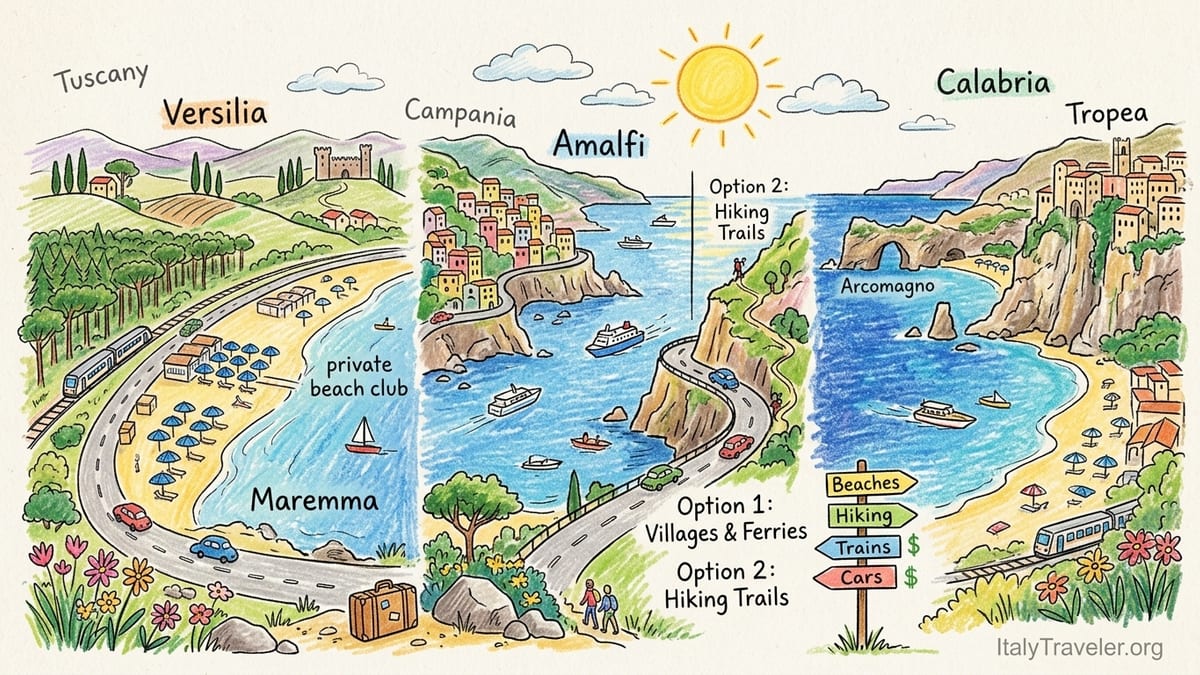
How to Think About the Tyrrhenian Coast as a First-Time Visitor
On the map, the Tyrrhenian coastline from northern Tuscany to the toe of Calabria looks like a single blue ribbon. In reality, it passes through several regions, each with its own character, price level and logistics. A week is usually enough for just one area, perhaps two if you are comfortable with a mid-trip transfer by train or car. Trying to cram in Versilia, Amalfi and Tropea in ten days, for example, often means spending at least two full days packing, checking in and out, and sitting on trains or in traffic instead of on the beach.
A realistic way to plan is to treat the coast as a chain of distinct travel regions: Versilia and Maremma in Tuscany, the quieter Riviera di Ulisse in southern Lazio, the famous Amalfi and Sorrento coasts and the more laid-back Cilento in Campania, then the Gulf of Policastro around Maratea and, further south, Calabria’s Riviera dei Cedri, Costa degli Dei and Costa Viola. Decide first what you want most, whether gentle family beaches with umbrellas, hiking and villages, or warm late-season swimming, then pick the stretch of shoreline that delivers that without constantly changing bases.
Transport links also vary by section. Parts of Versilia, Amalfi and Tropea are well-served by regional trains and ferries, which suits travelers without a car. Other stretches, such as sections of Maremma or Costa Viola, are easier with a rental car because stations are inland or infrequent and bus schedules thin outside July and August. When you choose which region to focus on, factor in how comfortable you are driving coastal roads and whether you prefer to rely on trains and boats.
Seasonality matters along this coast. July and August are hot, crowded and expensive almost everywhere, while June and September can bring warm seas and far lower prices, especially in Maremma, Cilento and Calabria. In early May or mid-October, a resort town like Tropea can feel sleepy with some beach clubs still closed, while larger hubs such as Viareggio or Salerno will still have restaurants and basic services open. Aligning your expectations and budget with the actual holiday rhythm of these regions will make the trip feel far smoother.
Versilia: Classic Tuscan Seaside With Easy Access
Versilia, at the northern tip of Tuscany’s Tyrrhenian coast, runs roughly from Forte dei Marmi down through Marina di Pietrasanta and Lido di Camaiore to Viareggio. This is one of Italy’s classic seaside playgrounds, with long, sandy beaches backed by pine trees and a near-continuous line of stabilimenti, the private beach clubs where you rent sunbeds and umbrellas by the day. In midsummer, a pair of loungers and an umbrella might cost in the region of 30 to 40 euros in Forte dei Marmi, a bit less in Viareggio, with discounts if you book for a week.
First-time visitors appreciate how straightforward Versilia is logistically. The main coastal towns sit on the Genoa to Pisa railway, with stations in Forte dei Marmi–Querceta, Pietrasanta and Viareggio, which means you can land at Pisa Airport, catch a direct regional train in under an hour and walk or taxi to your hotel. Bus services link the stations to the waterfront, and most towns have flat promenades that are easy to stroll, even with children or luggage. If you want variety, day trips by train to Lucca or by bus to the marble quarries above Carrara are very feasible.
Driving in Versilia is relatively gentle by Italian coastal standards. The main A12 motorway runs inland, while local roads parallel the seafront behind the line of hotels. Parking near the promenade can be paid and competitive in August, but many mid-range hotels offer on-site or contracted parking. If you stay in Viareggio or Lido di Camaiore, you can comfortably skip a car altogether and use trains and buses, which suits first-timers anxious about Italian traffic.
Food in Versilia suits sea-and-sun days: beach bars serving plates of spaghetti alle vongole, fried local fish, and gelato stands every few blocks. Prices are higher in upscale Forte dei Marmi, where you will find designer boutiques and private beach clubs with pool access, but more modest trattorias appear in side streets away from the water. For many first-time Tyrrhenian travelers, a few days here paired with a city like Florence or Pisa gives a gentle introduction to the Italian seaside without complex logistics.
Maremma: Wild Tuscan Shores and the Monte Argentario
South of Livorno, the Tuscan coast becomes wilder and less uniformly developed. The Maremma stretches down toward the border with Lazio and offers long, dune-backed beaches, pine forests and the dramatic Monte Argentario promontory. Places such as Castiglione della Pescaia and the beaches around the Maremma Regional Park offer a softer, nature-focused alternative to Versilia, with stretches of free, unorganized beach where you simply spread a towel and swim.
Monte Argentario itself, anchored by Porto Santo Stefano and Porto Ercole, feels like an island attached to the mainland by narrow strips of land. Roads climb and twist around the headland, offering views over small coves with pebble and rocky beaches. Many of the prettiest spots are easier to reach by local boat excursions from Porto Santo Stefano or Porto Ercole, which often cost in the range of 35 to 50 euros per person for a half-day cruise with swim stops. This area works best for travelers comfortable driving narrow roads or willing to rely on hotel-arranged transfers and boats.
Trains along the Maremma coast mostly run inland, with Orbetello being the key station for the Argentario area. From there, buses and taxis connect to the ports in about 15 to 25 minutes depending on traffic. Outside peak summer, bus frequencies drop, so first-timers coming without a car should plan arrival and departure around bus timetables and check that their accommodation can help arrange transfers. If you are pairing Maremma with Rome or Florence, the direct long-distance trains to Orbetello or Grosseto make it a reasonably simple coastal add-on.
Maremma’s food culture blends seafood with inland Tuscan dishes. You can eat grilled catch of the day in Porto Santo Stefano at lunch, then head inland in the evening for wild boar and red wines in a hill town. Prices are generally a bit lower than on the Amalfi Coast, with seafood mains at many casual trattorias in the 15 to 25 euro range and house wines priced modestly. For first-time visitors who want quieter beaches, nature reserves and a mix of sea and countryside without extreme crowds, Maremma is a strong candidate for a dedicated week.
Riviera di Ulisse: Southern Lazio’s Understated Coast
Crossing from Tuscany into Lazio, the coast south of Rome includes the Riviera di Ulisse, a scenic stretch around Terracina, Sperlonga, Gaeta and Formia. This area is popular with Italians but receives far fewer international visitors than Amalfi or Cinque Terre, which helps keep prices more moderate and gives seaside towns a lived-in feel year-round. Pale sandy beaches sit below historic hilltop quarters, particularly in Sperlonga, whose whitewashed alleys recall Greek islands.
For first-timers who want to mix Rome with sea time, the Riviera di Ulisse is practical. Regional and intercity trains from Rome reach Formia and Fondi–Sperlonga in around one to one and a half hours, with onward buses or taxis to the beach towns. In Sperlonga, for example, a common pattern is to take the train to Fondi–Sperlonga station, hop a bus or short taxi ride to the town, then walk down from the old center to the beach each day. This makes it realistic to spend three or four nights by the sea without renting a car.
Driving along this section of coast is more straightforward than in Amalfi but still requires attention on summer weekends, when traffic builds near Terracina and Gaeta. Parking in high season can be paid and tight, so accommodations with reserved spaces are useful if you are arriving by car. Boat excursions from Gaeta and Sperlonga often explore sea caves and nearby coves; expect to pay from around 30 to 45 euros per person for a half-day tour, sometimes including snorkeling equipment.
Food here leans heavily on seafood and simple beach fare, with plenty of family-run restaurants. Compared to Amalfi, you may find more affordable fixed-price menus and less emphasis on high-end dining. For a first Tyrrhenian trip where you split time between Rome and the sea but want a calmer, more local atmosphere than the Amalfi Coast, the Riviera di Ulisse is an appealing choice.
Amalfi & Sorrento Coasts: Iconic Cliffs and Busy Roads
The Amalfi Coast, stretching between roughly Positano and Vietri sul Mare, and the nearby Sorrento Peninsula are among Italy’s most photographed coastal areas. Colorful villages cling to cliffs, terraced lemon groves descend toward tiny beaches, and ferries dart between towns. For first-time visitors, this region offers extraordinary scenery, polished hotels and well-organized boat transport. It also brings serious crowds and higher prices, especially between mid-May and late September.
Logistically, most visitors arrive via Naples or Salerno. Trains connect these cities with Sorrento and Salerno, while the narrow Amalfi Drive road runs along the coast itself. Driving here is not recommended for those nervous about tight bends, buses and scooters; parking can cost upwards of 30 euros per day in peak season and spaces are limited. First-timers generally find it easier to base themselves in one town such as Sorrento, Amalfi or Salerno and rely on a combination of ferries and buses to explore.
Beach life on the Amalfi Coast is very different from the long sandy arcs of Versilia or Maremma. Many beaches are small pebbly coves at the base of cliffs, which you reach down steep staircases or by boat. Beach clubs rent loungers in the 25 to 40 euro range for a front-row spot in August, and public sections are often narrow and fill quickly. Boat excursions to Capri, the Li Galli islands or along the coast are a major part of the appeal; typical full-day shared trips can start around 80 to 120 euros per person, depending on route and inclusions.
Food and drink prices are among the highest on this coastline, reflecting the area’s global popularity. At the same time, the Amalfi and Sorrento coasts have excellent infrastructure for non-drivers and English-speaking visitors, along with top-tier hotels and restaurants. For first-timers with a healthy budget and a desire for classic postcard views, basing a week solely here can be rewarding, but combining it with far-flung stretches like Calabria in a single short trip usually spreads you too thin.
Cilento & Gulf of Policastro: Slower Campania and Maratea
South of Salerno, the Cilento coast feels significantly less crowded and more spacious than Amalfi, with hill towns, archaeological sites and long beaches of golden sand or pebbles. Towns such as Acciaroli, Palinuro and Marina di Camerota have a relaxed, almost retro seaside atmosphere, while the Cilento National Park offers hiking and inland villages. Beach clubs here tend to be more affordable than around Amalfi, with sunbed and umbrella rentals often costing less than in the more famous resorts, especially outside August.
Train access is via the long-distance line that continues south from Salerno. Stations such as Agropoli–Castellabate or Pisciotta–Palinuro give reasonable access to coastal towns by short bus or taxi rides. This makes Cilento a plausible option for first-timers who want quieter beaches but do not plan to drive. However, local buses can be infrequent, so it is wise to book accommodation within walking distance of the waterfront if you are not renting a car.
Continuing south, the Gulf of Policastro straddles the borders of Campania, Basilicata and Calabria. Maratea, in Basilicata, stands out for its old town on the hillside and several marinas and beaches spread along a rugged coastline dotted with small bays. Many visitors reach Maratea by train on the main Tyrrhenian line from Naples or Rome, getting off at Maratea station and arranging hotel shuttles or taxis down to the sea or up to the historic center. Driving along the Gulf of Policastro is scenic but winding, so this area suits travelers comfortable with curves and viewpoints.
Food here focuses on simple seafood, local cheeses and products from inland farms, often at prices noticeably lower than in the north. Many family-run hotels include half-board options with set dinner menus, which can be economical if you plan to stay put for several nights. For a first-time Tyrrhenian trip that favors quiet swimming, coastal hiking and village life over nightlife, Cilento and the Gulf of Policastro are strong candidates, especially in June or September when sea temperatures are pleasant and crowds manageable.
Riviera dei Cedri, Costa degli Dei & Costa Viola: Discovering Calabria
Once you cross into Calabria, the Tyrrhenian coast becomes more dramatic and, in many stretches, far less touristy than the better-known regions to the north. The Riviera dei Cedri in northern Calabria, around towns such as Scalea and San Nicola Arcella, offers long beaches and distinctive rock formations. The Arcomagno cove near San Nicola Arcella, for example, is a small beach enclosed by cliffs with a natural rock arch, reached by a short walk or boat, and has become a recognizable symbol of this coastline.
Further south, the Costa degli Dei around Pizzo, Tropea, Zambrone and Capo Vaticano is Calabria’s best-known Tyrrhenian stretch. Here, white and golden sand beaches alternate with rocky coves under a backdrop of cliffs and old towns like Tropea perched dramatically on bluffs above the sea. Many travelers arrive by train directly to Tropea, Pizzo or Zambrone on regional services from Lamezia Terme, the main local airport hub, taking roughly an hour. Beach clubs operate from about May to September, renting umbrellas and loungers and often including a simple restaurant or bar, making it easy to spend the whole day by the water.
On Costa degli Dei, first-time visitors can combine beach days with boat excursions along the shoreline between Tropea and Capo Vaticano. Shared half-day tours typically run in the 35 to 60 euro range per person and stop at coves accessible only by sea, where you can swim off the boat. Many small hotels in Tropea’s historic center do not have parking, so if you are renting a car, it can be practical to stay in a beachside resort area such as Zambrone, Parghelia or Capo Vaticano, where properties often include on-site parking and direct beach access.
South of the Strait of Tropea, the Costa Viola develops a more rugged personality as it approaches the Strait of Messina. Towns like Scilla and Bagnara Calabra offer pebble beaches, clear deep water and evening passeggiate along seafront promenades. Train lines run close to the coast here, making it possible to visit without a car, though some smaller coves require a short drive or steep walks. Compared with Amalfi or Versilia, prices for accommodation and dining in Calabria are generally lower, and even in August you may find parts of the shoreline less crowded than elsewhere, especially if you walk a little beyond the main beach access points.
Trains, Driving, Boats and Choosing Your Stretch
Given the length of the Tyrrhenian coast, transport is central to planning a first visit. The main north–south rail line roughly follows the shore from La Spezia through Tuscany, Lazio, Campania, Basilicata and Calabria, connecting hubs such as Viareggio, Grosseto, Orbetello, Formia, Salerno, Maratea, Scalea, Tropea (via the coastal branch) and Reggio di Calabria. For a first-time itinerary built around Versilia, Maremma, Riviera di Ulisse, Maratea or Costa degli Dei, you can rely primarily on trains plus short local transfers, which reduces stress and parking concerns.
Driving makes sense if your chosen region includes more rural stretches like parts of Maremma, Cilento or Costa Viola, where stations sit inland and buses are sporadic. However, coastal roads vary from easy dual carriageways to narrow cliff-hugging lanes. If this is your first time driving in Italy, you might avoid the most demanding roads such as segments of the Amalfi Drive and instead focus your car use on open stretches, letting trains handle the longer intercity legs. When comparing options, remember to factor in daily parking fees, limited ZTL restricted zones inside many town centers, and the time spent hunting for spaces in peak season.
Boats can be a highlight as well as a practical tool. In regions like Amalfi, Sorrento, Maratea and Costa degli Dei, regular ferries and private excursions connect towns and beaches that would otherwise involve long bus journeys. Using a ferry from Salerno to Amalfi or from Tropea to nearby bays might cost more than a bus but saves time and provides a memorable sea-level view of the coast. First-time visitors often find that planning for one or two boat days, instead of trying to weave ferries into every transfer, strikes a good balance between budget and experience.
When deciding which sections to link in a single trip, consider realistic travel times. For example, combining Versilia and Amalfi in a ten-day holiday is possible by taking a high-speed train from Florence or Pisa to Naples or Salerno and then a local connection, but you will spend most of one day in transit. Combining Amalfi with Cilento or the Gulf of Policastro, or Tropea with Costa Viola, typically involves shorter transfers and allows you to experience variety without exhausting yourself. In practice, most first-time visitors enjoy their trip more when they choose one primary coastal base plus perhaps a secondary region within a half-day journey.
Food, Budget and the Best Seasons
Food along the Tyrrhenian coast is a constant pleasure, but styles shift as you move south. In Versilia and Maremma you will find Tuscan seafood alongside inland classics like pici pasta and grilled meats. In Lazio’s Riviera di Ulisse, dishes often feature local fish, buffala mozzarella and olive oil from nearby groves. Amalfi and Sorrento showcase lemons, fresh mozzarella and refined seafood preparations, while Cilento and Calabria highlight anchovies, local cheeses, spicy salumi and specialties such as Tropea red onions. Prices generally decrease as you move away from the most famous areas and into Cilento, Maratea and Calabria.
For budgeting, accommodation in August in Forte dei Marmi, Positano or Amalfi can be several times the cost of similar properties in Cilento, Maratea or Tropea in June or September. Mid-range double rooms in highly sought-after towns might start in the low hundreds of euros per night in high season, while in less-known areas you can often find family-run hotels or apartments at lower nightly rates, especially outside school holidays. Beach club fees, restaurant prices and even simple things like gelato follow a similar pattern, being highest in the most iconic destinations.
Seasonally, June and September are widely considered ideal months for many parts of the Tyrrhenian coast. Sea temperatures are usually warm enough for comfortable swimming, many services and beach clubs are open, and crowds are substantial but not overwhelming. July and August bring school holidays, higher humidity and busy beaches, which can suit families who need those dates but require more advance booking and patience. In late April, May and October, you may find lower prices and pleasant daytime temperatures but cooler water and reduced ferry schedules, particularly in quieter regions like Cilento or Costa degli Dei.
For a first-time trip focused on sunbathing and swimming, planning between early June and late September makes sense. If your priority is hiking, coastal towns and photography rather than long beach days, late April to early June or late September into October can be very rewarding, especially in Amalfi, Riviera di Ulisse and Maremma where shoulder-season services remain relatively strong. Aligning your chosen region with the right month can do as much for your experience as choosing the right town.
The Takeaway
The Tyrrhenian coast of Italy is not a single homogeneous strip of sand but a series of distinct coastal worlds. Versilia and Maremma offer a digestible Tuscan introduction, Riviera di Ulisse provides a quieter companion to Rome, Amalfi and Sorrento deliver iconic cliffs and polished services, Cilento and the Gulf of Policastro slow the pace with nature and villages, and Calabria’s Riviera dei Cedri, Costa degli Dei and Costa Viola open the door to wilder scenery and generally lower prices.
For first-time visitors, the key to enjoying this coastline is accepting that you cannot see it all in one holiday. Choose one or two neighboring stretches that match your budget, your comfort with driving or train travel, and your appetite for crowds versus quiet. Whether you are sipping espresso on a pier in Viareggio, diving from a boat off Capo Vaticano or wandering the alleys of Sperlonga at sunset, taking the time to settle into just one part of this immense shore will reward you with a richer and more relaxed experience.
FAQ
Q1. Is it realistic to visit both the Amalfi Coast and Tropea in one week?
With only seven days, visiting both areas is technically possible using trains and a long transfer, but you would lose at least a full day to travel and packing. Most first-time visitors enjoy their trip more by focusing on just one of these regions or pairing Amalfi with nearby Cilento instead.
Q2. Do I need a car to explore the Tyrrhenian coast?
You can visit many key areas, such as Versilia, Riviera di Ulisse, Amalfi and Tropea, using trains, buses and boats. A car becomes more useful in rural stretches like parts of Maremma, Cilento or Costa Viola, where stations sit inland and buses are infrequent. If you are nervous about driving narrow coastal roads, plan your trip around places with strong rail and ferry links.
Q3. When is the best time of year for a beach-focused trip?
For warm sea and active beach life, June through early October generally works, with July and August being hottest and busiest. June and September often offer a good balance between pleasant water temperatures, open services and more manageable crowds, especially in popular areas like Amalfi or Costa degli Dei.
Q4. How expensive are private beach clubs compared to free beaches?
Private beach clubs typically charge a daily fee for a pair of loungers and an umbrella, which can range from modest amounts in quieter regions up to several dozen euros in peak season in high-end resorts. Free public sections exist almost everywhere, but they may be narrower or less serviced, so many visitors mix paid days with free-beach days to manage costs.
Q5. Which Tyrrhenian region is best for families with young children?
Areas with long, gently shelving sandy beaches and flat promenades, such as Versilia in Tuscany, parts of Maremma, sections of Cilento and some beaches around Zambrone and Capo Vaticano, usually work well for families. These places tend to offer easier stroller access, family-friendly beach clubs and a selection of self-catering apartments near the sea.
Q6. How far in advance should I book accommodation in August?
For popular destinations like Amalfi, Positano, Sorrento, Viareggio or Tropea in August, booking several months ahead is prudent, especially for sea-view rooms or family apartments. In quieter regions you may find more flexibility, but even there, August weekends and the mid-August holiday week can sell out quickly.
Q7. Are boat trips worth the cost for first-time visitors?
Boat trips are often a highlight, especially in regions with cliffs or coves only accessible from the sea, such as Amalfi, Maratea and Costa degli Dei. While they can be a noticeable expense, many travelers find that one or two half-day or full-day excursions offer memorable scenery and swimming experiences that justify the price.
Q8. Can I combine a city stay with a Tyrrhenian beach break without renting a car?
Yes, common pairings include Florence or Pisa with Versilia, Rome with the Riviera di Ulisse, and Naples with Sorrento, Amalfi or Cilento via train and bus. For Calabria, flying into Lamezia Terme and taking a regional train to Tropea or Pizzo is a straightforward city-to-sea transfer for a car-free trip.
Q9. What should I expect in terms of language and English availability?
In the most international destinations such as Amalfi, Positano, Sorrento and some Tuscan resorts, many hotel and restaurant staff speak enough English to handle common requests. In smaller towns in Cilento, Maratea or Calabria, English may be less common, so a phrasebook or translation app and a willingness to use basic Italian phrases are very helpful.
Q10. How many coastal bases should I plan for a 10 to 14 day trip?
For a two-week trip, two coastal bases, or at most three if they are relatively close, is usually ideal. For example, you might combine a week in Amalfi with several nights in Cilento, or split time between Versilia and Maremma, instead of trying to see the entire Tyrrhenian coast in one go.