


The Tyrrhenian Coast stretches in a long, dramatic arc from the pine-fringed beaches of Tuscany to the white sands and turquoise coves of Calabria. For travelers, this coastline can be confusing: some hotels sit directly on wide, swimmable beaches, others are perched on cliffs with elevators down to the sea, and many of the most atmospheric stays are not practical without a car. This guide focuses on concrete choices. Organized from north to south, it highlights specific hotels in Tuscany, Lazio, Campania, Maratea and Calabria, comparing how they really work in practice for beachfront access, sea-view rooms, pools, private beach services, parking, meals and rail connections.
How to Choose a Tyrrhenian Coast Hotel
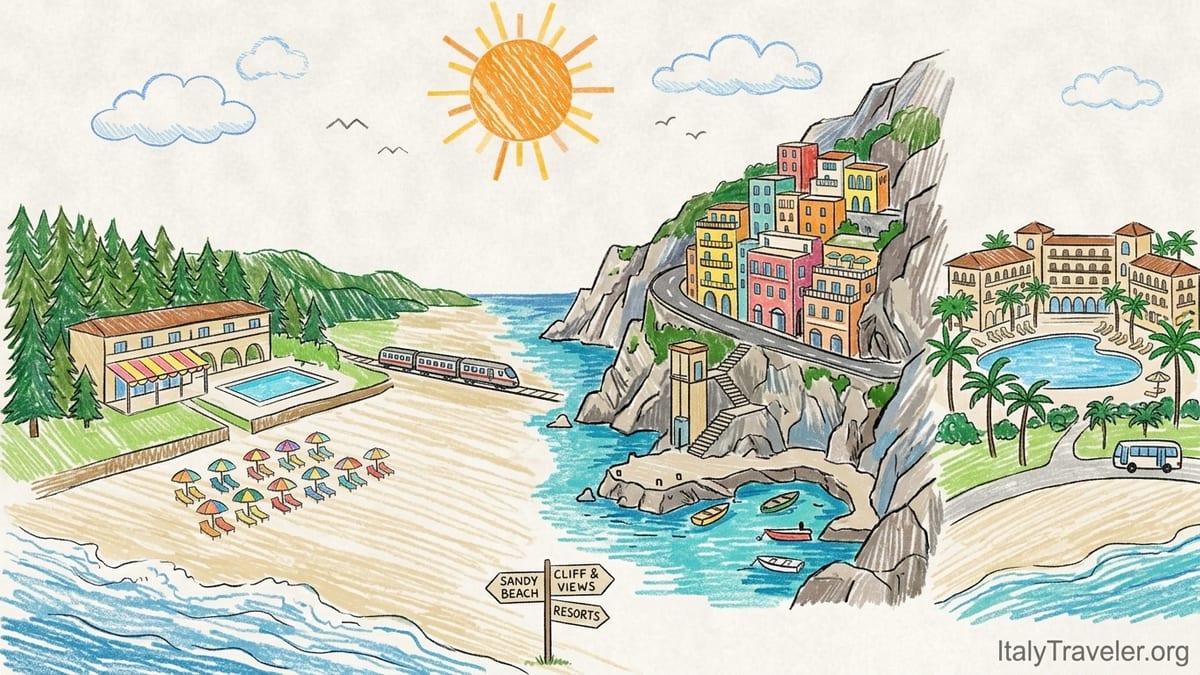
Before drilling into specific regions, it helps to be clear on what you actually want from a Tyrrhenian stay. True beachfront hotels, such as mid-range resorts outside Tropea or Pizzo in Calabria, sit either directly on the sand or just behind a private strip of lido with loungers and umbrellas. Cliffside properties, particularly along the Amalfi Coast and around Maratea, usually trade sand for drama: sea-view terraces, steps or lifts down to rocky platforms and small coves, and often a pool as the main daytime focus. Then there are inland or hilltop hotels that offer views and peace but require a short drive to the sea.
It is also worth deciding how car-dependent you want to be. On the Tuscan and Lazio coasts, rail lines run close to the sea, and some hotels near towns such as Viareggio, San Vincenzo, Sperlonga or Terracina are workable without a car if you are happy to walk or rely on taxis. In Campania and Basilicata, many of the most atmospheric small hotels cling to cliffs or sit in quiet coves reached by narrow local roads. In Calabria, larger seaside resorts with private beaches typically include ample parking and sometimes a shuttle into the nearest town, but public transport can be limited outside main hubs like Tropea and Pizzo.
Finally, budget and board basis matter. Breakfast-included is standard along the coast, from family-run three-star seafront hotels in Lazio to luxury cliffside properties in Campania. Half-board, where you eat most dinners on site, is more common in resort-style hotels in Calabria and around Maratea, and can offer good value if you do not plan to explore restaurants every night. Prices fluctuate sharply by season: a sea-view balcony room on the Amalfi Coast in July can cost several times what a comparable or larger room will cost on Calabria’s Coast of the Gods in June or September.
Tuscan Tyrrhenian Coast: Pine Forests, Promenades and Family Beaches
The Tuscan stretch of the Tyrrhenian coast runs from the Riviera-style towns north of Pisa down through the long sandy beaches of the Maremma. Here the coastline is flatter than further south, with wide strands backed by pine forests and low-key resort towns. This is prime territory if you want classic beach days, shallow entry to the sea for children and easy access by train. Around Viareggio and Forte dei Marmi, many hotels are set a street or two back from the promenade; you typically cross the road to reach a stabilimento balneare where the hotel either owns or partners with a beach club. The upside is long, walkable promenades and a wide choice of bars and gelaterie directly behind the sand.
Further south near San Vincenzo or Marina di Castagneto Carducci, you start to find more hotels directly behind the dunes, often with private paths through the pines to the sea. These are not usually towering resorts but mid-sized, family-oriented properties with gardens or pools. Many offer sea-view rooms on upper floors, though trees can partially screen lower levels, so it is worth checking room categories carefully. Because the Tuscan coast is relatively flat, car-free stays can work well in towns with rail stations such as Viareggio, Cecina and San Vincenzo, where you can arrive by train from Pisa or Florence and walk or take a short taxi ride to your hotel.
In terms of services, expect buffet breakfasts with plenty of pastries, fruit and coffee as standard, and the option of half-board at more resort-focused properties. On-site parking is common outside the densest town centers, and pools are widely available, particularly in hotels that cater to families. What Tuscany does not generally offer are dramatic clifftop infinity pools or elevators down to hidden coves; this is a region for long, sandy beaches, shaded playgrounds and evening passeggiata along the waterfront rather than high-drama seascapes.
Lazio’s Seaside Towns: Sperlonga, Terracina and Family-Friendly Sands
South of Rome, the Lazio stretch of the Tyrrhenian coast offers a mix of historical hill towns and modern seaside promenades, with some of central Italy’s most appealing family beaches. In Sperlonga, for example, the old town climbs a small headland while a series of long sandy beaches stretch out on either side. Hotels just behind the sand often have agreements with private lidos, providing reserved loungers and umbrellas as part of the room rate or for a modest daily supplement. Many are mid-sized, three or four-star properties, some with small pools or garden areas, and a focus on family stays from late spring through early autumn.
Because Sperlonga and nearby Terracina sit on the rail corridor between Rome and Naples, they are realistic choices for car-free travelers. You can typically take a regional train to Fondi-Sperlonga or Terracina, then a short bus or taxi ride to your hotel. Once settled, you can walk between your room, the beach and the waterfront restaurants. Sea-view rooms are usually on higher floors or in buildings facing the water directly, so if views matter you will want to book those categories specifically rather than assuming every room looks over the sea. Many hotels include breakfast and secure parking, and some bundle in private beach access, so it is worth confirming what is actually covered in the nightly rate.
Terracina itself offers a slightly more urban feel, with a long seafront road, a visible Roman temple on the hill and a clutch of mid-range hotels along the lungomare. Here too, most properties are across the road from the beach rather than directly on the sand, but the distance is minor and many advertise special rates with adjacent beach clubs. Lazio’s Tyrrhenian coast is a good compromise if you want more authentic Italian resort towns and realistic restaurant prices compared with better-known international hotspots, while still enjoying reliable rail access and wide, family-friendly beaches.
Campania’s Amalfi Coast and Beyond: Cliffs, Coves and Iconic Views
By the time the Tyrrhenian Sea reaches Campania, the coastline has reared up into some of Italy’s most photographed cliffs. The Amalfi Coast itself is technically a short stretch between Vietri sul Mare and Positano, but for hotel planning it helps to think of the broader Campania Tyrrhenian seaboard: the Sorrento Peninsula, Amalfi and Positano, plus quieter enclaves further south. What many first-time visitors do not realize is that highly walkable, sandy beaches directly fronting hotels are rare in this part of the coast. Instead, you get vividly located properties perched on terraces and cliffs, with stairways, tunnels or lifts leading down to rocky platforms or small coves where you swim.
In and around Amalfi and Positano, some of the most atmospheric mid-scale hotels are family-run cliffside places that offer sea-view balconies, terraced gardens and private sea access. A typical example is a small hotel built directly on the rocks below a village, with every room opening to unobstructed views of the Tyrrhenian Sea and the sound of waves below. Breakfast is often served on an outdoor terrace overlooking the coast, and there may be a ladder or platform at water level for swimming when the sea is calm. These hotels rarely have extensive parking and are usually reached via narrow local roads or stairways, so they suit travelers who pack light and are comfortable using ferries and buses between villages.
At the luxury end, several renowned Amalfi Coast properties combine cliffside settings with private elevators to small beach areas, multi-level pools and extensive services. You pay for that convenience: summer rates for sea-view rooms can reach the top tier of European coastal pricing. Many guests choose half-board packages or dine on site frequently, both because the restaurants are good and because getting to alternative dinner spots can involve navigating winding roads or steep steps. While rail access ends inland at Salerno or Sorrento, frequent ferries and buses connect the coastal towns, so a car is optional rather than essential. However, parking is expensive and limited, so guests who do drive often appreciate properties with on-site garages or valet arrangements, even at a premium.
Beyond the core Amalfi Coast, towns such as Paestum and the Cilento Coast offer a softer, more spacious Tyrrhenian shoreline with proper sandy beaches and a number of resort-style hotels. Here you find more straightforward beachfront stays, sometimes with large pools, garden areas and children’s clubs, as well as easier on-site parking. Prices tend to be lower than in Amalfi or Positano for similar room sizes, particularly outside the peak of August. For travelers who love the idea of Campania’s food and culture but are less attached to iconic cliffside views, this broader Tyrrhenian stretch can deliver a more relaxed and budget-friendly beach holiday.
Maratea: Basilicata’s Quiet Tyrrhenian Gem
South of Campania, the Basilicata region touches the Tyrrhenian Sea for just a short but spectacular segment around Maratea. This compact coastline is a good option for travelers who want dramatic scenery on a gentler scale than the Amalfi Coast, with fewer crowds and a quieter overall atmosphere. The town of Maratea itself climbs a hillside behind a small marina, watched over by a large Christ the Redeemer statue on the peak above. Hotels are scattered between the medieval center, the port area and the coves along the coastal road, with a mix of cliffside properties, hillside resorts and guesthouses closer to pebble beaches.
Among the better-known hotels here are comfortable resort-style properties above the sea, offering pools with panoramic views, gardens and shuttle services down to nearby beaches or the harbor. Many rooms have balconies facing the water, and the on-site restaurants emphasize local seafood and regional wines. Some hotels sit directly over rocky coves, with private access down to swimming platforms or small inlets, while others are set back slightly on terraces, prioritizing quiet and space over immediate sea access. Because the coastline is indented with coves rather than long sandy strands, Maratea is not the place for endless beachfront promenades, but it excels at intimate corners of coast and sunsets from elevated terraces.
Reaching Maratea without a car is possible thanks to the rail line that runs close to the sea, with a station serving the town. However, the most scenic hotels and beaches are often a short drive or taxi ride from the center, and local buses can be sporadic, so having a car makes exploring the many coves significantly easier. Most mid to upper-range hotels here provide free or low-cost parking and often include breakfast as standard. Half-board options are quite common, reflecting the slightly self-contained nature of many properties. For travelers who prefer to avoid the crowds of Positano or Amalfi but still want a dramatic Tyrrhenian landscape, Maratea offers a compelling alternative.
Calabria’s Coast of the Gods: Tropea, Capo Vaticano and Pizzo
The southernmost stretch of the Tyrrhenian coast, in Calabria, is where value-driven beach lovers often find their sweet spot. Known locally as the Coast of the Gods, the shoreline between Pizzo, Tropea and Capo Vaticano is characterized by steep headlands, bright white sand and unusually clear, turquoise water. Unlike the Amalfi Coast, this region has a number of substantial resort hotels and holiday villages that sit effectively on the beach or just behind a line of dunes, often with their own lidos. A typical example is a four-star resort near Capo Vaticano, set in gardens above the sea with a pool, bistro restaurant, wellness area and a private or serviced beach a short walk or shuttle ride away.
Around Tropea itself, you will find both small hotels embedded in the clifftop old town, with balconies overlooking the sea and the church on the promontory, and larger properties on the coastal plain below. The latter tend to offer more of the classic resort amenities: spacious pools, kids’ clubs, tennis courts and long sandy or gently shelving beaches suitable for families. These hotels frequently offer half-board or full-board packages, with buffet meals and organized entertainment in high season, and they almost always provide free on-site parking. While some are within walking distance of local train stations, in practice most guests find a car useful for reaching different beaches and hill towns, especially outside of July and August when shuttle services are less frequent.
Near Pizzo Calabro, resorts are often set amid pine woods close to broad sandy beaches, creating a more secluded feel even when the hotel is relatively large. You might walk through a short strip of woodland to reach the sea, where lines of loungers and umbrellas are reserved for guests. Pools are a near-constant feature, and many properties define themselves as village-style, with clusters of low-rise buildings rather than single towers. Sea-view rooms are widely available but not universal, as some complexes stretch back from the shore, so check booking descriptions carefully if waking up to a direct Tyrrhenian panorama is important to you. Compared with northern stretches of the coast, nightly rates here are generally lower, even at the height of summer, though flights and transfers to Calabria can add to the overall trip cost.
Comparing Beachfront Access, Sea Views and Practicalities
Looking across the Tyrrhenian coast as a whole, patterns emerge that can help narrow your hotel search. If your top priority is true beachfront access on wide sandy shores, Tuscany’s Maremma, Lazio around Sperlonga and Terracina, and Calabria’s Coast of the Gods offer the most straightforward choices. In these regions, it is common to step out of your hotel and reach either the sand itself or a dedicated lido in a matter of moments, often with loungers and umbrellas either included or available at a predictable daily rate. Pools are widely available in Tuscany and Calabria, less so right on the seafront in some Lazio towns where space is tighter, though many hotels there compensate with proximity to the water and lively promenades.
If you are willing to trade sand for drama, Campania’s Amalfi Coast and Basilicata’s Maratea deliver exceptional sea views from cliffside rooms and terraces. Here, beach access often means a staircase, shuttle or private elevator down to a rocky platform or compact cove, and the sea itself may be deep directly offshore, which suits confident swimmers more than small children. Pools, when present, are frequently perched on terraces with sweeping views and become the main daytime relaxation zone. These areas are also where private beach service is most likely to be a charged extra rather than a bundled perk, and where parking is scarce and expensive, making car-free travel more appealing despite the extra planning it requires.
Rail access is most practical in Tuscan resort towns with nearby stations, Lazio’s coastal belt between Rome and Naples, and around Maratea and some parts of Calabria. However, even where a station exists, the most attractive hotels are not always within easy walking distance with luggage. As a rule of thumb, travelers who want to avoid driving will have the easiest time focusing on compact towns such as Viareggio, San Vincenzo, Sperlonga, Terracina or central Tropea, where taxis and local buses can cover the last mile to seafront hotels. Those set on headland resorts, rural retreats or village-style complexes with private beaches will generally find a hire car the most practical solution, especially when traveling with children or bulky beach gear.
The Takeaway
Selecting the right hotel on Italy’s Tyrrhenian coast starts with matching your expectations to the realities of each region. Tuscany and Lazio excel at long, sandy, family-friendly beaches with plenty of promenade life and straightforward access, plus a healthy mix of mid-range hotels and simple resort-style properties. Campania’s Amalfi Coast and the neighboring Tyrrhenian shoreline deliver the famous cliffside scenes, intimate coves and highly atmospheric small hotels, but require more tolerance for steps, elevators, higher prices and sometimes limited parking. Maratea offers a quieter, more concentrated version of that cliff-and-cove drama, with a handful of comfortable hotels that work particularly well for couples or travelers seeking calm.
Further south, Calabria’s Coast of the Gods collects some of the most appealing sand-and-sea combinations on the Tyrrhenian, with a solid infrastructure of beach resorts that provide pools, kids’ clubs, private lidos and ample parking, often at prices that compare favorably with northern regions. In all these areas, understanding whether a hotel is truly beachfront or one street back, whether sea views are guaranteed or limited to specific room types, and how easily you can get around without a car will shape your experience more than star ratings alone. With those realities in mind, the Tyrrhenian coast offers a wide spectrum of stays, from simple seaside hotels perfectly placed for morning swims to full-scale resorts and discreet cliffside hideaways where the sea feels like a private backdrop.
FAQ
Q1. What is the best region on the Tyrrhenian coast for a car-free beach holiday?
For largely car-free trips, look at Tuscan towns with rail stations such as Viareggio or San Vincenzo, Lazio’s Sperlonga and Terracina, or compact centers like Tropea and Maratea where taxis and local buses can handle the last stretch between the station and seafront hotels.
Q2. Where can I find true beachfront hotels with wide sandy beaches?
The most straightforward sandy beachfront options are in Tuscany’s Maremma, around Sperlonga and Terracina in Lazio, and along Calabria’s Coast of the Gods between Pizzo, Tropea and Capo Vaticano, where many resorts sit directly on or just behind long, walkable strands.
Q3. Are Amalfi Coast hotels good for families who want easy beach access?
Many Amalfi Coast hotels are perched on cliffs with steps or elevators down to rocky platforms, so they suit confident swimmers and parents comfortable with vertical terrain; families wanting simple, shallow-entry beaches often find Tuscany, Lazio or Calabria more relaxing.
Q4. How important is a pool on the Tyrrhenian coast?
On flat, sandy coasts a pool is a nice extra but not essential, while on cliff-heavy stretches like the Amalfi Coast or Maratea a pool often becomes the main daytime relaxation area and can be a decisive factor, especially in high summer.
Q5. Do most Tyrrhenian coast hotels include breakfast or half-board?
Breakfast is standard almost everywhere, from small seaside hotels to larger resorts; half-board is particularly common in resort-style properties in Calabria and around Maratea, where many guests prefer to dine on site most evenings.
Q6. How far in advance should I book popular Tyrrhenian coast hotels?
For peak months such as late June through early September, especially on the Amalfi Coast, in Tropea or in sought-after towns like Sperlonga, it is wise to secure sea-view rooms several months ahead to avoid limited choices or sharply higher prices.
Q7. Are there budget-friendly options with sea views on the Tyrrhenian coast?
Yes, more budget-friendly sea-view rooms are often found in lesser-known Tuscan and Lazio towns and in Calabria, where small hotels and guesthouses on headlands or above the beach can offer balconies over the sea at lower prices than in iconic hotspots.
Q8. Is parking usually available at Tyrrhenian coast hotels?
Outside dense historic centers and cliffside villages, many hotels and resorts, especially in Tuscany and Calabria, include on-site or nearby parking, often free; along the Amalfi Coast and in older town centers, parking is limited and can be an extra daily charge.
Q9. What is the main difference between a beachfront hotel and one with sea views only?
A beachfront hotel typically gives direct or almost direct access to the sand or a private lido, while a hotel with sea views might sit on a cliff or a street back from the shore, requiring stairs, lifts or short walks to reach the water.
Q10. When is the best time of year to visit the Tyrrhenian coast for swimming?
For warm sea temperatures and open beach services without peak crowds, late May to early July and September are usually ideal, while August brings the highest prices and the busiest beaches, especially around Italian public holidays.