


Along Italy’s Tyrrhenian shore, some of the country’s most memorable coastal experiences are only possible from the water. High cliffs, hidden coves and marine parks often block land access, so choosing the right boat tour can unlock entire stretches of coastline that road travelers never see. From Argentario’s Tuscan islets to Ponza’s volcanic bays, Amalfi’s vertical villages, the sea caves of Maratea and the turquoise coves of Tropea and Capo Vaticano, this guide focuses on bookable boat excursions where the sea is your only real ticket in.
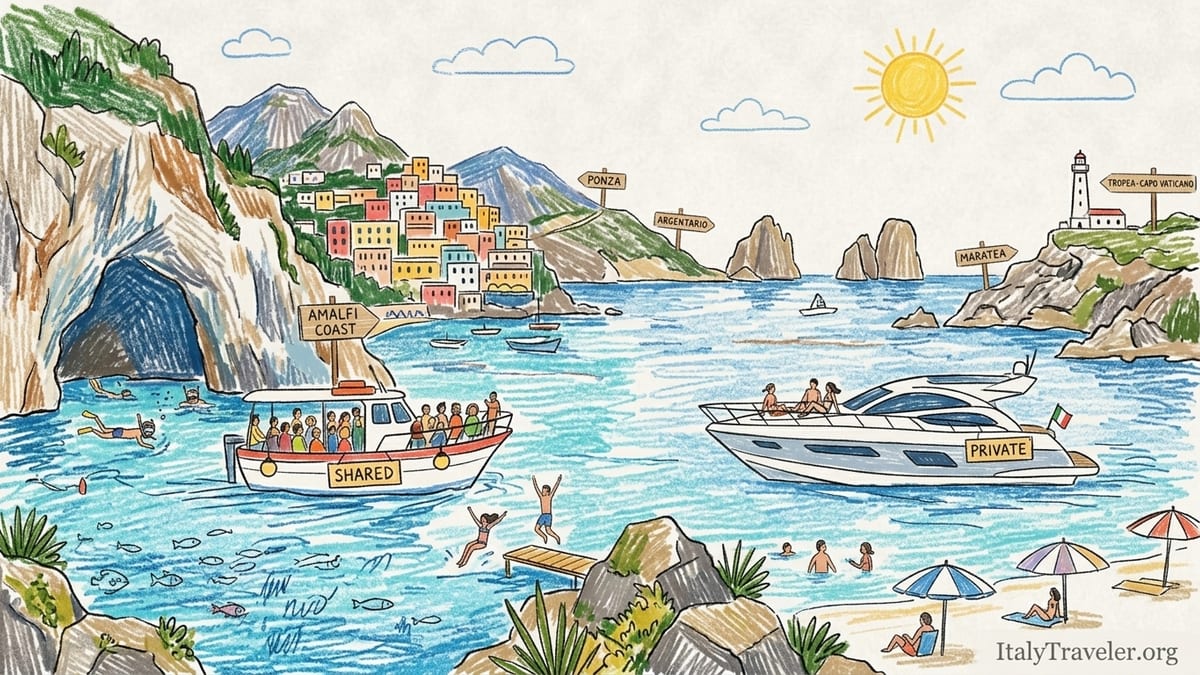
How Tyrrhenian Boat Tours Work: Shared vs Private, Seasons and Sea Conditions
Across the Tyrrhenian coast, most day tours operate from late spring through early autumn, typically May to October, with July and August the busiest. Sea conditions dictate everything: operators commonly reserve the right to cancel or change routes if winds pick up or swell builds, and you should expect early-morning confirmation by message or email on marginal days. On the Costa degli Dei in Calabria, for example, companies running Tropea to Capo Vaticano excursions state clearly that trips can be cancelled at any time if conditions deteriorate, with rebooking or refunds offered rather than forcing departures in unsafe seas.
You will usually choose between a shared small-group boat and a private charter. Shared boats might carry 8 to 20 passengers, keeping prices accessible while still small enough to slip into coves and near sea caves. Private charters range from simple rubber RIBs and gozzo-style boats with a skipper up to sleek motor yachts on the Amalfi Coast. A three-hour shared Capo Vaticano coastal cruise with snorkeling, including multiple swim stops and a light aperitif, can start around 40 to 60 euros per person in high season, while a full-day private Amalfi yacht for a couple or small group can easily reach several hundred euros or more depending on size and inclusions.
Most itineraries combine coastal sightseeing with at least one swim or snorkeling stop where access from land is difficult or impossible. On the Costa degli Dei, boats choose coves and cave entrances depending on wind and light at different times of day, selecting the clearest and most sheltered water. Similar patterns play out off Argentario, Ponza and Maratea, where skippers know which caves are safe to enter in a given swell and which beaches, like Praia i Focu near Capo Vaticano, can only practically be reached by boat.
For travelers deciding between routes, remember that boat tours are more vulnerable to weather cancellations than land excursions. Particularly exposed areas such as the Tuscan Archipelago or Ponza may lose more days to wind than the more sheltered coves around Tropea. Build flexibility into your schedule, avoid booking fixed onward transport immediately after, and ask about the operator’s cancellation and refund policies before you pay a deposit.
Argentario and the Tuscan Archipelago: Coves, Islets and Marine Parks
The Argentario promontory in southern Tuscany is almost an island, connected to the mainland by sandy tombolos and ringed by hidden coves that are hard to reach from shore. Boat tours from Porto Santo Stefano and Porto Ercole typically hug the rocky headlands, rounding points like Cala del Gesso, and then push out toward the Tuscan Archipelago. On calm days, shared excursions make for the nearer islands and marine areas, often combining coastal views with snorkeling stops over rocky seabeds rich in fish and sea fans.
A typical Argentario half-day small-group tour might last 3 to 4 hours, with one or two swim stops in coves where steep cliffs and private villas limit land access. Some itineraries extend to the shallows off Giannutri Island, known for clear water and submerged Roman remains, or to the fringes of the Argentario protected marine zones where anchoring is restricted and mooring buoys or drift-swimming from the boat are the only ways to experience the reef. These are places you cannot realistically enjoy without coming by sea, and the boats are licensed precisely to operate within those rules.
Shared excursions here usually run in the 60 to 100 euro range per adult for a half-day, depending on route and inclusions, with basic soft drinks on board. Private boats cost more but let you linger at particular coves or request quiet snorkeling bays away from groups. Because this stretch of the Tyrrhenian can be windy, expect last-minute changes: your skipper might choose a lee shore on the inside of the promontory instead of a more exposed outer route, still delivering sea-only views of cliff-backed beaches and headlands that are almost impossible to reach otherwise.
To maximize your time actually in the water around Argentario, choose tours that highlight snorkeling and swimming rather than pure sightseeing. Ask about onboard ladders or swim platforms, whether masks and fins are provided, and how many stops are scheduled. Routes that incorporate both rocky inlets and open-water swims closer to the archipelago islands provide the best sense of how this coast unfolds from the sea.
Ponza and the Lazio Coast: Volcanic Bays Only a Boat Can Reach
Ponza, the largest of the Pontine Islands off Lazio, is a classic boat-first destination. High, eroded tufa cliffs, arched grottoes and steep staircases mean that many of its best swimming spots are realistically accessible only from the water. Fast services like Pontina Navigazione connect the Lazio coast with Ponza in around an hour during the main summer period, with daily runs from San Felice Circeo between mid-July and early September. Once on the island, visitors usually join local skippers for a circumnavigation or focused cove tour.
Shared boat trips from Ponza harbor often circle the island in 4 to 5 hours, pointing out sculpted rock formations and stopping to swim in luminescent bays such as the area around the faraglioni sea stacks or grottoes on the western side. Because some of these coves sit under crumbly cliffs and lack any safe land access, swimming off the boat is the only way to immerse yourself in the milky blue water that Ponza is known for. On calm days, skippers nose into narrow grotto entrances, cutting the engines so passengers can slip into the water or simply float and watch patterns of light on the rock.
Prices for shared circumnavigation tours tend to fall in the 40 to 70 euro range per person, sometimes including a simple lunch of panini or pasta served on board. Private gozzo or RIB rentals with a skipper give more freedom to linger at quieter spots, but you will pay substantially more. If you are traveling from the mainland on a day trip, factor in ferry timings and the reality that rough seas can disrupt both the crossing and local tours. During July and August, demand is intense, so it is wise to reserve your boat tour at the same time you book your ferry ticket.
Because Ponza’s coastline is more exposed to open-sea swell than, say, the coves of Tropea, operators may cancel or adapt routes when winds turn onshore. In those conditions, ask whether the skipper will use more sheltered sections of coast rather than insist on a full loop. The best experiences usually combine one or two standout grotto swims with longer scenic glides along cliffs and offshore stacks, giving you time to appreciate Ponza’s volcanic shapes from perspectives no land hike can provide.
Amalfi and Cilento: Vertical Villages, Hidden Beaches and Flexible Cruises
Along the Amalfi Coast, steep slopes push the road high above the water, leaving many small beaches, caves and inlets visible but unreachable from the highway. This is where boat tours from Sorrento, Amalfi, Positano and Salerno come into their own. Shared small-group cruises often follow the coast between Sorrento and Amalfi or Amalfi and Positano, stopping in quiet bays for swims and offering optional time ashore in one of the towns. Recent itineraries marketed to international visitors include 8-hour sharing-boat days that weave past Nerano, Positano and Amalfi with two or three swim and snorkeling stops built in.
What you see from the sea is fundamentally different from the road experience. Passing under arched bridges in narrow fjord-like inlets, edging beneath rock arches or viewing watchtowers perched on cliffs are all features of the Amalfi coastline that only boats can realistically deliver. Out at sea you gain uninterrupted views of entire towns like Positano stacked up the hillside, and in calmer coves the crew invites passengers to slip into startlingly clear water for a swim away from the crowded public beaches.
Price-wise, shared Amalfi Coast boat tours vary widely. A full-day small-group cruise from Sorrento or Amalfi with drinks and a few hours of free time ashore might cost somewhere in the range of 100 to 180 euros per person in high season, depending on the vessel and group size. Private charters along this coast can start at several hundred euros for a shorter 4-hour outing and rise significantly for all-day or larger, more luxurious boats. The trade-off is flexibility: on a private charter, your skipper can respond to the day’s conditions and your interests, perhaps spending extra time in sheltered swimming spots if the main bays are choppy or crowded.
To extend the experience beyond the well-known villages, some operators run cruises into the Cilento Coast south of Amalfi, an area of marine reserves and less-developed shorelines. Here, sheltered coves and secluded beaches near fishing villages and headlands are often inaccessible by car or require long walks, so arriving by boat simplifies everything. As with other Tyrrhenian routes, weather remains the governing factor: it is not unusual for operators to switch routes or cut certain coastal segments if afternoon winds rise, and you should treat any published timetable as provisional until your captain confirms it on the day.
Maratea and the Sea Caves of Basilicata: A Rugged, Boat-First Coastline
Maratea occupies a dramatic stretch of coastline in Basilicata, wedged between Campania and Calabria. Here, high limestone cliffs plunge into deep-blue water, riddled with sea caves and narrow inlets that make road access difficult. Boat excursions from Maratea harbor and nearby marinas typically focus on cave exploration and short swims, gliding along the base of cliffs that motorists on the coastal road can only glimpse from above.
A representative half-day sea-cave trip from Maratea might run 3 to 4 hours, visiting multiple grottos where the captain judges it safe to enter. In fine weather, boats edge into caverns lit by shafts of sunlight that turn the water vivid emerald or cobalt, and passengers are often invited to jump in for a short swim just outside the cave mouths. Some itineraries push as far as neighboring Dino Island and the Arcomagno sea arch area in nearby Calabria, where natural stone arches shelter pocket beaches reachable only by water or demanding coastal trails.
These tours tend to focus more on scenery and short swims than on extended time in one spot, reflecting the nature of the coastline. Prices are often similar to other Tyrrhenian sea-cave trips, roughly in the 40 to 70 euro per person band for shared outings, with private boats costing more depending on size and distance covered. Because cave access is so dependent on swell height and direction, expect captains to decide on the day which grottos are safe. If a particular cave is a must-see for you, discuss this when booking and ask how often it is actually reachable in typical conditions at the time of year you are visiting.
Maratea’s coast can be particularly rewarding in shoulder seasons like June and September, when the sea is usually warm enough for comfortable swimming yet traffic on both land and water is lower. At those times, skippers may have more flexibility to linger in quiet coves or adjust timings to catch the best light inside sea caves. As always, pack a light jacket even in summer: shade and breeze inside caves can feel cool after time in the sun.
Tropea – Capo Vaticano and the Costa degli Dei: Snorkeling and Sea-Only Coves
Between Tropea and Capo Vaticano in Calabria stretches the Costa degli Dei, a sweep of luminous water, white-sand bays and rock formations that have become a flagship Italian boat-tour destination. The coastline is punctuated by coves and beaches, some of which, like Praia i Focu beneath the Capo Vaticano lighthouse, are realistically accessible only by sea or by technical coastal paths. As a result, boat excursions from Tropea’s marina are the primary way most visitors experience the full drama of this shore.
Current small-group tours commonly offer 3-hour circuits from Tropea toward Capo Vaticano, with multiple stops for snorkeling and swimming in coves such as Grotticelle, Santa Maria, Riaci and the Blue Cave area. Operators provide masks and snorkels, and some include fins, so you can drift over rocky seabeds alive with fish without bringing your own kit. Many companies also add a simple Calabrian aperitif on board, pairing local wine or soft drinks with small bites as you float in sheltered bays. Recent price examples show shared cruises with snorkeling equipment included starting around 40 to 60 euros per adult for a three-hour outing, with slightly higher rates for itineraries that include aperitifs or sunset timings.
From the sea, the Costa degli Dei reveals perspectives that beachgoers never see. Boats glide beneath the cliffs of Tropea’s old town, circle free-standing rock stacks off the shoreline, then run along the base of the Capo Vaticano promontory as the lighthouse appears high above. At Praia i Focu, a crescent of sand backed by sheer rock faces, passengers disembark directly from the boat to swim and explore. On many tours, this tiny bay is accessible only to those arriving by sea, preserving a sense of isolation even at the height of summer.
Several operators structure their routes to respond to daily sea and wind conditions, choosing specific coves based on where the water is clearest and calmest at a given hour. This means that while brochures might list a standard sequence of stops, the actual order and even the exact bays visited can change. Weather-related cancellations are most likely in periods of strong onshore winds or after storms, but in settled summer patterns tours run several times a day from morning through late afternoon, with additional sunset departures in peak season. For travelers looking to combine snorkeling, short swims and close-up cliff views in one compact trip, this Tropea to Capo Vaticano segment is one of the most efficient boat experiences on the Tyrrhenian coast.
Choosing and Booking the Right Tyrrhenian Boat Tour
Across Argentario, Ponza, Amalfi, Maratea and Tropea–Capo Vaticano, the most important choice is how you want to experience the coast rather than simply which town you are in. If your priority is snorkeling and easy access to coves that are hard or impossible to reach on foot, Tropea’s Costa degli Dei cruises, Ponza’s circumnavigations and Argentario’s marine-park runs stand out. If you are more interested in iconic vistas of towns and villages from the water, Amalfi Coast and Cilento itineraries deliver sweeping village panoramas and harbor-time ashore. For rugged sea caves and dramatic cliff scenery with shorter swims, Maratea is the obvious focus.
When comparing shared and private options, weigh not just price but group size, route flexibility and how much time you will actually spend in the water. A shared 3-hour Costa degli Dei tour with snorkeling gear and several swim stops can offer excellent value compared with a more expensive private charter where you might spend much of the day cruising rather than swimming. On the other hand, a private Amalfi or Argentario charter gives you control over when and where to stop, crucial if you want to avoid crowds or have specific photo or snorkeling goals.
Booking practices vary, but in peak months from mid-June to early September, advance reservations are strongly recommended in all these destinations, especially for Ponza connections from the Lazio coast and prime-time Tropea to Capo Vaticano excursions. Many operators accept online card payment with clear cancellation terms, often allowing free cancellation up to 24 or 48 hours before departure. Because weather remains the final arbiter, responsible companies will cancel if conditions are unsafe even at the last minute, usually offering a switch to another day or a refund. Have a backup plan ashore for such days, whether that is exploring Tropea’s historic center, hiking above Amalfi or sampling wines inland from Argentario.
Finally, prepare for your day at sea so you can focus on the experience rather than logistics. Bring a light cover-up, a dry bag for electronics, reef-safe sunscreen and any medications you might need for motion sickness, especially on more exposed stretches like Ponza and the Tuscan Archipelago. Check whether towels and snorkeling gear are included or you need to bring your own. With those basics covered, the sea will do the rest, revealing cliff-backed coves, cave-lit waters and remote beaches that the road network will never reach.
The Takeaway
Italy’s Tyrrhenian coast rewards travelers who are willing to step off the road and onto the water. Around Argentario, boats slip beneath cliffs and into marine zones that turn a simple swim into a brush with underwater archaeology and protected reefs. Ponza’s volcanic grottoes and carved bays unfold in a series of luminous blues that only a slow circumnavigation can reveal. Amalfi and the Cilento Coast transform from congested roads into a string of vertical villages, arches and inlets once you are looking back at them from the sea.
Farther south, Maratea’s caves and overhanging cliffs underscore how much of this shoreline is truly boat-first, not just boat-friendly. And on Calabria’s Costa degli Dei, Tropea to Capo Vaticano tours connect a necklace of coves and beaches where swimmers drop straight from deck to turquoise water, with tiny strips of sand like Praia i Focu remaining the preserve of those who arrive by boat. Across all these destinations, shared and private options, snorkeling stops, weather contingencies and departure ports differ in detail, but the core idea is the same: many of the Tyrrhenian’s finest coastal moments simply cannot be experienced from land.
Choosing the right tour is less about chasing the most famous name and more about matching your priorities to the route. Whether you are a swimmer looking for quiet coves, a photographer chasing cliffside villages at golden hour or a family wanting gentle cave visits and short swims, there is a Tyrrhenian boat itinerary to fit. Build in some flexibility for the wind and waves, book with operators who communicate clearly about conditions, and let the sea open up an Italy that the highway never touches.
FAQ
Q1. Do I need to book Tyrrhenian boat tours in advance or can I reserve on the spot?
In peak season from mid-June to early September, it is wise to book Argentario, Ponza, Amalfi, Maratea and Tropea–Capo Vaticano tours at least a few days ahead, especially popular morning and sunset departures. Outside the busiest weeks you can often reserve the day before, but same-day walk-up spots are not guaranteed.
Q2. What happens if my boat tour is cancelled due to bad weather?
Most reputable operators will cancel or modify routes if wind or swell makes conditions unsafe, then offer either a new date or a refund. On exposed stretches such as Ponza or the Tuscan Archipelago cancellations are more common, while more sheltered coasts like the Costa degli Dei may still operate by adjusting coves and timings.
Q3. How long do typical Tyrrhenian boat tours last?
Standard shared excursions usually last 3 to 4 hours, which is typical for Tropea to Capo Vaticano cruises, Argentario coastal runs and many Ponza and Maratea cave trips. Full-day Amalfi Coast and extended island or Cilento itineraries can run 7 to 8 hours, often including time ashore in one of the towns.
Q4. Are shared boat tours suitable for children and less confident swimmers?
Many shared tours welcome families, but conditions vary by route. Relatively sheltered areas like the Costa degli Dei or some Amalfi bays are often comfortable for children and cautious swimmers, especially on calm days. For more exposed or cave-focused trips, discuss safety, life jackets and ladder access with the operator before booking.
Q5. What should I bring for a Tyrrhenian boat excursion?
Plan on swimwear, a light cover-up, a hat, sunglasses, reef-safe sunscreen, a towel, and a small dry bag for phones and cameras. If you are prone to seasickness, bring suitable medication and take it before departure. Check in advance whether snorkeling gear and water are included or you need your own.
Q6. How do prices compare between shared and private tours?
Shared small-group tours on routes like Tropea–Capo Vaticano, Ponza circumnavigations or Maratea cave trips often start around 40 to 70 euros per person for a half-day. Private charters along the Amalfi Coast, Argentario or Ponza are significantly more expensive in total but can be good value if you fill the boat with friends and want route flexibility.
Q7. Can I rely on public ferries instead of booking a boat tour on the Amalfi Coast?
Ferries are useful for point-to-point travel between coastal towns and offer good views, but they do not usually include swimming stops, cave visits or access to small coves. A dedicated boat tour, shared or private, is better if you want time in the water and close-up views of arches, grottoes and cliff-backed beaches.
Q8. Are snorkeling conditions good along the Tyrrhenian coast?
Snorkeling is generally best around rocky coves and marine areas such as parts of Argentario, Ponza, Maratea and the Costa degli Dei, where clear water and rocky seabeds attract fish. Visibility and marine life can vary by day and season, so treat snorkeling as an enjoyable extra rather than the sole purpose of your trip.
Q9. Which departure ports are most convenient for these tours?
For Argentario and the Tuscan Archipelago, Porto Santo Stefano and Porto Ercole are the main hubs. Ponza tours depart from Ponza harbor after ferry arrivals from ports like San Felice Circeo. Amalfi Coast cruises leave from Sorrento, Amalfi, Positano or Salerno, Maratea trips from the town’s harbor, and Costa degli Dei excursions primarily from Tropea marina.
Q10. How can I minimize seasickness on Tyrrhenian boat trips?
Choose morning departures when the sea is often calmer, opt for shorter tours on more sheltered coasts like Tropea–Capo Vaticano, and avoid heavy meals and alcohol before boarding. Sit toward the center of the boat where motion is less pronounced and take approved motion-sickness medication in advance if you are sensitive.