


Driving the Tyrrhenian coast of Italy does not have to be a marathon from Tuscany to Calabria. In practice, most travelers enjoy this shoreline in smaller, more manageable sections: a long weekend between Maremma and Lazio, a five-day loop along the Riviera di Ulisse and Campania, a nature-focused escape through Cilento and Maratea, or a one-week deep dive along the Tyrrhenian coast of Calabria. This guide is built around those realistic chunks, so you can choose the stretch that fits your time, driving confidence, and appetite for hotel changes.
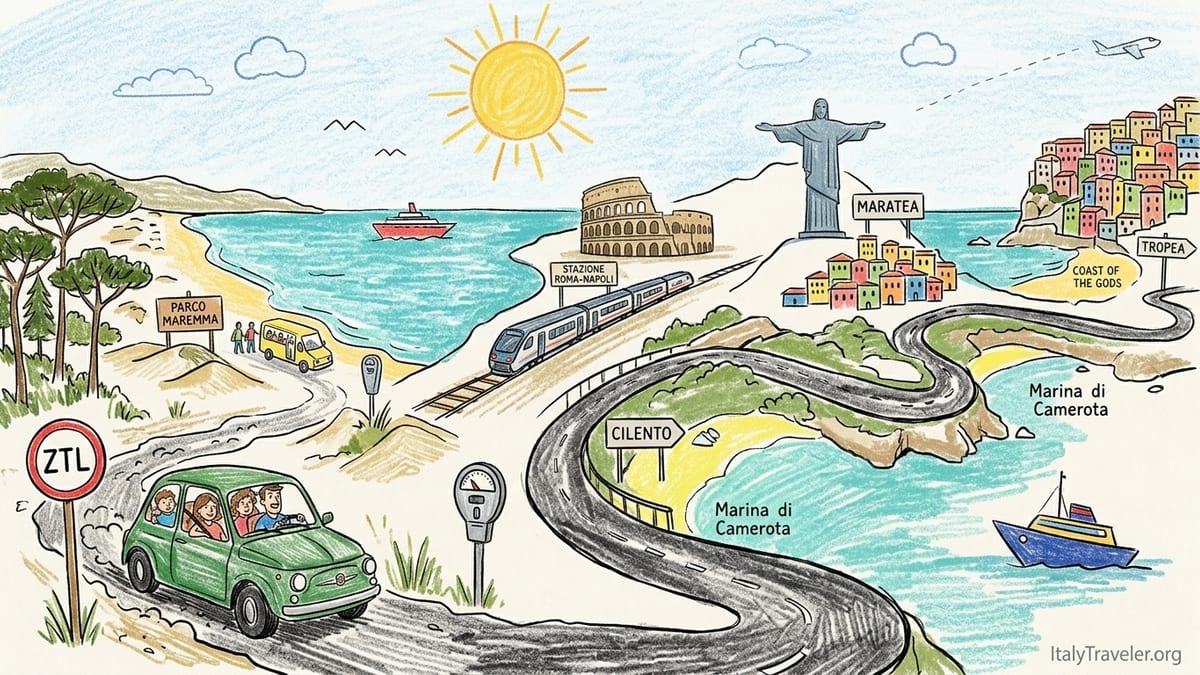
How to Use This Flexible Tyrrhenian Coast Guide
Think of the Tyrrhenian coast as a series of connected chapters, not a single linear race from north to south. Italian tourism boards and route planners quietly do the same. Italia’s official site suggests a five-day Riviera di Ulisse itinerary between Terracina, Sperlonga, Gaeta and Formia in southern Lazio, while ViaMichelin publishes a 260 kilometer Salerno to Maratea road trip through the Cilento coast, and regional tourism in Calabria promotes seven-day Tyrrhenian itineraries from the Cedri Riviera to the Coast of the Gods. These are real-world itineraries that match how people actually travel.
This guide mirrors that approach. You can pick one section, like Maremma plus Lazio if you are already in Tuscany, or stitch two together, such as Riviera di Ulisse plus Cilento and Maratea for a ten to twelve day trip. Each section includes realistic driving distances, typical toll and fuel expectations, common ZTL (limited traffic zone) pitfalls, and ideas for reducing hotel changes by picking smart bases.
Most routes assume you will rent a compact car from a gateway city such as Rome, Naples, Salerno or Lamezia Terme. Daily rental rates for a manual compact car often range from about 35 to 60 euro in shoulder season, rising in August. If you prefer to avoid driving, the guide also points out where the coastal railway runs close to the sea, such as on the Riviera di Ulisse, around Salerno and the Cilento, and along much of the Tyrrhenian Calabria shoreline.
The aim is not to see every village. It is to combine a realistic amount of driving, a few carefully chosen scenic roads, and enough downtime to actually swim, wander and eat.
Maremma & Southern Lazio: From Wild Beaches to the Riviera di Ulisse
A classic first slice of the Tyrrhenian coast links the Maremma in southern Tuscany to Lazio’s Riviera di Ulisse. Many travelers start near Grosseto or Orbetello, then follow the Aurelia road south toward Civitavecchia and onwards to Terracina and Sperlonga. This keeps daily driving to two or three hours, leaves time for swims in protected coves, and lets you avoid the urban stress of central Rome entirely.
In Maremma, bases such as Talamone or Porto Santo Stefano put you within easy reach of the Parco della Maremma, where you can park in Alberese, pay a modest shuttle fee, and reach long, undeveloped beaches backed by dunes and pine woods. Parking at popular summer beaches can cost roughly 8 to 15 euro per day, often payable at a small kiosk or via a parking meter that takes coins. Inland detours to hill towns like Capalbio or Pitigliano mean tighter roads and parallel parking on steep streets, so renting a smaller car genuinely helps.
Driving south, the main Aurelia route between Grosseto and Civitavecchia is a mix of divided highway and standard road, usually toll free but with frequent speed changes and fixed cameras. Once you cross into Lazio and head toward Terracina, expect slower two-lane sections and weekend traffic as Romans head to the sea. The Riviera di Ulisse segment recommended by Italia’s tourism board typically links Terracina, Sperlonga, Gaeta and Formia over about five days, with coastal promenades, archaeological sites and sandy coves. Formia and Gaeta are working towns as well as resorts, which means better year-round restaurants and practical services such as large supermarkets and staffed parking garages.
If you dislike hotel hopping, base yourself for three or four nights in Sperlonga or Gaeta and day trip along the coast. Both towns sit on the Rome–Naples rail line, so you can even leave the car parked and use regional trains for side trips inland or along the bay. A midrange seafront hotel in June or September might run from about 120 to 180 euro per night, while simple guesthouses set a few blocks inland can be significantly cheaper outside August.
Riviera di Ulisse & Campania: Linking Lazio to the Gulf of Naples
The Riviera di Ulisse connects naturally into northern Campania and the Gulf of Naples. A practical route for five to seven days starts in Formia, follows the coast past Minturno and Baia Domizia, then continues toward Pozzuoli and the broader Bay of Naples area. Distances remain short, but you need to pay close attention to ZTL zones and busy arterials as you enter metropolitan Naples.
On this stretch you will cross from Lazio into Campania with only a sign marking the change. The road remains mostly toll free until you approach the Naples hinterland and hop on the A1 or A3 toll autostrade. Expect to pay a few euro for short hops on these highways, which you can pay in cash or by card at toll booths. Staying outside central Naples, for instance in Pozzuoli or along the Phlegraean Fields coast, can save you from navigating dense ZTLs and chaotic inner-city traffic. Many hotels in these areas advertise private parking for an extra nightly fee, often 10 to 20 euro.
If you want to dip into Naples or Pompeii without driving, use the regional rail network once you have parked the car for a couple of nights. Circumvesuviana or Campania regional trains link Naples with Pompeii, Sorrento and smaller stations along the bay. In practice, that means you can leave your car at a hotel garage in Pozzuoli or Castellammare di Stabia and ride the train for day trips, returning in the evening to a quieter coastal base.
In the high season months of July and August, coastal traffic between Formia and the Bay of Naples can be sluggish on Friday afternoons and Sunday evenings as weekenders depart and return. Build margin into your timings if you must catch a train or flight. If your priority is calmer driving, late May, June, September and early October usually bring lighter traffic and more available parking, while beach clubs and restaurants are still operating.
Cilento & Maratea: Scenic Roads Between Salerno and Basilicata
South of Salerno, the Tyrrhenian shore turns greener and less developed as you enter the Cilento and Vallo di Diano National Park. ViaMichelin highlights a 260 kilometer itinerary from Salerno to Maratea, with stops in coastal villages such as Acciaroli, Palinuro and Sapri before crossing into Basilicata. This is one of southern Italy’s most rewarding scenic coastal drives, but you should expect narrower roads, hairpin curves and slower progress than on the Amalfi Coast highway.
A realistic three to five day trip might start with one night in or near Salerno, where you can pick up a rental car, then move to a base such as Santa Maria di Castellabate or Palinuro for two or three nights. From there you can day trip to nearby beaches like Marina di Camerota or to inland villages perched above the sea. Distances between most Cilento towns are under an hour, but average speeds can dip below 50 kilometers per hour on winding sections, so plan accordingly.
Parking in smaller Cilento resorts is often in municipal lots just behind the waterfront. High season daily rates can run to around 10 to 15 euro, with lower hourly caps in shoulder season. Many lots still operate with pay-and-display tickets from machines that accept coins, though newer installations may take cards. Wild parking at roadside pullouts might be tempting on scenic headlands, but look for painted lines and signage to avoid fines. Local police in these small municipalities routinely check coastal parking in July and August.
Continuing to Maratea, you cross into Basilicata and one of the most photographed corners of the Tyrrhenian. The town climbs steeply above the sea, with its giant Cristo Redentore statue and terrace views. Because the historic center is compact and streets are steep, many visitors choose accommodations that include dedicated parking spaces on the edge of the old town, then explore on foot. For a two or three night stay, expect midrange hotels and guesthouses to cost from roughly 90 to 160 euro per night outside the August peak, rising for sea views and pools.
Tyrrhenian Calabria: From the Cedri Riviera to the Coast of the Gods
From Maratea it is a short hop into Calabria’s northern Tyrrhenian coast, often called the Cedri Riviera around Praia a Mare, Scalea and Diamante. Regional and local tourism boards promote seven-day itineraries that follow the coastline from the Basilicata border down past Tropea and the Coast of the Gods, sometimes looping inland to Sila National Park or Aspromonte before returning to the sea. You can easily adapt these plans into a five to eight day coastal drive.
A common pattern is to split your time between the north and south of Tyrrhenian Calabria. For instance, you might spend three nights near Praia a Mare or Scalea, exploring San Nicola Arcella, the Arcomagno sea arch and Diamante with its chili pepper festival in season, then drive about three hours south to Tropea or Capo Vaticano for another three or four nights. The entire coastal run between Praia a Mare and Tropea is under 200 kilometers, but curves, villages and occasional roadworks slow progress.
Unlike some parts of the Amalfi Coast, much of Tyrrhenian Calabria has fewer formal parking structures, relying instead on waterfront lots, on-street spaces and hotel car parks. In towns like Tropea, central parking gets tight in August, and daily prices at the main lots can climb to around 15 to 20 euro in peak season. Booking accommodation that explicitly includes a reserved parking space just outside the historic center is worth the small extra cost, and allows you to walk into town in ten to fifteen minutes rather than circling narrow lanes in traffic.
Calabria’s Tyrrhenian coast is also one of the easiest sections to visit without a car. Trains run along the shoreline linking towns such as Paola, Amantea, Pizzo, Tropea and Scilla. Many visitors now combine a few days of driving in more rural stretches, such as the Cedri Riviera, with a car-free base in Tropea or Scilla for three or four nights. A regional train from Lamezia Terme airport area to Tropea is typically under two hours with a change, and summer schedules are reinforced with additional services, although crowds can be heavy on weekends.
Tolls, ZTLs, Coastal Traffic and Parking: What to Expect
Across the whole Tyrrhenian coast, your main tolled segments are the autostrade that link the coastal zones to major cities and airports. Examples include the A12 between Civitavecchia and Rome, the A1 and A3 corridors around Naples, and the A2 Autostrada del Mediterraneo in Calabria. For most of the routes in this guide, you will only use toll roads briefly to escape or approach big hubs. Typical short hops can cost a few euro, payable with cash or card at gantry booths where you collect a ticket on entry and pay on exit.
More disruptive than tolls are the ZTLs, which protect historic centers from through traffic. You will encounter them in medium-sized towns such as Orbetello, Gaeta, Salerno, Tropea and many inland hill towns. Signs are usually white with a red circle, sometimes with time windows and camera icons. Accidentally entering can result in fines that rental companies pass on weeks later, sometimes with an extra administrative fee. The simplest defense is to program your hotel’s parking lot into your navigation system rather than its street address in the old town, and to study the hotel’s arrival instructions which often include annotated maps showing which approach roads avoid ZTL cameras.
Coastal traffic is highly seasonal. On the Maremma and Lazio stretches, weekend congestion from Rome can clog approaches to popular beaches in July and August, with queues to access car parks and slow-moving lines through small towns. Around Salerno, the junctions that feed the Amalfi Coast and Cilento can back up in both directions on summer afternoons. In Calabria, traffic density is generally lower, but single-lane coastal roads mean even a minor incident or festival can slow progress considerably. Planning main driving legs for midweek mornings and avoiding late Sunday returns reduces stress.
Parking costs vary widely, but a conservative budget for peak summer might be 10 to 20 euro per day in resort towns and far less in shoulder season. Many smaller hotels and agriturismi outside the densest centers include free onsite parking. Where possible, book properties that specify a reserved place, especially in Tropea, Maratea, Sperlonga and the busiest Riviera di Ulisse towns. For day trips, look for signed parcheggio areas just outside the compact centers, even if it means a ten-minute walk, which is often quicker than circling narrow alleys hoping for a free space.
Railway Alternatives and One-Way Scenarios
If you are hesitant about driving all of the Tyrrhenian coast, you can still experience most of its highlights by combining rail and short rental periods. The Rome to Naples to Salerno trunk line hugs the sea for long stretches and connects easily to the Riviera di Ulisse towns, the Cilento gateway at Agropoli or Paestum, and later to the Tyrrhenian cities of Calabria. This makes it entirely feasible to travel between major nodes by train and pick up cars only for two or three day segments where you want to reach rural beaches or hill villages.
One common strategy is to base in Rome or Naples without a car, then take a regional train to Formia, Sperlonga or Gaeta for three seaside nights using taxis or local buses. From there, continue by rail to Salerno, rent a car for four or five days to explore Cilento and Maratea, and drop it in Sapri or Paola before boarding a southbound train to Tropea or Scilla. Along the Calabrian coast, frequent regional trains make one-way journeys easy, so you can walk or take short taxis between stations and your accommodations.
Renting a car one way between regions, such as Rome to Lamezia Terme, is possible but can involve higher drop fees, sometimes 100 to 200 euro, depending on the company and season. Often it is more economical to return the car to the same region and use trains for longer north-south jumps. Before booking, compare quotes for round-trip rentals paired with train tickets against full one-way rental plans, taking into account fuel, tolls and urban parking costs you would avoid by using rail.
For travelers uncomfortable with any Italian driving, it is still realistic to build a Tyrrhenian coast journey entirely around rail and ferries. Examples include a Rome to Sperlonga and Gaeta segment, a Salerno to Cilento stretch based around Agropoli or Santa Maria di Castellabate with bus links, and a Tyrrhenian Calabria chapter between Paola, Pizzo, Tropea and Scilla. You will trade some remote coves and hilltop villages for simpler logistics, but gain a much lower-stress trip overall.
Planning Your Section-by-Section Tyrrhenian Road Trip
To assemble your own route, start with how many nights you realistically have and how often you are willing to change hotels. If you have seven to eight nights and like slow travel, you might pick just one section such as Cilento and Maratea or Tyrrhenian Calabria, basing in two towns for three or four nights each. With ten to twelve nights you could link Maremma and Lazio with the Riviera di Ulisse and a taste of Campania, or combine the ViaMichelin-style Salerno to Maratea route with several days around Tropea.
Align your expectations with the Italian holiday calendar as well. August is the traditional vacation month, and the week around Ferragosto in mid-August can see packed beaches, busy roads and higher prices from Maremma all the way down to Calabria. If you can travel in late May, June, September or early October, you will usually find lighter traffic, more available parking, and moderate sea temperatures suitable for swimming, especially in the south.
Budgeting should include more than just fuel and hotels. Factor in tolls on approach and departure days, daily parking in the busiest resorts, beach club fees if you prefer serviced lidos, and any ZTL fines you might inadvertently incur. Buying full collision damage waivers from your rental company or a reputable third party can feel expensive up front but reduces the stress of parking on tight medieval streets in hill towns.
Above all, allow some slack in your schedule. A headland viewpoint in Cilento, an unplanned lunch stop in a Calabrian fishing town, or an extra swim at sunset on the Riviera di Ulisse often become the trip’s defining memories. Shorter driving legs and longer stays in each base give those moments room to appear.
The Takeaway
The Tyrrhenian coast from Maremma to Calabria is best approached as a series of overlapping, flexible itineraries rather than a single forced march down Italy’s western flank. Real-world routes promoted by tourism boards and mapping services already break the journey into manageable chapters like the Riviera di Ulisse, the Salerno to Maratea drive, and a week along Tyrrhenian Calabria. Following their lead means less time in the car and more time on the beach, in coastal villages and at scenic viewpoints.
Whether you choose a long weekend in southern Tuscany and Lazio, a multi-stop adventure through Cilento and Basilicata, or a rail-and-road exploration of Calabria’s Coast of the Gods, the same principles apply. Respect ZTLs, plan parking, avoid peak weekend traffic where you can, use trains for longer hops, and keep your daily driving ambitions realistic. The reward is a coastal journey that feels like a holiday rather than a logistical challenge.
FAQ
Q1. Do I need a car to enjoy the Tyrrhenian coast between Maremma and Calabria?
You can travel large portions by train, especially between Rome, the Riviera di Ulisse, Salerno and Tyrrhenian Calabria, but a car is very helpful for reaching smaller beaches, rural villages and scenic viewpoints in Maremma, Cilento and parts of Calabria.
Q2. How many nights should I plan for a Cilento and Maratea road trip?
A comfortable minimum is four to five nights, with at least two nights in a Cilento base such as Santa Maria di Castellabate or Palinuro and two or three nights in or near Maratea, allowing relaxed drives and beach time.
Q3. Is driving on the Tyrrhenian coastal roads dangerous?
The roads are generally well maintained, but they can be narrow, winding and busy in summer. If you keep speeds moderate, avoid driving at night on unfamiliar stretches and choose a small car, most drivers with some experience feel comfortable after the first day.
Q4. How expensive are tolls on these routes?
Most coastal segments themselves are toll free, but you will pay tolls on autostrade when entering or leaving major hubs such as Rome, Naples or Lamezia Terme. For typical short segments at each end of a trip, many travelers spend a few tens of euro in total on tolls.
Q5. What is the best time of year for a Tyrrhenian coast road trip?
Late May, June, September and early October usually offer warm weather, swimmable seas, open services and lighter traffic than July and August, when Italian holidaymakers fill beaches and car parks.
Q6. How can I avoid ZTL fines in coastal towns?
Before arrival, check your hotel’s directions and enter its parking coordinates into your navigation system. Look carefully for white signs with red circles indicating restricted zones and do not follow other cars automatically, since locals may have permits that you do not.
Q7. Are there good railway alternatives along the Tyrrhenian coast?
Yes, regional trains link many key stops, including Formia, Gaeta area stations, Salerno, Agropoli and other Cilento gateways, plus Tyrrhenian Calabria towns such as Paola, Pizzo, Tropea and Scilla, making it possible to combine rail and short rental periods.
Q8. How often should I change hotels on a coastal road trip?
Many travelers find that two or three bases per week offer a good balance. For example, staying three nights each in a northern and southern coastal town allows day trips without packing every morning.
Q9. Is parking difficult in popular places like Sperlonga, Maratea and Tropea?
In July and August, central parking can be tight and relatively expensive, sometimes 15 to 20 euro per day. Booking accommodation that includes a reserved space just outside the historic center usually simplifies arrivals and daily outings.
Q10. Can I do a one-way Tyrrhenian road trip from Rome to Calabria?
It is possible to rent a car in Rome and drop it in Calabria, but one-way fees can be significant. Many travelers choose instead to return the car to its starting region and use trains for the long north-south segments to keep costs and stress lower.