


The Tyrrhenian coast of Italy runs from the marble-backed beaches of northern Tuscany to the subtropical cliffs of Calabria, taking in some of Europe’s most coveted shoreline. Yet for many travelers, names like Forte dei Marmi, Argentario, Sperlonga, Amalfi, Cilento, Tropea or Scilla blur together into a single dreamy idea of “the Italian coast.” This guide is designed to help you choose the stretch that actually fits your style, whether you care most about sandy beaches for kids, nightlife, drama-on-the-cliffs scenery, road-trip potential or a quiet village where the loudest sound is the surf.
How to Choose Your Tyrrhenian Coast Base
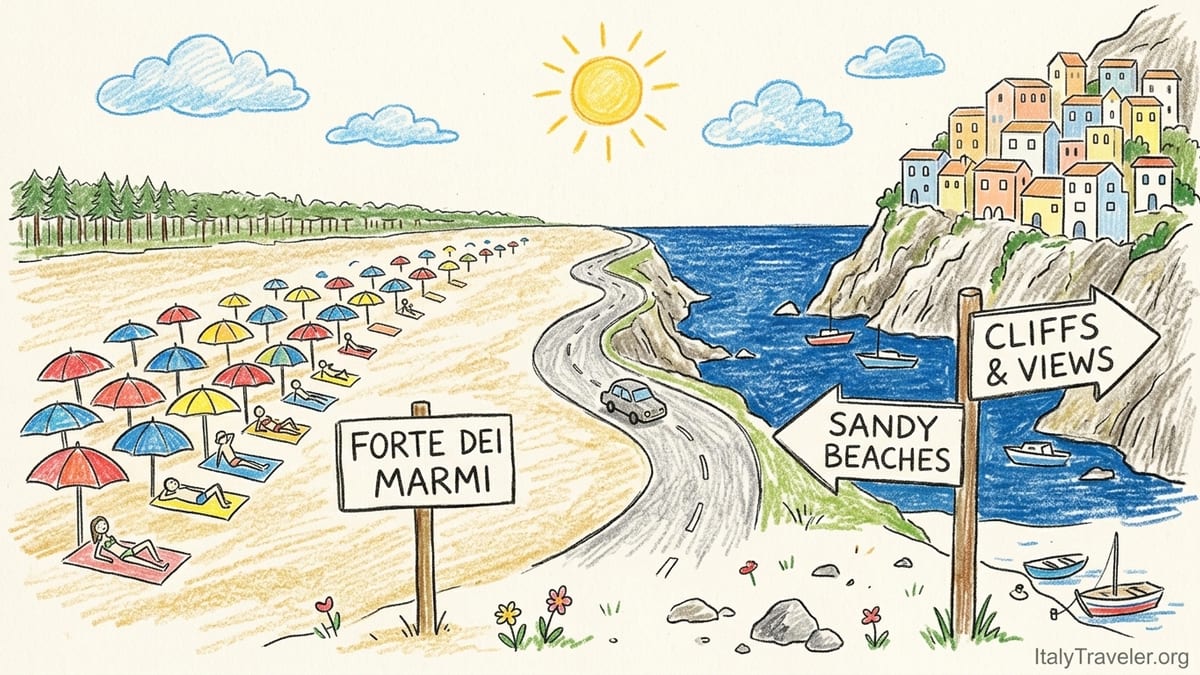
Before zooming in on individual places, it helps to think about what kind of coast you want. On the Tyrrhenian, there is a real split between long sandy strands backed by pine forests, and steep cliffs where towns perch high above deep blue coves. Forte dei Marmi and Viareggio in northern Tuscany, much of the Cilento, and the beaches around Tropea and Capo Vaticano are classic sand and lido territory. The Amalfi Coast, Argentario, Maratea and Scilla lean toward dramatic headlands, rockier coves and postcard panoramas.
Budget and expectations matter too. A family day at a mid-range beach club in Forte dei Marmi or Argentario can easily run to 80–150 euros for two loungers and an umbrella in peak season, while similar setups on the Cilento coast or near Tropea often cost noticeably less, especially if you step away from the busiest towns. In classic resort areas like Forte dei Marmi or Amalfi, you will find polished service, valet parking and designer boutiques but also higher restaurant prices and the need to book months ahead for August. In quieter towns such as Acciaroli in Cilento or Scilla in Calabria, you are more likely to see fishing boats pulled up on the beach and locals at the bar ordering a 1.50 euro espresso.
Travel logistics are another filter. From Florence or Pisa, Forte dei Marmi and Viareggio are straightforward train rides followed by short taxi hops to beach clubs. From Rome, Sperlonga and Gaeta are the easiest low-stress Tyrrhenian escapes, with regular trains to Fondi-Sperlonga or Formia-Gaeta and frequent buses or taxis onward. To reach Amalfi and the Cilento coast, many travelers combine high-speed trains to Salerno with ferries, local trains or car rentals, while Tropea and Scilla are usually best reached by flying into Lamezia Terme and continuing by regional train or car.
Finally, think about how much “action” you actually want. If your dream is late nights at famous clubs followed by morning cappuccinos on a serviced lounger, then Forte dei Marmi, Viareggio or the Amalfi Coast will feel like home. If a perfect day looks more like reading under a parasol while kids build sandcastles, or a morning hike followed by a seafood lunch for under 25 euros, then Castiglione della Pescaia, parts of Cilento, Maratea or Scilla will probably fit better.
Forte dei Marmi & Viareggio: Sand, Style and Nightlife in Versilia
Forte dei Marmi and nearby Viareggio form the heart of the Tuscan resort area known as Versilia. Here the Tyrrhenian is really a long sweep of pale sand backed by private stabilimenti balneari, or beach clubs. Between the marina in Forte and the Fiumetto river, several kilometres of beach are divided into individual clubs with neat rows of umbrellas, many with restaurants, bars, kids’ play areas and even small swimming pools. Some, like Alpemare or Dalmazia, lean into high-end design and are frequented by regulars from Milan and abroad; others focus more on families, with shallow water, playgrounds and quieter music.
This stretch works best if you want easy, flat sandy beaches with full services and a polished resort town feel. It is ideal for families who like structure: you can reserve the same umbrella for a week, leave your kids’ toys in the cabana, and order plates of spaghetti alle vongole and grilled fish without changing out of your swimsuit. It is also one of the strongest choices on the Tyrrhenian for classic “dolce vita” atmosphere. Forte’s centre is full of designer boutiques, gelato bars and cocktail spots, and legendary venues like La Capannina still draw crowds for late-night dancing in summer.
Viareggio next door offers a looser, slightly more democratic version of the same formula. There are still plenty of beach clubs, but with more public access, a long liberty-style promenade and a working-town undercurrent behind the seafront. Prices for a basic umbrella and two loungers on a normal summer weekday might start around 30–40 euros in Viareggio versus 60 euros or more at fashionable Forte clubs, making it a better base if you want the Versilia experience without the steepest price tags. Train connections from cities like Florence or Lucca are straightforward, so it is also a practical choice for travelers who do not want to rent a car.
Choose Forte dei Marmi or Viareggio if your priorities are sandy child-friendly beaches with excellent services, a wide choice of beach clubs at different price points, energetic nightlife, and easy day-trip options inland to Lucca, Pisa and the marble quarries of Carrara. Skip it if you are looking for wild coves, historic stone villages right on the water or a feeling of discovery; this is polished, established resort Italy at its most confident.
Castiglione della Pescaia & Argentario: Tuscan Beach Resorts with Historic Soul
Further south in Tuscany, Castiglione della Pescaia and the Monte Argentario peninsula blend sandy beaches with a stronger sense of history and a more varied coastline. Castiglione is an ancient fishing town where an old stone castle and walls crown the hill above the modern waterfront. Below, a long low sandy shoreline stretches past beach clubs and simple bars to pine forests and nature reserves. Nearby spots such as Rocchette offer especially clear, shallow water and soft sand, which appeal to families with younger children and travelers who prioritize sea quality and a relaxed rhythm over intense nightlife.
Castiglione works particularly well if you want a mid-sized town with a lived-in Italian feel. In the evenings, the main corso fills with strollers licking gelato, and you can wander up through alleys to the old town for views over the lagoon and coast. A typical day might include renting bikes to ride out to less crowded stretches, stopping at a bakery for schiacciata bread to eat under your umbrella, then returning for an affordable seafood dinner in town. Compared with Forte, prices are often a notch lower, especially outside August, though beach clubs in prime locations still charge a premium for front-row loungers.
Monte Argentario, reached by causeways across lagoons, feels different again. The main towns of Porto Santo Stefano and Porto Ercole look out over marinas packed with fishing boats and yachts, while roads climb to viewpoints where you can see across to the islands of Giglio and Giannutri. Instead of one continuous sandy strand, Argentario offers a patchwork of pebble coves, small beaches and lido platforms set into rocks. This is a natural choice for travelers who enjoy exploring by car or scooter, dropping down to a different cove each day and lingering for sunset aperitivo in a harbour bar.
Argentario is especially strong for travelers seeking a mix of low-key luxury and coastal road-trip scenery. You might spend one day swimming at a serviced beach with a restaurant that grills local fish, and the next day hiking part of the coastal path to find almost hidden coves where you share the water with only a few other people. Accommodation ranges from simple apartments in the old town streets of Porto Ercole to boutique hotels tucked above the sea. This is not the best choice for wide sandy beaches where children can run for miles, but for couples and groups of friends who want a blend of history, scenery and a taste of discreet yacht-club glamour, it is hard to beat.
Sperlonga & Gaeta: Rome’s Classic Weekend Escape
Between Rome and Naples, the Lazio coast around Sperlonga and Gaeta offers some of the best beaches within easy reach of the capital. Sperlonga is the more photogenic at first glance: a whitewashed historic centre piled up on a rocky headland, narrow stairways and little arches framing views of turquoise shallows. On one side of town, a long sandy beach runs toward Terracina, fronted by a string of beach clubs that rent umbrellas and loungers by the day. On the other side, smaller coves and rocky points lead toward Gaeta, giving swimmers a choice between broad, family-friendly stretches and more intimate corners.
Gaeta, slightly larger and more lived-in, has its own historic quarter with old churches, lanes and defensive walls. Its most famous beach, Serapo, is a wide sandy crescent, while the more rugged coast toward the Montagna Spaccata and the protected area of Monte Orlando offers cliff paths, viewpoints and smaller bays. Many travelers combine the two towns, staying in whichever offers the better accommodation deal and using local buses or taxis to reach other beaches like the scenic Spiaggia di Sant’Agostino between them.
This section of coast is one of the most practical for car-free travelers. High-speed and regional trains from Rome reach Fondi-Sperlonga or Formia-Gaeta in about an hour, with shuttle buses and taxis waiting outside stations in summer. For a realistic example, a couple from Rome could leave after breakfast, pay for two loungers and an umbrella in a mid-range lido for roughly 30–40 euros, enjoy a long lunch of fried calamari and a carafe of local white wine for around 40–60 euros, and be back in the city by evening. For longer stays, apartment rentals can keep costs predictable for families.
Choose Sperlonga and Gaeta if you want reliable sandy beaches, relatively affordable lidos, some nightlife without a clubbing scene, and the option to combine beach days with Roman or Neapolitan city trips. The towns have enough authentic life to feel Italian rather than purely resort-driven, yet in high season they are very much on the radar of Romans and Neapolitans seeking a weekend escape, so advance booking is wise in July and August.
Sorrento & the Amalfi Coast: Iconic Cliffs and Glamour
Sorrento and the Amalfi Coast are probably the most famous names on the Tyrrhenian, thanks to their cliff-hugging roads, citrus groves and pastel towns like Positano and Amalfi clinging to vertical slopes. Here the coastline is all about drama: steep drops to the sea, terraces of lemon trees, churches perched above tiny harbours and switchback roads rewarded by sweeping views. If your picture of an Italian holiday involves hairpin bends, glamorous hotels and sunset aperitivo high above the water, this is the obvious choice.
However, the Amalfi Coast is not primarily a sandy-beach destination. Sorrento itself sits high on a tuff cliff above small platforms and marinas; access to the sea is via lifts, staircases or piers where private establishments rent deckchairs and umbrellas on wooden decks. Around Amalfi and Positano, beaches tend to be pebbly or dark sand crescents wedged between cliffs, many only reachable by boat or by walking down steep stairways. The trade-off is incredible scenery: even a simple ferry ride between towns can feel like a cruise, with rock formations, towers and terraces passing in constant succession.
In practical terms, Sorrento makes the best base on this stretch for travelers who want a broader set of options. The town has regular trains to Naples and Pompeii, ferries across the bay to Capri and hydrofoils down the coast. There are several organized lidos at Marina Piccola and Marina Grande, and plenty of mid-range hotels and family-run pensions. Amalfi, Positano and Praiano skew more to couples and honeymooners, with many boutique hotels hugging the cliffs and prices that reflect international demand. A light lunch with drinks in a prime seafront spot can easily top 30–40 euros per person in peak season.
This coast section works best if your priorities are scenery, romantic settings, boat trips and fine hotels rather than long lazy days on sandy beaches. It also suits travelers who enjoy hopping between towns by ferry or bus, and who do not mind that getting to the sea can involve stairs and planning. Families with small children or travelers who prefer to walk straight onto a shallow, sandy shore may be happier further south in Cilento or in Calabria.
Cilento & Maratea: Quieter Campania and Basilicata
South of the Amalfi Coast, the Cilento coast feels like a different world: slower, quieter, with longer beaches and towns that are still geared as much toward local families as international visitors. Resorts like Agropoli, Santa Maria di Castellabate, Acciaroli, Palinuro and Marina di Camerota share a basic formula of soft sand, clear water and a mix of free beaches and traditional lidos. Inland, hills rise quickly to national park mountains dotted with medieval villages. It is an excellent compromise if you like the idea of Campania’s food and warm sea but would rather skip the crowds of Amalfi.
For example, a family could rent an apartment in Santa Maria di Castellabate for a week, walk to a nearby supermarket and bakery, and spend most days on local beaches where daily umbrella rentals are lower than in Amalfi or Forte dei Marmi. On one day they might drive to Paestum to see Greek temples set among fields, and on another join a small boat trip from Palinuro to explore caves and hidden coves. Even simple beach bars here often serve excellent local mozzarella, grilled vegetables and house wine at prices that feel reasonable by Italian holiday standards.
Continuing south, the small town of Maratea in Basilicata combines sandy and pebble beaches with spectacular hillside scenery. The historic centre sits above the sea, with narrow lanes, churches and a hilltop Christ statue overlooking the coast. Below, a winding coastal road drops to coves and small harbours where you find beach clubs and simple trattorie right on the water. Compared with high-profile Amalfi, Maratea is usually less discovered by international tourists, which can translate into quieter evenings and a more local crowd in summer.
Cilento and Maratea are particularly suitable for road trips. Having a car makes it easy to string together different beaches, hill towns and inland hikes. This is a coast for travelers who enjoy driving scenic but less hectic roads than Amalfi, and who value a slower rhythm with a good balance between beach time, small-town life and nature. It is not the place for designer shopping or high-energy nightlife, but for many that is exactly the appeal.
Tropea, Capo Vaticano & Scilla: Southern Calabria’s Standout Shores
Farther south, in Calabria, the coast around Tropea, Capo Vaticano and Scilla offers some of the most striking sea-and-sand combinations on the Tyrrhenian. Tropea sits on cliffs above wide sandy beaches, its historic centre a dense web of palazzi, small churches and atmospheric alleys. An iconic view is of the sanctuary on a rocky outcrop just offshore, with turquoise water and anchored boats below. Beach clubs line the main strands, but there are also stretches of free beach where you can simply lay a towel and swim in deep, clear water.
Capo Vaticano, a short drive away, is more about coves and viewpoints. From headlands you look down on small bays framed by rocks, often reached by paths or stairways carved into the hillside. Many travelers stay in small hotels or agriturismi set back from the cliffs, using a shuttle or short drive to reach beaches such as Grotticelle. Water clarity here is a major draw; snorkelling among rocky outcrops and patches of seagrass is a simple pleasure that does not require any equipment beyond a mask and fins.
On the opposite side of the region, near the Strait of Messina, Scilla combines a compact sandy beach with a romantic fishing quarter, Chianalea, where houses seem to rise directly from the water. Here small restaurants set tables on terraces above the sea, serving swordfish caught in the strait. The main beach is backed by lidos and low-key bars rather than luxury developments, and evenings tend to revolve around seaside strolls, gelato and relaxed dinners rather than clubs.
Calabria’s Tyrrhenian towns work well for travelers who want a mix of sandy beaches, historic settings and more accessible prices. Accommodation and restaurant bills are often lower than in Tuscany or Amalfi for comparable quality, especially outside the busiest weeks in August. The trade-off is that public transport can be slower or less frequent, and English may be less commonly spoken in smaller establishments, though many younger locals do speak some. For confident travelers, that sense of being further “off the beaten path” is part of the charm.
Matching Coast Sections to Your Travel Style
Seen together, these destinations form a spectrum that can help you match the Tyrrhenian to your priorities. For wide sandy beaches with lots of services and shallow water for children, Forte dei Marmi, Viareggio, Castiglione della Pescaia, much of the Cilento, Tropea and the main beach in Scilla all fit the bill. If you dream more of towering cliffs and panoramic views, focus on Argentario, the Amalfi Coast, the coves of Capo Vaticano and the headlands around Maratea and Gaeta.
For nightlife, Forte dei Marmi stands out, with its long-established clubs and stylish beach bars that can feel like open-air living rooms during peak season. Viareggio, Sorrento and parts of the Amalfi Coast also offer busy evenings, especially in July and August. In contrast, Castiglione, Cilento towns, Maratea and Scilla tend to quiet down earlier, with the focus on dinners and passeggiata rather than dancing. Couples seeking romance but not necessarily clubs might gravitate to Argentario, Sperlonga, Positano, Amalfi, Maratea, Tropea or Scilla, where waterfront dinners and sunset viewpoints are easy to find.
Families usually care about three things: safe swimming, easy logistics and enough non-beach diversions for occasional cloudy days. Versilia’s structured beach clubs near Forte and Viareggio, the spacious sandy shores of Cilento, and the flat waterfronts of Gaeta and Castiglione tick those boxes. For multigenerational groups or travelers seeking luxury, Forte dei Marmi, Argentario and the best Amalfi hotels offer private transfers, concierge services, high-end dining and sometimes spa facilities directly in their resorts or nearby. Road-trip enthusiasts, on the other hand, might design a route from Rome to Naples via Sperlonga and Gaeta, or from Salerno down through Cilento to Maratea and on to Tropea, stopping in hill towns and viewpoints as they go.
If your ideal holiday is very quiet, focus on shoulder seasons and less famous stretches. Late May in Argentario, early June in Cilento or late September in Scilla and Tropea often bring warm sea temperatures with fewer crowds and more attractive accommodation rates. In those periods, you could easily find yourself as one of only a few table groups in a seaside trattoria, eating grilled fish of the day with a glass of local white wine while waves break a few metres away.
The Takeaway
Rather than asking “Which is the best place on the Italian coast?”, it is more useful to ask “Which stretch of the Tyrrhenian fits the kind of trip I want this year?” If you picture structured beach days with full services, a buzzing town centre and plenty of nightlife, then Versilia around Forte dei Marmi and Viareggio is likely to suit you best. If you want sandy beaches linked to an atmospheric old town but with a more relaxed pace, Castiglione della Pescaia, Sperlonga, Gaeta or some Cilento villages are natural contenders.
For a once-in-a-lifetime romantic escape, with cliffside hotels, boat trips and iconic views, it is hard to argue against Sorrento and the Amalfi Coast, accepting that beaches are smaller and prices higher. If you would rather discover corners that still feel a little under the international radar, then Cilento, Maratea, Tropea, Capo Vaticano and Scilla offer a compelling mix of beauty, value and authenticity. Ultimately, any of these places can deliver a memorable Italian summer; the art lies in matching their character to your own travel style and timing.
FAQ
Q1. Which area on the Tyrrhenian coast is best for long sandy beaches?
For classic long sandy beaches with plenty of space and shallow water, look first at Forte dei Marmi and Viareggio in Tuscany, the stretches around Castiglione della Pescaia, the main resorts in Cilento such as Santa Maria di Castellabate or Marina di Camerota, and the beaches below Tropea and along Capo Vaticano in Calabria.
Q2. Where should I go if I want dramatic cliffs and postcard views rather than big beaches?
For dramatic cliff scenery and sweeping views, the Amalfi Coast, Sorrento’s headlands, Monte Argentario in Tuscany, Maratea in Basilicata and the rocky sections of Capo Vaticano are all strong options, with towns perched above the sea and coves tucked under high slopes.
Q3. Which destinations are best for nightlife and evening atmosphere?
Forte dei Marmi has the strongest nightlife, with established clubs and stylish beach bars that stay busy into the night in summer. Viareggio, Sorrento and key Amalfi Coast towns like Positano and Amalfi offer lively promenades and bars, while sperlonga, Gaeta, Cilento towns, Maratea and Scilla lean more toward relaxed dinners and evening strolls than clubs.
Q4. What is the most family-friendly stretch of this coast?
Families usually do well in Versilia around Forte dei Marmi and Viareggio, where beach clubs are set up with shallow water, lifeguards and services, and in Castiglione della Pescaia, Gaeta, the main Cilento resorts and Tropea. These areas combine easy beach access with supermarkets, casual restaurants and simple day trips.
Q5. Which area is best if we want a bit of luxury and high-end hotels?
If budget allows, Forte dei Marmi, Monte Argentario and the Amalfi Coast offer the most established high-end scenes, with luxury hotels, private transfers, concierge services, refined beach clubs and fine dining. Sorrento has a mix of upscale and mid-range options, while Tropea and some parts of Cilento are slowly adding more boutique properties.
Q6. Where can I find quieter, less crowded holidays on the Tyrrhenian?
For quieter stays, focus on Cilento towns like Acciaroli or Marina di Camerota outside the peak weeks, Maratea in Basilicata, and Calabria’s Scilla, Tropea and Capo Vaticano, especially in late May, June or September. Argentario and Castiglione della Pescaia can also feel calm outside August.
Q7. Is it possible to explore these coasts without renting a car?
You can comfortably visit Forte dei Marmi, Viareggio, Sperlonga, Gaeta, Sorrento and the main Amalfi towns by train, bus and ferry. The Cilento coast, Maratea, Tropea and Capo Vaticano are partly reachable by train, but having a car greatly increases your flexibility for beaches and small villages.
Q8. How expensive are beach clubs, and where are they more affordable?
Beach club prices vary widely. In peak season, top clubs in Forte dei Marmi or on the Amalfi Coast can charge upward of 60 euros per day for two loungers and an umbrella, sometimes more for front rows. In Viareggio, Gaeta, Cilento or Calabria, similar setups may cost substantially less, especially away from the most famous spots and outside August.
Q9. Which coast section is best for a scenic road trip?
For road trips, consider driving from Rome to Naples via Sperlonga and Gaeta, or from Salerno down through the Cilento coast to Maratea and on to Tropea and Scilla. Monte Argentario also offers rewarding coastal drives with frequent viewpoints and detours to coves.
Q10. When is the best time of year to visit the Tyrrhenian coast?
Late May, June and September usually offer warm seas, pleasant temperatures and fewer crowds than July and August. In those shoulder months, prices are often lower, and towns such as Castiglione della Pescaia, Cilento resorts, Maratea, Tropea and Scilla feel lively but not overwhelmed.