

Italy’s Tyrrhenian coast stretches from the marble-backed beaches of northern Tuscany to the sunburned cliffs of Calabria. Along the way, a string of resort towns offer very different takes on a beach holiday, from Versilia’s polished stabilimenti with perfectly spaced umbrellas to the wilder coves of Maratea and the turquoise shallows around Tropea and Capo Vaticano. Choosing between them is less about finding “the best” beach and more about matching each destination’s character, prices and infrastructure to the type of trip you want.
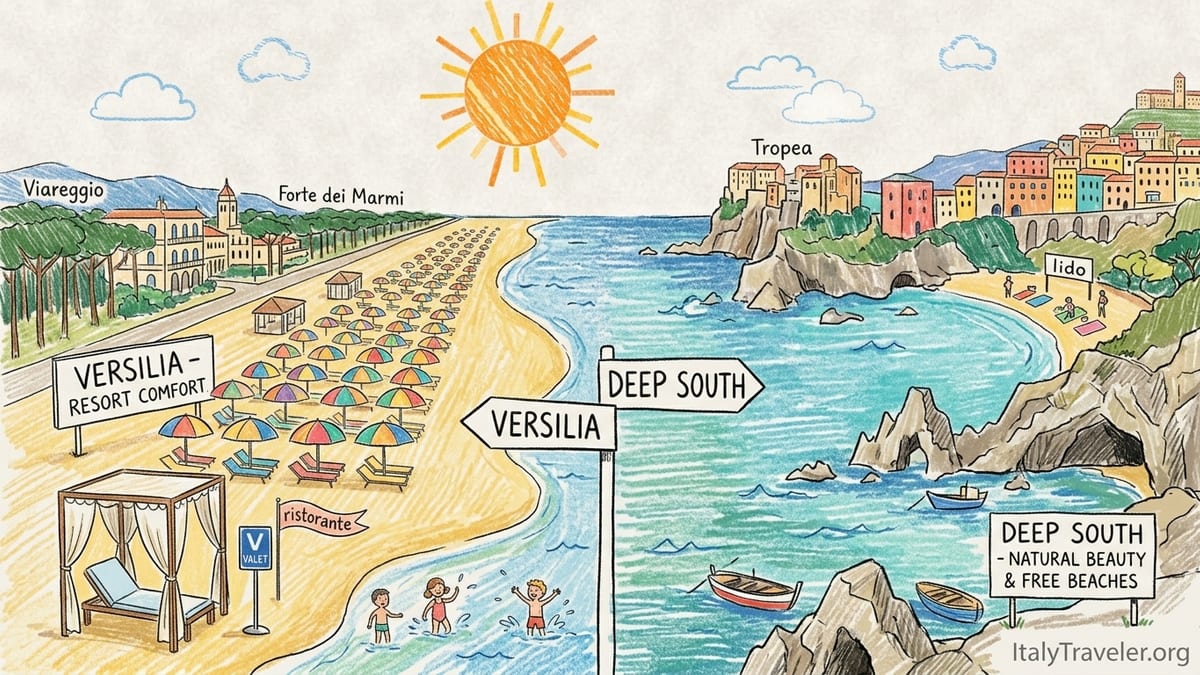
How the Tyrrhenian Coast Differs: Versilia vs the Deep South
One of the most striking contrasts on the Tyrrhenian coast lies between the manicured strands of northern Tuscany’s Versilia and the more dramatic, sometimes rugged shorelines further south in Campania, Basilicata and Calabria. In Versilia, and particularly around Forte dei Marmi, Viareggio and Lido di Camaiore, the beach is wide, sandy and almost entirely organized into stabilimenti, or private beach clubs, with uniform rows of loungers, on-site restaurants and hot showers. It feels like a well-run outdoor living room where you rent your patch of sand by the day, week or season.
As you move south toward the Cilento coast, Maratea and finally Tropea and Capo Vaticano, the configuration changes. There are still beach clubs and lidos with sunbeds and bars, but they alternate with long stretches of free, undeveloped shore where you can simply spread a towel. Calabria’s Tyrrhenian side in particular is known for this mix of organized sections around main resort towns such as Tropea and Scalea, and wilder coves and cliffs in between. The result is a coastline that can cater both to travelers who want full-service comfort and those seeking a more natural escape.
Prices track this difference. In peak summer, a front-row beach tent at a prestige club in Forte dei Marmi can cost several hundred euros per day for two loungers and a cabana, while a standard pair of beds and umbrella in Calabria or Cilento might run closer to 25 to 40 euros in August, and less in June or September. Beach quality, though, does not line up neatly with price. The water and sand around Sperlonga, parts of Cilento, Maratea and Tropea often rank among Italy’s cleanest and most scenic, with repeated Blue Flag recognition and family-friendly “green flag” designations in some areas.
When planning, it helps to decide whether you want a resort that feels like a luxurious extension of your hotel, complete with pools, valet parking and full-service clubs, or a base where you can dip in and out of more natural beaches and small-town life. The Tyrrhenian coast offers both, often within a short drive of each other.
Versilia: Forte dei Marmi, Viareggio and Lido di Camaiore
Versilia is explicitly known in Italy for high-quality beach infrastructure. In Forte dei Marmi, clubs like Bagno Alpemare and Augustus Beach Club operate more like boutique hotels on the sand, with cabanas, manicured gardens, pools and attentive staff. Day rates in July and August typically start around 120 to 150 euros for a standard setup in the back rows at mid-range bagni, rising to well over 300 euros for front-row tents at the most exclusive clubs. Seasonal rentals of the same spot, fiercely reserved by Italian families year after year, can reach several thousand euros. Nearby Viareggio and Lido di Camaiore usually offer the same basic services at gentler prices, sometimes 35 to 70 euros per day for two loungers and umbrella in high season.
The sand in Versilia is flat and golden, ideal for families with small children. The shallow slope means kids can paddle for some distance before the water gets deep, and most clubs provide lifeguards, changing cabins and playground corners. Many also have children’s pools or baby pools set back from the sea. For example, a mid-range club in Viareggio might have a standard pool plus a shallow splash area, while clubs in Forte dei Marmi often add jacuzzis, shaded play areas and dedicated kids’ activity staff in August. Beach access for day visitors can feel limited, because the public sections are narrow and quickly fill, so this region suits travelers comfortable with booking a stabilimento rather than relying on free sand.
Versilia’s restaurant and nightlife scene is dense and upscale by seaside standards. Along the promenade in Viareggio and Lido di Camaiore you will find everything from simple trattorias serving fritto misto and spaghetti alle vongole for 18 to 25 euros a plate, to contemporary seafood restaurants where a tasting menu can reach 80 euros per person. Forte dei Marmi sees Milanese-style cocktail bars and clubs such as La Capannina draw a dressed-up crowd in July and August, with late-night dancing and bottle service that can rival big-city prices. Parking is often the main headache: waterfront street spaces fill quickly, and many visitors end up in paid car parks just behind the lungomare for 10 to 20 euros per day, or they rely on hotel garages that can add another 20 to 30 euros per night.
Overall, Versilia is the right choice if you want comfort, services and a polished environment more than wild scenery. Think tailored linen, designer boutiques in Forte dei Marmi’s center and a holiday rhythm built around your chosen beach club. For travelers on tighter budgets, staying in Viareggio or Lido di Camaiore and day-tripping to Forte dei Marmi for a single splurge day at a top club can be a smart way to sample this world without committing to its prices all week.
Sperlonga and the Southern Lazio Coast
Sperlonga, roughly halfway between Rome and Naples, offers a very different experience while still providing structured beach services. The town sits on a rocky spur, with a whitewashed historic center above and a ribbon of pale sand curving on either side. Much of that sand is organized into stabilimenti with classic rows of umbrellas and loungers, plus bars and small restaurants. Prices here are generally lower than in Versilia. In high summer, a pair of beds and an umbrella might cost 30 to 45 euros per day at a well-located lido close to town, with discounts possible in May, June and September.
Beach quality is a major draw. Sperlonga’s waters are repeatedly recognized for their cleanliness and family appeal, with long, shallow approaches and fine, compact sand that is comfortable underfoot. Many stretches have lifeguards and are rated highly for child-friendliness, which you see in practice with Italian families installing themselves for long summer afternoons, children building sandcastles close to the shoreline while grandparents relax under the umbrellas. A few sections farther from town, such as more secluded coves tucked under cliffs, remain free or lightly equipped, appealing to visitors who do not need full-service facilities.
In terms of facilities beyond the beach, Sperlonga’s stabilimenti tend to be straightforward rather than glamorous. Most provide showers, changing cabins and a bar for coffee, cold drinks and simple lunches like panini, salads and pasta dishes. Expect to pay around 10 to 15 euros for a plate of seafood pasta at a beachfront bar, and 4 to 6 euros for an aperitivo spritz with snacks in town later. There are a handful of hotels with direct or almost-direct beach access, but many visitors stay in small guesthouses up in the historic center and walk down to their preferred lido each morning.
Nightlife here is low-key compared with Forte dei Marmi. After dinner, the main activity is strolling the lanes of the old town, grabbing a gelato, or having a drink at a terrace bar with views down to the sea. Parking, however, can be challenging in peak season. Town lots near the beach often charge around 15 to 20 euros for a day, and spaces fill by late morning in August. If you plan to visit from Rome for the day by car, arriving early or booking a lido that includes reserved parking can make a big difference to the experience.
Cilento and Scalea: Southern Campania’s Quieter Resorts
South of the better-known Amalfi Coast, the Cilento coastline in Campania offers a very different rhythm. Resorts such as Santa Maria di Castellabate, Acciaroli and Palinuro are popular with Italian families but see fewer international visitors, and prices remain more forgiving. Like elsewhere in Italy, much of the shoreline here is divided between free beaches and lidos with organized rows of umbrellas. A typical daily rate for two loungers and an umbrella in August might range from 25 to 40 euros in a village center, dropping in June or September or on less central stretches.
The beaches themselves vary from long, sandy arcs with pine forests behind them to small bays framed by cliffs. Water quality is generally good, and families appreciate the combination of sandy shallows and a more relaxed atmosphere than Amalfi or Capri. Some hotels in Cilento operate their own small beach clubs with reserved sections and shuttle services, especially those set slightly back from the shore. Pools are common at mid-range and upscale properties, making this region a practical choice if you want a mix of beach time and pool lounging without high-end resort pricing.
Scalea, further south on the border with Basilicata, functions as a classic Italian holiday town. The main beach is pebbly rather than sandy, and dotted with stabilimenti offering sunbeds, umbrellas and simple bars. Here, costs are often lower than in more famous resorts, and you can still find day packages around 20 to 30 euros for two loungers and an umbrella in high season, with cheaper options if you are willing to be farther from the town center. Parking is usually easier than in tight cliff-top villages, since much of the resort area sits on a flat coastal plain with on-street and pay-lot options.
In both Cilento and Scalea, nightlife tends to center on seaside promenades, evening markets and open-air bars rather than full clubs. Family facilities lean toward playgrounds, small funfairs in July and August, and hotel-run kids’ clubs in larger properties. For travelers who like the idea of a traditional Italian seaside holiday atmosphere without the polish and prices of Forte dei Marmi, these resorts offer a comfortable middle ground between infrastructure and authenticity.
Maratea: Basilicata’s Cliff-Edge Pearl
Maratea is a different proposition again. It sprawls across a rugged stretch of Basilicata’s only Tyrrhenian shoreline, with a hilltop old town, modern lower districts and a string of coves and small beaches tucked between cliffs. Instead of one long continuous strand of sand, you get a series of compact bays, many with pebble or coarse-sand beaches and clear, deep water. Several of these coves host small lidos with sunbeds and umbrellas, but a significant proportion of Maratea’s seaside remains free, with just a kiosk or bar near the parking area.
Beach quality here is about drama and water clarity rather than wide sandy shallows. Spots like Fiumicello and stretches around Acquafredda are known for transparent, often cool water and strong contrasts between dark rock and bright blue sea. Families with younger children tend to prefer the more sheltered, gently shelving bays, while couples and older travelers often base themselves in hotels perched above the water. A number of properties, including long-established four and five star hotels, offer direct access via private staircases or small lifts down to tiny, semi-private lidos or platforms built on the rocks.
Prices vary widely depending on how integrated your hotel is with the beach. Booking a room at a higher-end property with its own beach platform and pool can push the daily budget up, especially in July and August, but it effectively includes the stabilimento experience. For those paying day rates at independent lidos, expect roughly 20 to 35 euros for two beds and an umbrella in high season. Restaurant prices reflect the semi-remote, boutique feel: a seafood dinner with local white wine might run 35 to 60 euros per person at a mid-range place, though you can still find local pizzerias and simple trattorias charging far less.
Maratea’s nightlife is subdued, oriented toward evening walks in the historic center, small bars on squares and occasional live music events. There are no large nightclubs of the Versilia type, and late-night noise is limited. On the other hand, parking for beaches can be tricky, with small pull-offs and paid lots along the twisting coastal road that fills quickly in August weekends. The town suits travelers looking for scenic, somewhat secluded coves and hotel-based comfort more than those who want to walk out of a beach bar at 2 a.m. into a buzzing strip of clubs.
Tropea, Capo Vaticano and Calabria’s Wild Tyrrhenian Coast
Tropea, on Calabria’s Tyrrhenian “Coast of the Gods,” has become a star of Italian beach rankings for its dramatic setting and clear, turquoise water. The historic center sits high on cliffs, with sandy beaches spread out below, some directly accessible from the town via staircases and others reached by short drives. Most main beaches feature a mixture of free areas and lidos offering sunbeds, umbrellas, cold showers and bars. Day prices at these lidos are usually lower than in Versilia, often starting around 20 to 25 euros in June and rising to 30 to 40 euros in August for a pair of beds and umbrella in a central spot.
The water here is notably transparent, and the sand tends to be coarser than in Tuscany, white to pale beige and shelving more steeply into the sea. This makes for gorgeous swimming but requires closer supervision of smaller children. Many families compensate by booking lidos with good lifeguard coverage and choosing areas where the entry remains gentle for a few meters. Beach clubs in Tropea are simpler in infrastructure than those in Forte dei Marmi; you will find sunbeds, showers, some have basic changing cabins and shaded dining areas, but few offer pools directly on the sand. Instead, several hotels just above the shore compensate with sea-view pools and terraces.
Capo Vaticano, about a 15 to 20 minute drive from Tropea, pushes the scenery further. It is a promontory broken into a series of coves and smaller beaches, many accessible via steep paths or stairs, with clear emerald water and rock formations popular for snorkeling. Here, organized lidos coexist with completely wild stretches where there is no infrastructure beyond a path and maybe a seasonal shack selling drinks. This is where Calabria’s reputation for combining organized resorts with wild coastline really comes through: you can spend the morning on a fully equipped beach with bar and sunbeds, and the afternoon hiking down to a near-empty cove.
Prices in the Capo Vaticano area are generally moderate, even in peak season. Accommodation ranges from simple seaside apartments to full-service holiday villages with pools, kids’ clubs and private beach sections. A family-oriented resort might bundle daily beach service into the room rate, including reserved loungers and umbrellas, making overall costs competitive with renting day-by-day in more expensive regions. Parking can be tight right above the most popular coves, with small paid lots charging a few euros per hour, but many accommodations provide shuttles to their associated beach areas to avoid the stress of the coastal roads.
Nightlife in Tropea centers on the old town lanes: aperitivo bars with sea views, gelato stands open late and a handful of venues with DJ sets or live music, particularly in July and August. It is lively without tipping into full clubbing territory. Capo Vaticano is quieter, with much of the evening activity contained within resort complexes. For travelers who want a balance of scenery, relatively affordable prices and a sense of still being in a place where local life continues alongside tourism, this stretch of Calabria is a compelling option.
Beach Quality, Family Facilities, Parking and Price: A Side-by-Side View
When you compare these resorts across key practical categories, some patterns emerge. In terms of pure beach quality and water clarity, Tropea and Capo Vaticano, Sperlonga and Maratea all stand out, with a mix of clear, often turquoise water and scenic backdrops. Versilia’s beaches are wide and comfortable, but the water can be more affected by nearby ports and river mouths, especially around Viareggio, so it is less about dramatic color and more about space and services. Cilento and Scalea offer a middle ground, with attractive, swimmable beaches that generally feel less crowded than the big-name resorts north and south of them.
For families with young children who value infrastructure, Versilia and Sperlonga are especially strong. The long, gently shelving sand of Forte dei Marmi, Viareggio and Lido di Camaiore, combined with lifeguards, playgrounds and children’s pools at many clubs, makes daily logistics straightforward. Sperlonga brings similarly family-friendly shallows with a more intimate scale and lower prices. In Calabria and around Maratea, families often choose hotels or resorts with their own pools and private or semi-private beach access, using the pool for safer playtime and treating the beaches as shared spaces for shorter, supervised swims.
Parking and access can be a bigger deciding factor than travelers anticipate. Forte dei Marmi and Viareggio are well connected by rail and road, but close-in parking in peak season is both expensive and scarce, driving many visitors to park farther back from the shore or rely on bicycles and hotel shuttles. Sperlonga, Tropea and Maratea all sit in tighter, sometimes steep terrain, which means beach parking lots fill fast and often entail a bit of walking. Scalea and much of Cilento are gentler in this respect, with more straightforward access to beachfront roads and larger lots near the sand. If you plan to drive rather than arrive by train, choosing a resort with included parking at your accommodation and, if possible, at its partner beach club will save time and frustration.
On price, Versilia is the clear outlier at the top end, both for hotel rates and daily beach costs, especially in Forte dei Marmi. Mid-range hotels there in peak season can easily exceed 300 euros per night, while comparable comfort in Tropea, Maratea or Cilento may start closer to 150 to 220 euros, sometimes including breakfast and beach service. Daily costs for restaurant meals track this pattern: in Forte dei Marmi, a seafood main course in a fashionable restaurant can run 35 to 45 euros, whereas an excellent grilled fish plate in Tropea or Cilento might sit between 20 and 30 euros. Travelers willing to shift south often find that the same holiday budget buys a better sea view, more space or simply more days on the coast.
The Takeaway
The Tyrrhenian coast is not one destination but many. Versilia’s Forte dei Marmi, Viareggio and Lido di Camaiore excel if you want perfectly organized beach clubs, extensive restaurant and nightlife options, and are prepared to pay for that comfort. Sperlonga offers a softer, more intimate take on the stabilimento model, with very good water quality and easier prices, especially for families driving from Rome or Naples. Further south, Cilento and Scalea deliver classic Italian seaside life with reasonable infrastructure and fewer foreign crowds.
Maratea and Calabria’s Tropea and Capo Vaticano shift the focus to scenery and a balance between organized resorts and wild coastline. They pair clear, deeply colored water and dramatic backdrops with a network of lidos, hotels with beach platforms and family-friendly resorts that seldom reach the price levels of Tuscany’s north coast. The trade-off is more variable access, pebble beaches in places and a nightlife scene that leans toward strolls and sea-view bars rather than big-name clubs.
Choosing the best beach resort on the Italian Tyrrhenian coast ultimately comes down to your priorities. If you value all-day comfort and polished service, target Versilia and perhaps plan a splurge day at a top beach club. If you want clear water, local atmosphere and a mix of organized and wild stretches, point your compass toward Sperlonga, Cilento, Maratea or Calabria’s Coast of the Gods. In all of these destinations, booking key elements such as parking, beach club access or hotel beach packages ahead of high season will pay off, leaving you free to enjoy what this coast does best: long days where the rhythm of sun, sea and late dinners dictates everything else.
FAQ
Q1. Which Tyrrhenian resort is best for families with young children?
Sperlonga and Versilia’s Forte dei Marmi, Viareggio and Lido di Camaiore are particularly good for families thanks to their long, gently shelving sandy beaches, lifeguards and well-equipped beach clubs with playgrounds and, in many cases, children’s pools.
Q2. Where on the Tyrrhenian coast will I find the clearest water?
The waters around Tropea and Capo Vaticano in Calabria, several coves near Maratea and the main beaches at Sperlonga are widely praised for their clarity and vivid blue or turquoise colors.
Q3. Is Forte dei Marmi worth the higher beach club prices?
It can be if you value polished service, designer surroundings and a strong restaurant and nightlife scene. Many travelers choose to stay in nearby Viareggio or Lido di Camaiore and book one or two splurge days at top Forte dei Marmi clubs rather than staying the entire week.
Q4. Can I still find free beaches in these resort areas?
Yes. Even in heavily organized areas like Versilia there are small free sections, though they can be crowded in August. Around Sperlonga, Maratea, Cilento, Tropea and Capo Vaticano you will find longer stretches of free or lightly serviced shoreline between the lidos.
Q5. How much should I budget per day for sunbeds and an umbrella?
In high season, expect roughly 30 to 60 euros per day for two loungers and an umbrella at mid-range clubs in Sperlonga, Cilento, Maratea, Tropea and Scalea, and significantly more, often above 100 euros, at top-end clubs in Forte dei Marmi.
Q6. Do I need to book beach clubs in advance?
For August and peak July weekends it is wise to reserve, especially in Forte dei Marmi, Sperlonga and Tropea. Many clubs accept reservations by email or phone, and some hotels handle bookings with their partner stabilimenti on your behalf.
Q7. Which area offers the best nightlife?
Forte dei Marmi and the broader Versilia strip have the most developed nightlife, with beach clubs that turn into late-night venues and historic discos. Tropea has a lively but more relaxed evening scene, while Sperlonga, Cilento, Maratea and Capo Vaticano are quieter and better suited to long dinners and evening walks.
Q8. Are pools common at hotels along the Tyrrhenian coast?
In Versilia and Calabria’s larger resorts, many mid-range and upscale hotels have pools, sometimes with children’s areas. Around Maratea and in parts of Cilento, cliffside or hillside hotels often feature panoramic pools as a key selling point.
Q9. What is parking like in these beach towns?
Parking can be tight and relatively expensive in compact or upscale resorts such as Forte dei Marmi, Sperlonga, Tropea and Maratea, especially in August. Larger, more spread-out towns like Viareggio, Lido di Camaiore, parts of Cilento and Scalea usually have more accessible parking near the seafront.
Q10. When is the best time to visit to avoid crowds but still enjoy good weather?
Late June, early July and the first half of September usually offer warm sea temperatures and full services with fewer crowds than peak August. Weekdays are also noticeably quieter than weekends in all of these resorts.