


The Italian Riviera looks made for road trips, with pastel villages clinging to cliffs and the blue Ligurian Sea at every curve. In reality, the decision to rent a car here is less romantic and more strategic. Between crowded coastal roads, expensive parking and strict ZTL (limited traffic) zones, a vehicle can be either a smart asset or an expensive hassle. This guide walks you through when a car genuinely adds value on the Riviera and when trains, buses and boats will give you a smoother, cheaper trip.
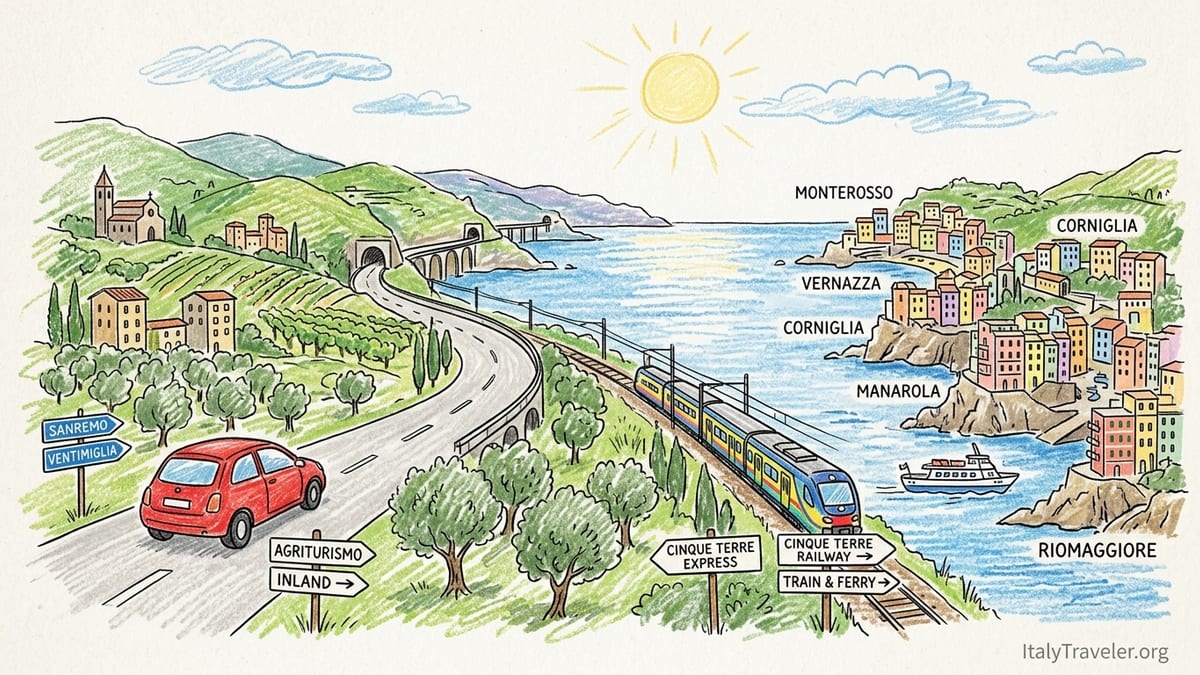
Do You Actually Need a Car on the Italian Riviera?
The Italian Riviera stretches from the French border at Ventimiglia across Liguria to La Spezia and on toward Tuscany. Parts of it are ideal driving country, especially the western Riviera and the inland valleys. Other parts, such as the Portofino Peninsula and Cinque Terre, are now better served by dense rail and ferry networks. Before locking in a rental, think about exactly where you plan to sleep and what you want to see day by day.
As of the 2026 season, Trenitalia and the Liguria region are running an expanded Cinque Terre Express regional service between La Spezia, the five villages and Levanto from mid March to early November. Trains on this line typically run about every 15 to 30 minutes in daytime hours during the main season, with extra services layered on top of the regular regional timetable. This means that for the classic village hopping between Monterosso, Vernazza, Corniglia, Manarola and Riomaggiore, a car is not just unnecessary but often a liability.
By contrast, travelers focusing on the western Riviera between Savona and Sanremo, or planning to explore vineyard-covered inland valleys such as Val Bormida or the hinterland of Albenga, will benefit far more from having a car. Public transport in these areas is thinner, especially in the evening and on Sundays, and some hill villages with agriturismi or boutique hotels are simply not reachable without your own wheels or expensive private transfers.
A practical rule of thumb is this: if your itinerary is mostly coastal resort towns on the eastern Riviera and Cinque Terre, plan around trains, buses and ferries. If you are stringing together smaller towns across the entire coast from Ventimiglia to La Spezia, or staying inland where buses are infrequent, then a car can transform what would be a complicated journey into a flexible and scenic road trip.
Where to Pick Up: Genoa Airport, Milan and Pisa
Genoa Cristoforo Colombo Airport is the most convenient car rental gateway specifically for the Ligurian coast. It is a compact airport with a small lineup of rental brands such as Europcar, Hertz, Avis and local operators, with desks inside the terminal and vehicles in adjacent lots. Because facilities are small and the supply of automatic cars is limited, booking at least several weeks ahead for late spring through early autumn is strongly recommended, particularly if you want an automatic or a larger SUV.
Milan’s airports, especially Malpensa and Linate, are common alternatives when travelers combine the Riviera with the Lakes or a broader northern Italy itinerary. Rental supply is much larger in Milan, and you will often find slightly better availability of automatic cars and a wider range of vehicle classes. The trade-off is a longer first drive: in normal conditions it takes around two and a half to three hours from Malpensa to Genoa by autostrada, plus tolls. For many visitors who are nervous about driving on the Ligurian coast itself, a smart strategy is to take a direct train from Milan to Genoa or La Spezia, then only rent a car locally for inland or western Riviera segments.
Pisa Airport is another useful entry point, particularly if you are combining Cinque Terre with Tuscany. Pisa has a dedicated rental car village connected to the terminal by a short shuttle. From Pisa, the A12 autostrada runs northwest to La Spezia and into Liguria, while slower coastal roads follow the Tyrrhenian shore. If your first days are centered on Cinque Terre, many travelers now skip driving this portion entirely, take the direct regional or Intercity train from Pisa to La Spezia, and only pick up a car later in the trip in La Spezia or back at Pisa when moving on to rural Tuscany.
One detail to consider when choosing your pickup point is whether you are comfortable driving straight from a long-haul flight. The coastal autostrade between Genoa and both France and Tuscany involve tunnels, viaducts and tight curves. If you land jet-lagged in Milan or Rome, taking a high-speed or Intercity train to Genoa or La Spezia first and starting your driving days after a night’s rest can make the whole experience feel more manageable.
Driving Realities: Tolls, ZTLs and Parking on the Riviera
The main coastal motorways in Liguria are the A10 from Genoa to Ventimiglia and the A12 east from Genoa toward La Spezia. These are toll roads, with charges based primarily on distance and vehicle class. For a typical compact rental car, travelers often find that a one-way journey such as Genoa to Sanremo costs in the ballpark of tens of euros in tolls, depending on the exact entry and exit points. Several stretches also have frequent tunnels and viaducts, which explains why driving can feel intense and why tolls are higher than on flat inland routes.
Toll booths still mostly use paper tickets: you take a ticket when entering the autostrada and pay by card or cash when you exit. Some lanes are reserved for the Telepass electronic system. As a visitor, you should avoid the yellow Telepass-only lanes unless your rental car is explicitly equipped with a Telepass device. If you accidentally drive through a Telepass lane without the device, the toll company can trace the license plate and bill the rental company, which then adds an administrative fee to your card. Given the frequency of tolls in Liguria, those fees can add up quickly.
In cities and many historic towns, the bigger concern is ZTL zones: restricted traffic areas usually in old centers where only residents and vehicles with permits can drive. Genoa, La Spezia and smaller places like Rapallo or Chiavari all have some form of restricted area. Entering a ZTL by mistake can trigger automatic camera fines that arrive months later by post via your rental company, often with extra administrative charges. Navigation apps are improving at warning about ZTLs, but you should still watch roadside signs carefully and plan to park in official garages or lots on the edge of old towns rather than trying to drive directly to your hotel door.
Parking is another major constraint, especially close to the sea. In popular Riviera towns, free street parking near the center is rare. You are more likely to find paid blue-line street bays charging by the hour, or multi-storey garages that can easily cost the equivalent of a modest hotel dinner for a single day of parking. In high summer, it is common for coastal towns like Camogli or Santa Margherita Ligure to fill all their public spaces by mid-morning, forcing late arrivals to circle uphill areas or park far from the waterfront and walk down. When you book accommodation, always check whether it includes on-site parking or a reserved space, and factor that into your choice.
Automatic vs Manual, Insurance and One-way Rentals
In Italy, manual transmission remains the default. Rental fleets in Genoa, Pisa and Milan still consist largely of manual compact and economy cars, especially in lower price categories. Automatics are widely available but tend to be mid-size or premium models and cost more per day. In peak months such as July and August, or around spring public holidays, automatic cars at Genoa Airport and La Spezia often sell out entirely for certain days, which is another reason to book early if you cannot drive a stick shift.
For the Ligurian coast specifically, a smaller car is generally more practical than a large SUV or minivan. Village streets and parking garages can be narrow and steep, with tight spiral ramps and small spaces. In places like the hills above Sestri Levante or the hinterland around Finale Ligure, you may find yourself on rural roads barely wide enough for two vehicles to pass. A compact hatchback with enough power for climbs, rather than a large luxury sedan, is usually the happiest compromise between comfort and maneuverability.
When it comes to insurance, basic packages in Italy normally include mandatory third-party liability and a collision damage waiver with a substantial excess. Many travelers opt to reduce or eliminate that excess, either by purchasing the rental company’s full coverage or by relying on a separate policy through a credit card or independent insurer. Given the combination of tight parking and busy roads on the Riviera, minor scrapes are not uncommon. Before leaving the lot, photograph all four sides of the car, the wheels and the interior, and make sure any existing marks are noted on the rental form.
One-way rentals are popular on the Riviera, for example picking up in Nice or Milan and dropping in Genoa or Pisa, or starting in Genoa and ending in Florence or Rome. Most companies allow this but charge a drop-off fee that can range from modest to significant depending on the distance between depots. Cross-border one-ways, such as from France to Italy, usually carry the highest surcharges. If you are only using a car for a few days of inland exploration, it can be cheaper to return it to the same location and continue the trip by train, rather than paying for a long one-way rental you hardly use.
Cinque Terre and the Portofino Coast: Why the Train Often Wins
The Cinque Terre and the nearby Portofino Peninsula are the two areas where first-time visitors are most tempted to drive, and also where a car is least useful. The stretch of railway between La Spezia, the five Cinque Terre villages and Levanto has been heavily prioritized for tourism. For the 2026 season, the Cinque Terre Express service runs from mid March through early November, adding frequent regional trains roughly every half hour on top of the standard timetable. In practice, this means you can step off a train in Vernazza, wander for a couple of hours, and almost always catch another train to the next village without more than a short wait.
Cars, by contrast, are largely kept away from the Cinque Terre villages. The roads that do exist are narrow and steep, and most visitors are required to park in lots well above the villages or in nearby towns like La Spezia and Levanto. On peak days in May through September, parking at popular trailheads and viewpoints can fill early in the morning. Many travelers driving into the area end up paying for all-day parking and then using the same trains or boats they could have used without a car, while worrying about return times and parking tickets.
The Portofino Coast, including Santa Margherita Ligure, Rapallo and Camogli, offers a similar picture. These towns are connected by regular regional trains and coastal buses, and Portofino itself is reached by a short bus ride, taxi boat or a seafront walk from Santa Margherita. Road access into Portofino is restricted and often congested, with limited parking at high daily rates. Leaving your car in a garage in Rapallo or Santa Margherita and moving along the coast by rail and bus is usually faster and considerably less stressful than trying to drive door to door.
A practical strategy for many itineraries is to base in La Spezia or Levanto for Cinque Terre, and in Santa Margherita Ligure or Rapallo for the Portofino area, using trains and boats for local exploration. If you also want to see inland Liguria or the western Riviera, you could schedule those days together and rent a car only for that specific segment, returning it before your Cinque Terre and Portofino stays so that you are not paying to store a vehicle you barely use.
When a Car Adds Real Value: Western Riviera and Inland Liguria
The western Riviera, from Savona through Finale Ligure, Alassio and Sanremo to Ventimiglia and the French border, is where a car most clearly pays off. This coastline is served by the A10 motorway and older coastal roads, but train service between smaller towns can be less frequent than on the eastern Riviera. If you are hopping between seaside resorts, hilltop villages and rural agriturismi, waiting for buses and regional trains can easily eat into your days. With a rental car, you can stop in places like Noli or the medieval center of Cervo for an hour or two, then move on without being tied to a timetable.
Driving also opens up inland valleys that are hard to reach otherwise. North of Albenga and Finale Ligure, winding roads climb into the Ligurian Alps, dotted with small stone villages, vineyards and chestnut forests. These are areas where public buses might only run a few times a day, if at all, and where taxis are scarce and expensive. A couple wanting to visit a remote agriturismo for a long lunch or to stay overnight in a countryside B&B will find that having their own car turns a complex, multi-stage trip into a simple 40-minute drive.
Even on the eastern Riviera, a car is useful if you plan a multi-day coast-wide road trip rather than staying put in one or two towns. For example, you might start in Genoa, drive west to Sanremo with stops in Varigotti and Finalborgo, then loop back past Savona, cross the Apennines into the Val Trebbia, and end near Piacenza or Pavia. Such itineraries, with frequent short stops and detours to viewpoints or small trattorie, would be cumbersome by public transport. The scenic Via Aurelia coastal road and lesser-known provincial roads offer viewpoints and small beaches that trains and buses simply bypass.
The key is to align your means of transport with your style of travel. If you prefer spontaneous detours, countryside lunches and quiet beaches, the flexibility of a car is hard to beat. If you mainly want to stroll historic centers, swim, and enjoy aperitivo on seafront promenades, the Riviera’s growing network of regional trains, local buses and seasonal ferries will get you almost everywhere with less expense and stress.
Practical Tips: Parking Strategies, Navigation and Seasonal Timing
Once you decide to rent, some practical habits will make driving on the Italian Riviera easier. Try to arrive in popular towns before late morning, especially from late June to early September and on sunny weekends from April onward. By lunchtime, car parks in places like Santa Margherita, Camogli or Monterosso often approach capacity. Booking accommodation with guaranteed parking, even at a nightly surcharge, is usually worth it in high season, as it saves you from hunting for a spot at the end of each day.
For navigation, use a combination of a reliable app and common sense. Major platforms now flag many ZTL zones, but coverage is not perfect and temporary restrictions for markets or festivals are not always updated. When you see a ZTL sign or a camera symbol, do not assume the app is correct if it is telling you to continue; take a detour, even if it adds a few minutes. Where possible, program public car parks or park-and-ride facilities as your destination instead of specific addresses in old towns.
Seasonality also matters. In winter, from November to early March, coastal traffic is usually lighter and parking is easier outside of holiday periods, but some smaller rental branches may reduce fleets, and ferry services are limited. In shoulder months such as April, May, late September and early October, you may find the best balance: full Cinque Terre train services, reasonable weather and fewer crowds, although weekends and public holidays can still be busy. In peak summer, the combination of heat, crowded roads and scarce parking makes using trains and boats even more appealing for the Cinque Terre and Portofino segments of your trip.
Finally, keep your fuel and toll costs realistic. Mountainous stretches and frequent tunnels increase fuel consumption compared with flat highways. If your itinerary involves multiple autostrada segments per day, the cumulative cost of tolls, fuel, parking and rental insurance can easily exceed what you would pay for a combination of regional train tickets, Cinque Terre passes and an occasional taxi. Running a rough comparison for your specific dates and route before booking a car can confirm whether driving offers real value or simply romantic appeal.
The Takeaway
On the Italian Riviera, renting a car is not an automatic must. For many travelers focusing on Cinque Terre, Portofino and a couple of larger towns like Genoa or La Spezia, the expanded 2026 Cinque Terre Express schedule and dense regional train network mean that rail, bus and boat travel are not only viable but often superior to driving. A car in those areas can sit unused in a paid garage while you move more freely without it.
A vehicle becomes genuinely useful when your plans extend beyond the main rail spine and into the western Riviera or inland Liguria. If you imagine a trip of seaside towns, hilltop villages and countryside stays spread along the coast from Ventimiglia to La Spezia, or days exploring rural valleys and small wine-producing areas, then a compact rental car picked up at Genoa Airport, Milan or Pisa can turn difficult logistics into a flexible, memorable road trip.
Ultimately, your decision should hinge on where you will sleep, how much you will move and how comfortable you are with Italian driving, tolls and ZTL rules. If in doubt, consider a hybrid approach: rely on trains and boats for Cinque Terre and the Portofino Coast, then add a short car rental segment for the parts of Liguria that still reward drivers. That way you experience the best of both worlds: the freedom of the open road where it counts, and the ease of stepping off a train straight into a cliffside village where a car can do little more than get in the way.
FAQ
Q1. Do I need a car to visit Cinque Terre in 2026?
No. With the Cinque Terre Express and regular regional trains running roughly every 15 to 30 minutes in season between La Spezia, the five villages and Levanto, most visitors are better off using trains, boats and walking paths instead of driving.
Q2. Is it better to rent a car at Genoa Airport or in the city?
For most travelers, Genoa Airport is more convenient. The rental desks are inside or next to the terminal, and you can join the motorway quickly without navigating city ZTL zones. Renting in the city may offer slightly more choice in busy periods but involves trickier driving and parking to pick up and drop off.
Q3. Are automatic cars easy to find on the Italian Riviera?
Automatics are available but limited, especially in smaller locations such as Genoa Airport or La Spezia. They usually cost more and sell out quickly in summer. If you need an automatic, book well in advance and consider picking up in a larger hub like Milan or Pisa, where fleets are bigger.
Q4. How expensive are tolls between Milan and the Riviera?
Exact costs vary by route and distance, but travelers typically spend the equivalent of several tens of euros in tolls between Milan and coastal Liguria. The more you use autostrade like the A7, A10 and A12, the more tolls add up, so plan this into your budget alongside fuel and parking.
Q5. What should I know about ZTL zones on the Riviera?
ZTL zones are restricted areas in historic centers where only vehicles with permits can enter. Cameras enforce them, and fines are issued automatically if you drive in by mistake. Genoa, La Spezia and many smaller towns have ZTLs. Always look for signs at town entrances, avoid following your GPS blindly into old centers and choose parking on the perimeter instead.
Q6. Is parking difficult in Portofino and Santa Margherita Ligure?
Yes, especially from late spring through early autumn and on weekends. Spaces are limited and daily rates are high. Many travelers leave their car in a garage in Santa Margherita or Rapallo and reach Portofino by bus, taxi boat or on foot along the coastal path.
Q7. When does it make sense to rent a car for the Italian Riviera?
A car makes the most sense if you are exploring the western Riviera, staying in inland villages, visiting rural agriturismi or planning a multi-day coast-wide road trip with frequent stops in small towns. If your plans center on Cinque Terre, Portofino and a couple of larger hubs, you can usually skip the car.
Q8. Can I do a one-way car rental between the Riviera and Tuscany or Piedmont?
Yes, most major companies allow one-way rentals between Ligurian locations like Genoa or La Spezia and cities in Tuscany or Piedmont, such as Florence, Pisa or Turin. Expect a drop-off fee, which can be modest for short distances but higher for long or cross-border routes.
Q9. Is driving on the Ligurian coast dangerous?
Driving is not inherently dangerous, but it can be demanding. Expect narrow, winding roads, many tunnels and viaducts, and local drivers who know the roads well. Taking your time, choosing a smaller car and avoiding night driving on unfamiliar coastal stretches can make the experience more comfortable.
Q10. Should I rely on trains or boats instead of a car in high season?
For Cinque Terre and the Portofino Coast, yes. In peak summer, coastal roads are crowded and parking is scarce, while trains and seasonal ferries offer frequent, direct connections between the main villages. For inland or western Riviera segments, a car can still be worthwhile even in high season if you plan carefully.