


The Italian Riviera is far more than postcard shots of Cinque Terre and Portofino. Stretching from the French border at Ventimiglia to the Tuscan fringe near Lerici, Liguria’s coastline is a continuous chain of beaches, Art Nouveau resort towns, working ports, fishing villages and terraced hillsides. For first-time visitors, it helps to understand the broader picture so you can choose the right base, move efficiently by train or boat, and discover that the famous spots are only two pieces of a much larger and surprisingly varied coast.
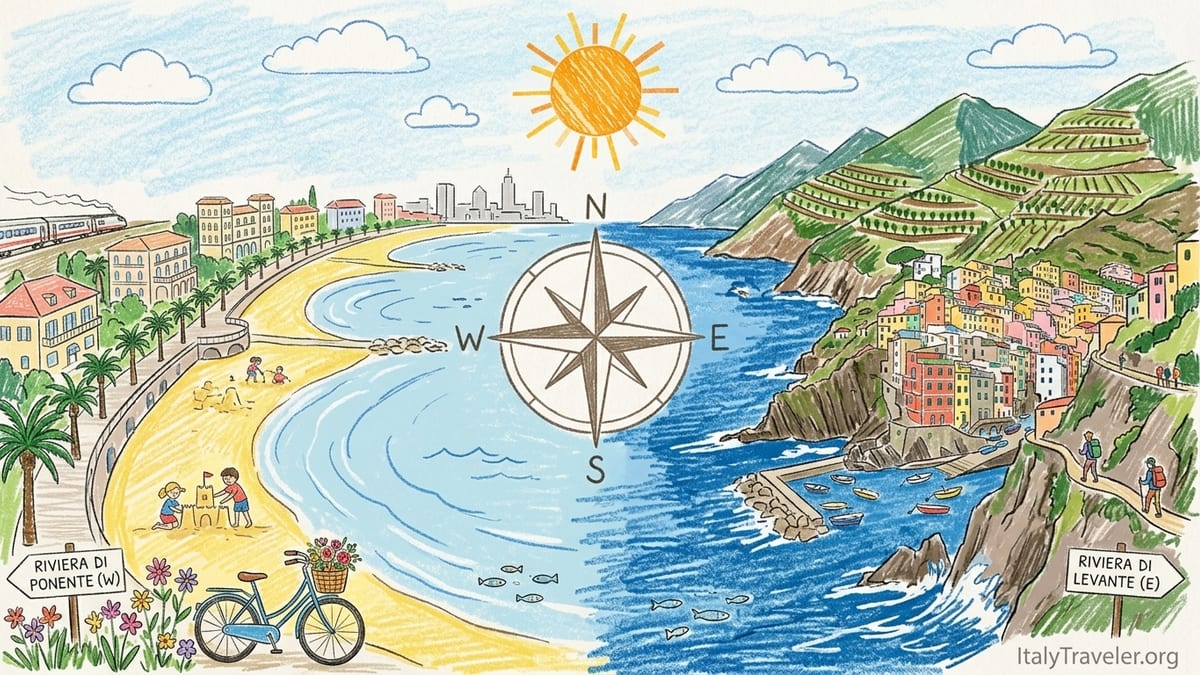
Riviera di Ponente vs Riviera di Levante: Understanding the Coast
Locals split the Ligurian shoreline into two halves, and knowing the difference is key when you plan. The Riviera di Ponente is everything west of Genoa, running from the city out past Savona, Alassio, Imperia and Sanremo to the French border at Ventimiglia. It is often called the “Riviera of Flowers” in its westernmost stretch for its historic flower cultivation and mild winter climate. Expect broader bays, more sandy beaches and classic resort towns with promenades and palm trees where Italian families return year after year.
The Riviera di Levante runs east from Genoa through Camogli, Portofino and Santa Margherita Ligure, continuing past Sestri Levante to Levanto, the Cinque Terre villages, Portovenere and finally the Gulf of La Spezia and Lerici. Here the mountains drop more steeply into the sea, creating terraced vineyards, dramatic headlands and smaller coves. Instead of long sandy crescents, you often find pebbly inlets, fishing harbors and cliffside paths. Popular walking routes such as the trails inside Cinque Terre National Park and the path from Santa Margherita to Portofino show how integrated hiking is into everyday life on the Levante side.
For a first-time visitor, it can help to think of Ponente as the better region for classic beach holidays and long, flat seafront strolls, and Levante as the more dramatic and compact side, with villages squeezed between rock and sea and hiking right from town centers. Many travelers combine a few nights on each side, for instance starting around Sanremo or Finale Ligure before moving on to Rapallo, Sestri Levante or Levanto to access Portofino and Cinque Terre.
The city of Genoa sits roughly in the middle and is part of both stories. Its western neighborhoods face the Ponente, while its eastern districts open onto the Levante. If you fly into Genoa or arrive by train from Milan or Turin, it works well as a starting point for day trips in both directions before you commit to a smaller base town.
Key Towns from Ventimiglia to Genoa: Riviera di Ponente Highlights
Ventimiglia is the first Italian town after crossing from France and a practical starting point if you arrive via Nice or the French Riviera. The regional trains that run along the coast connect Ventimiglia with all major Ponente towns and Genoa roughly hourly in each direction, and a second-class ticket to Genoa on a Regionale Veloce typically costs around 20 to 25 euros. Ventimiglia itself has a mix of pebble and coarse-sand beaches, a lively weekly market near the seafront, and a quieter medieval old town climbing the hill above the Roja river.
Just along the coast, Sanremo combines the feel of a working town with grand belle époque hotels and a famous casino. The seafront cycle path, built on an old railway line, offers a flat, car-free way to move between beaches and neighboring villages using rented bikes or e-bikes from kiosks near the station. In summer, many private beach clubs in Sanremo offer a day package that might include a sun lounger, umbrella, changing cabin and shower access for roughly 25 to 40 euros depending on the front-row position and month, while public stretches of sand or shingle remain free but more basic.
Further east, Alassio and its neighbors offer some of the Ponente’s best sandy beaches. Alassio’s wide bay is lined with tightly packed stabilimenti balneari, privately operated beach clubs where a pair of sunbeds and a shared umbrella might run 30 to 45 euros in high season but less in June or September. Families tend to like Alassio because the seabed stays shallow for a good distance and because trains from Genoa or Ventimiglia drop you within a short flat walk of the water. Inland, the small town has boutiques, gelato shops and a classic evening passeggiata under pastel arcades.
Finale Ligure, a little further toward Genoa, has become a favorite with both beachgoers and outdoor enthusiasts. Its seafront, backed by a long promenade, offers golden sand and a mix of public and private sections, while the inland hamlet of Finalborgo has stone walls, quiet squares and small restaurants that feel far removed from the resort scene just fifteen minutes’ walk away. The wider Finale area is also one of Europe’s top mountain-biking and rock-climbing hubs, so it can work well for mixed groups where some want sea days and others prefer active excursions in the surrounding hills.
From Genoa to Lerici: Riviera di Levante, Beyond Cinque Terre and Portofino
While names like Portofino and Manarola dominate social media feeds, the Riviera di Levante is dotted with dozens of other villages and small towns that share similar landscapes with fewer crowds. Genoa itself is worth at least a night or two: its lanes in the old city hide palazzi with frescoed ceilings, and its port district mixes working docks with museums and an urban waterfront. From the central stations of Genoa Piazza Principe and Genoa Brignole, regional trains fan out eastward along the coast every 20 to 40 minutes, so day trips by rail are straightforward.
Just east of the city, Camogli offers an almost vertical wall of pastel houses facing a narrow pebble beach and small harbor. In summer, you can reach it on a direct regional train from Genoa in roughly 25 minutes and step straight into the old town from the station. Camogli works well as a quieter alternative to more glamorous Portofino, with family-run hotels in the lanes above the seafront and taverns serving trofie al pesto, a local twisted pasta with basil sauce that originated in this region.
Santa Margherita Ligure and Portofino together form a compact, upscale pocket of the coast. Santa Margherita is larger and more practical as a base, with midrange hotels, a broad promenade and frequent buses and boats to Portofino. Portofino itself sits in a protected cove surrounded by wooded hills, its small harbor lined with luxury boutiques and high-end restaurants. Many visitors choose to sleep in Santa Margherita, where simple trattorie still serve affordable seafood pastas and a glass of local Vermentino wine might cost 6 to 8 euros, then visit Portofino for a half-day by boat or on foot along the scenic path from Paraggi.
Continuing east, Sestri Levante and Levanto often surprise travelers who initially focused only on Cinque Terre. Sestri is set on a narrow peninsula with two bays on either side: the main town beach and the more sheltered Baia del Silenzio, which is ringed with old houses right at the water’s edge. Levanto, one stop beyond the Cinque Terre villages on the main train line, has a long sandy beach, surf schools and a relaxed, untouristy center. Both towns provide direct access to the same train and boat lines that serve Cinque Terre, but with slightly more space and better value accommodation, especially in peak months when the five villages themselves are under heavy pressure.
Beaches, Swimming and Hiking: How the Riviera Actually Feels
On the Riviera di Ponente, much of the coastline alternates between sandy or coarse-sand bays and rocky headlands. Towns like Alassio, Pietra Ligure, Loano and Finale Ligure have long, continuous beaches, often with a promenade and parallel railway line directly behind. Travelers used to wide-open public beaches should know that in Liguria, many stretches are managed as paid beach clubs. These clubs provide sunbeds, umbrellas, changing cabins, lifeguards and sometimes kids’ play areas or small pools, while narrow slices of free public beach sit in between. A practical strategy is to use public sections for a quick swim and views, and reserve one or two full days in a beach club for comfort.
On the Riviera di Levante, beaches are generally smaller and more varied, often tucked into coves surrounded by cliffs. In Camogli, sunbathers spread out on dark pebbles beneath the colorful facades. In Monterosso al Mare, the largest of the Cinque Terre villages, a sandy strip runs along the waterfront with both public and private sections. Vernazza, Manarola and Riomaggiore have tiny harbors with concrete platforms and ladders for swimming rather than traditional beaches, while Corniglia has no direct sea access and requires a downhill walk to rocky coves. South of the five villages, Portovenere and Lerici sit at the mouth of the Gulf of La Spezia, an area known as the Gulf of Poets, where small beaches and swimming platforms look across to the islands of Palmaria and Tino.
Hiking is one of the strongest reasons to explore the Levante side. The Cinque Terre National Park maintains a network of coastal and hillside trails connecting the villages and surrounding ridges. The most famous segments between Monterosso, Vernazza and Corniglia are sometimes subject to closures after heavy rain or for maintenance, and park authorities sell a combined trail and train pass that covers the paid coastal sections and unlimited local train rides between Levanto, the five villages and La Spezia on valid days. Because conditions change, it is wise to check the park’s official updates a day or two before hiking and to have backup inland routes in mind.
Outside Cinque Terre, quieter but equally scenic paths lace the Portofino promontory and the hills behind Camogli and Sestri Levante. One well-known excursion is the hike from Camogli or Portofino to the abbey of San Fruttuoso, accessible only on foot or by boat. In summer, many visitors choose a loop, hiking one way through shaded pine forest and returning by ferry with views of the cliffs from sea level. Sturdy walking shoes, a refillable water bottle and sun protection are important, even when sections appear short on the map, because stair-like stone paths can be steep and exposed.
Trains, Boats and Driving: Getting Around the Italian Riviera
Trains are the most efficient way to travel along almost the entire Ligurian coast. A single coastal line runs from Ventimiglia through Sanremo, Imperia, Alassio, Finale Ligure, Savona and Genoa before continuing east through Rapallo, Sestri Levante, Levanto, the Cinque Terre villages and La Spezia. Regionale trains are relatively inexpensive, with short hops such as Genoa to Camogli or Santa Margherita often costing under 5 euros, and they are less affected by summer traffic than driving. On weekends and peak periods, trains can be crowded, especially between Levanto, the five Cinque Terre stations and La Spezia, so boarding early in the day or between peak commuting hours can make journeys more comfortable.
Boat services complement the trains, particularly on the Riviera di Levante. Seasonal ferries typically operate from around April or May through late September, depending on weather and sea conditions. From La Spezia and Portovenere, regular boats connect to several Cinque Terre villages and to Levanto, allowing visitors to see the terraced hills and colorful houses from the water while avoiding the congestion in the train tunnels during the busiest hours. From Rapallo and Santa Margherita, boats run to Portofino and San Fruttuoso, which can be combined with coastal walks for flexible day trips. Tickets are usually sold as single journeys or day passes, and it is common to take a boat one way and return by train.
Driving the Italian Riviera is possible but often less relaxing, especially in the Levante region. The main A10 and A12 motorways run inland, with exits that drop down to coastal towns on winding local roads. Parking in historic centers and small villages is limited and frequently paid. In Cinque Terre, most visitors are strongly advised to park in La Spezia, Levanto or Monterosso’s upper car parks and continue by train or boat, both for convenience and to reduce traffic in the fragile villages. On the Ponente side, a car can be more advantageous for exploring inland valleys, perched hill villages or multiple beach towns in a single day, but you still need to budget for daily parking fees in resort areas.
If you plan to combine several modes of transport, consider structuring your route west to east or east to west to avoid backtracking. For example, some travelers fly into Nice, take the regional train to Ventimiglia and work their way along to Genoa and La Spezia entirely by train, then depart from Pisa or Florence. Others reverse the route. In both cases you avoid returning to your entry airport and maximize time on the coast.
Ligurian Food, Pesto and Everyday Eating
Ligurian cuisine is shaped by narrow coastal plains and terraced hillsides that favor olives, herbs and vegetables over large herds or vast wheat fields. Pesto alla Genovese, the region’s most famous export, combines local basil, pine nuts, Parmigiano Reggiano, pecorino, garlic, coarse salt and extra virgin olive oil, crushed traditionally in a marble mortar. In restaurants from Genoa to Levanto, you will often see pesto served with trofie, a short twisted pasta, or with trenette, a flat long pasta similar to linguine, usually accompanied by potatoes and green beans. A plate of trofie al pesto in a midrange trattoria might cost around 12 to 16 euros, often with house wine available by the glass for a modest supplement.
Another everyday staple is focaccia, a flat oven-baked bread dimpled with olive oil and salt, sometimes topped with onions, olives or fresh herbs. In Genoa and many coastal towns, bakeries sell it by weight from early morning, and locals often order a slice and a small cappuccino at the bar for breakfast. Around Recco, east of Genoa, a specialty called focaccia di Recco is filled with fresh cheese and cooked on a thin, crispy base. It is rich, so a small portion shared between two people with a simple salad makes a satisfying lunch after a morning swim or hike.
Seafood appears on most menus along both the Ponente and Levante coasts. Common dishes include spaghetti alle vongole with small clams, fritto misto di mare with fried anchovies, calamari and shrimp, and grilled local fish served whole with lemon and olive oil. In Cinque Terre and the Gulf of Poets, cones of fried anchovies and vegetables sold from small take-away shops make a quick, affordable snack that you can carry down to the waterfront. Inland villages and Genoa’s old town also showcase vegetable-based specialties such as torta di verdura, a savory pie with chard or artichokes, and farinata, a thin, baked chickpea pancake often eaten hot with black pepper.
When choosing where to eat, you can often trust small places that list a short menu focused on local dishes and wines. Reservations are recommended in peak months, especially in smaller villages where popular trattorie might have only a handful of tables. Budget-conscious travelers can balance restaurant dinners with lighter meals built from bakery purchases, local cheese, cured meats and seasonal fruit from small grocery shops or weekly markets in towns like Ventimiglia, Sanremo and La Spezia.
The Best Bases for First-Time Visitors
Selecting a base on the Italian Riviera depends on whether you prefer sandy beaches, dramatic scenery, nightlife, or quick connections. On the Riviera di Ponente, Alassio and Finale Ligure are strong options for a first visit. Both have attractive seafronts, frequent trains, and a good range of hotels and apartment rentals. Alassio leans more toward traditional resort life with family-friendly services, while Finale Ligure offers a mix of sea and outdoor sports, along with the atmospheric inland quarter of Finalborgo. Sanremo can also work as a base if you enjoy a slightly larger city feel with more shopping streets and events.
In and around Genoa, staying in the historic center or near the Porto Antico waterfront allows you to combine city sightseeing with easy day trips east and west. From Genoa, you can reach Camogli, Santa Margherita Ligure, Rapallo and even Sestri Levante by direct train in under an hour. This makes it possible to experience different parts of the coast while returning to a single urban base with a wide range of dining and accommodation choices, from simple guesthouses in old alleys to grand hotels overlooking the harbor.
On the Riviera di Levante near Portofino, Santa Margherita Ligure is often the most practical base. It has a larger selection of midrange hotels than Portofino itself, level streets, and a train station on the main line. From here you can ride a bus or boat to Portofino, walk to the beaches at Paraggi, or continue by train to Rapallo, Chiavari and Sestri Levante for day trips. Camogli is smaller and quieter but very scenic, ideal if you like a compact, walkable base with a strong local feel and are comfortable with hilly streets and steps.
For exploring Cinque Terre and the Gulf of Poets, many first-time visitors choose either Monterosso within the five villages, Levanto just to the north, or La Spezia and Lerici to the south. Monterosso has the best beach and direct access to park trails but is often the most expensive and crowded. Levanto offers slightly lower prices, a larger beach and direct trains into all five villages. La Spezia is a working port city where accommodation can be better value, with frequent trains to the villages and boats to Portovenere. Lerici, on the opposite side of the Gulf, has a castle-topped skyline, small beaches and seasonal boat links toward Cinque Terre, making it a good choice for travelers seeking a quieter, romantic base within reach of the main sights.
Remember: Portofino and Cinque Terre Are Only Part of the Story
Social media often compresses the entire Italian Riviera into two images: Portofino’s harbor and a Cinque Terre village perched above the sea. In reality, the Ligurian coast stretches for roughly 300 kilometers, from Ventimiglia on the French border to the Gulf of La Spezia near the Tuscan limit, and includes dozens of towns and villages that rarely appear on postcards. Places like Ventimiglia, Bordighera, Diano Marina, Noli, Chiavari, Moneglia or Levanto may not trend online, yet they offer the same Mediterranean light, local food traditions and sea views with less pressure on space.
This wider perspective matters for the quality of your trip. If you plan four or five nights solely inside the tiniest, most famous villages, you might spend much of your time dealing with crowds, luggage on steps and booked-out restaurants. Spreading your stay across different parts of Liguria, or using rail-connected towns just outside the highest-demand zones, often yields a more relaxed experience. For example, staying in Finale Ligure or Alassio for pure beach days, then moving to Santa Margherita Ligure or Sestri Levante for Portofino and Cinque Terre excursions, lets you enjoy variety without long transfers.
Thinking beyond the marquee names also supports more sustainable tourism on a coastline where space is limited and infrastructure is under constant strain in summer. By adding lesser-known villages or shoulder-season travel in late April, May, late September or October, you contribute to a more balanced distribution of visitors. Ultimately, the charm of the Italian Riviera comes not from a single viewpoint or village, but from the continuous sequence of bays, headlands, gardens, stations and small harbors that connect Ventimiglia to Lerici.
The Takeaway
For first-time visitors, the Italian Riviera is easiest to enjoy when you see it as one long, varied shoreline rather than a couple of isolated hotspots. The Riviera di Ponente offers classic resort towns with wide beaches and palm-lined promenades, while the Riviera di Levante features steeper terrain, terraced villages and famous hiking routes. Trains knit the entire coast together, seasonal boats add scenic options between key towns, and driving works best if you accept limited parking and choose your targets carefully.
Good planning means picking one or two bases that match your style, whether that is an easygoing beach town like Alassio, an outdoor hub like Finale Ligure, a city break in Genoa, or a strategic base such as Santa Margherita, Sestri Levante, Levanto, La Spezia or Lerici for Portofino and Cinque Terre. Along the way you will eat pesto where it was invented, snack on focaccia warm from the oven, and swim in coves framed by pines and pastel houses. Cinque Terre and Portofino deserve their fame, but they are chapters in a much longer story. With a bit of curiosity and a train timetable, you can trace that story from Ventimiglia to the Gulf of Poets and find your own corner of the Ligurian sea.
FAQ
Q1. When is the best time to visit the Italian Riviera for a first trip?
The most comfortable months are usually late April to early June and mid September to October, when temperatures are mild, sea conditions are good for boat trips, and crowds are thinner than in July and August. High summer offers the warmest swimming but also the busiest trains, beaches and villages.
Q2. How many days do I need to see both Portofino and Cinque Terre?
Allow at least three full days if you want to visit Portofino, explore two or three Cinque Terre villages, and still have time for a boat ride or short hike. With five or more days, you can slow down, add nearby towns like Camogli or Levanto, and avoid rushing between viewpoints.
Q3. Is it better to stay inside Cinque Terre or in a nearby town?
Staying inside Cinque Terre, for example in Monterosso or Vernazza, gives strong atmosphere but higher prices and more steps with luggage. Bases like Levanto or La Spezia usually provide better value, easier station access and more services, while still putting you 10 to 20 minutes by train from the villages.
Q4. Do I need a car on the Italian Riviera?
No, a car is not essential for most first-time itineraries. The coastal train line makes it easy to move between major towns, and boats cover many popular stretches on the Levante. A car can help for inland day trips in the Ponente region, but parking in small coastal villages is limited and often paid.
Q5. How expensive are beach clubs compared to free beaches?
Free public beaches cost nothing but usually lack services. Private beach clubs charge for sunbeds and umbrellas, which in popular towns might run from about 25 euros per day for a basic pair in shoulder season to over 40 euros for front-row spots in high summer. In return you get showers, changing rooms and more space.
Q6. Can I visit Cinque Terre and Portofino in one day from Florence?
It is technically possible with a very long day involving early trains and tight connections, but it is not recommended. You would see only a few crowded streets in each place. For a better experience, base yourself for at least one or two nights on the Ligurian coast and focus on one area at a time.
Q7. What is the easiest town for travelers with limited mobility?
Among the coastal options, Monterosso in Cinque Terre, Alassio, Finale Ligure and Santa Margherita Ligure are relatively flat near the seafront and close to their train stations. Many other villages, especially in Cinque Terre, involve steep lanes and numerous stairs, so checking hotel access carefully before booking is important.
Q8. How do I buy train and boat tickets along the coast?
Train tickets can be purchased from ticket machines and staffed counters at stations, or via the main national railway app. Regional tickets usually require validation in a machine before boarding, unless they are for a specific train and time. Boat tickets are sold at harbor kiosks in each town, sometimes with the option to buy same day open passes for hop on hop off travel.
Q9. Is swimming safe everywhere on the Italian Riviera?
Water quality is generally good, and many beaches meet strict European standards. That said, always follow local advice, respect red flag warnings, and be careful around rocky entries or strong swells, especially near harbor mouths or cliff bases. Only swim from authorized spots and keep an eye on changing sea conditions.
Q10. What should I pack for a Ligurian coastal trip?
Pack light, breathable clothing, a swimsuit, sturdy walking shoes or sandals with grip, a hat and high-factor sunscreen. A small daypack, reusable water bottle and a light layer for cooler evenings are useful. If you plan to hike, consider trekking poles and a compact rain jacket, as coastal weather can change quickly even on warm days.