

Choosing where to base yourself on the Italian Riviera can shape your whole trip. In 2026, Liguria divides naturally into two classic holiday zones: the western resorts around Sanremo and Alassio, and the eastern corridor from Portofino through Cinque Terre to the Gulf of Poets. Each hub offers a very different mix of beach time, transport convenience, nightlife and day-trip potential. This guide walks through the main options so you can pick the base that fits how you actually want to travel.
How to Choose Your Base on the Italian Riviera
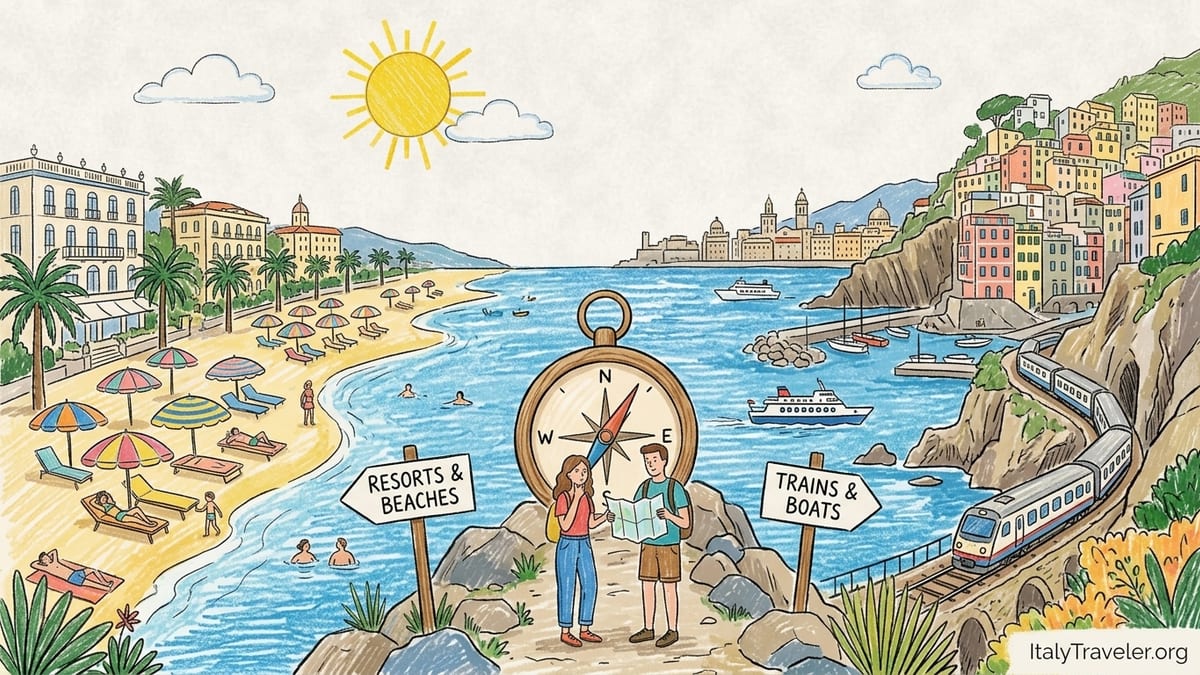
On the western side, Sanremo and Alassio still feel like traditional Italian seaside resorts, with long strands of sand or shingle, private beach clubs and a summer season that peaks in July and August. This is where you book a lounger for several days in a row, wander the promenade at sunset and dip into cafés and gelato bars without worrying too much about timetables. Typical double rooms in mid-range hotels in 2026 run in the ballpark of 120 to 220 euros per night in high season, with sea-view four and five star properties climbing higher.
The eastern side, roughly from Genoa to La Spezia, works better if you want to use trains and boats to explore. Santa Margherita Ligure and Rapallo are natural bases for Portofino and the Tigullio Gulf, with regular ferries connecting the resorts. Sestri Levante and Levanto sit directly on the main Genoa to La Spezia railway line, so you can hop regional trains to Cinque Terre villages or back towards Genoa in under an hour in many cases. Expect broadly similar hotel prices to the western resorts, though small guesthouses a street or two inland can still fall closer to 90 to 130 euros in shoulder seasons.
Parking and road access are another major dividing line. Larger towns such as Genoa, Sanremo, Rapallo and Sestri Levante have paid garages and more street parking, though summer weekends are always tight. In compact bays like Portofino and Portovenere, parking is limited and often expensive, and staying in a hotel with a reserved garage space can be a decisive advantage. If you plan to arrive by car in July or August, it is worth checking in advance whether your chosen hotel offers on-site or partner parking and what the nightly supplement will be.
Finally, think honestly about how many day trips you will take. Travelers often imagine daily excursions to Cinque Terre or Portofino but find themselves happier repeating a favorite beach. If your priority is that simple beach holiday, Sanremo or Alassio may make more sense. If you are keen to see several different coastal towns, hike, and move around by train and boat, the Portofino to Cinque Terre corridor is usually the smarter base.
Sanremo vs Alassio: Classic Riviera Beach Holiday
Sanremo remains one of Liguria’s best known resort towns, with a broad seafront, historic casino and a string of beach hotels facing the Lungomare. In 2026, many mid-range beachfront properties quote summer weekend rates equivalent to roughly 180 to 260 euros per night for a double room, with simpler inland options sometimes closer to 90 to 130 euros, especially midweek outside August. Sanremo’s beaches are a mix of sand and fine shingle, divided into stabilimenti balneari, private beach clubs where a daily package typically covers sunbed, umbrella, changing cabin and showers.
The atmosphere in Sanremo suits travelers who enjoy some bustle. The old town, known as La Pigna, climbs the hill behind the seafront and offers tightly packed lanes, little bars and restaurants serving classic Ligurian dishes like trenette al pesto and fried anchovies. Nightlife centers on seafront bars and the casino area, with live music and later opening hours in high summer and during major events. The town is also a useful transport hub: regional and InterCity trains connect to Ventimiglia and the French border in one direction and towards Genoa in the other, which makes day trips along the coast straightforward without a car.
Alassio, about an hour east by regional train from Sanremo, generally has a more relaxed, family-oriented mood. Its long, mostly sandy beach is one of the best in Liguria for travelers who dislike pebbles, and much of the waterfront is lined with mid-rise hotels and private lidos. Prices in peak summer are broadly comparable to Sanremo for similar category hotels, but beach services can feel better value because of the broad, flat strand. If you plan a week of swimming and renting kayaks or pedal boats, Alassio is an easy base where everything is a short walk from the promenade.
For a traditional beach holiday, the choice between the two often comes down to whether you prefer a slightly grander, more urban backdrop with events and nightlife, or a smaller town with a more unified focus on the beach. Sanremo gives you more choice of restaurants and evening strolls through the shopping streets, while Alassio leans towards days that revolve almost entirely around the sea. Train access from both towns is good, but they sit far from the Cinque Terre and Portofino area, so you would not normally use them as a base for that part of the coast.
Genoa: Culture Hub and Transport Powerhouse
Genoa is less of a resort and more of a working port city, but it makes an excellent base if you value museums, food and direct long-distance connections over immediate beach access. The historic center, one of the largest medieval quarters in Europe, is packed with palace museums, churches and narrow lanes that open onto busy piazzas. You can spend a full day touring the Palazzi dei Rolli and another exploring the Porto Antico waterfront area with its aquarium and maritime attractions.
Accommodation in Genoa tends to be better value than small resort towns during the height of summer. It is not unusual to find good central three star hotels in the approximate range of 100 to 160 euros per night in busy periods, with business-oriented four star properties sometimes offering competitive weekend rates when corporate demand is lower. Neighborhoods around Brignole and Principe stations give especially easy train access but can be busy with traffic, while the Carignano and Castelletto hills offer quieter residential streets and panoramic views, balanced with the need to navigate lifts or funiculars.
From a transport perspective, Genoa is one of the most connected places you can choose. The mainline running along the Ligurian coast passes through the city, so direct regional trains head west towards Savona and Sanremo and east towards Rapallo, Sestri Levante, Levanto and La Spezia. High speed and InterCity services link Genoa with Milan, Turin and, via Pisa, with Florence and Rome. For day trips, this means you can reach Santa Margherita Ligure in roughly an hour on regular regional services and continue on to towns like Sestri Levante or Levanto with a simple connection if needed.
The trade off is that Genoa is not a classic beach town. There are small urban beaches at Boccadasse and along the Corso Italia, plus lidos in suburbs like Nervi or Pegli, but they are not as expansive or resort-focused as Alassio or Sanremo. Nightlife is lively in the centro storico and Porto Antico, with late closing times for bars and a broad choice of trattorie and seafood restaurants. If you want a cultural city with strong rail connections, Genoa works very well as a hub, but if you imagine waking up to a wide sandy beach directly in front of your hotel, you may be happier spending most nights elsewhere and visiting Genoa as a day trip.
Santa Margherita Ligure and Rapallo: Gateways to Portofino
Santa Margherita Ligure and Rapallo sit on the same deep blue gulf, a short train ride apart and connected by frequent ferries that also run to Portofino and, in season, to San Fruttuoso and other coves. Santa Margherita is slightly more upscale, with elegant waterfront hotels, yacht-lined quays and boutique shopping streets. Rapallo is bigger and a bit more workaday, with a long seafront promenade, castle on the water and a wide choice of mid-range accommodation that often comes in slightly cheaper than Santa Margherita.
Hotel prices in both towns rise sharply in high summer and during weekends in May, June and September. A well-located three star or simple four star hotel in Santa Margherita might commonly price around 180 to 260 euros per night in July and August for a double room, with Rapallo sometimes undercutting that by 20 to 40 euros for comparable comfort. Many waterfront hotels have private sections of beach or agreements with nearby lidos, but the coastline here is mostly narrow and pebbly, so the real attraction is access to the surrounding bays rather than wide sandy beaches.
Boat services are one of the main reasons to base here. In season, ferries typically run every day linking Santa Margherita, Rapallo and Portofino, with extra routes to abbeys and coves along the Portofino promontory. Fares for a simple return trip to Portofino are modest by Italian resort standards and turn what could be a crowded, winding bus ride into a scenic cruise past villas and pine-covered cliffs. That convenience is particularly valuable in summer when roads are slow and parking spaces in Portofino itself are extremely limited and expensive.
Both towns also work well for eating and evenings. Santa Margherita offers wine bars and seafront restaurants that fill with smart weekending Italians, while Rapallo has a broad choice of family-run trattorie on side streets behind the promenade. Nightlife is more about long dinners and leisurely passeggiate than late-night clubs, though in July and August there are often temporary beach bars and occasional events. For travelers focused on exploring Portofino and the surrounding headland without worrying about parking, Santa Margherita or Rapallo are arguably the most convenient bases.
Sestri Levante: Beach Resort With Village Atmosphere
Sestri Levante sits on a promontory between two bays, the more famous being the Baia del Silenzio, a remarkably sheltered curve of sand backed by pastel houses. The combination of a real working town, charming old streets and proper beaches has made Sestri Levante increasingly popular with travelers who want a beach holiday that still feels rooted in local life rather than entirely oriented to tourism. Compared with Portofino or the tight Cinque Terre villages, there is more everyday infrastructure here, from supermarkets and bakeries to a range of accommodation categories.
The town’s main station sits directly on the Genoa to La Spezia line and functions as both a terminus and through stop for regional services. That means regular trains to Genoa and Savona in one direction and to the Cinque Terre area and La Spezia in the other. Frequent regional trains make journeys of under an hour common to towns like Santa Margherita Ligure to the northwest and Levanto to the southeast, which is a practical advantage if you want to mix beach days with exploratory trips up and down the coast.
Accommodation runs from small B&Bs and apartments to more formal hotels on or near the seafront. In 2026, it is common to see mid-range rooms listing around 140 to 220 euros per night in high summer, with more modest prices in late spring and early autumn. The Baia del Silenzio is largely lined with private beach clubs in season, where a pair of sunbeds and an umbrella can easily reach a daily cost that is comparable with other well-known Italian seaside resorts, especially in August. However, the combination of this bay with the slightly larger Baia delle Favole means you have more space to spread out than in the compact coves of Cinque Terre.
For evenings, Sestri Levante has a classic Riviera mix: ice cream and aperitivo bars crowded along pedestrian streets, seafood restaurants around the peninsula, and family-friendly promenades where locals and visitors stroll after dinner. Nightlife is moderate rather than intense; it is a place where you will hear children playing late into the evening, more than thumping club music. If you want a base that balances a proper beach holiday with the ability to jump on a train to Cinque Terre or Portofino for the day, Sestri Levante is one of the most versatile choices.
Levanto: Gateway to Cinque Terre
Levanto sits just outside the official Cinque Terre National Park but feels closely connected to it. The town has a wide, mostly sandy main beach that is popular with families and, outside the calmest months, with surfers attracted by the shape of the bay. The seafront is backed by a pedestrian promenade and low-rise hotels and apartments, while the compact old center sits slightly inland. This gives Levanto a different feel from the tighter, cliff-hugging Cinque Terre villages and makes it easier to find accommodation with more space at slightly gentler prices.
Levanto station is on the main Genoa to Pisa line and serves as the western limit of the frequent Cinque Terre Express regional services in season. From roughly spring through early autumn, those local trains typically run about every 30 minutes between Levanto and La Spezia, stopping at all the Cinque Terre villages. A simple one-way ticket between towns on this stretch often falls in the approximate 5 to 10 euro range for adults depending on the time of year and type of ticket, while park passes combine unlimited train travel with access to key hiking trails.
Accommodation in Levanto in 2026 covers a broad spectrum, from simple guesthouses in townhouses and farm-style agriturismi on the hillsides to beach-facing hotels. High season prices are usually somewhat lower than in the five villages themselves for similar comfort, especially for larger rooms and properties with parking. This makes Levanto attractive for visitors arriving by car: there are public parking areas and more hotels with on-site or reserved spaces than in the compact Cinque Terre towns, though midsummer can still be tight and paid daily rates are common.
Boat services complement the trains. In season, ferries run from Levanto to some or all of the Cinque Terre villages and sometimes onward towards Portovenere or other nearby ports, giving you the classic postcard views of the pastel cliffside houses from the water. On days when the sea is calm, combining a morning train to hike between villages with an afternoon return by boat is a memorable way to experience the coastline. For travelers primarily focused on Cinque Terre but looking for a slightly quieter, better connected and more spacious base, Levanto is one of the most practical choices.
Portovenere and Lerici: The Gulf of Poets
At the southeastern end of the Ligurian coast, beyond the Cinque Terre, the Gulf of Poets curves around a sheltered bay framed by Portovenere on one side and Lerici on the other. Portovenere is a compact, photogenic village with a fortified church on its headland and tall houses lining a narrow harbor. Lerici is larger, unfolding around a deep bay dominated by a castle and a long promenade. Both serve as gateways to boat trips across the gulf and up towards the Cinque Terre, but each offers a different kind of stay.
Portovenere’s old core is pedestrian and parking is limited, which is part of its charm but also its challenge. Streets are narrow and set on a slope, and non-resident parking outside the historic center fills quickly in high season. A handful of hotels and guesthouses offer private garage spaces or reserved spots, often highlighting this clearly in their descriptions because of the scarcity. If you plan to arrive by car, booking a place that specifies parking arrangements can save a lot of stress, even if it adds a noticeable nightly supplement to your overall bill.
Lerici, on the opposite side of the bay, spreads more widely and has better overall road access. Several hotels sit on hillsides above the town, with on-site parking and elevator or shuttle access down to the seafront. From the promenade, public ferries cross the gulf to Portovenere and, in season, continue on day cruises towards the Cinque Terre. Accommodation prices in both towns rise during summer and on Italian holiday weekends; a mid-range hotel room will often fall somewhere between 150 and 250 euros per night in peak periods, though shoulder season deals are easier to find, particularly in Lerici where there is a larger volume of rooms.
Beaches around the Gulf of Poets are a mix of small sandy coves and pebbly stretches, often organized into beach clubs with rental sunbeds and umbrellas. Lerici and nearby San Terenzo have some of the more accessible sandy patches, making them good choices for families. Portovenere’s charm lies more in its dramatic rocky headlands and views across to the islands than in conventional sunbathing, though there are bathing platforms and small beaches on the road into town. Evenings in both places center on waterfront restaurants and wine bars, with a gentle, romantic atmosphere that suits couples and relaxed groups rather than party seekers.
The Takeaway
The Italian Riviera is compact on a map but varied in mood. If you imagine a classic, almost nostalgic beach holiday of sand, sunbeds and evening promenades, Sanremo or Alassio on the western side are strong candidates. If your dream is boats to Portofino, train hops through Cinque Terre and evenings in harborside restaurants, you will be better served somewhere along the eastern corridor from Santa Margherita and Rapallo through Sestri Levante and Levanto to the Gulf of Poets.
In practical terms, choosing your base comes down to a few key questions. How often will you realistically move around, and do you prefer trains and boats or a rental car. Are you willing to pay a premium for a sea view and private lido, or would you rather trade a block or two from the water for better prices and easier parking. Do you want late-night bustle or a quieter, village-like feel.
For culture and rail convenience combined, Genoa deserves more attention as a hub than many travelers give it. For Portofino, Santa Margherita Ligure and Rapallo are clear winners. For a beach village with its own life plus good rail links, Sestri Levante is hard to beat. If Cinque Terre is your focus but you prefer more space, Levanto is an excellent compromise. And for a romantic, slightly quieter finale to a Ligurian journey, the Gulf of Poets around Portovenere and Lerici offers exactly the blend of scenery and boat access that its name suggests.
FAQ
Q1. Is it better to stay in Sanremo or Alassio for a classic beach holiday.
Sanremo offers a livelier town, casino and more nightlife, while Alassio has one of Liguria’s best sandy beaches and a calmer, family-focused atmosphere. For events and evening buzz, Sanremo usually wins; for long sandy days with everything close together, Alassio is often the easier choice.
Q2. Is Genoa a good base for visiting Portofino and Cinque Terre.
Genoa is an excellent rail hub and cultural city, and you can reach Santa Margherita Ligure or Rapallo by direct regional train in roughly an hour, then connect onward to Portofino by boat or bus. Day trips to Cinque Terre are also possible, but journey times are longer than from bases closer to the park, so Genoa suits travelers who want a city experience more than a pure seaside holiday.
Q3. Should I stay in Santa Margherita Ligure or Rapallo to explore Portofino.
Santa Margherita is smaller and more upscale, with stylish waterfront hotels and a polished feel, while Rapallo is larger and usually a bit more affordable. Both have frequent boats and buses to Portofino, so the choice often comes down to budget and whether you prefer a chic resort vibe or a slightly more everyday town with a wider spread of mid-range hotels.
Q4. Is Sestri Levante a good base if I want both beaches and easy day trips.
Yes. Sestri Levante has two attractive bays, a real local community and a station on the main Genoa to La Spezia line. That makes it simple to mix relaxed beach days with train trips to towns like Santa Margherita, Levanto or the Cinque Terre villages, without sacrificing the feel of a genuine coastal town.
Q5. Why do many people recommend Levanto instead of staying inside Cinque Terre.
Levanto has a wider beach, more space and generally easier parking than the compact Cinque Terre villages, while still being directly connected to them by frequent trains and seasonal boats. Accommodation can be better value for larger rooms or families, and the town has more everyday services, which makes it a comfortable base for several nights.
Q6. How expensive are hotels on the Italian Riviera in 2026.
Prices vary by town and season, but in busy summer months many mid-range hotels in popular resorts fall roughly between 140 and 250 euros per night for a double room. Simple guesthouses and B&Bs a few streets back from the sea can be lower, especially in shoulder seasons, while premium sea-view hotels in destinations like Portofino or Portovenere can be considerably higher.
Q7. Is it worth renting a car, or can I rely on trains and boats.
The eastern Riviera from Genoa to La Spezia is well served by regional trains and seasonal boats, so many travelers manage happily without a car, especially if they stay near a station. A car can still be useful for exploring inland villages or the western Riviera around Sanremo and Alassio, but parking in small bays like Portofino or Portovenere is limited and often costly, so it is important to factor that into your plans.
Q8. Where is parking easiest along the Italian Riviera.
Larger towns such as Genoa, Rapallo, Sestri Levante, Levanto and Sanremo tend to have more garages and public parking, though they can still be busy in peak season. In smaller, more compact places like Portofino and Portovenere, parking is scarce, so booking accommodation that offers a reserved garage or dedicated spaces can make a big difference, even if you pay a nightly supplement.
Q9. Which base is best if my priority is nightlife.
Sanremo and Genoa offer the most varied nightlife, with bars, events and late openings, especially in summer. Santa Margherita Ligure and Rapallo have lively evenings focused on aperitivo and long dinners rather than clubs, while Sestri Levante, Levanto and the Gulf of Poets are generally quieter and better suited to relaxed nights by the sea.
Q10. How far in advance should I book accommodation on the Italian Riviera.
For stays in July and August, or around major Italian holidays, booking several months ahead is sensible, especially for sea-view rooms, parking-inclusive hotels or popular small B&Bs. In shoulder seasons like May, June, September and early October you can sometimes book closer to arrival, but the best located and best value options still tend to go first, particularly in towns that serve as gateways to Portofino or Cinque Terre.