


Few travel decisions tie people in knots like choosing between the Italian Riviera and the Amalfi Coast. Both deliver pastel towns, plunging cliffs and days that revolve around swims, long lunches and golden-hour aperitivo. Yet they offer very different experiences once you look past the postcard views. This guide compares Cinque Terre and Portofino with Positano, Amalfi and Ravello, then zooms out to beaches, transport, budgets and trip style so you can match the right coast to your own Italian itinerary.
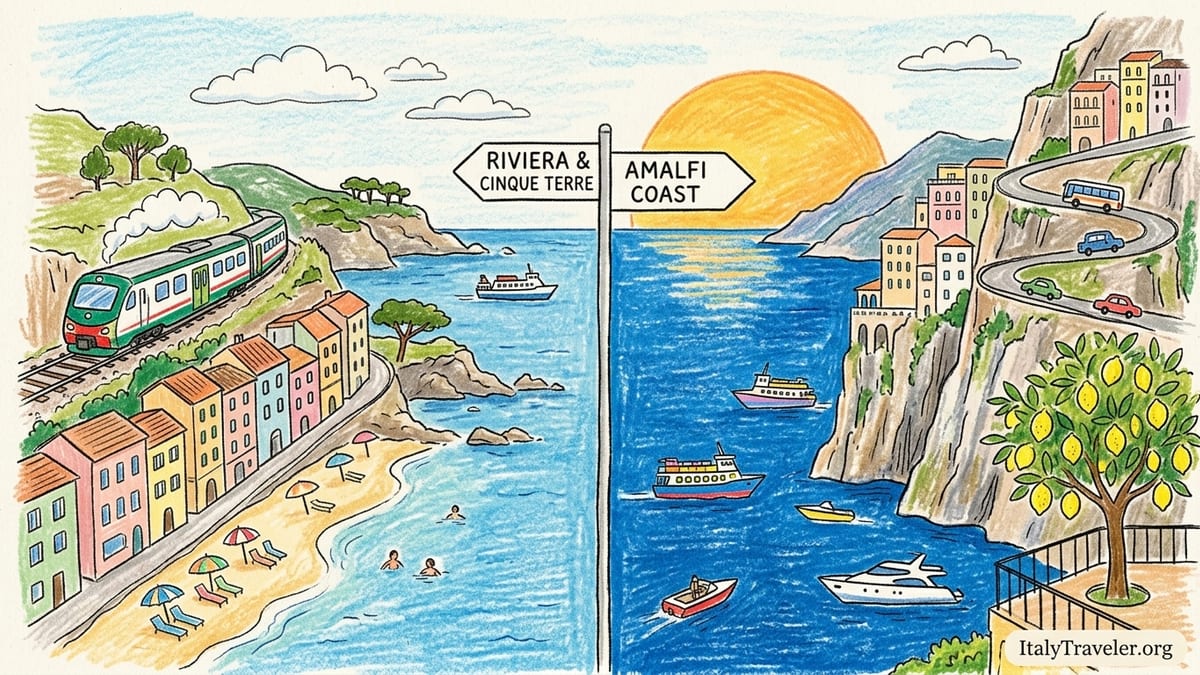
Big Picture: Two Coasts, Two Very Different Trip Styles
The Italian Riviera stretches for roughly 300 kilometers along Liguria from the French border past Sanremo, Finale Ligure and Genoa to the Cinque Terre and beyond. It is a long, varied coastline where working port cities, classic 19th century beach resorts and quiet fishing villages share the same rail line. You might spend the morning on a sandy beach in Alassio, the afternoon wandering Genoa’s medieval alleys, and the next day hiking between Cinque Terre villages without ever renting a car.
The Amalfi Coast, by contrast, is a compact, intensely dramatic strip of cliffs south of Naples, from just beyond Sorrento through Positano and Amalfi to Vietri sul Mare, plus hill towns like Ravello and the offshore islands of Capri and Ischia. The coast itself is only about 50 kilometers long, but it feels dense: hairpin roads, vertical villages and viewpoints at every bend. You are unlikely to “pass through” Amalfi by accident; most travelers build their whole stay around this one stretch of coast.
In simple terms, the Italian Riviera is better if you want variety, trains, and more conventional beach towns alongside Cinque Terre and Portofino. The Amalfi Coast is better if your dream is a concentrated cliff-coast experience: one or two base towns, boats instead of trains, glamorous hotels and long dinners overlooking the sea.
For a one-week Italy trip that already includes Florence or Milan, the Riviera often slots in more easily: fast trains run from those cities to La Spezia and Genoa in a few hours. For an itinerary built around Rome, Naples or Pompeii, the Amalfi Coast is a more natural spin-off, with frequent ferries and buses from Naples, Salerno and Sorrento.
Cities & Villages: Cinque Terre & Portofino vs Positano, Amalfi & Ravello
Cinque Terre is a compact string of five villages between Levanto and La Spezia, each with a distinct feel. Monterosso is the largest and flattest, with a real beach, promenade and the most hotel choice. Vernazza and Manarola are the classic postcard harbors, where small fishing boats sit on the slipway and bar terraces cling to the rocks. Corniglia perches higher on a headland, reached by a long stair or shuttle bus from its station. Riomaggiore feels the most lived-in, with steep streets, small grocery shops and twilight swims from the rocky harbor.
Portofino sits to the northwest, an easy day trip from Santa Margherita Ligure or Rapallo by boat or local bus. Here the experience tips firmly toward luxury: polished yachts in the harbor, designer boutiques under pastel facades, and hotel terraces where cocktails can easily run into double-digit euro prices. You can hike from Santa Margherita through forested headlands into Portofino in about 90 minutes and then take a boat back, combining scenery with a taste of the jet-set setting without paying to stay there.
On the Amalfi Coast, Positano is the headline act. It is a steep amphitheater of houses cascading down to two shingle beaches, lined with beach clubs and boat kiosks. Most visitors stay high above the main road and walk down long stairways to the water. A room with a balcony that looks over the town and sea commands some of the highest coastal hotel rates in Italy, especially from late May to September, and availability for popular midrange hotels can disappear months in advance.
Amalfi itself feels more like a small working town, with a central piazza, a cathedral rising above the square and ferries shuttling constantly in and out of the harbor. Hotel prices are still high in summer but often a notch below Positano, and it is a practical transport hub for ferries and SITA buses. Ravello, set high above Amalfi, is different again: quiet streets, gardens and villas such as Villa Cimbrone and Villa Rufolo, and a cooler, calmer atmosphere. Many travelers doing a short stay on the coast split their time as two or three nights in Positano or Amalfi for beach and boats, plus a night in Ravello for views and serenity.
Beaches, Swimming & Sea Time
If long days on an actual beach are a priority, the Italian Riviera has the edge. Monterosso in Cinque Terre has the largest and most practical beach in the UNESCO-protected zone, with public areas plus bagni where you can rent loungers and umbrellas for a fee that in high summer often starts around a few dozen euros for two beds and a parasol. Beyond Cinque Terre, west of Genoa, towns like Finale Ligure, Pietra Ligure, Alassio and Varigotti are essentially beach resorts: wide sandy or mixed-sand beaches fronting the main promenade, rows of sunbeds, beach bars and family-friendly shallows.
Swimming in Cinque Terre itself is more about coves and harbors. Vernazza has a small sandy cove inside the harbor wall. Manarola and Riomaggiore attract cliff jumpers and snorkelers in calm conditions, entering the sea from ladders bolted to the rocks. Water quality is often excellent in clear weather, but facilities are basic: rock platforms instead of loungers, and you will be climbing stairs back to the village afterwards. In shoulder seasons like late May or late September, you might share an evening swim in Manarola with just a handful of locals.
The Amalfi Coast’s beaches are mostly narrow strips of dark pebbles or coarse sand set directly below town centers or under cliffs. Positano has two main beaches: Spiaggia Grande, lined with bars, boat kiosks and private beach clubs, and the smaller Fornillo, ten minutes’ walk along a coastal path. Expect to pay a premium for front-row sunbeds at Spiaggia Grande in peak months. Amalfi’s beach is right beside the ferry pier and busy with day-trippers, but smaller coves such as Atrani, Marina di Praia near Praiano or Gavitella Bay offer more atmospheric swims, sometimes accessible via long staircases or shuttle boats from town.
For the most purely beach-focused Amalfi trip, many travelers actually base in nearby towns like Maiori, Minori or even Salerno. These offer longer stretches of beach, more local life and lower prices, with easy boat or bus day trips to Positano and Amalfi. It is a pattern that mirrors the Riviera, where people often sleep in midrange towns such as Levanto or Santa Margherita Ligure and then day trip to Cinque Terre or Portofino for the views.
Trains, Boats & Driving: How Easy Is It to Get Around?
The single biggest practical difference between these coasts is rail transport. The Italian Riviera is threaded by the Genoa–Ventimiglia railway, which hugs the shoreline and serves almost every coastal town. Regional trains connect Genoa to resort towns like Santa Margherita Ligure, Rapallo, Sestri Levante and Finale Ligure, as well as La Spezia and the Cinque Terre stations at Monterosso, Vernazza, Corniglia, Manarola and Riomaggiore. For travelers, this means that hopping between villages often takes only 5 to 15 minutes by train, and you can cover dozens of kilometers of coastline in under an hour without touching a car.
Within Cinque Terre, a dedicated regional train shuttle runs roughly every 20 to 30 minutes in high season between La Spezia and Levanto, stopping in all five villages. Many visitors buy a Cinque Terre Card that bundles trail access with unlimited use of these regional trains for a day or more. Ferries also run in the warmer months, linking Levanto, the five villages (except Corniglia, which lacks a harbor) and Portovenere. In practice, most travelers use trains as their default, ferries when the sea is calm and for scenic variety, and hiking trails when the weather is not too hot.
The Amalfi Coast has no train line running along the cliffs between Positano, Amalfi and Ravello. Instead, public transport relies on SITA buses and coastal ferries. Buses cover routes such as Sorrento to Amalfi and Amalfi to Ravello and neighboring villages. They are affordable and generally reliable, but in peak summer they can be crowded, and standing for 45 minutes on a winding coastal road is common. Ferries from late spring to early autumn link key coastal towns and often provide the quickest way to move between Positano, Amalfi and Salerno or Sorrento, subject to sea conditions. On choppy days, services are reduced or canceled at short notice.
Driving on the Amalfi Coast’s SS163 road can look romantic in photos, but in reality it is stressful for most visitors: narrow lanes, tour buses taking the full width of blind curves, limited parking and seasonal restrictions on private cars. Many travelers who rent a car in Italy choose to park it in Sorrento or Salerno and rely on boats, buses and private transfers on the actual coast. By contrast, driving on the Italian Riviera is still coastal and occasionally busy but generally less nerve-racking, particularly west of Genoa where the coast alternates with short highway tunnels, and parking in medium-size resorts is easier to arrange in advance.
Hiking, Views & Outdoor Activities
If you imagine your Italian coastal days anchored by hiking, both coasts deliver but in slightly different styles. Cinque Terre is built around one of Italy’s best-known trail networks, a web of paths linking the five villages and their terraces. The famous Sentiero Azzurro, or Blue Trail, runs close to the coast, connecting the villages with generally moderate walks of a couple of hours each. Higher routes climb to sanctuaries and ridgelines with bigger views and fewer crowds. Trail closures due to maintenance, weather or landslides are common, so checking official updates in La Spezia or village information offices before you set out is part of the routine.
On the wider Riviera, you can combine coastal walking with headland paths near Portofino, trails above Camogli and San Fruttuoso or easier promenades in resort towns. A typical hiking day might involve catching a morning train from Genoa to Camogli, hiking into Portofino Natural Park, stopping for a swim at San Fruttuoso’s tiny cove, then taking a boat to Portofino and a local train back to your base.
The Amalfi Coast’s marquee hike is the Path of the Gods between Bomerano and Nocelle, high above the sea between Amalfi and Positano. On a clear day, the views stretch toward Capri. The walk itself takes around two to three hours at a moderate pace, but getting to and from the start and end points involves buses, taxis or long stair descents into Positano. Other routes climb from Amalfi up through terraced lemon groves toward Ravello or inland hamlets. The landscape feels steeper and more vertical than Cinque Terre, with villages clinging to ridges and many walks ending or starting with long flights of stone steps.
Beyond hiking, both coasts offer boat tours, kayaking, snorkeling and sailing. On the Riviera, you might rent a kayak from Monterosso for an hour to explore sea caves and the base of the cliffs, or join a sunset cruise from Riomaggiore. On the Amalfi Coast, common day trips include small-boat excursions from Positano or Amalfi to hidden coves, sea grottoes and Capri, often with swimming stops and on-board prosecco. These private or small-group tours command higher prices than simple scheduled ferries but deliver the “from the water” view that many people associate with Amalfi.
Hotels, Prices, Luxury & Trip Length
In broad terms, the Amalfi Coast is more expensive per night than the Italian Riviera, especially in Positano, Capri and cliff-edge boutique hotels with sea-view terraces. In high season, midrange double rooms with good views in Positano can run well into the high three or low four figures in euro terms per night, and four- or five-night stays add up quickly. Amalfi town, Praiano and quieter villages such as Minori or Cetara offer lower prices, but the overall level of cost for dining, drinks and beach clubs remains high compared with many other parts of Italy.
On the Italian Riviera, prices certainly spike in July and August, especially in Cinque Terre villages and Portofino, but the overall range of options is wider. You can stay in towns like Levanto, La Spezia, Rapallo, Santa Margherita Ligure or even Genoa itself and commute into Cinque Terre or Portofino by train or boat for the day, often paying significantly less for larger rooms and easier access to supermarkets and local restaurants. Guesthouses and small family-run hotels are common, and high-end luxury is concentrated in specific spots such as Portofino rather than spread along the entire coast.
Trip length also plays a role. For a short getaway of three or four nights dedicated just to coastal scenery, the Amalfi Coast works well if you are willing to accept higher prices and a slower pace of movement between towns. You might base in Positano and Amalfi, visit Ravello on a day trip, and add one full day on a boat around Capri. For itineraries of a week or more or for travelers who like to hop between places, the Riviera’s rail-linked string of towns makes it easier to see multiple bases without complicated transfers.
Families and groups often find the Riviera more forgiving on the budget, especially when traveling in shoulder seasons. Being able to pick accommodation in a larger town on the train line, book an apartment with a kitchen, and use reasonably priced trains and buses can shave a noticeable amount off a week’s spending compared with an equivalent stay on the Amalfi Coast in high season.
Atmosphere, Nightlife & Who Each Coast Suits Best
The Amalfi Coast feels undeniably glamorous. Sunset in Positano means slopes of pastel houses lighting up as boats bob offshore, beach bars turning up the music and restaurant terraces filling with couples dressed for a big night out. Positano and Capri in particular attract honeymooners, special-occasion trips and people who enjoy smart dining and a bit of a scene. Nightlife is more bar-and-lounge than clubbing, with evenings lingering late over seafood dinners and negroni rather than high-energy nightclubs, but it is still more polished and performative than most of the Riviera.
The Italian Riviera’s mood is more varied and generally more low-key. Genoa has a gritty, historic urban energy, with narrow alleys and lively aperitivo culture. Santa Margherita Ligure and Rapallo feel like classic European resorts: promenade strolls, gelato in hand, children playing late into the evening. Cinque Terre villages get very busy during day-tripping hours, then often quieten down at night except for a few busy bars and harborside restaurants. Portofino brings a concentrated hit of chic boutiques and expensive cocktails, but step one town away and you are back in smaller, more local settings.
For solo travelers and those prioritizing ease over glamor, the Riviera’s trains, more frequent midrange dining options and broader choice of town sizes can feel more relaxed. For couples on a once-in-a-decade trip, Amalfi’s drama and romance are hard to beat, provided you are prepared to book early and accept the extra logistics.
Families with young children often lean toward Riviera bases such as Monterosso, Levanto, Finale Ligure or Alassio, where flat promenades, playgrounds and sandy or mixed-sand beaches make daily life simpler. Multigenerational groups who prefer to stay mostly in one spot and book private transfers may find Amalfi or Positano ideal, turning the complexities of transport into part of the experience rather than a chore.
The Takeaway
If your perfect Italian coastal trip means hopping effortlessly between villages by train, mixing postcard scenery with more ordinary beach towns, and keeping a closer eye on the budget, the Italian Riviera is likely the better fit. You might base in Monterosso for a few nights of Cinque Terre hiking and swims, add Santa Margherita Ligure for Portofino and the Tigullio Gulf, and finish with a couple of days on the sandy beaches west of Genoa, all stitched together by straightforward rail journeys.
If instead you dream of waking up to a balcony view directly over a vertical village, spending one day on a small boat anchored off Capri and the next walking the Path of the Gods high above the sea, the Amalfi Coast suits you better. It rewards travelers who are comfortable planning ahead, budgeting for higher prices and accepting that buses and boats can be crowded or disrupted, but in exchange it delivers some of the most concentrated coastal drama in Europe.
For many people, the decision also comes down to the rest of the itinerary. Pair Florence and the Cinque Terre for an easy north-Italy loop by train. Combine Rome, Pompeii and the Amalfi Coast for a south-Italy route that ties ancient history to the modern seaside. Both coasts are extraordinary; the best choice is simply the one whose logistics, prices and atmosphere line up with what you want most from this particular trip.
FAQ
Q1. Which is better for a first-time visitor to Italy, the Italian Riviera or the Amalfi Coast?
For a first trip that already includes Rome and maybe Pompeii, the Amalfi Coast pairs naturally and delivers the classic cliffside-village experience. If your route centers on Florence, Milan or the north, the Italian Riviera is easier to add by train and offers more varied towns and beaches.
Q2. Is Cinque Terre cheaper than Positano and Amalfi?
Generally yes, especially if you stay in nearby towns like Levanto or La Spezia and use the train. Positano and central Amalfi often command some of Italy’s highest coastal hotel rates in summer, and beach clubs and restaurants are priced accordingly.
Q3. Do I need a car for either coast?
You do not need a car for Cinque Terre or most of the Italian Riviera, because trains serve almost every town and boats cover the gaps. On the Amalfi Coast, many visitors arrive by train to Salerno or Sorrento and then rely on buses, ferries and occasional taxis or private transfers rather than renting a car on the cliff road.
Q4. Which coast has better beaches for swimming?
The Italian Riviera wins for longer and more conventional beaches, especially in towns west of Genoa and in Monterosso within Cinque Terre. The Amalfi Coast has beautiful but mostly smaller pebble or mixed beaches tucked under cliffs, with a stronger emphasis on views and boat trips than long sandy stretches.
Q5. How many days do I need on the Amalfi Coast?
With three full days you can base in one town, visit a neighbor and perhaps add a short boat trip. Five to six days allow time for at least two bases, a day on the water to Capri or nearby coves, and a hike such as the Path of the Gods without rushing.
Q6. How many days do I need on the Italian Riviera?
Allow at least three nights if your focus is just Cinque Terre, so you can hike, take a boat and have a flexible day for weather. A week gives you time to add Portofino and a more traditional beach town like Santa Margherita Ligure, Levanto or Finale Ligure.
Q7. Which coast is easier for families with children?
The Italian Riviera is usually easier, thanks to flatter promenades in towns like Monterosso, Levanto and Alassio, sandy or mixed-sand beaches, and reliable trains. On the Amalfi Coast, expect more stairs, pebble beaches and reliance on buses and boats, which can be tiring with younger kids.
Q8. Where will I find better nightlife?
For dressed-up evenings, stylish bars and a more glamorous crowd, Positano, Capri and parts of the Amalfi Coast have the edge. The Riviera tends to be quieter and more local, with busy promenades, harborfront aperitivo and a handful of lively bars rather than an overt party scene.
Q9. Can I visit both coasts on one trip?
It is possible but usually only makes sense on a longer itinerary of at least two weeks, as the train journey between the regions takes most of a day with changes. Most travelers get more out of their time by choosing one coast per trip and exploring it in more depth.
Q10. Which coast is better outside the summer months?
Late April to early June and September to early October work well for both. The Riviera’s larger cities and towns feel more “normal” outside peak season, with more year-round life. Parts of the Amalfi Coast become very quiet in winter, with some hotels and beach services closing, but it can be wonderful if you prioritize scenery over swimming and do not mind cooler weather.