


The Italian Riviera stretches in a glittering arc from the French border through Sanremo, Alassio and Genoa to Portofino and the cliff villages of the Cinque Terre. With more than 18,000 registered accommodations across Liguria, the challenge is not finding a room but choosing the right coastal base for your travel style. This guide starts with location first and style second, comparing sea views, beach access, pools, private beach clubs, parking and proximity to the railway so you can match real hotels to the way you actually travel.
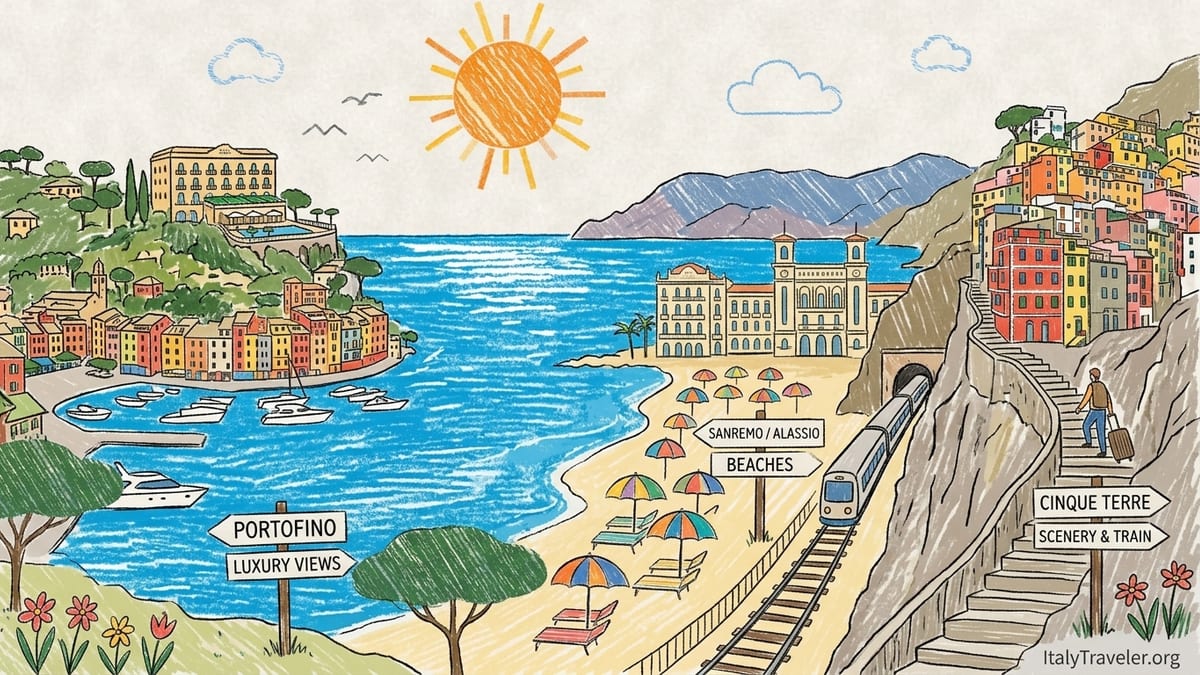
How to Choose Your Italian Riviera Base
On the Italian Riviera, the coastline matters more than the category label on your hotel. Portofino and Santa Margherita Ligure are about luxury views and glossy yacht energy. Sanremo and Alassio suit traditional seaside holidays with promenades and private beach clubs. Camogli and Sestri Levante are ideal if you like boutique scale and local life. Cinque Terre and nearby Levanto are all about scenery and train access. Genoa works as a practical hub with better prices and fast rail links.
Before you book, decide whether you want to step directly onto sand, look down at the sea from a clifftop terrace, or simply be within a short walk of a station. In Portofino, for example, Splendido, A Belmond Hotel, sits high above the bay with panoramic views of the marina and wooded headlands, while Eight Hotel Portofino is tucked in the village streets, closer to the harbor but without the same open sweep of water. In Cinque Terre, a small guesthouse in Vernazza may have a postcard-perfect balcony but require climbing 80 or more stone steps with luggage.
Your budget is also closely tied to these choices. A standard room at a five star property such as Belmond Splendido in peak summer can start around 1,000 euros per night, while a seafront four star in Alassio might cost roughly 250 to 400 euros for the same August weekend, and a simple but well located room in Levanto often falls closer to 150 to 220 euros. Trains run along most of the coast, so it is often smarter to choose an easily reached base and day trip to the most famous villages rather than pay peak prices for the most iconic address.
Think in terms of logistics as much as romance. If you are arriving by car, check whether your hotel offers valet or on site parking and what it costs per day. In Cinque Terre many villages have restricted traffic zones, so parking can mean leaving the car in a public garage above town. If you are relying on the train, it may be worth choosing a hotel like Starhotels President in Genoa, which sits a short walk from Brignole station, or a Levanto property a few minutes from the platforms, simply to avoid long uphill walks with suitcases after a travel day.
Portofino & Santa Margherita: Luxury Sea Views and Private Clubs
Portofino has one of the densest concentrations of premium rooms anywhere on the Italian Riviera, with a small but very high end inventory. The village itself is tiny, wrapped around a horseshoe bay filled with yachts. Classic luxury stays focus on atmosphere and sea views rather than direct beach access. Splendido, A Belmond Hotel, occupies a former monastery on the hill with terraces cascading down toward the harbor, a heated saltwater pool and unobstructed views of Portofino’s pastel houses and the headland. Standard rooms run into four figures in high season, but in return you avoid the crowds at ground level and wake up to silence above the village.
Down on the waterfront, Splendido Mare, Belmond’s smaller sister property, places you right on the piazzetta, steps from the boats and restaurants. Here you trade pool and grounds for instant harbor life. Eight Hotel Portofino, a contemporary boutique option set a few minutes’ walk back from the square, suits travelers who want upscale interiors and a quieter village side street. It offers a small garden and, typically in season, access to a private beach club in nearby Paraggi, which is important because Portofino itself does not have a broad sandy beach.
Santa Margherita Ligure, just around the headland and linked by frequent buses and boats, can be a smarter base if you want some Portofino glamour at a slightly softer price point and with more practical facilities. Here grand waterfront hotels often combine pools, sea views and easier parking. Many face the promenade: sea views are real, but separated from the water by a road and marina. In return you often gain larger rooms and family friendly amenities. This base works especially well if you plan day trips to Portofino, Camogli and the Abbey of San Fruttuoso by boat.
For drivers, Santa Margherita is also more forgiving. Several hotels offer underground or valet parking, something that is heavily limited in Portofino’s compact harbor bowl. If you are arriving by train, Santa Margherita’s station is a few blocks inland; look for properties that specify walking distance and, if stairs are an issue, ask in advance about gradients. Taxi boats and buses run late in summer, so you can dine in Portofino’s waterfront restaurants, then return to a quieter and more affordable room.
Sanremo & Alassio: Classic Seaside Hotels and Beach Holidays
On the western Riviera, Sanremo and Alassio suit travelers who picture long seafront promenades, Belle Epoque architecture and traditional bath cabins lined up on the sand. In Sanremo, Royal Hotel Sanremo is a textbook grand hotel choice, set in gardens above the Lungomare. Rooms with sea view balconies look over a large outdoor pool and the coastline. Recent summer rates on major booking platforms have shown sea view doubles frequently in the 500 to 800 US dollar range, depending on room category and date, reflecting its position among the few true five star options in town.
Royal Hotel Sanremo illustrates a common Riviera trade off. The hotel has extensive grounds, a sizeable pool and sweeping sea views, but it is raised above the road. You walk down to the promenade rather than stepping directly onto sand, and sunbathing is mostly around the pool rather than a private beach. Travelers who prefer a traditional spiaggia with rows of umbrellas might instead choose a four star on the seafront, accepting smaller gardens in exchange for easier access to the water.
Alassio, further along the coast, offers one of Liguria’s longest natural sandy beaches. Here, genuine beachfront hotels are more common. Grand Hotel Spiaggia stands directly on the seafront, with a rooftop pool and terrace plus a garden that leads straight to its section of beach. Its listings on hotel platforms describe a rooftop swimming pool and an on-site restaurant, while many guests pay a daily fee for sun loungers and umbrellas on the beach in front. Prices can range broadly, but it is realistic in peak summer to expect around 250 to 450 euros per night for a sea view room at well rated four star properties.
Just along the sand, Grand Hotel Alassio Beach & Spa Resort offers a five star alternative with an in-house thalassotherapy spa, indoor pool and a private beach club, all housed in a restored neoclassical structure facing the sea. It appeals to travelers who want resort level services without leaving town. Parking here is often via reserved garage spaces that must be prebooked and paid for separately, a reminder that on this stretch of coast you should always clarify parking fees and availability in advance, especially in July and August when the promenade fills with Italian holidaymakers.
Camogli & Sestri Levante: Boutique Charm Between Sea and Station
Between Genoa and the Cinque Terre, the coastal towns of Camogli and Sestri Levante feel more intimate than the big resort centers, yet they offer several hotels that combine character, views and train access. In Camogli, Hotel Cenobio dei Dogi is the standout. Built into the rock at the end of the promenade, it offers a pool perched above the water, a sea view restaurant and a private strip of pebble beach and platforms at the base of the cliff. Rooms range from classic courtyard facing doubles to balconies directly over the sea, and the walk from the station is downhill through the village, though the return involves a modest climb.
Camogli suits travelers who like a lived in town more than a pure resort. Fishermen still work from the harbor, and in the evenings locals stroll the promenade alongside visitors. Compared with Portofino, dining prices are lower and the mood more relaxed, but you still get classic Ligurian scenery. For day trips, ferries run to San Fruttuoso and Portofino in season, and regional trains connect quickly to Genoa and Santa Margherita. Parking is limited and often in public garages above town, so guests arriving by car should check whether their hotel can secure a space and be prepared for elevator or shuttle rides down to the seafront.
Sestri Levante, about halfway between Genoa and the Cinque Terre, occupies a narrow peninsula with two bays: the main town beach and the sheltered Baia del Silenzio, framed by old buildings right at the water’s edge. Boutique hotels cluster around the quieter bay. Hotel Helvetia sits at the tip of the peninsula with terraces overlooking both bays and direct access to a private area of Citto Beach in the Bay of Silence, where hotel guests can use sun loungers reserved for them. Several room categories offer balconies or terraces angled over the sea, blurring the line between hotel and beach club.
For logistics, Sestri Levante is hard to beat. The train station lies just behind the old town, typically a five to ten minute walk from most central hotels, and regional trains reach the Cinque Terre villages in under half an hour. This makes Sestri an excellent base if you want to visit the famous cliff villages by day but sleep somewhere with more restaurant choice and slightly lower prices. As with much of Liguria, dedicated parking is limited and often charged, but some boutique properties maintain small private lots or valet arrangements, which can be worth the nightly fee to avoid circling for a space after a day trip.
Cinque Terre & Levanto: Clifftop Views, Train Lines and Luggage Reality
The Cinque Terre villages of Monterosso al Mare, Vernazza, Corniglia, Manarola and Riomaggiore are as dramatic in person as they look in photos, but accommodation here is fragmented. Instead of large hotels, you will find small family run properties, guesthouses and apartments tucked into old stone buildings. Genuine sea views usually mean climbing steep stairways and accepting compact rooms. In Vernazza, for example, many of the coveted balconies overlooking the harbor sit several flights above the main street, and visitors regularly mention hauling suitcases up narrow staircases that seem more like ladders.
If you want a more traditional hotel experience within the five villages, Monterosso is the most practical choice. It has the longest stretch of beach, more mid range hotels and easier access from the train station. Properties such as Villa Steno and Hotel La Colonnina are often cited by recent travelers for combining terraces with partial sea or town views, friendly service and relatively straightforward walks from the station compared with other villages. Monterosso also gives you the option of a real swim from the beach at Fegina, with sun lounger rental in front of the train tracks.
For many visitors, however, staying just outside the Cinque Terre provides the best balance. Levanto, one stop north of Monterosso, functions as a gateway town, with a sandy beach, a compact historic center and several hotels and guesthouses within a few minutes’ walk of the station. Prices are often lower than in the five villages, and you avoid some of the crowd pressure while still reaching Monterosso in about five minutes by train. This is especially attractive for families and travelers with larger luggage who do not want to navigate stairs and hills every time they go out.
Luggage logistics should heavily influence your choice here. If you plan to arrive with a heavy suitcase, consider basing in Levanto or La Spezia, or choose Monterosso accommodation that clearly states its distance from the station and whether there are major climbs. In villages like Manarola and Riomaggiore, some of the most photogenic rooms hang on the cliff face above the water, but they can involve gradients that feel like a hike. Check hotel photos carefully to confirm whether your “sea view” is uninterrupted water or glimpses between rooftops, and if arrival day stress is a concern, it can be worth sacrificing the last bit of view for an easier approach.
Genoa & Practical Rail Hubs for the Riviera
Genoa is the largest city on the Italian Riviera and divides it into the western Riviera di Ponente and eastern Riviera di Levante. For travelers focused on day trips, it can make a surprisingly good base. Hotel rates are generally lower than in Portofino or Cinque Terre, and you gain fast train connections both ways. The city has two main stations, Piazza Principe and Brignole, each surrounded by mid range hotels that are particularly useful for early departures or late arrivals.
Near Brignole, Starhotels President sits close to the station on Piazza Verdi, making it easy to roll suitcases from train to lobby without needing a taxi. Rooms cater more to business and city travelers than beachgoers, but if your plan is to ride the morning train to Sestri Levante or Monterosso and return in the evening, this kind of property is very efficient. Around Piazza Principe, several traditional hotels line the streets just outside the station, which itself is a key hub for long distance trains. These locations trade sea views for pure practicality.
Genoa’s appeal as a base increases if you are flying in or out or planning a one night stop between the Riviera and elsewhere in Italy. The city’s historic center, aquarium, palazzi and port area give you plenty to do on a travel day without needing a car. From here you can also connect by train to smaller coastal towns such as Camogli, Nervi or Sestri Levante for day trips. Parking in the city center is paid and often in garages, so if you arrive by car and plan to stay several nights, factor in the daily cost of a secure garage attached to or near your hotel.
For beach focused holidays, Genoa itself is not the first choice, but its role in an itinerary is important. An efficient strategy is to spend a night near the station on arrival, then transfer by morning train to your chosen resort, whether that is Portofino via Santa Margherita Ligure, Sestri Levante, Alassio or the Cinque Terre. On departure, doing the reverse can reduce stress, allowing you to stay in your coastal hotel until the last full day before moving closer to the airport or high speed rail connections.
Sea Views, Beach Access, Pools, Parking and Trains: What Really Matters
Across the Italian Riviera, marketing descriptions often blur the difference between “sea view,” “seafront” and “on the beach.” A hillside property above Portofino may have extraordinary panoramas yet require a shuttle or a walk to reach the water, while a hotel on the promenade in Alassio may stand between the beach clubs and a busy road. When comparing options, look at photos and maps rather than relying on labels. If the view you want is simply to wake up to blue water, a hillside terrace in Camogli or Sestri Levante can be more satisfying than a partial glimpse between umbrellas on a crowded beach.
Beach access on this coast usually means entry to a stabilimento, a managed beach club that rents sun loungers and umbrellas by the day. Some hotels, such as Grand Hotel Alassio or Grand Hotel Spiaggia, have their own designated beach areas in front of the property and may include or discount access for guests. Others, like many in Cinque Terre, rely on nearby public or private beaches where you pay separately. Pool access is rarer than many travelers expect; in historic villages like Vernazza or Manarola you are far more likely to find a cliff path to a swimming spot than a hotel swimming pool, while larger resorts and luxury properties back it into their pricing.
Parking is the quiet deal breaker. In Portofino, Cinque Terre and the smaller Ligurian towns, you cannot assume there will be an included parking space, even at four and five star hotels. Nightly fees of 20 to 40 euros are common where on site garages exist, and public parking lots can fill by late morning in high season. If you are driving, verify not only whether parking is available, but whether you must reserve it ahead of time, and consider pairing the car with a base such as Santa Margherita, Sestri Levante or Alassio where hotel garages are more common.
Railway proximity largely defines convenience. Towns like Sestri Levante and Levanto, where many hotels sit within an easy walk of the station, are ideal for travelers without cars. In contrast, properties perched high above the water may require shuttles or taxis that add both cost and time. When booking, check how many minutes your chosen hotel is from the nearest station and whether that walk involves stairs or steep gradients. This small detail can transform your experience, especially in the Cinque Terre where every suitcase may need to be carried up and down stone alleys more than once.
The Takeaway
Choosing where to stay on the Italian Riviera is less about chasing the single most famous village and more about matching a specific stretch of coast to your travel style. Portofino and Santa Margherita reward travelers who value layered sea views, polished service and proximity to high end dining, even if that means relying on shuttles and private clubs for beach time. Sanremo and Alassio deliver classic seaside holidays with promenades, pools and private beaches close at hand.
Camogli and Sestri Levante shine for boutique charm and balance, offering real communities, characterful hotels and easy train access along the coast. In and around the Cinque Terre, you trade larger hotel facilities for dramatic scenery and hiking trails, often accepting stairs and compact rooms as the price of those famous views. Genoa and Levanto fill in the practical gaps, acting as cost effective rail hubs that simplify luggage and connections without sacrificing access to the sea.
Decide early whether you care more about stepping onto sand, floating in a pool, looking out over the water from a balcony, or minimizing transfers and stairs. Then choose a base first, a hotel second, and individual room types third. On a coastline where hotel inventory is dense and diverse, that order of decisions will help you turn the Italian Riviera from a beautiful idea into a stay that actually fits the way you like to travel.
FAQ
Q1. Which town on the Italian Riviera is best for a first time visitor? For a first trip, Sestri Levante or Santa Margherita Ligure work well, combining rail access, a walkable center, nearby beaches and easy day trips to Portofino, Camogli and the Cinque Terre without the crowds or prices of the smallest villages.
Q2. Is it better to stay in Cinque Terre or nearby towns like Levanto or La Spezia? If you prioritize atmosphere and do not mind stairs or smaller rooms, staying in a Cinque Terre village is memorable. If you want easier luggage handling, more hotel style options and lower prices, Levanto and La Spezia are very practical bases with quick train links into the park.
Q3. Do I need a car to explore the Italian Riviera? No. The regional train line covers most of the coast, and boats link key spots in season. A car is useful for rural inland villages or very specific itineraries, but it can be a liability in Portofino and Cinque Terre, where parking is limited and expensive.
Q4. How far in advance should I book hotels in Portofino and Cinque Terre? For peak summer months and holiday periods, aim to book key properties three to six months ahead, especially if you want specific room types with balconies or sea views in boutique hotels with only a handful of such rooms.
Q5. Are sea view rooms worth the extra cost? On this coastline, a true sea view can significantly change your experience, particularly in places like Portofino, Camogli or Vernazza where much of the magic is in the outlook, but if you plan to be out all day, a comfortable non view room in a better located hotel may be a smarter use of budget.
Q6. Which towns have the easiest beach access for families? Monterosso al Mare, Alassio, Levanto and parts of Sanremo offer relatively flat promenades and sandy or fine pebble beaches with organized lidos, making them more comfortable for families with strollers or travelers who prefer to avoid steep climbs.
Q7. What is the best base if I am arriving by train with heavy luggage? Consider Genoa near Brignole or Piazza Principe stations, Sestri Levante, Levanto or Santa Margherita Ligure, where many hotels are within a short, mostly level walk of the platforms and taxis are readily available if needed.
Q8. Are pools common at Italian Riviera hotels? Pools are common at larger resort style and luxury hotels in places like Portofino, Sanremo, Alassio and Sestri Levante, but far less common in the smaller Cinque Terre villages, where cliffside buildings and limited space favor terraces and sea ladders over full swimming pools.
Q9. How expensive are top luxury hotels in Portofino? In high season, five star icons such as Belmond Splendido can start around four figures per night for entry level rooms, with suites and prime view categories significantly higher, reflecting the small supply and intense demand in this tiny harbor.
Q10. What is a good strategy to balance budget and experience on the Italian Riviera? A balanced approach is to base in a mid priced town like Sestri Levante, Levanto or Santa Margherita Ligure for most nights, using trains and boats for day trips to Portofino and Cinque Terre, and, if budget allows, add a single splurge night in a marquee property purely for the experience.