

The Italian Riviera stretches in a long, scalloped line from the French border to Tuscany, and much of it still flies under the radar of international visitors who focus almost entirely on Cinque Terre. Yet this narrow Ligurian coast hides a remarkable variety of beaches: long sandy crescents, tiny pebble coves, resort promenades and quiet bays framed by pastel villages. Understanding how the main resorts differ in sand type, access, facilities and atmosphere can help you plan a smarter trip that matches your style, whether you are traveling with young children, chasing clear water for swimming, or simply hoping to drop your towel somewhere that is not already on every postcard rack.
Liguria’s Blue and Green Flags: What They Mean for Travelers
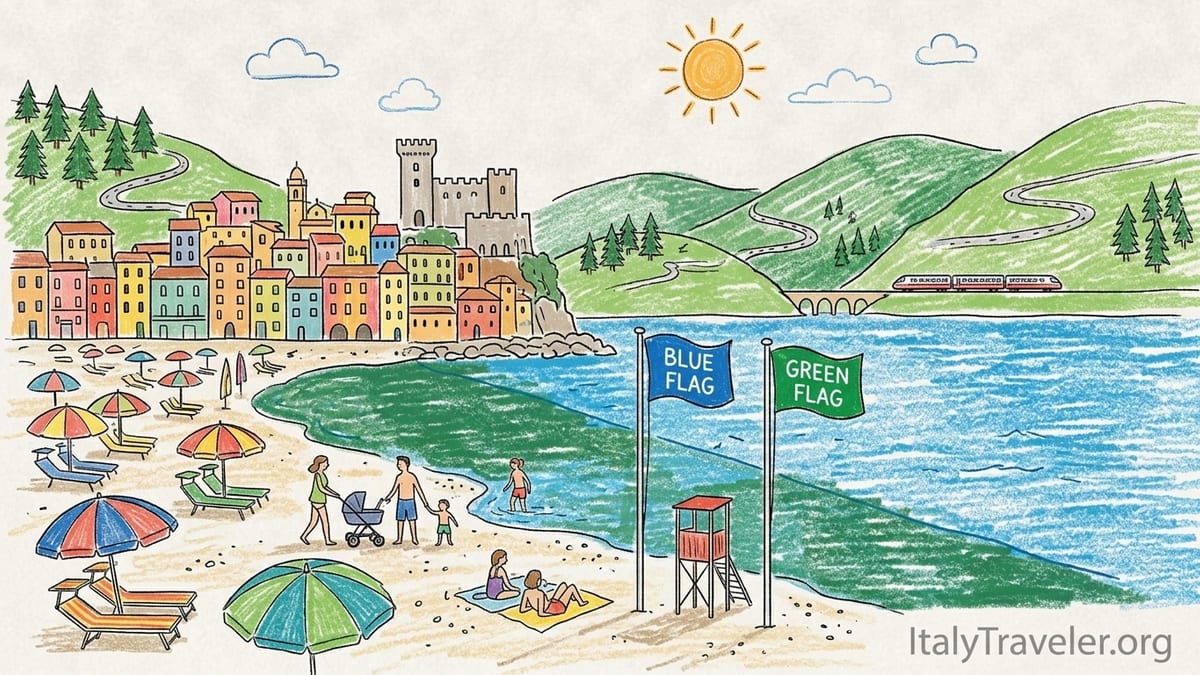
For beach travelers, Liguria’s biggest calling card is the quality of its sea. The region consistently ranks at or near the top in Italy for Blue Flag awards, an international certification that evaluates water quality, environmental management and safety services. Recent counts show 64 Blue Flag beaches spread across 33 municipalities along the Ligurian coast, a density that is unusually high for such a compact region. For visitors, this does not mean every cove is pristine, but it does signal that many of the best-known resort towns invest heavily in keeping beaches clean, lifeguards on duty and basic services in good order.
Families get an extra layer of reassurance from Italy’s “Green Flag” scheme, where pediatricians select beaches that are especially suitable for children. In the 2026 list, Finale Ligure, Noli, Lavagna and Lerici in Liguria all received Green Flags for their combination of clean water, soft entry into the sea, lifeguards, nearby facilities and family-friendly atmosphere. Parents arriving with a stroller and a beach bag full of toys may find it helpful to look for these names when deciding where to base themselves on the Riviera.
These labels are not marketing slogans. At Finale Ligure, for example, the main beach is backed by a traffic-calmed promenade with playgrounds and shaded benches right behind the sand, while Lerici’s main town beach offers gently shelving water, a public playground and easy access to cafes for an ice cream break. If you compare these to a dramatic but less serviced rocky cove near the Cinque Terre hiking trails, you begin to understand why pediatricians and local families gravitate toward the Green Flag towns.
Most of the destinations described below combine at least one Blue Flag with a spectrum of public and private beach options. When you see those flags flying near the lifeguard stand or harbor, it is a useful shorthand that you are in a place where local authorities are paying attention to water testing, waste management and basic safety standards.
Understanding Italian Riviera Beaches: Sand, Pebbles and Stabilimenti
Before zeroing in on specific resorts, it helps to understand how Ligurian beaches are organized. The coastline is mostly narrow and backed by hills, so space is at a premium. Long, naturally sandy stretches are the exception rather than the rule. Where nature has provided sand, like in Alassio or parts of Finale Ligure, the feel is closer to the classic resort beaches of the Adriatic. In many other towns, from Sestri Levante to Monterosso, the sand is mixed with grit or small pebbles, while tighter coves such as Paraggi and some stretches around Lerici can be mostly pebbles underfoot. Bringing lightweight water shoes is a practical way to make both rocky entries and hot midsummer sand more comfortable.
The most visible feature of an Italian Riviera beach is the line of colored umbrellas that usually belongs to private beach clubs, known as stabilimenti balneari. These establishments typically charge a daily fee for a pair of sun loungers and an umbrella. On the central seafront in Alassio on a busy August weekend, a front-row spot at a well-known lido could easily reach 60 to 90 euros per day for two people, while more modest clubs a few rows back or in smaller towns might range from 30 to 50 euros for the same setup. In high prestige spots such as Paraggi near Portofino, prices can climb much higher, making it one of the most expensive small bays in Italy for a sunbed.
By law, the sea itself is public, and there are always at least some stretches of “spiaggia libera,” or free beach, where you can lay your towel without renting equipment. In practice, especially in built-up resorts, the free sections may be narrow or fill quickly, and they usually offer no shade and limited facilities. Experienced travelers often mix the two options over a trip: a paid stabilimento day when they want showers, changing cabins and a bar, then a free beach day with a picnic and a simple towel when they find a wider public stretch such as the eastern end of Monterosso or the outer edges of Finale Ligure.
Access also varies. One of the Riviera’s practical advantages is the coastal railway, with frequent trains linking Genoa to Ventimiglia in the west and La Spezia in the east. Many of the beaches in this guide are within a 5 to 10 minute walk of a train station. This makes it realistic to visit multiple resorts without a car, but it also means parking is often tight and metered near the seafront. In July and August, paying 2 to 3 euros per hour for street or garage parking near the beach is typical in larger resorts, while some towns encourage drivers to use park-and-ride lots set back from the center.
Alassio: Classic Sandy Resort for Families and Strollers
Alassio is one of the Riviera di Ponente’s best-known sandy beaches and feels immediately different from the rockier coves that many travelers associate with Liguria. The town curves around a wide bay lined with soft, fine sand that slopes very gently into the sea. This shallow gradient creates a wide, knee-deep area where small children can splash and adults can wade far out before the water reaches their shoulders. On calm summer mornings, the sea often feels more like a large swimming pool than an open coast, which is precisely why Italian families flock here.
The seafront is dominated by stabilimenti, each with its own color scheme and atmosphere. A typical mid-range beach club might offer changing cabins, showers, a small playground, pedal boat rentals and a bar for coffee and focaccia. Daily prices vary by row and month, but visitors in late July might expect to pay around 40 to 60 euros for two loungers and an umbrella near the water at a family-oriented club. Free beach sections exist, especially at the fringes of town, yet they can be thin ribbons of sand between the private decks and the shoreline. Arriving early, before 9 am, is the best way to secure a spot with some breathing room without paying for a sunbed.
Alassio also works well logistically. The train station is only a few blocks from the promenade, and many mid-range hotels and guesthouses sit either on the seafront or one or two streets behind it. This allows travelers to push a stroller directly from accommodation to the sand without tackling steep hills or long staircases. Budget-conscious visitors may choose a simple family-run hotel a five-minute walk inland to reduce room rates, then spend on a stabilimento day pass for comfort. For those seeking a change of scene, the neighboring village of Laigueglia offers a similar sandy setting with a slightly quieter, more traditional feeling, reachable in a short regional train ride or by a flat seaside walk.
Beyond the beach itself, Alassio’s historic center and the famous Muretto wall of ceramic tiles provide something to do during the late afternoon when the sun becomes intense. In practice, many families adopt a simple rhythm: beach until lunchtime, a break for pasta or focaccia under a shaded arcade, then a stroll and gelato in the early evening. For travelers who prioritize ease, soft sand and a resort atmosphere over wild scenery, it is hard to beat Alassio as a base on the western Riviera.
Finale Ligure and Noli: Active Beaches with Green Flag Comfort
Further east along the Riviera di Ponente, Finale Ligure and neighboring Noli have evolved from working coastal towns into some of Liguria’s most versatile seaside bases. Finale Ligure stretches along nearly 8 kilometers of coastline, with distinct areas such as Finalmarina, Finalpia and Varigotti. The beaches here are generally a mix of sand and small pebbles, wide enough in many sections to support generous rows of umbrellas as well as comfortable public areas. The town has earned both a Blue Flag for water quality and a Green Flag for child-friendly conditions, and on a summer day you see why: lifeguards are omnipresent, the promenade is flat and stroller-friendly, and there are dedicated play areas behind the beach.
Unlike some purely sunbathing resorts, Finale has a strong active-sports identity. Early in the morning, especially outside peak season, you might see cyclists towing surfboards, divers loading gear for trips to underwater caves, or climbers grabbing a swim after a morning on the nearby limestone cliffs. Beach clubs and guesthouses have adapted, offering gear storage, early breakfast options and package deals that combine accommodation with guided activities. For a visiting traveler, this means you can easily mix days on the sand with boat trips, snorkeling around rocky headlands, or kayaking under the ochre cliffs of Varigotti.
Noli, just to the east, feels more intimate. The medieval center sits right behind the waterfront, and the town beach is a narrow but charming arc of sand and pebbles almost entirely taken up by stabilimenti. Yet, as a Green Flag holder, it maintains a family-friendly profile, with shallow entry into the water and a more tranquil evening ambiance compared to larger resorts. Travelers who prefer to feel part of a living village, with locals strolling the seafront at dusk and small grocery shops behind the promenade, often respond well to Noli’s scale.
Both Finale Ligure and Noli are on the coastal train line, so car-free travelers can arrive directly. Those who do drive should be prepared for limited beachfront parking in high season and may need to leave their car in a back-street garage or on the edge of town. Accommodation ranges from modest pensions and self-catering apartments in the historic streets to mid-range hotels on or near the seafront. Prices for sunbed rentals are generally a notch lower than in Paraggi and comparable to Alassio, with families often opting for weekly packages at the same beach club to secure a consistent spot close to play areas.
Sestri Levante’s Bay of Silence and the Levante Coast
Crossing into the Riviera di Levante, Sestri Levante marks a change of mood. The town occupies a narrow isthmus that juts into the sea, creating two distinct bays. On one side is the larger Baia delle Favole, lined with a long beach where most of the stabilimenti and family facilities sit. On the other is the smaller, picture-perfect Baia del Silenzio, where colorful houses wrap around a crescent of sand and small boats are pulled up on shore. The sand in both bays is soft mixed with fine pebbles rather than powdery, but remains comfortable for bare feet. Many travelers consider the Bay of Silence one of the most atmospheric swimming spots on the Riviera, especially in the early morning or at sunset when the light warms the pastel facades.
The Bay of Silence is mostly free beach, with only a few limited services and strict rules to preserve its character. In high summer, the municipality sometimes caps the number of bathers during peak hours, so arriving early is crucial. Families with young children may gravitate more toward Baia delle Favole, where beach clubs provide changing cabins, lifeguards and rentals of pedal boats or stand-up paddleboards. A typical mid-range club here might charge around 35 to 50 euros for two loungers and an umbrella in July, with discounted rates late in the afternoon.
Sestri Levante benefits from excellent train connections, with frequent services to Genoa, Cinque Terre, La Spezia and beyond. The station lies a short walk from both bays, which makes it a practical base for travelers who want to enjoy a charming beach town while taking day trips by rail. Parking can be challenging near the historic center in peak season, and drivers often end up using paid lots set slightly inland, walking 10 to 15 minutes to reach the beach. Accommodation clusters in and around the old town, with everything from small boutique hotels in historic buildings to apartments above local shops.
Compared with Alassio or Finale, Sestri feels more like a classic Ligurian borgo that happens to have good beaches. The waterfront restaurants serve a high proportion of local seafood, and in the evenings locals and visitors mingle on the promenade rather than retreating into all-inclusive resorts. For travelers choosing between Cinque Terre villages and a nearby base, Sestri Levante often emerges as a compromise: it offers a pretty, swimmable beach at the doorstep and direct train access to the famous hiking villages without their logistical constraints or crowd density.
Monterosso al Mare and Paraggi: Cinque Terre’s Beach Hub and Portofino’s Emerald Cove
Within the Cinque Terre, Monterosso al Mare is the clear choice for beach time. It is the only one of the five villages with a substantial stretch of beach accessible without stairs or steep paths. The main Fegina beach, directly opposite the train station, is a broad mix of coarse sand and small pebbles, largely taken up by neat rows of bright umbrellas in summer. Here, visitors can choose between paying for a sun lounger at a stabilimento, which grants access to showers and toilets, or heading to the marked free sections near the edges of the bay. Even in the free areas, the water entry is relatively gentle by Ligurian standards, and the scenery of terraced hills rising behind the tracks remains striking.
Monterosso can be extremely busy in high season, with day-trippers arriving by train and boat. In practice, those who stay overnight in the village have a tactical advantage: you can go for a swim before 9 am, when the beach is quiet and the light is soft, then retreat during the midday crush to explore shaded alleys or enjoy a long lunch. Accommodation in Monterosso ranges from simple rooms in old fishermen’s houses to higher-end boutique hotels near the waterfront. Prices reflect the village’s popularity, especially for sea-view rooms, so some travelers choose to base themselves in nearby Levanto or Sestri Levante and visit Monterosso purely for a beach day.
Roughly an hour west by train and bus, Paraggi presents a different type of experience. Technically part of Santa Margherita Ligure and just a short coastal walk or local bus ride from Portofino, this tiny bay is renowned for its emerald-green water and sheltered setting. The beach itself is a narrow strip of sand and small pebbles backed almost entirely by private beach clubs and upscale establishments. Daily rental prices here can be among the highest on the Riviera, reflecting Paraggi’s status as a luxury destination frequented by yacht owners and high-end travelers. Although there is a small public section, space is limited and fills early, especially on weekends.
Despite the prices, the swimming at Paraggi is exceptional on calm days. The enclosed nature of the bay and the rocky seabed beyond the shallow zone contribute to clear water and good visibility for snorkeling. Travelers on a budget sometimes treat Paraggi as a quick swim stop rather than a full day out: arriving early by bus from Santa Margherita, taking a dip in the free section with their own towels, then continuing the coastal path toward Portofino. Others decide that a one-day splurge at a luxury club, with comfortable loungers, waiter service and a front-row view of the yachts, is worth the cost as a special-occasion treat.
Lerici and the Eastern Gulf: Scenic Bays with Green Flag Comfort
On the eastern edge of Liguria, facing the sheltered Gulf of La Spezia, Lerici combines impressive scenery with practical beaches. The town spreads along a hillside topped by a medieval castle, with the main town beach and several smaller coves spreading out on either side. The sand here is mixed with fine pebbles, and in places you will encounter stone jetties and rocky sections, but the water entry is generally gentle. Lerici’s designation as a Green Flag beach town reflects its family-friendly mix of clean water, lifeguards and nearby services, and on a summer afternoon the seafront promenade hums with strollers, ice cream stands and terrace cafes.
The main town beach offers both stabilimenti with loungers and umbrellas and marked free sections. Prices for two loungers and an umbrella are generally in line with other mid-range Ligurian resorts, with some variation depending on exact location and month. Families who want more space often look toward nearby San Terenzo, a suburb of Lerici with a wide sandy-curving bay, or rent an apartment up the hillside and walk or use local shuttle buses down to the sea each day. The Gulf’s orientation means the water is often relatively calm, which suits young swimmers and paddleboarders.
Lerici is not on the main coastal railway line, which slightly complicates access for car-free travelers compared to Monterosso or Sestri Levante. The closest major train hub is La Spezia, from where regular buses and ferries run to Lerici. Those arriving by car should expect narrow hillside roads and limited parking near the center, especially in August, but several structured car parks serve the town, with daily rates comparable to larger Riviera resorts. In return for this effort, visitors enjoy a more relaxed feel than in the Cinque Terre villages, with evenings characterized by passeggiata along the waterfront and outdoor dining under castle walls.
For those willing to explore, the wider Gulf of La Spezia offers a string of small beaches and coves, some reachable only on foot or by boat. Compared to the dramatic cliffs west of La Spezia, the landscape here is softer but still deeply atmospheric, especially when the evening light falls across the gulf and the islands of Palmaria and Tino. Lerici works well as a base for travelers who want a scenic setting and safe swimming for children, but who also plan day trips by boat to Portovenere or by bus and train to the Cinque Terre trails.
Choosing Your Base: How the Main Resorts Compare
Different sections of the Italian Riviera suit different travelers, and the towns highlighted here form a kind of menu of beach experiences. If soft sand and easy wading for toddlers are top priorities, Alassio and parts of Finale Ligure stand out. Their wide, sandy or sand-and-fine-grit beaches resemble classic Mediterranean resorts and are backed by extensive stabilimenti that cater directly to families. The trade-off is that scenery is gentler and more built-up, and in peak weeks the atmosphere can feel intensely resort-like.
For travelers who enjoy a mix of charming old-town atmosphere and accessible beaches, Sestri Levante and Lerici make compelling bases. Both offer attractive historic centers, manageable scale, and beaches that, while not as purely sandy as Alassio, remain comfortable for swimmers of all ages. Sestri has the edge for train connections and quick access to Cinque Terre, while Lerici provides a more self-contained Gulf setting with boat connections across the water to Portovenere and nearby coves.
Those drawn to iconic names and dramatic settings might focus on Monterosso and Paraggi. Monterosso is the only one of the classic Cinque Terre villages where you can simply step off the train and walk a few meters to lay your towel on a proper beach, which makes it very convenient but also heavily visited. Paraggi, with its emerald water and luxury beach clubs, offers a glamorous atmosphere that some travelers dream about and others find too exclusive. Using nearby Santa Margherita Ligure as a base, with its broader range of hotels and easier train access, can give you flexibility to dip into Paraggi for a day without committing to its high prices.
Practical considerations also matter. Car-free travelers will find life easiest in Alassio, Finale Ligure, Sestri Levante and Monterosso, all of which sit directly on the main coastal rail line. Those with a car need to budget for parking and consider travel dates carefully; staying slightly outside the core weeks of late July and mid August can dramatically reduce both crowding and daily costs for sunbeds and parking. Whichever base you choose, it is worth leaving at least one or two days unplanned. With a regional train ticket or local bus pass, you can follow the weather and your mood to another bay along the coast, comparing for yourself how the sand feels underfoot and how quickly the train station appears behind the palm trees when it is time to head back.
The Takeaway
Seen from a train window, the Italian Riviera can look like one long blur of beaches and pastel buildings, but experienced on foot and with your feet in the water, its differences are striking. Long sandy Alassio is a different world from miniature Paraggi, and child-friendly Finale Ligure offers a distinct atmosphere from hiking hub Monterosso. By paying attention to sand type, degree of urbanization, train access and the balance between free beach and stabilimenti, you can match your base to your travel style instead of defaulting to the most famous name.
Liguria’s dense cluster of Blue Flag awards and the family-focused Green Flags in Finale Ligure, Noli, Lavagna and Lerici provide helpful starting points, but they are not the whole story. Some travelers will gladly trade a certification for an uncrowded pebble cove, while others value the reassurance of lifeguards, shaded playgrounds and ramps for strollers above all else. The coast is compact enough that, with a few days and a flexible plan, you can try more than one style: perhaps a sandy resort day in Alassio, a village-and-bay combination in Sestri Levante, and a dramatic Cinque Terre swim in Monterosso.
In the end, the “best” beach on the Italian Riviera is the one that fits your priorities on that particular day. For some, that will mean a front-row lounger at a well-run stabilimento with a cappuccino delivered to the umbrella. For others, it will be a patch of free sand in the Bay of Silence at sunrise or a late-afternoon dip from the pebbles at Lerici under castle walls. The real luxury of Liguria lies in having all of these options within a short train ride of each other, letting you shape a coastal trip that goes far beyond a single postcard view of Cinque Terre.
FAQ
Q1. Are Ligurian beaches mostly sandy or pebbly?
Many Ligurian beaches are a mix of coarse sand and small pebbles, but there are notable sandy stretches in places like Alassio, parts of Finale Ligure and the broader bays around the Gulf of La Spezia. In tighter coves such as Paraggi, and along some sections of the Cinque Terre, you should expect pebbles or rocky entries and plan to bring water shoes if you have sensitive feet.
Q2. How expensive are beach clubs on the Italian Riviera?
Prices vary widely by town, month and exact location on the beach. In mid-range resorts such as Sestri Levante or Finale Ligure, two loungers and an umbrella typically cost around 30 to 50 euros per day in July. In highly sought-after spots like central Alassio or Paraggi near Portofino, front-row setups can run well above that, and in Paraggi the most exclusive establishments may charge premium rates that reflect the bay’s luxury profile.
Q3. Can I use the beach for free, or do I have to pay?
You can always use the sea and at least some sections of beach for free. Every coastal town has stretches of spiaggia libera where you can lay a towel without paying for a lounger. However, in built-up resorts these free sections can be quite narrow and fill early, especially in August. Many visitors mix free beach time with occasional days at stabilimenti when they want showers, shade and easy access to food and drinks.
Q4. Which Italian Riviera towns are best for families with small children?
Alassio, Finale Ligure, Noli, Lavagna and Lerici are particularly popular with families thanks to their relatively gentle water entry, promenade facilities and family-oriented services. Finale Ligure, Noli, Lavagna and Lerici have been recognized with Green Flags for child-friendly beach conditions, and all of these towns offer a good choice of accommodation within easy walking distance of the sea.
Q5. Is it better to stay in Cinque Terre or in a nearby beach town?
Staying in Cinque Terre villages like Monterosso puts you at the heart of the hiking trails and postcard scenery, but space is tight and beaches are limited to a few spots. Nearby towns such as Sestri Levante, Levanto or Lerici often offer more spacious beaches, easier logistics and a wider range of accommodation. Many travelers choose a beach town base and visit Cinque Terre by train or boat for day trips.
Q6. Do I need a car to explore the Italian Riviera beaches?
No, a car is not essential and can even be a burden in peak season because parking near the sea is limited and often expensive. The coastal railway connects major beach towns including Alassio, Finale Ligure, Sestri Levante and Monterosso, with stations usually within a short walk of the shore. Local buses and ferries supplement the trains in areas like the Gulf of La Spezia and around Portofino.
Q7. When is the best time to visit these beaches to avoid crowds?
Late May and June, as well as September, are excellent months for a beach-focused trip to Liguria. Sea temperatures are generally pleasant, stabilimenti are open, and crowds are lighter than in late July and August, when Italian school holidays peak. Weekdays are usually quieter than weekends, and even in high season early morning and late afternoon swims can feel more relaxed.
Q8. How cold is the water on the Italian Riviera?
Water temperatures typically become comfortable for swimming from late May through September, with the warmest months usually July and August. Exact temperatures vary year by year, but in high summer the sea often feels pleasantly warm near the shore, especially in shallow bays like Alassio and the Gulf of La Spezia. Outside this core period, hardy swimmers may still enjoy short dips, but many beach clubs close.
Q9. Are there good snorkeling spots near these beaches?
Yes, several areas along the Ligurian coast offer enjoyable snorkeling, especially around rocky headlands where marine life gathers. The cliffs and coves near Paraggi and Portofino, the rocks off Varigotti near Finale Ligure, and some stretches around the Cinque Terre and Portovenere are known for clear water and interesting underwater views on calm days. For the best experience, bring your own mask and fins and always check local conditions and currents before entering the water.
Q10. How far in advance should I book accommodation in these towns?
For stays in July and August, especially in popular places like Monterosso, Sestri Levante, Alassio or near Portofino, it is wise to book accommodation several months in advance to secure the best locations and prices. Outside peak season, you can often find rooms with less notice, but booking at least a few weeks ahead still helps, particularly if you want specific features such as sea views, parking or family rooms close to the beach.