


Driving the Italian Riviera from the French border to the Cinque Terre is one of Europe’s great coastal journeys, a narrow ribbon of asphalt squeezed between sea and mountains. In 2026, ViaMichelin published a 380‑kilometre Ventimiglia to Cinque Terre route that closely follows the natural flow of the coast, linking Ventimiglia, Sanremo, Alassio, Albenga, Genoa, Camogli, the Portofino coast, Sestri Levante and finally the Cinque Terre, with Portovenere and Lerici as an optional finale. This guide follows that coast-wide structure and focuses on what road‑trippers really need to know: how to mix the scenic coastal road with the faster autostrada, how to handle tolls, ZTLs and parking, and when to park the car and rely on trains or boats instead.
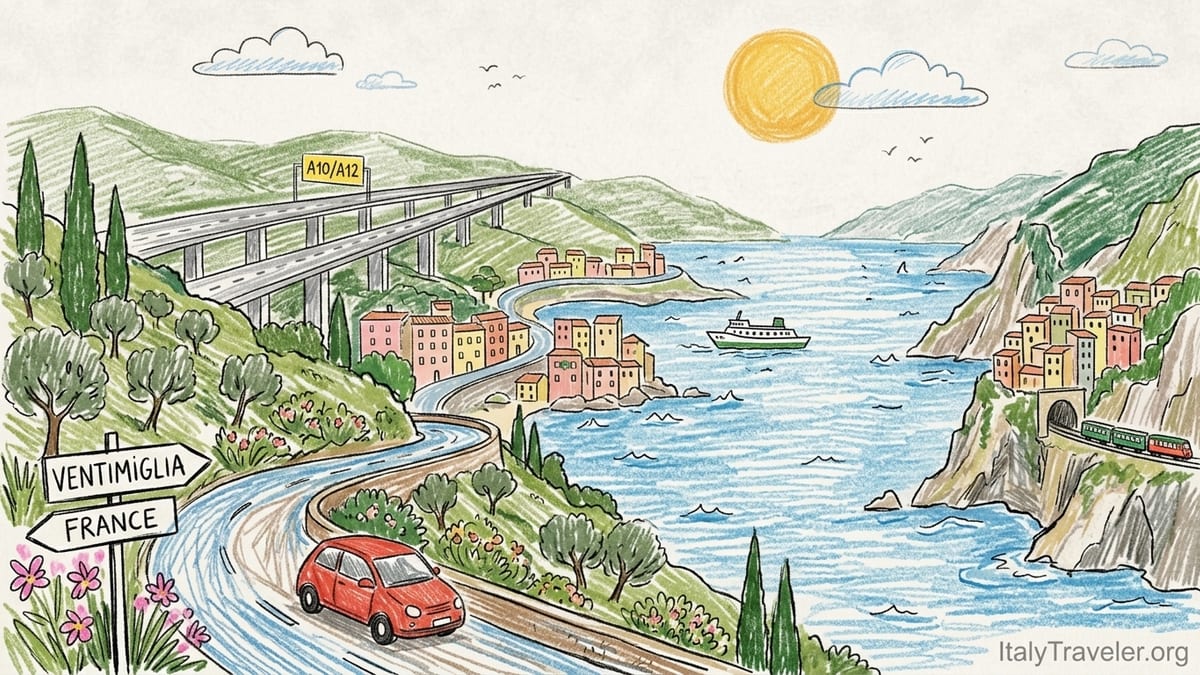
How the Italian Riviera road trip fits together
The Italian Riviera is essentially a long, narrow balcony facing the Ligurian Sea, running from Ventimiglia near the French border to the Gulf of La Spezia near Tuscany. The ViaMichelin route from Ventimiglia to the Cinque Terre strings together almost all of the classic seaside names without forcing contrived detours, which makes it a solid backbone for planning a real self-drive itinerary. You follow the old SS1 Via Aurelia and parallel autostrade through the Riviera di Ponente around Sanremo and Alassio, pass through Genoa, then continue along the Riviera di Levante past Camogli, Portofino and Sestri Levante before finishing in the Cinque Terre.
For most drivers, the smart pattern is to combine the A10 and A12 autostrade for the long hops and then drop down to the coastal road or local spurs for the prettiest sections. Driving every kilometre of the old SS1 would be exhausting and slow, with frequent traffic lights, tunnels and urban stretches that feel more like city commuting than a holiday. The key is to decide where the journey should be about the road itself, such as the dramatic headlands east of Genoa, and where it is simply a link between two bases, where the motorway’s tunnels and viaducts save you hours and reduce stress.
Because many of the Riviera’s historic centres are wrapped in ZTLs, or limited traffic zones, and hemmed in by steep hillsides, the car becomes more of a burden in certain stretches, particularly around Portofino and the Cinque Terre. It is entirely realistic to drive happily from Ventimiglia to somewhere like Sestri Levante with a car at your side, then park it in a secure lot and continue by regional trains and boats for the most fragile and crowded sections. Thinking of this trip as a mix of road touring and rail or ferry hops, rather than as a pure driving marathon, will make it both smoother and more enjoyable.
Ventimiglia and Sanremo to Alassio and Albenga: flowers, markets and the old Via Aurelia
Ventimiglia is the natural western gateway, especially if you are arriving by train or car from Nice or Menton in France. The town has its own ZTL over the upper old town, which is where many visitors want to wander, so most drivers base themselves in a seafront hotel or at a garage near the station and explore the medieval lanes on foot. A typical pattern for a first afternoon is to park at a paid lot near the seafront, drop your luggage at a hotel on the lungomare, then walk up through the old bridge to the historic quarter without worrying about cameras or access permits.
From Ventimiglia to Sanremo, you face your first decision: autostrada or coast road. The A10 Autostrada dei Fiori runs in the hills behind the coast and gives you a quick, mostly tunnelled run, usually in under 30 minutes, with tolls that are modest for such a mountainous stretch. If you value views over speed, you can take the SS1 Via Aurelia, the old Roman road that threads directly through resort towns like Bordighera and Ospedaletti. Expect a slower pace, traffic lights and scooters, but also glimpses of pastel palazzi, working beaches and the Ligurian version of everyday life that you will entirely miss from the motorway viaducts.
Sanremo itself is much easier to enjoy if you pick a hotel with parking included or pre-book a space in a central garage for your stay. A four-star property slightly back from the seafront may include indoor parking in the room rate, which can easily save you 25 to 35 euros a day compared with paying a public lot separately. From Sanremo east to Alassio and Albenga, continuing via the SS1 is worthwhile on at least one leg of your journey, perhaps on a day where you are not trying to cover too much ground. This is where you feel why the area is marketed as the Riviera dei Fiori, with greenhouses and garden centres lining the road and small seaside towns like Diano Marina, Laigueglia and Andora inviting spontaneous coffee stops.
Alassio and Albenga make natural first overnight bases if you want a gentler start than Sanremo. Both have compact historic centres and accessible seafronts, but with slightly easier parking pressure than the westernmost towns. Many travellers set up here for two or three nights, leave the car in a hotel lot and use the local train for side trips back to Sanremo or forward to Savona and Genoa, getting used to the rhythm of the coastal railway that will become more important as you move east.
Genoa and the realities of driving into a Ligurian city
Genoa is both a major destination and a logistical hinge for this route, but it is also the first place where urban driving can feel genuinely intimidating. Approaching from the west on the A10, you will face a series of exits, flyovers and tunnels that all seem to point to “Genova” without making clear which one you actually want. Before you drive in, decide whether you are staying overnight in the city or simply passing through for a few hours. If you are only breaking the journey, a practical solution is to aim for one of the large multi-storey garages near the Porto Antico, where you can leave the car for three or four hours while you walk the medieval alleyways and visit the aquarium or the palazzi on Via Garibaldi.
Like many Italian cities, Genoa operates several ZTL zones that protect its historic centre. They are controlled by cameras rather than barriers and the fines can be significant, so you should not drive blindly toward “centro” following your sat-nav. If you have booked a hotel in the old town that offers parking, ask in advance whether your plate will be registered with the local parking authority and what exact route they recommend. Many properties email a small map that shows which streets you may use without triggering a ticket. If your hotel is outside the ZTL, consider leaving the car in a commercial garage like one of the Porto Antico facilities, then taking a taxi or simply walking with an overnight bag to your accommodation.
Genoa is also a natural place to reconsider how often you want to change hotels on this road trip. One workable pattern is to use it as a three-night hub: you arrive, park the car and then use trains to explore the surroundings. Frequent regional trains run east to Camogli, Santa Margherita Ligure and Rapallo and west to towns like Savona and Varazze. A day trip by train to Portofino’s gateway, Santa Margherita Ligure, or to the palm-framed promenade at Nervi can be far more relaxing than trying to thread narrow, one-way streets and hunt for beach parking every afternoon.
If you do choose to drive across Genoa, for example to continue east toward Sestri Levante without stopping, staying on the motorway ring is usually the least stressful option. The A12 splits off toward Livorno and La Spezia, and although you pay tolls for the privilege, the savings in time and nervous energy compared with hugging the built-up seafront can be considerable, especially in peak season or during weekday rush hours.
Camogli to the Portofino coast: beauty, bottlenecks and parking pressure
East of Genoa, the coast tightens into a string of headlands and coves that have made names like Camogli, Portofino and Santa Margherita Ligure famous far beyond Italy. For drivers, this is also where the road narrows and the balance between scenic pleasure and practical access becomes more delicate. Camogli, for example, sits in a natural amphitheatre under the Monte di Portofino, and the main approach road descends in a series of bends to a small waterfront. The village has structured parking at the top and a few smaller garages closer to the sea, but in high season these fill quickly and day visitors often end up leaving their cars in spaces along the upper road and walking down.
Santa Margherita Ligure is the main base for visitors to the Portofino promontory and works well for drivers because it combines several mid-sized hotels with private parking and a choice of public garages. A common strategy is to book a hotel a few blocks back from the harbour, where car access is straightforward, drop your vehicle in their courtyard or underground lot and then explore the rest of the promontory without it. From Santa Margherita, you can take a short bus ride or slow, twisting drive to Portofino itself, but for many the simplest option is the frequent boat service that links Santa Margherita, Rapallo and Portofino in a neat triangle.
Portofino is the clearest example on this route of a place where keeping the car with you is rarely worth the trouble. The access road is narrow and can be restricted at busy times, and the village relies on a single multi-storey car park that is expensive and often full. Drivers arriving without a guaranteed hotel space frequently find themselves circling or being turned back, which wastes time and patience. Staying in Santa Margherita Ligure or Rapallo and visiting Portofino by boat or bus keeps the glamour of an espresso on the harbour, but removes the anxiety of high parking fees and potential traffic restrictions.
From a road-trip perspective, the Portofino promontory works best as a side loop off the main A12 and SS1 axis. You drop down once, base yourself in Camogli or Santa Margherita Ligure for two or three nights, explore Portofino, San Fruttuoso and the local hiking trails, then climb back to the main road network when you are ready to continue east. Trying to drive in and out for a quick photo stop risks turning one of the Riviera’s loveliest sections into a frustrating bottleneck.
Sestri Levante and the shift from driving to rail
Continuing east, Sestri Levante is where the Riviera begins to change character again, and it is also the most logical place to rebalance your trip from a car-centred journey to one that leans heavily on trains. The town itself is built on a slender promontory between two bays, with a compact old town, a seafront promenade and several medium-sized hotels that include underground or courtyard parking. Arriving on the A12, you can exit directly at Sestri Levante, skirt the town and drop into one of the larger garages near the station or the seafront, then check in and leave the car untouched for several days.
From Sestri Levante eastward, the roads that lead to the cinque villages become progressively narrower and more winding, and the parking possibilities decrease just as tourist numbers rise. Regional trains, on the other hand, run every 20 to 30 minutes in season and connect Sestri Levante with Levanto, Monterosso and Vernazza in well under an hour. Many travellers choose to base in Sestri Levante or Levanto rather than inside the Cinque Terre villages themselves, precisely to avoid driving into the steep folds of the coast and dealing with tiny, saturated car parks at the end of dead-end roads.
Sestri Levante also works as a comfortable base for day trips back along the coast by train or a mixture of train and short drives. It is feasible, for example, to leave the car parked and use the regional line to hop to Chiavari for its covered arcades and food market in the morning, then continue to Rapallo or Camogli for an afternoon stroll before returning in time for dinner on the Baia del Silenzio. In practice, this pattern of parking once and leaning on the railway is often where first-time visitors finally relax into the rhythm of the Riviera.
If you do wish to continue driving for a little farther, Levanto is the last town before the Cinque Terre where an ordinary car remains genuinely practical. It has larger surface car parks near the station and the beach, and some hotels offer on-site spaces or arrangements with nearby garages. Once you venture beyond Levanto toward Monterosso by car, the road begins to feel more like a mountain track than a coastal drive, with high, narrow tunnels and hairpins where even experienced drivers need to concentrate.
Cinque Terre, Portovenere and Lerici: when to stop driving
The Cinque Terre themselves are the point where any sensible Riviera road trip stops being about the car and becomes almost entirely about trains, boats and hiking trails. The five villages wrap around cliffs and ravines and offer only small, highly regulated parking lots at their edges, with access controlled by ZTL cameras on the approach roads. Fines for unauthorised entry into these restricted areas are significant, so relying on a sat-nav that suggests a shortcut to the “centre” is not a good idea.
Most visitors with a car do one of two things. Either they base themselves in Levanto or La Spezia, pay for a multi-day spot in a station car park or underground garage, and commute into the villages on the frequent Cinque Terre Express trains, or they book a hotel in one of the villages that includes a reserved parking space outside the ZTL and a clear written route for reaching it. In practice, the Levanto or La Spezia base model is simpler because it does not require precise timing or coordination with hotel staff. You park once, lock the car, and then treat the railway like a horizontal lift along the cliffs.
Boats add a third axis to this final section of the route. In season, ferries run along the coast linking the Cinque Terre villages, often all the way to Portovenere, where the pastel facades of the old harbour and the exposed church on the headland give a different, almost vertical perspective compared with the train’s tunnels. From Portovenere it is a short bus or taxi ride to La Spezia, which has its own station and larger garages. Continuing further into the Gulf of La Spezia, Lerici offers a final, quieter base with hotels that look back across the water at the Riviera’s cliffs, but with easier driving access to the A12 for the onward journey south toward Tuscany.
By the time you reach Portovenere or Lerici, the car has usually turned into little more than a luggage locker. Many travellers simply leave it in La Spezia’s long-stay car parks for two or three days while they explore the villages by boat and train. This is also the point where you should revisit your toll and parking budget. Between Ventimiglia and La Spezia, a combination of A10 and A12 stretches with occasional exits for coastal segments and scenic towns will add up to a noticeable but manageable total, especially if shared between two or more passengers. The bigger costs near the end are daily parking fees near stations and ports, which you can reduce by booking accommodation that includes or discounts a private spot.
Tolls, ZTLs and parking: practical rules of the road
Understanding how the Ligurian autostrade and ZTLs work will make this trip feel structured rather than chaotic. The A10 between Ventimiglia and Savona and the A12 between Genoa and La Spezia are toll roads, with charges calculated by distance and slightly higher unit tariffs in mountain sections with many tunnels. For a compact car, you can expect each major segment to cost in the order of a handful of euros rather than tens, although repeated entries and exits do add up. Payment is straightforward at toll booths, where you take a ticket at the entry barrier and pay in cash or by card at the exit; if you rent a car in Italy or France, ask whether it is fitted with an electronic toll tag, which speeds things up at busy plazas.
ZTLs are the second major structural element of driving on this route. Ventimiglia, Sanremo, Genoa, many Riviera resort towns and all five Cinque Terre villages have some form of limited traffic zone. Typically, these cover the most historic and central streets and are enforced around the clock by automatic cameras that read number plates. If you drive into one without permission, a fine is generated and sent to the vehicle owner, which for a rental car means it will eventually be forwarded to you with an administrative surcharge. The simplest way to avoid this is to enter each town with a precise plan: either you are heading to a hotel that has confirmed in writing that it will register your plate, or you are aiming directly for a public garage that you have checked is outside the ZTL perimeter.
Parking, finally, is where many road trips succeed or fail. Along this route, you will encounter free roadside spaces, blue-lined paid street parking, small cliffside lots, vast asphalt station car parks, hotel garages and port-side multi-storeys. In general, the closer you are to water and to a famous name, the more you will pay and the less likely you are to find a space without some pre-planning. Booking accommodation that guarantees a parking spot, even at a surcharge, is often cheaper and less stressful than gambling on street parking each evening, especially in places like Sanremo, Santa Margherita Ligure, Sestri Levante and Levanto where pressure is consistently high in summer.
One last practical point concerns rental cars and insurance. Because the Riviera’s roads include narrow tunnels, tight urban corners and steep garage ramps, opt for the smallest vehicle that will comfortably hold your passengers and luggage, rather than the largest you can afford. Compact hatchbacks are easier to thread through Ligurian villages and cheaper to park. It is also worth considering zero-excess insurance, either via a stand-alone policy or as an add-on when booking, so that a scraped alloy in a tight hotel garage or a minor bumper tap in a crowded car park does not overshadow the trip.
The Takeaway
Approached with the right structure, the Italian Riviera is one of Europe’s most rewarding coastal drives. The natural Ventimiglia to Cinque Terre route gives your journey a clear backbone, from flower-framed Sanremo and the golden beaches of Alassio and Albenga through the urban drama of Genoa and the elegance of the Portofino coast, to the cliff-hugging villages of the Cinque Terre and the quieter harbours of Portovenere and Lerici.
The key is to treat your car as a tool rather than a burden. Use the A10 and A12 to cover ground efficiently, then drop down to the coast road for selected scenic runs. Choose a handful of bases with secure parking, such as Alassio or Albenga, Genoa, Santa Margherita Ligure or Camogli, Sestri Levante and Levanto or La Spezia, instead of changing hotels every night. And once the roads tighten and the cliffs rise around the Cinque Terre, accept that the smartest move is to park up and rely on the region’s excellent trains and boat services.
If you combine those principles with realistic daily distances, a modest toll and parking budget and a willingness to leave the car behind when it stops adding value, this 380‑kilometre sweep of the Ligurian coast becomes not just a line on a map but a memorable, manageable journey that connects some of Italy’s most distinctive coastal landscapes in a single, coherent arc.
FAQ
Q1. Can I drive the entire Italian Riviera from Ventimiglia to the Cinque Terre on the coastal road only?
It is technically possible to follow the SS1 Via Aurelia almost all the way, but it would be slow, tiring and often stressful because the road passes through built-up areas, traffic lights and narrow sections. Most travellers use a mix of autostrada for the long links and the coastal road for selected scenic stretches.
Q2. How much should I budget for tolls between Ventimiglia and the Cinque Terre?
Toll costs vary with distance and any detours you make, but for a typical compact car using the A10 and A12 for the main links and exiting for key coastal towns, you should expect to spend the equivalent of a modest daily restaurant meal spread over several days, rather than a major line item in your budget.
Q3. Is it better to base in Sanremo or Alassio for the western section of the trip?
Sanremo offers more nightlife and big-hotel choices but comes with heavier traffic and parking pressure. Alassio is smaller and a little quieter, with easier access to the beach and generally simpler parking, which many drivers find less stressful as a first base on the Riviera.
Q4. How difficult is driving and parking in Genoa?
Driving into Genoa can feel confusing because of multiple tunnels, flyovers and one-way streets, and the historic centre is largely covered by ZTLs. For most visitors, the easiest approach is to park in a large garage near the port or station and explore the centre on foot and by public transport.
Q5. Should I drive all the way to Portofino or leave the car in Santa Margherita Ligure?
Unless your hotel in Portofino guarantees a space, it is usually better to leave the car in Santa Margherita Ligure or Rapallo and reach Portofino by boat or bus. The access road is narrow, the village car park is expensive and often full, and restrictions can apply at busy times.
Q6. Where is the best place to park for visiting the Cinque Terre by train?
Levanto and La Spezia are the most practical bases for drivers. Both have larger car parks near their stations, and frequent regional trains serve all five villages. Many travellers leave the car in one of these towns for several days and rely entirely on the train within the Cinque Terre.
Q7. Can I stay inside a Cinque Terre village if I have a rental car?
It is possible, but you must choose accommodation that clearly explains where you will park and how to avoid the ZTL cameras. Often you park at the edge of the village or in a reserved space outside the core and then walk or use a small shuttle provided by your host.
Q8. How many hotel bases do you recommend for this route?
For most travellers, three to five bases work well: one in the western Riviera around Sanremo or Alassio, one in or near Genoa, one on the Portofino coast such as Santa Margherita Ligure or Camogli, and one in Sestri Levante, Levanto or La Spezia for the Cinque Terre and Portovenere.
Q9. Do I need a special permit or sticker to drive on the Italian autostrada?
No special vignette is required. You simply take a ticket when you enter the autostrada and pay the toll when you exit, by cash or card. Some rental cars are equipped with electronic tags that allow you to use dedicated lanes and charge tolls automatically to your contract.
Q10. When is the best time of year to do this road trip?
Late spring and early autumn usually offer the best balance of pleasant weather, open services and manageable traffic. July and August can still be rewarding, but parking and crowds increase sharply, especially around Portofino and the Cinque Terre, so advance booking and careful planning become more important.