


The Italian Riviera runs in a glittering arc from the French border past Sanremo and Genoa to the pastel villages of Cinque Terre and the quiet bays around Lerici. With so many tempting names on one short coastline, the hardest part is deciding where to stay and which towns to save for day trips. This guide compares the key destinations from west to east and shows, with real-world examples, which places work best for sandy beaches, colorful villages, luxury, nightlife, families, hiking, food, historic sightseeing and car-free travelers.
How to Choose Your Italian Riviera Base
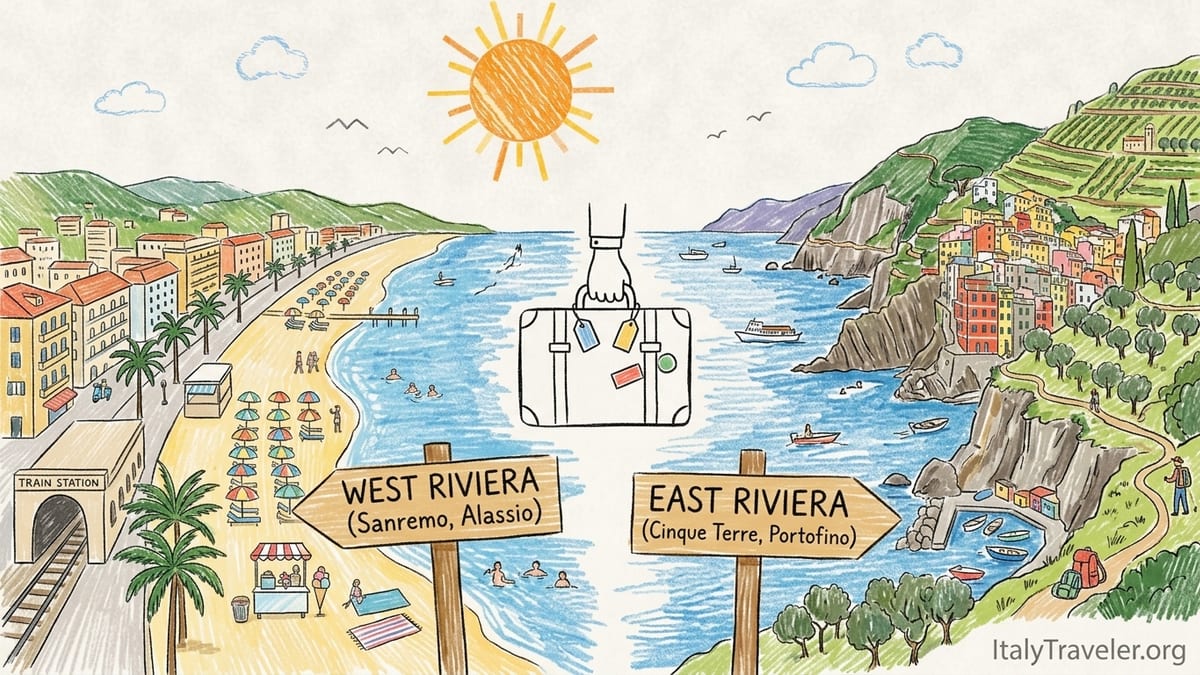
Think of the Riviera in two broad halves. To the west of Genoa, places like Sanremo, Alassio and Finale Ligure are classic resort towns with long, often sandy beaches and a relaxed holiday atmosphere. To the east of Genoa, villages such as Camogli, Portofino, Santa Margherita Ligure, Rapallo, Sestri Levante, Cinque Terre, Portovenere and Lerici sit against steeper hillsides, with smaller coves, colorful harbors and dramatic hiking terrain. Distances are short but the vibe changes quickly as you move along the coast.
Public transport shapes how easy each place is without a car. The main railway line hugs almost the entire shoreline, stopping right in town at Finale Ligure, Alassio, Sanremo, Genoa, Camogli, Rapallo, Santa Margherita Ligure, Sestri Levante and in all five Cinque Terre villages. Portofino, Portovenere and Lerici sit slightly off the line and are reached by bus, taxi or boat from nearby rail hubs such as Santa Margherita Ligure, La Spezia or Sarzana. For a traveler arriving by train from Milan or Pisa with luggage, choosing a town with a station close to the sea can make arrival and departure much smoother.
Prices also vary noticeably. A midrange double room in mid summer might average around 120 to 160 euro in Sestri Levante or Rapallo, but easily climb above 250 euro in Portofino or Monterosso’s seafront. In shoulder seasons such as May or late September, the same rooms can drop by a third, transforming once-in-a-lifetime destinations into more realistic options. If you are planning several nights of coastal downtime, it often makes sense to base in a slightly less famous town with good train or ferry links, then visit the hottest names like Portofino or Vernazza on day trips.
West of Genoa: Sanremo, Alassio and Finale Ligure
Sanremo is best for travelers wanting a mix of historic center, nightlife and promenade living. Its main station sits a short walk from the seafront, where a long bike path runs along converted railway tracks. Sandy and mixed-sand beaches such as the Ports Beach between the old harbor and Portosole offer classic rows of umbrellas, while the atmospheric old town of La Pigna climbs steeply behind the modern city. Evenings focus on the seafront bars and the casino area, with several cocktail spots offering aperitivo deals where a spritz and plate of snacks in high season may cost about 8 to 10 euro.
Alassio, about 80 kilometers from the French border, is a specialist destination for sandy beaches and families. Its shoreline is one of the longest sandy stretches in Liguria, with soft golden sand that shelves gently into the sea and is lined with tightly packed beach clubs. Many establishments organize children’s activities and have shallow, calm water that suits younger swimmers. In practice this means you can rent two sunbeds and an umbrella for around 30 to 40 euro per day in July, have lunch at a simple beach bar behind you and let kids play in the sand without worrying about steep drop offs or large pebbles.
Finale Ligure, on the line between Savona and Imperia, combines a wide resort beach with a charming terracotta-colored historic center just back from the water. The sandy beach near the station is busy and backed by a steady line of lidos and gelato stands, making it straightforward for a two or three night stay without a car. Inland, Finale is one of Europe’s major mountain biking hubs, so you will see vans shuttling riders up into the hills and specialist bike hotels offering wash stations and workshop areas. For many travelers, Finale works as a more relaxed and slightly less polished alternative to Alassio, while still offering classic sand-and-sea holidays.
Of the three, Alassio and Finale Ligure are the stronger choices for travelers focused on long, sandy beaches and family time, and they reward stays of three nights or more. Sanremo works better for one or two nights if you are interested in its music festival heritage, old town and nightlife, or if you are connecting with the French Riviera, since trains to Ventimiglia and onwards to Menton and Nice are frequent.
Genoa: Urban Culture Hub and Practical Gateway
Genoa (Genova) is a working port city, not a beach resort, and that is exactly why some travelers love it. The car-free medieval center behind the old harbor is one of the largest historic centers in Europe, filled with narrow alleyways, grand palazzi and neighborhood trattorias. You can spend a full day simply wandering from the aquarium and old docks up to Via Garibaldi, peeking into ornate courtyards and ducking into hole-in-the-wall bakeries selling focaccia by the slice for a couple of euro.
As a base, Genoa makes most sense for visitors who prioritize food, history and access to day trips over sunbathing. From Genoa Brignole or Genoa Piazza Principe stations, direct trains radiate in both directions. In a single day you can eat breakfast in the city, take a 40 minute train to Camogli for a seafood lunch on the harbor, then continue 20 minutes to Santa Margherita Ligure and boat to Portofino before returning to Genoa at night. If you are arriving internationally into Milan and want an easy first stop with big-city services and relatively affordable hotels, Genoa offers plenty of choice around the stations at prices that are often lower than the smaller Riviera resorts.
For travelers without a car, Genoa is one of the best-connected points on the coast. You can arrive by high-speed train from Milan in under two hours, then transition to a regional train for the rest of your trip. The trade-off is that the central city has only small urban beaches and busy roads along part of the waterfront. Genoa is not the place to settle for a week of swimming, but it does make an excellent two or three night base at the start or end of a broader Italian Riviera itinerary.
Gulf of Paradise to Tigullio: Camogli, Portofino, Santa Margherita and Rapallo
Just east of Genoa, Camogli is the first truly photogenic fishing village many travelers encounter. The tall pastel houses are stacked tightly along a pebble beach, and the harbor still has a working feel. Trains from Genoa Brignole reach Camogli in about half an hour, and the station sits above the main street so you can roll a suitcase down to many small hotels and guesthouses. Even though the beach is pebbly rather than sandy, families often appreciate the compact layout, relaxed nightlife and easy rail access. Camogli is also a gateway to the Portofino Regional Park, with popular hikes to San Fruttuoso abbey, where a small stone beach and clear water attract day trippers arriving by boat.
Portofino itself is small, glossy and expensive. The tiny harbor framed by pastel houses and luxury boutiques looks exactly like the postcards, but the village has only a few streets and limited midrange accommodation. Many visitors arrive on a half day excursion by ferry from Santa Margherita Ligure or Rapallo, wander up to the Brown Castle for views, have a coffee or drink at a waterfront terrace where a simple espresso might cost 4 to 5 euro, then sail or bus back out. As a result, Portofino often works better as a day trip than as a multi-night base unless you specifically want a high-end, secluded stay.
Santa Margherita Ligure and Rapallo form the practical heart of this part of the Riviera. Both have seafront promenades, a mix of pebbly and man-made small sandy sections, and wide choices of hotels and apartments within walking distance of the station. Santa Margherita feels a touch more polished, with elegant villas on the hillsides and a compact center full of restaurants and wine bars. Rapallo is larger and more urban, often slightly cheaper, with a small castle on the shore and frequent ferries to both Portofino and the southern villages around Sestri Levante and Portovenere in summer. For travelers without a car who want one base to combine Portofino, day trips to Cinque Terre by train and relaxed evenings with good dining options, Santa Margherita and Rapallo are two of the best all-round choices.
If you plan to stay four or five nights and do several day trips by boat and train, base in Santa Margherita or Rapallo. Use Camogli and Portofino as day-trip destinations for color, coastal walks and scenic harbors, unless you find a stay in a boutique hotel there that fits your budget and you are comfortable with quieter evenings and limited beach space.
Sestri Levante and Cinque Terre: Colorful Villages and Hiking
Sestri Levante sits on a narrow peninsula where two bays almost meet. One side holds the wide curve of the Baia delle Favole, with a sandy urban beach backed by hotels and a traffic-free promenade, while the far side shelters the smaller Baia del Silenzio, framed by pastel buildings and usually lined with sunbeds in season. The train station is a short, almost flat walk from both bays, so arriving with luggage is straightforward. Sestri’s sandy beach, child-friendly shallows and relaxed evening passeggiata make it a strong base for families who also want to take day trips into Cinque Terre or Portofino without losing a classic beach holiday atmosphere.
The Cinque Terre themselves are five villages, each with a distinct personality. Monterosso has the largest true beach, a mix of paid lidos and free sections with coarse sand and pebbles, and a lively strip of seafront bars and restaurants. Vernazza and Manarola are the most photographed, with colorful houses wrapped around tiny harbors where people sunbathe on rocks and swim off ladders. Riomaggiore stacks tall buildings above a small boat ramp, while Corniglia perches on a cliff and requires a stair climb or shuttle bus from the station. There is very limited car access and almost no parking in the villages, so most visitors arrive by train on the Cinque Terre Express or by coastal ferry in season.
Hiking is one of the main reasons to stay several nights in Cinque Terre. The famous Blue Trail that connects the villages has reopened in stages and is often partially accessible, but conditions still change with weather and maintenance, so you should check current trail status shortly before you travel. Even when parts of the coastal path are closed, alternative routes such as the Corniglia to Manarola hike via Volastra provide spectacular vineyard and sea views. In practice, spending two full days on the coast allows you to mix hikes, swims off rocks or small beaches, and relaxed aperitivo stops in more than one village.
Given high accommodation prices and crowding at midday, Cinque Terre is best for travelers willing to pay a premium to experience the villages in the early morning and late evening once day trippers leave. If you are on a tighter budget or prefer sandy beaches, Sestri Levante, Levanto or even Monterosso’s newer part near the station can be more practical bases. From Sestri, frequent direct trains reach Monterosso in under half an hour, making it easy to explore the villages by train with a daily rail pass while returning to a calmer base each night.
Portovenere and Lerici: Quiet Bays and Poets’ Landscapes
South of Cinque Terre, the coastline curves into the Gulf of La Spezia, also known as the Gulf of Poets. Portovenere sits on its western arm, a small medieval village with a row of tall, narrow houses painted in deep shades facing the harbor. Above the village, the church of San Pietro stands on a rocky promontory with sweeping views over the sea and the islands. There is no train station in Portovenere, so most travelers arrive by bus from La Spezia or by boat from the Cinque Terre and the Tigullio coast in high season. Once there, you can swim off rocks near the Grotta Byron, take short coastal walks or join boat trips out to the islands of Palmaria, Tino and Tinetto.
Lerici sits on the opposite side of the gulf, framed by a large fortress and waterfront promenade. The town has small sandy sections backed by lidos, and several beaches spread along the bay toward neighboring San Terenzo. It feels more residential than Portovenere, with a year-round population, neighborhood cafes and evening life that continues outside peak tourist months. Travelers without a car typically reach Lerici by bus from La Spezia or Sarzana, both on the main rail line, and then explore the bay on foot or by local shuttle boats in summer.
Both Portovenere and Lerici are appealing for travelers who prioritize sea views, relaxed evenings and short coastal walks over big-city services or large beaches. A traveler might spend three or four nights in Lerici, waking up to views of moored fishing boats, taking a morning dip at a nearby lido, then catching a boat across to Portovenere for lunch and a climb to the church. While Cinque Terre is often crowded midday, the Gulf of Poets has a softer pace, especially in the shoulder seasons of May, early June and late September.
Because neither Portovenere nor Lerici has direct rail access, they are less convenient for one-night stops if you are moving frequently with luggage. They shine when you slow down. If you have a week on the Riviera after visiting Florence or Tuscany, basing in Lerici or Portovenere gives you a quieter, more contemplative end to your trip while still allowing a day trip into Cinque Terre by boat or train-and-boat combination.
Beaches, Nightlife, Food and Car-Free Practicalities Compared
For sandy beaches, Alassio, Finale Ligure and Sestri Levante come first, followed by Monterosso and parts of Lerici. In these towns you can realistically plan full beach days, rent loungers and umbrellas, and find shallow, relatively calm water. Travelers with children will appreciate resorts where the beach starts close to the station, such as Alassio, Finale and Sestri, allowing an easy walk with strollers and gear. If you prefer swimming from rocks or small coves with clear water rather than sand, villages like Camogli, Vernazza, Manarola, Riomaggiore and Portovenere are more suitable.
When it comes to nightlife, Sanremo, Genoa, Santa Margherita Ligure and, to a lesser degree, Monterosso and Rapallo offer the best range of bars and late-opening restaurants. Sanremo’s seafront has both casual beach bars with DJ sets and more elegant cocktail terraces. Genoa’s historic center hides student bars and wine bars in its narrow alleys. Santa Margherita offers stylish waterfront aperitivo spots that fill from around 7 pm, where a glass of local Vermentino wine may cost 6 to 8 euro and arrive with generous snacks. In contrast, Portofino, Camogli, Cinque Terre villages, Portovenere and Lerici have evenings that are lively at aperitivo but generally quiet after midnight.
Food is a highlight across the Riviera, centered on seafood, pesto, focaccia and local wines. For travelers seeking a strong dining scene within easy walking distance, Genoa, Camogli, Santa Margherita Ligure, Sestri Levante and the Cinque Terre villages stand out. In practice this might mean grabbing a slice of focaccia di Recco filled with stracchino cheese in Camogli for around 4 euro, then sitting on the harbor wall to eat, or booking a family-run trattoria in Vernazza a day or two ahead during summer to secure a terrace overlooking the water. Santa Margherita and Sestri also have several gelato shops and bakeries clustered near the promenades, making it easy to build casual, budget-friendly meals between sit-down dinners.
For travelers without a car, the simplest bases are those directly on the main rail line with stations close to the water: Sanremo, Alassio, Finale Ligure, Genoa, Camogli, Rapallo, Santa Margherita Ligure, Sestri Levante and the Cinque Terre villages. In these places you can step off the train and walk to most hotels within 10 to 15 minutes, then use regional trains and boats for day trips. Portofino, Portovenere and Lerici require an extra bus or boat connection, which is perfectly manageable for a multi-night stay but adds friction for short one-night stops or for travelers with heavy luggage or mobility challenges.
How Many Nights in Each Place: Bases vs Day Trips
Some Riviera towns are natural multi-night bases, while others shine as day trips. As a rule of thumb, Alassio, Finale Ligure, Genoa, Santa Margherita Ligure, Rapallo, Sestri Levante, at least one Cinque Terre village, Lerici and Portovenere can all justify three or more nights depending on your interests. Alassio and Finale work for a week of beach time, especially with children. Sestri Levante supports a mix of beach days and excursions. Santa Margherita or Rapallo can anchor a four or five night stay combining Portofino, day trips to Cinque Terre and inland wine tastings.
Camogli, Portofino and individual Cinque Terre villages such as Vernazza or Manarola are ideal for one or two night stays if you want to experience them in the quiet hours, but many travelers happily visit them as day trips from bigger bases. For example, you might base in Santa Margherita Ligure for three nights, visiting Portofino one morning by boat and hiking to San Fruttuoso another day, or stay in Sestri Levante and spend one long day hopping between the Cinque Terre villages by train and short hikes. Because overnight stays in the most famous villages are costly and book up early, using nearby towns as bases is often more flexible.
Sanremo and Genoa often work better at the beginning or end of a trip. You might fly into Milan or Nice, take a train to Sanremo for two nights of seaside walks and casino glamour, then continue on to the eastern Riviera. Similarly, two or three nights in Genoa can frame a coastal itinerary with urban culture and good rail connections. Portovenere and Lerici suit travelers who have already enjoyed the busier parts of the coast and now want a quieter environment for three or four nights of slower travel.
When planning, remember that moving between bases takes time and energy, especially in high summer when regional trains can be crowded. For a seven night trip, consider choosing two different bases, one on the western side such as Alassio or Finale and one on the eastern side like Santa Margherita, Sestri or Lerici, rather than changing hotel every night. This way you can explore many of the named places on comfortable day trips while still unpacking your suitcase only twice.
The Takeaway
The Italian Riviera is compact enough that you can see several headline destinations in a single week, but varied enough that choosing the right base matters. West of Genoa, Alassio and Finale Ligure excel at sandy, family-friendly beaches, while Sanremo adds nightlife and an easy link to the French Riviera. Genoa itself is the cultural and transport hub, ideal for travelers interested in history and food more than sunbeds.
East of Genoa, Camogli and Sestri Levante offer a sweet spot between scenic beauty, reasonable prices and practical train access, with Sestri adding one of the best sandy bays on this side of the coast. Santa Margherita Ligure and Rapallo stand out as flexible, well-connected bases for exploring Portofino and even making long day trips to Cinque Terre by train or boat. The Cinque Terre villages are spectacular but crowded and expensive, rewarding those who stay overnight and explore early and late in the day.
Further south, Portovenere and Lerici give a quieter, more reflective perspective on the Ligurian coast, with shorter walks, sea views and comfortable swimming spots. They are perfect for travelers finishing a longer Italy itinerary who now want a slower pace. By deciding whether your priorities are sandy beaches, hiking, nightlife, luxury, family convenience or car-free ease, and then matching those priorities to the right town or combination of towns, you can turn a beautiful coastline into a trip that feels tailored to you rather than a sprint between famous names.
FAQ
Q1. Which Italian Riviera town is best for sandy beaches with children? Alassio and Finale Ligure are top choices, with long sandy beaches, shallow water and many family-oriented beach clubs and facilities close to town.
Q2. If I do not have a car, where should I base to see Portofino and Cinque Terre? Santa Margherita Ligure or Rapallo work very well, as both sit on the main rail line and have frequent boats and buses to Portofino and easy train connections to the Cinque Terre.
Q3. Is it worth staying overnight in a Cinque Terre village instead of day tripping? Yes, if your budget allows, staying one or two nights lets you enjoy the villages in the quieter early morning and evening hours after most day trippers leave.
Q4. Which place is best for nightlife on the Italian Riviera? Sanremo, Genoa and Santa Margherita Ligure offer the liveliest mix of bars and late-opening restaurants, while many smaller villages become calm after dinner.
Q5. Where should I stay for a mix of beach, food and day trips without changing hotels too often? Sestri Levante, Santa Margherita Ligure and Rapallo are strong all-round bases, each with a seafront, good dining and direct train or boat links for varied day trips.
Q6. Is Portofino a good base for several nights? Portofino is beautiful but small, expensive and has limited midrange accommodation, so most travelers prefer to visit on a day trip from Santa Margherita Ligure or Rapallo.
Q7. Which towns are best for hiking? The Cinque Terre villages are the prime hiking base, with multiple coastal and hillside trails, while Camogli and Portofino also have excellent walks in the Portofino Regional Park.
Q8. What is the best destination for history and culture rather than beaches? Genoa offers the richest mix of historic palaces, museums and a large medieval center, while smaller towns like Portovenere and Lerici add atmospheric castles and churches.
Q9. Are Portovenere and Lerici suitable without a car? Yes, both can be reached by bus from La Spezia or Sarzana and by seasonal boats, though you should allow extra time for transfers compared with rail-connected towns.
Q10. How many nights should I plan on the Italian Riviera for a first visit? With five to seven nights you can choose two bases, for example Alassio and Santa Margherita Ligure, and comfortably explore several other towns as day trips without rushing.