


The Italian Lakes are one of Europe’s classic holiday regions, but first-time visitors are often overwhelmed by choice. Lake Como, Lake Garda and Lake Maggiore are the headline names that appear in every 2026 guide, with the quieter Lake Iseo and Lake Orta praised as worthwhile smaller alternatives. Each lake has its own character, transport quirks and ideal bases. This guide explains how they differ, how to move around by ferry and train, and why you usually do not need to visit every lake on a single trip.
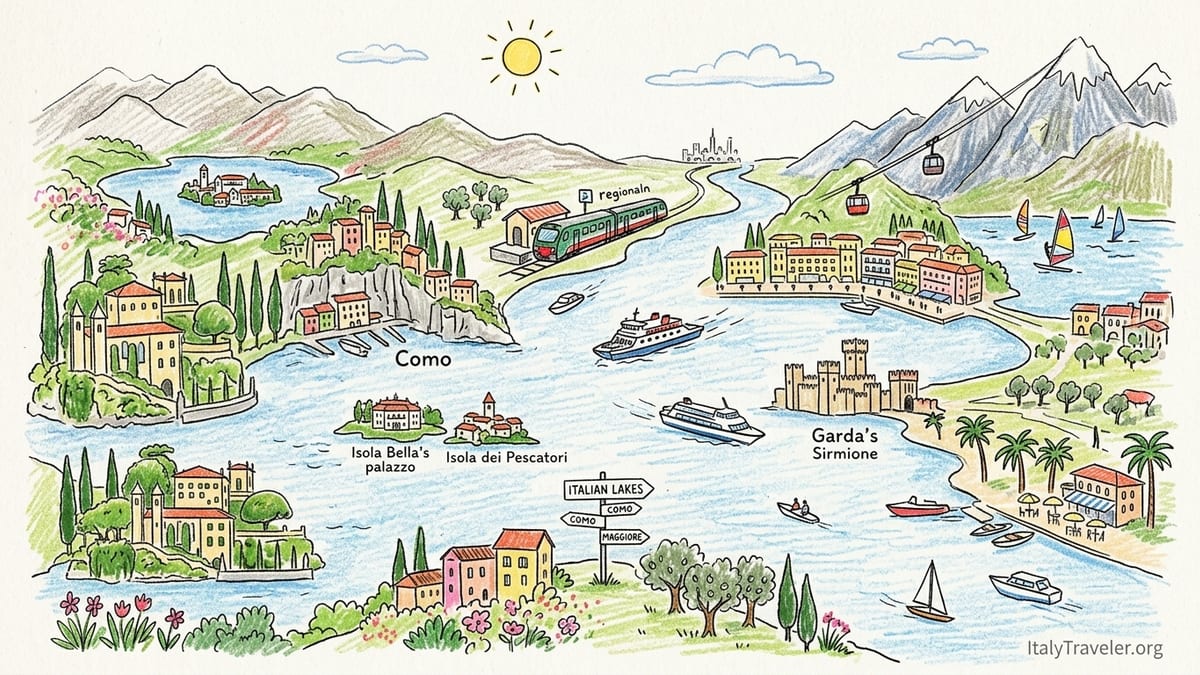
Understanding the Italian Lakes Region
The five lakes in this guide stretch in an arc across northern Italy, from Lake Orta in the west across to Lake Garda in the east. Lake Garda, Lake Maggiore and Lake Como are large alpine lakes, each well over 100 square kilometres in surface area, with long shorelines, sizeable resort towns and busy ferry systems. Lake Iseo and Lake Orta are much smaller in comparison, with quieter waterfronts and more local-feeling villages. All five can be reached within roughly two to three hours of Milan by a combination of trains and regional buses or ferries.
For a first visit, it helps to think of the Italian Lakes not as one destination but as several different short trips. Many first-time itineraries focus on just one major lake, or combine two that connect logically by train. For example, a classic eight-day route might pair Lake Como and Lake Maggiore before returning to Milan, or spend a week looping Milan, Lake Garda and Verona. Trying to add Iseo and Orta to the same week often turns a relaxing holiday into a chain of hotel check outs and transfers.
Transport is a defining feature of the region. Ferries on Como, Garda, Maggiore and Iseo operate year-round public services linking lakeside towns, with more departures in spring and summer. Trains from Milan reach Como town, Varenna on Lake Como’s eastern shore, Desenzano and Peschiera on Lake Garda’s southern shore, and Stresa and Laveno on Lake Maggiore. Separate branch lines connect Brescia to Lake Iseo and regional trains link Novara and Domodossola with Lake Orta and Lake Maggiore. Once you understand that most people combine trains for the long stretches and ferries for the short hops, planning becomes much easier.
Air access is also straightforward. Milan Malpensa and Milan Linate are the main gateways for Lake Como and Lake Maggiore, with Bergamo Orio al Serio a useful low-cost hub for Como, Iseo and Garda. Verona’s airport works well for Lake Garda, particularly if you plan to base in Sirmione or the southern resorts. Turin’s airport is another option for Lake Maggiore and Lake Orta. In practice, many visitors simply fly into whichever of these airports offers the best schedule and fare, then connect by regional train.
Lake Como: Villas, Ferries and Steep Villages
Lake Como is one of Italy’s most recognisable landscapes, a deep Y-shaped lake backed by steep mountains and lined with villas. It is also relatively compact compared with Garda and Maggiore, which means that the central section around Bellagio and Varenna concentrates much of what first-time visitors hope to see. Como, the main town at the southern tip, feels like a small city with a cathedral, waterfront promenade and easy train connections to Milan. Many first-timers choose between staying in Como for convenience or in the smaller villages in the central lake for scenery.
Bellagio sits where the three arms of the lake meet and is often described as the showpiece village, with narrow lanes, boutique hotels and views in all directions. It has no train station, so most visitors arrive by ferry, often after taking a regional train from Milano Centrale to Varenna-Esino and then the 15-minute ferry across the water. Varenna on the eastern shore feels quieter and more compact than Bellagio, with a small old town, swimming spots along the lakefront and direct trains back to Milan. Como, Bellagio and Varenna are linked by a web of ferries, including slower “battello” boats and faster hydrofoils in season, and a car-ferry triangle between Bellagio, Varenna and Menaggio.
Lake Como’s villa culture is a major draw. Real-world examples include Villa Carlotta near Tremezzo, where visitors pay a moderate entry fee to walk through formal gardens and view 19th-century interiors, and Villa del Balbianello near Lenno, which sometimes requires timed tickets in peak season. Many first-time visitors will spend one day simply ferry-hopping between Bellagio, Varenna and these villa stops, building in time for a lakeside lunch and a swim from a lido or public beach. Expect to pay a modest daily fee at private lidos that include sun loungers and changing cabins, or nothing for a simple public pebble beach.
From Milan, trains to Como San Giovanni or Varenna-Esino typically take around an hour, run many times per day and cost roughly the price of an ordinary regional ticket rather than a premium tourist fare. This means that Como makes a realistic day trip, even in high season, and many visitors will time their arrival in Bellagio or Varenna for mid-morning to avoid the biggest crowds. Ferries are frequent in summer, but first-timers should still check the current Navigazione Laghi timetable a few days before travel and allow a buffer for queues at busy piers. Driving is rarely the best option: roads around the lake are narrow and twisty, and parking near Bellagio or Varenna can be limited and expensive.
Lake Garda: Italy’s Largest Lake and a Tale of Two Shores
Lake Garda, the largest lake in Italy, stretches dramatically from the Alpine foothills in the north down to the flat plains near Verona in the south. Its size means the character of the lake changes markedly from one end to the other. The southern shore around Sirmione, Desenzano and Peschiera has a milder climate, broad promenades and easy rail access. The northern end, including Riva del Garda and Malcesine, is windier and more dramatic, framed by cliffs that attract sailors, windsurfers and hikers. Visitors often choose a base depending on whether they prioritise relaxed lakeside strolling and day trips to Verona, or mountain views and outdoor sports.
Sirmione is one of the best known bases on Lake Garda for first-timers. The historic center sits on a long peninsula, reached via a causeway and overlooked by a medieval castle. Non-resident cars are generally stopped before the castle, so many visitors park in signed lots outside the pedestrian zone and walk into town. Once there, people combine lake-view gelato shops, small thermal spas and short boat trips with swims from the south-facing beaches. Riva del Garda, at the northern tip, feels more alpine, with pastel façades around a small harbor and easy boat connections to towns along the western and eastern shores. Malcesine on the eastern shore combines a compact old town with a cable car up Monte Baldo for high-level hiking and views over the length of the lake.
Transport on Lake Garda is varied but requires a bit of planning. Ferries and fast boats criss-cross the lake, particularly between popular stops such as Sirmione, Desenzano, Riva, Limone and Malcesine. In high season, boats run frequently during the day, though services thin out in shoulder seasons and evenings. Trains from Milan and Verona serve Desenzano del Garda and Peschiera del Garda, both on the south shore, which makes these towns convenient arrival points for visitors without a car. From there, buses and ferries fan out to other resorts. Many visitors buy a one-day ferry pass in summer, allowing them to hop between towns rather than commit to a single out-and-back route.
Because of its size, Lake Garda can feel busy at peak times, particularly in July and August when holidaymakers from across Europe converge on its campgrounds, lakeside promenades and beaches. For first-timers, late May, June and September are often more comfortable, with warm enough water for swimming, long daylight hours and less crowding on ferries. Prices for lakefront hotels in Sirmione and Riva reflect the popularity of these locations, so budget travelers might look at slightly inland villages served by local buses, or at self-catering apartments a few minutes’ walk from the shore.
Lake Maggiore: Stresa, Islands and a Relaxed Pace
Lake Maggiore straddles Italy and Switzerland, with elegant resort towns, palm-lined promenades and a slightly more relaxed atmosphere than Garda in peak season. It is the second largest of the Italian Lakes by surface area and stretches in a long north-south line. For first-time visitors, the Italian town of Stresa on the western shore is a natural base. Stresa has waterfront hotels, a small historic center and, most importantly, a pier with frequent boats to the Borromean Islands: Isola Bella, Isola dei Pescatori and Isola Madre.
The Borromean Islands provide one of the region’s signature experiences. A typical day might see visitors catching a morning boat from Stresa to Isola Bella, touring the ornate palazzo and terraced gardens, then moving on to Isola dei Pescatori for a simple lunch of lake fish at a trattoria facing the water. In the afternoon, they might continue to Isola Madre to walk through botanical gardens and shaded paths before returning to Stresa by late afternoon. Ferries and private boat services operate this circuit regularly in the main season from late spring to early autumn, with ticket sellers at Stresa’s lakeside promenade.
Maggiore’s ferry system is run as part of the same Navigazione Laghi network that serves Como and Garda, and provides year-round links between Italian towns such as Stresa, Verbania and Baveno and Swiss towns like Locarno and Ascona. This makes it possible, for instance, to travel by train from Milan to Stresa in around an hour, base there for several days, then continue onward by boat and train into Switzerland. Many travelers use a combination of regional trains and ferries, occasionally adding a short taxi ride to reach hotels that are not directly on the main piers.
Compared with Lake Garda, Lake Maggiore’s vibe feels slightly quieter and more old-fashioned, with a mix of grand waterfront hotels and smaller guesthouses. Swimming is possible from designated beaches, some of which charge a small entry fee and provide changing cabins and cafés. The surrounding hills offer gentle walking routes and viewpoints, and scenic mountain railways and cable cars operate in season. For first-timers, Maggiore works well either as a standalone base for four to five nights or combined with Lake Como or Lake Orta via train and ferry.
Lake Iseo: Monte Isola and a Local Feel
Lake Iseo is smaller and less internationally famous than Como, Garda and Maggiore, which is precisely what appeals to many visitors. It lies roughly between Bergamo and Brescia and is easily reached from those cities by regional train to Iseo or other lakeside stops. The atmosphere feels more local, with fewer large resort hotels and more small family-run properties and apartments. Prices for lakeside accommodation and restaurant meals are often a little lower than on Como or Garda, which can make Iseo attractive for longer stays or for travelers who prefer to avoid the busiest tourist centers.
The standout feature of Lake Iseo is Monte Isola, the wooded island that rises steeply from the middle of the lake. Regular passenger ferries connect Monte Isola to several lakeside towns, with a frequent shuttle from Sulzano that takes only a few minutes. Visitors typically spend a day walking or cycling around the island’s lower roads, stopping in small villages and at lakeside trattorias. Cars are heavily restricted on Monte Isola, so movement is by foot, bicycle and small local buses, which contributes to a quieter, slower rhythm.
Swimming in Lake Iseo is popular in summer, especially at designated beaches and lidos on the eastern and western shores and on Monte Isola itself. While the water is cooler than in the Mediterranean, it usually becomes comfortable for swimming from June through early September. Ferries operate year-round on the lake, though with a reduced schedule outside high season. This reliable ferry network makes it easy to base in one town, such as Iseo, and still explore the island and opposite shore without a car.
For first-time visitors weighing Iseo against the better known lakes, the main differences are scale and atmosphere. There are fewer famous villas or headline sites than on Como or Maggiore, and nightlife is limited compared with Garda’s larger resorts. On the other hand, the lakefront feels less crowded, and it is still straightforward to combine a few days on Lake Iseo with city time in Bergamo or Brescia thanks to regular trains. Many travelers who have already visited Como or Garda choose Iseo as a second or third lake for a slower, more low-key experience.
Lake Orta: Orta San Giulio and Intimate Shores
Lake Orta, west of Lake Maggiore, is the smallest and most intimate of the lakes covered here. Its compact size and limited number of towns give it a tranquil, almost secluded character compared with the big three lakes. The main hub for visitors is Orta San Giulio, a pretty town on a peninsula that juts into the lake and faces the small island of Isola San Giulio. Narrow cobbled streets, a main piazza by the water and a small network of lanes climbing uphill create a village atmosphere that feels distinct from the busier resort towns of Garda and Como.
Most first-time visitors base themselves in or near Orta San Giulio. From the waterfront, small ferries shuttle across the short distance to Isola San Giulio, where a stone path encircles the island and visitors can admire lakeside views and a historic basilica. A typical day in Orta might include a morning ferry to the island, a long lunch in a lakeside restaurant back in town and an afternoon swimming from a public jetty or paying a modest fee for access to a local lido. The lake is small enough that even without a car, a visitor can gain a good sense of it over two or three days.
Getting to Lake Orta usually involves a regional train to a nearby station such as Orta-Miasino or a transfer from larger rail hubs like Novara or Domodossola. From there, short taxi or bus rides cover the final stretch to the lakeside. There is no large ferry system like on Como or Garda, but small boat services link the key points, and many hotels can help arrange private boat trips in season. This relative isolation helps keep Orta quieter, especially in the evenings once day trippers have left.
Because it does not have large towns or big resort infrastructure, Lake Orta particularly suits travelers looking for a peaceful base rather than a busy schedule of sightseeing. It works well combined with Lake Maggiore, since the two are relatively close, or as a short add-on to a trip that starts and ends in Milan or Turin. For a first-time visitor who wants to experience one of the Italian Lakes without the intensity of high-season crowds, Orta can be an appealing alternative to the big three.
Choosing Your Lake and Planning Seasons, Airports and Transport
When planning a first trip, the most important decision is which lake or lakes to focus on. Most 2026 guides agree that Como, Garda and Maggiore are the three headline lakes, with Iseo and Orta acting as smaller, worthwhile alternatives. For a week-long holiday, a realistic pattern is to choose one major lake as your main base and, if you enjoy moving around, add a second lake that connects logically by train. For example, five nights on Lake Como and two nights on Lake Maggiore work well using Milan as the rail hub. Attempting to cover Como, Garda, Maggiore, Iseo and Orta in a single week usually means packing and unpacking every day or two and spending a lot of time on trains and buses rather than by the water.
Seasonality matters. From late June through August, all of the lakes can be very busy, particularly Como’s central villages, Sirmione and Riva on Lake Garda, and Stresa on Lake Maggiore. Ferries run most frequently in these months and water temperatures are warmest for swimming, but crowds and prices are at their peak. Late April, May, June and September are often ideal for first-timers, combining generally pleasant weather, lighter crowds and full ferry timetables. In October, many hotels and seasonal restaurants begin to close, and ferry services reduce, though the lakes can still be atmospheric for quiet walks and day trips.
Airports play a supporting role in route planning. For Lake Como and Lake Maggiore, Milan Malpensa offers direct trains into the city and onward connections, while Linate is convenient for central Milan but requires a change to reach the lakes. Bergamo Orio al Serio, used heavily by low-cost airlines, is especially practical for Lake Iseo and for some parts of Lake Garda when combined with regional trains and buses. Verona’s airport is the closest to Lake Garda’s southern shore and is useful if you plan to base in Sirmione, Desenzano or Peschiera. Turin’s airport works for Lake Maggiore and Lake Orta, particularly if you are combining the lakes with time in Turin itself.
On the ground, first-timers should lean on public transport whenever feasible. Regional trains in northern Italy are relatively frequent and affordable, with set prices that are usually much lower than hiring a car for a week. Ferries on the main lakes operate as regular public services rather than private tours, and buying point-to-point tickets at the pier is the norm. For example, a visitor might pay a modest sum for a one-way ferry from Varenna to Bellagio, another small amount for Bellagio to Menaggio, and slightly more for long-distance boats that cross whole sections of Como or Garda. Taxis fill the gaps but can be expensive over longer distances, particularly around Lake Garda, so it is worth checking local bus timetables in advance.
The Takeaway
The Italian Lakes offer much more variety than a single postcard view suggests. Lake Como concentrates villas, ferry-hopping and steep little villages around its central basin. Lake Garda stretches from Mediterranean-feeling south to alpine north, with Sirmione, Riva and Malcesine each offering a different balance of history, lakeside strolling and mountain scenery. Lake Maggiore combines genteel resort towns with the island palaces of the Borromean Gulf. Lake Iseo and Lake Orta, meanwhile, offer smaller-scale alternatives built around Monte Isola and Orta San Giulio.
For first-time visitors, the key is to resist the urge to see everything in one go. Choosing one or at most two lakes that match your interests and travel style will usually result in a more relaxed and memorable trip than racing between all five. Think in terms of concrete days: perhaps three days of ferry-hopping and villa visits on Como, followed by three days exploring the Borromean Islands from Stresa, or a few days of swimming and strolling in Sirmione balanced with quieter walks on Monte Isola. With good train and ferry links, you can always return to discover a different lake on a future trip.
Whichever lake you pick, build in time simply to sit by the water, watch ferries come and go, and notice the differences between morning calm and evening lights across the water. The Italian Lakes reward slow travel, and first-timers who plan carefully, use public transport and avoid overpacking their itinerary often find that a single well-chosen base delivers the classic lakes experience they were hoping for.
FAQ
Q1. Do I need to visit more than one lake on my first trip?
Most first-time visitors do not. Focusing on a single lake such as Como, Garda or Maggiore for five to seven nights gives plenty of time to explore by ferry and relax without constant packing and transfers.
Q2. Which lake is easiest to reach from Milan without a car?
Lake Como is usually simplest, thanks to frequent direct trains from Milano Centrale to Como San Giovanni and Varenna-Esino and short ferry links onward. Lake Garda and Lake Maggiore are also straightforward via trains to Desenzano, Peschiera or Stresa.
Q3. Is Lake Garda or Lake Como better for a family holiday?
Both work well, but Lake Garda often suits families thanks to its larger beaches, campgrounds and easy access to theme parks and bike paths. Lake Como feels more about villas, views and village-hopping and may appeal more to couples or older families.
Q4. Can I swim in all of the Italian Lakes mentioned here?
Yes, swimming is common in summer on Como, Garda, Maggiore, Iseo and Orta, especially at designated beaches and lidos. Water temperatures are usually comfortable from roughly June to early September, though conditions vary with weather and location.
Q5. Do I need to book ferries in advance?
On most regular public ferries you simply buy tickets at the pier on the day. Booking is more relevant for private boat tours, car ferries on very busy weekends, or special excursions. In high season, arriving at the pier early for popular routes helps avoid long waits.
Q6. Which lake is best if I want a quieter, local atmosphere?
Lake Iseo and Lake Orta generally feel less crowded and more local than the big three. Monte Isola on Lake Iseo and Orta San Giulio on Lake Orta are good choices if you prefer small villages, simple trattorias and calmer promenades.
Q7. What is the best season to visit the Italian Lakes?
Late April, May, June and September usually offer a good balance of pleasant temperatures, active ferry schedules and manageable crowds. July and August bring the warmest water and longest days but also the highest prices and busiest promenades.
Q8. Are the Italian Lakes expensive compared with other parts of Italy?
Lakefront hotels and restaurants in hotspots such as Bellagio, Sirmione and Stresa can be relatively expensive. Budget-conscious travelers often save by staying a few streets back from the water, choosing self-catering apartments, or basing in smaller towns linked by ferry or train.
Q9. Is it worth renting a car for the Italian Lakes?
A car can be useful for accessing rural areas and hill villages, but in many lake towns narrow roads, limited parking and traffic restrictions make driving stressful. For most first-timers, a mix of trains, ferries and occasional taxis works well, especially on Como, Garda and Maggiore.
Q10. How far in advance should I book accommodation?
For visits in May, June or September, booking several months ahead is sensible for popular spots like Bellagio, Sirmione and Stresa. For July and August, it is wise to secure lakefront hotels even earlier, while off-season stays in October or early spring usually allow more flexibility.