


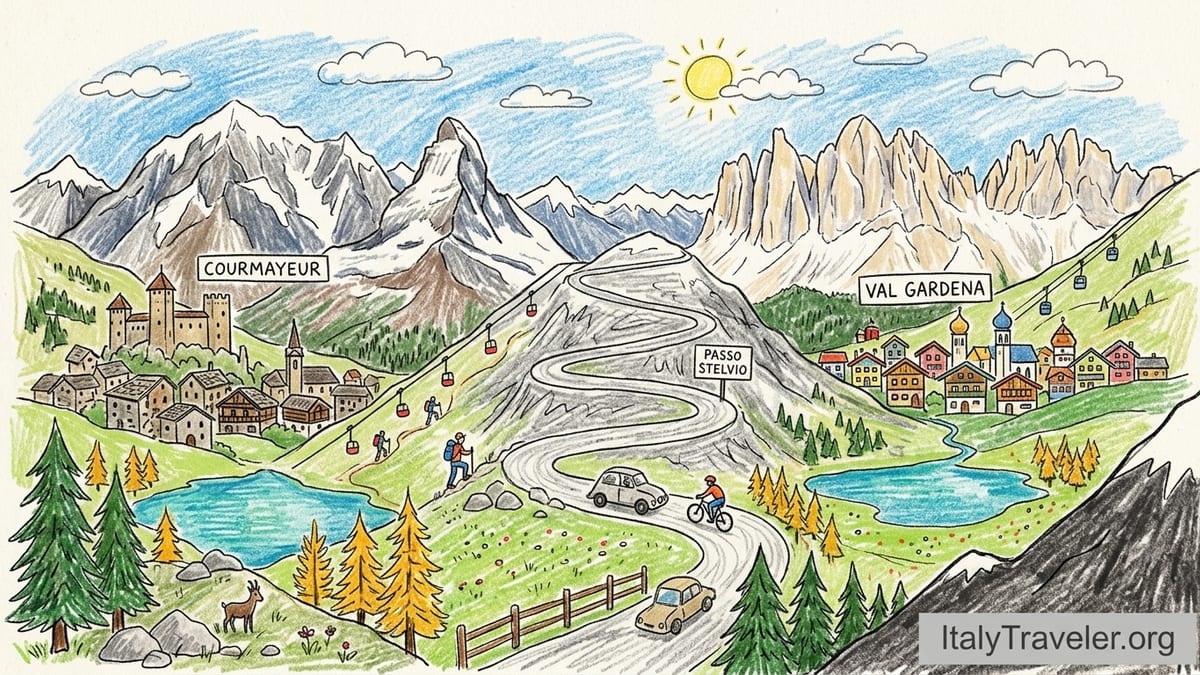
The Italian Alps stretch in a dramatic arc from the French border to Slovenia, taking in glaciated peaks, storybook villages and some of Europe’s most accessible high-mountain landscapes. For a first-time visitor, it can be hard to understand how Aosta, Lombardy, Trentino, South Tyrol and the Dolomites all fit together, or how to choose between Courmayeur, Val Gardena or Cortina. This guide gives a practical, year-round overview of the Italian Alpine arc, with concrete examples on where to ski, hike, soak in thermal baths and ride cable cars, plus how to move around by train or car in different seasons.
Understanding the Italian Alpine Arc
The Italian Alps form a continuous chain, but travel planners usually divide them into four broad areas: the Aosta Valley and Western Alps on the French and Swiss borders, the mountains of Piedmont, Lombardy and the Stelvio area in central Northern Italy, and finally Trentino, South Tyrol and the Dolomites to the east. The Dolomites are geographically part of the Alps and sit within regions such as Trentino Alto Adige and Veneto, yet their pale rock towers, wide bowls and distinctive villages have created a tourism identity strong enough that most guidebooks and tour operators treat them as a separate hub.
For a first trip, it helps to think in terms of what you want to prioritise. If you dream of Mont Blanc views, historic castles and classic ski resorts, the Aosta Valley and Western Alps are a natural starting point. If you like tax-free shopping and high passes, the Valtellina around Livigno and Bormio in Lombardy is appealing. Hikers who want flower-filled meadows, easy access to rifugi and a mix of Italian and Austrian culture often gravitate to Trentino and South Tyrol. Those seduced by iconic images of jagged limestone spires, rolling green pastures and wooden rifugi perched on hillsides are usually picturing the Dolomites.
Distances across the arc are shorter than many people expect, but the mountains slow you down. Driving from Turin to Courmayeur takes about two hours in normal conditions, while Milan to Bormio or Madonna di Campiglio is often four to five hours by car, more if you hit weekend traffic. Rail journeys such as Milan to Bolzano or Trento usually take around three hours with at least one change, so it is realistic to combine two areas in a week, but you will want to avoid constant point-to-point travel.
Seasonality is crucial. Ski areas typically operate from late November or early December to early April, depending on snowfall and altitude. High mountain passes like the Stelvio usually open around early June and close again by late October, and exact dates vary with snow conditions. Hiking, via ferrata and lake swimming are at their best from late June through September. Autumn is underrated, with quieter trails and larch forests turning deep gold in places such as the Aosta side valleys and the Dolomites.
Aosta Valley and the Western Alps: Courmayeur, Cervinia and Monte Rosa
The Aosta Valley is Italy’s smallest region but has some of its biggest mountain names, including the Italian flanks of Mont Blanc, the Matterhorn and Monte Rosa. Courmayeur sits at the southern foot of Mont Blanc, a compact town with cobbled streets, high-end boutiques and a reputation for stylish weekender breaks from Milan and Turin. In winter, its Courmayeur Mont Blanc ski area offers a mix of red and black runs above the tree line and long forest tracks back to town, with a single-day adult lift pass often priced in the region of 70 to 80 euros for peak dates. The Skyway Monte Bianco cable car lifts sightseers and skiers to Punta Helbronner at over 3,400 metres, where on clear days you can step out onto terraces with full-circle Alpine panoramas.
Further east, Cervinia sits on a high plateau below the southern face of the Matterhorn, known as Monte Cervino in Italian. Linked with Zermatt in Switzerland, it offers one of the largest ski domains in the Alps, including summer skiing on the glacier above Plateau Rosa in good snow years. The village is higher and more purpose-built than Courmayeur, with a long central street of rental shops, pizzerias and hotels, and a strong focus on long intermediate pistes that appeal to confident but not expert skiers. Prices in cafes and mountain restaurants are generally lower than over the border in Zermatt, which is one reason many budget-conscious visitors choose to stay on the Italian side.
Monte Rosa, accessed from Aosta Valley villages like Gressoney and Champoluc and from Alagna in Piedmont, is famous for long off-piste itineraries and a quieter, more traditional feel. The Monterosa Ski area links three valleys with mainly red runs and spectacular views of 4,000 metre peaks. In summer these valleys are a gateway to multi-day hut-to-hut hikes through the Monte Rosa massif and to classic high passes used for sections of the long-distance Tour of Monte Rosa and Tour du Mont Blanc. Many rifugi here are simple former shepherd huts with dormitories, shared meals, and half-board rates that often fall in the 60 to 90 euro per person range, offering an affordable immersion in high-mountain life.
Courmayeur and the Aosta Valley are not only winter destinations. In July and August, the valley becomes a base for trail running, alpine hiking and spa weekends. Day hikes from Courmayeur into Val Ferret and Val Veny give direct views of Mont Blanc’s southern face, and local guides can arrange glacier walks on the Italian side of the massif for small groups. Many visitors pair hiking with wellness by staying in hotels that have small spas and saunas, or by booking a day pass at a dedicated spa complex, where a typical three to four hour access ticket might cost somewhere between 50 and 70 euros and include indoor and outdoor thermal pools with mountain views.
Piedmont: Sestriere and the Western Ski Circuit
Moving south and slightly east, Piedmont’s Alps form a long barrier along the French border. Sestriere is one of the best-known resorts here, sitting at around 2,000 metres on a high col between the Susa and Chisone valleys. Built in the 1930s and significantly upgraded for the 2006 Turin Winter Olympics, Sestriere is part of the vast Via Lattea, or Milky Way, ski area, which spreads across multiple Italian villages and links with Montgenèvre in France. A typical day on the slopes might see you breakfasting in Sestriere, skiing over ridges to Sauze d’Oulx for lunch in a wood-panelled rifugio, then looping back in time for late-afternoon aperitivo in Sestriere’s compact centre.
Architecturally, Sestriere has a functional, sports-focused feel with modern hotels, apartment blocks and the distinctive cylindrical towers that dominate its skyline. For many visitors, the appeal lies less in Alpine charm and more in the practicality of ski in and ski out accommodation and the chance to cover large distances on skis. Lift passes for the full Via Lattea are usually competitively priced compared with big-name French domains, which attracts ski clubs and university groups from across Europe. Off the slopes, evenings tend to focus on simple trattorie, lively bars and occasional live music events rather than fine-dining gastronomy.
In summer, the Susa Valley and its side valleys are bases for hiking and cycling. Road cyclists come for long climbs such as the Colle delle Finestre, while mountain bikers use chairlifts to access high trails. Historic sites, including fortresses like Fenestrelle and ancient alpine passes, add interest to day trips from the Turin area. Villages lower down the valley, such as Bardonecchia, offer a greener, forested feel and family-friendly walks to alpine lakes that thaw by late June or early July, depending on the year’s snowpack.
Piedmont’s alpine villages are also known for food and wine. While the famous Barolo and Barbaresco vineyards sit in the rolling Langhe hills rather than in the high mountains, their influence on local restaurant menus is strong. It is easy to combine a few ski days in Sestriere or Monte Rosa with a detour to Alba or Asti for truffle dishes and wine tastings, especially in autumn when the weather in the Alps is often clear and cool and the valleys are less crowded than in peak winter.
Lombardy and the Stelvio Area: Livigno, Bormio and High Passes
East of Piedmont, Lombardy’s Alps include wide valleys such as Valtellina, home to Livigno and Bormio, and the road to the Stelvio Pass. Livigno sits in a high, broad valley close to the Swiss border and is designated a duty-free zone. That status means lower prices on fuel, alcohol and some goods, which has made it popular with Italian and international visitors alike. The village stretches along the valley floor with a mix of modern hotels, apartments and shops. Its ski area has extensive intermediate terrain on both sides of the valley, and a long snow-sure season that often runs from late November to early May. Snowparks and wide pistes make it attractive to snowboarders and freestyle skiers.
Bormio, further down Valtellina, combines a medieval historic centre with famous thermal baths and a World Cup downhill ski run. The Stelvio piste on Bormio’s home mountain hosts elite men’s downhill races most winters, and recreational skiers can test themselves on the same steep, shaded course. Off the slopes, the town’s spa culture is a major draw. There are multiple bath complexes that draw on hot springs, ranging from relatively simple pools built into the hillside to full-service day spas with saunas, steam rooms and relaxation areas. Day access tickets often cost in the region of 40 to 70 euros depending on the facility and included services, and many visitors book an evening session after skiing or hiking.
Above Bormio, the Stelvio Pass road climbs in tight hairpins to more than 2,700 metres, one of the highest paved passes in the Alps. It is famous among drivers and cyclists for its stacked switchbacks and lunar scenery. The pass is closed in winter and usually reopens sometime in late May or June, often around the beginning of June in an average year, though heavy snow seasons can delay that. This makes it important for drivers planning a grand tour to check current road status shortly before departure rather than relying on an assumed opening date. In late October and early November, fresh snowfalls can also trigger early closures even if no official winter shutdown has begun.
Summer in Valtellina is equally active. Livigno transforms into a mountain biking base with chairlifts carrying riders and bikes up to flow trails and technical descents, while hikers head for lakes such as Lago di San Giacomo or high plateaus dotted with alpine huts. Around Bormio, national parkland protects valleys like Val Viola and Val Zebrù, where well-marked paths lead to remote rifugi that serve polenta, local cheeses and hearty stews to day hikers and overnight guests. Lower in Lombardy, lakes such as Como and Iseo can easily be combined with time in the high Alps, giving a mix of waterfront relaxation and mountain air on a single trip.
Trentino, South Tyrol and the Dolomites: Madonna di Campiglio, Val Gardena and Cortina
To the east, the autonomous region of Trentino Alto Adige, made up of the provinces of Trentino and South Tyrol, forms a transition between the central Alps and the Dolomites. Madonna di Campiglio in Trentino is a sophisticated resort set in the Brenta Dolomites, with elegant hotels, traffic-free streets and a long-standing reputation among Italian skiers. Its ski area offers wooded runs that rise above town and link to nearby villages, and it regularly hosts World Cup slalom and giant slalom races. In summer, the same lifts give quick access to limestone towers and karst plateaus, with via ferrata routes and balcony paths that appeal to adventurous hikers.
South Tyrol, or Alto Adige, begins just to the north, around towns such as Bolzano, Bressanone and Brunico. Here, Italian and German are both widely spoken, and the blend of cultures shows in everything from bakery counters stocked with strudel and krapfen to architecture that mixes Tyrolean chalets with Italian piazzas. The region includes parts of the Dolomites, but also other alpine groups, and is a good base for day trips to multiple valleys. High-quality public transport links make it realistic to stay in a town like Bolzano and take trains or buses to trailheads and cable car stations, especially in high season when services are frequent.
The Dolomites themselves are technically part of the Alps, classified as a segment of the Southern Limestone Alps, but their light-coloured rock, sheer cliffs and broad, grassy basins give them a look quite different from the darker granite and gneiss of areas like Mont Blanc or Monte Rosa. This unique appearance, along with a dense network of rifugi and lifts, has created a distinct tourism identity. Many travellers think of the Dolomites almost as a standalone destination within Italy, whether for skiing, via ferrata or scenic road trips.
Val Gardena is one of the most famous Dolomite valleys, with villages such as Ortisei, Santa Cristina and Selva strung along the valley floor. In winter, it is part of the Dolomiti Superski carousel and directly on the Sella Ronda circuit, a loop of lifts and pistes around the Sella massif. A day on the Sella Ronda might see you circling through four valleys with lunch on a sun-deck rifugio terrace, where a plate of pasta and a drink might total around 15 to 25 euros, depending on location. In summer, Val Gardena is a base for hikes to meadows like Alpe di Siusi and to jagged groups like the Odle/Geisler, with family-friendly cable cars rising straight from village centres.
Cortina d’Ampezzo, in the Veneto Dolomites, has long been one of Italy’s most fashionable mountain towns and will co-host the 2026 Winter Olympics. Its broad valley is ringed by dramatic cliffs, including the Tofane and Cristallo groups, and the town centre is lined with boutiques, cafes and classic hotels. Ski areas around Cortina offer a mix of challenging runs, gentler slopes and off-piste itineraries, although they are currently spread across several separate sectors linked by ski buses. Summer brings climbers and hikers to famous day hikes such as the Tre Cime di Lavaredo circuit and to war-era open-air museums on high ridges. Rifugi around Cortina range from simple dormitory huts to almost hotel-like lodges where private rooms must be booked months ahead for August weekends.
Activities Across the Seasons: Skiing, Hiking, Lakes, Rifugi and Spas
Winter in the Italian Alps is dominated by skiing and snowboarding, but non-skiers are far from excluded. Resorts such as Courmayeur, Madonna di Campiglio, Val Gardena and Cortina all operate extensive lift systems with pedestrian tickets, allowing visitors to ride gondolas and cable cars to panoramic decks and mountain restaurants without skis. A return trip on a major cable car like the Skyway Monte Bianco or a Dolomite gondola often falls in the 40 to 70 euro range for adults, depending on the specific lift and season, and many families budget for at least one such outing during a week-long stay.
Hiking becomes the main activity from late spring to autumn. In June, lower trails under 2,000 metres are generally snow free, while higher paths and via ferrata routes may still hold old snowfields. By mid-July, most standard routes are accessible. Classic first-time hikes include balcony paths above Courmayeur’s Val Ferret, valley-bottom walks between Val Gardena villages, and day circuits around Dolomite landmarks such as the Sasso Lungo group. Multi-day hut-to-hut itineraries let you experience the rifugio network: you hike with a light pack and sleep in staffed huts where dinner, breakfast and simple dorm beds are provided. Many huts offer half-board packages that come in around 65 to 100 euros per person per night, which is often competitive with valley hotels once meals are factored in.
Mountain lakes are a highlight in all regions. In the west, smaller tarns above Courmayeur and in the Gran Paradiso National Park reward short but steep hikes, with icy waters suitable only for quick dips in high summer. In Lombardy and Trentino, natural lakes such as Lago di Tovel or the upper Valtellina reservoirs provide photogenic picnic spots, while glacial lakes in the Dolomites, like the milky turquoise Lago di Sorapis near Cortina, have become social media favourites. Many of these lakes now see heavy footfall in July and August, and local authorities occasionally introduce parking quotas or shuttle buses, so it is wise to check current access regulations through local tourist offices or accommodation hosts a few weeks before travelling.
Spas are spread throughout the arc. Bormio’s thermal baths are among the best known, but you will find smaller wellness centres in hotels from Courmayeur to Val Gardena. In South Tyrol, upscale spa hotels often bundle half-board dining with extensive sauna and pool areas, and guests may happily spend a full day moving between steam rooms, cold plunge pools and relaxation zones with mountain views. Day visitors typically pay a flat fee for a three or four hour session, with optional extras such as massages or private treatments available at additional cost. In winter, pairing morning skiing with afternoon spa time is one of the most appealing ways to experience the region.
Getting Around: Trains, Driving and Practical Tips
Reaching the Italian Alps by public transport is straightforward if you plan for at least one or two changes from major cities. High speed trains run to gateways such as Turin, Milan, Verona, Trento and Bolzano. From there, regional trains and buses continue into the valleys. For example, reaching Bormio usually involves taking a train from Milan to Tirano and then a regional bus up Valtellina. Val Gardena is usually accessed via train to Bolzano or Bressanone, followed by a bus to Ortisei or Selva. Cortina can be reached from Venice or Treviso airports by bus or a combination of train to a hub like Calalzo or Belluno, then onward coach services.
Driving offers more flexibility, especially if you want to link several valleys or visit out-of-the-way trailheads. Major roads to Courmayeur, Sestriere, Livigno, Bormio and the main Dolomite valleys are well maintained and regularly cleared in winter, but you must be prepared for snow, ice and fog. Italian regulations require winter tyres or chains on board on many alpine roads between November and April, with exact dates and rules varying by province. Parking in resort villages often incurs daily charges, especially for covered garages; budgeting around 10 to 20 euros per day for parking in larger resorts is sensible. In older village centres, streets can be narrow and one-way systems confusing, so many visitors prefer to park once and rely on local ski buses or hotel shuttles.
Mountain passes demand particular caution. High roads like the Stelvio, Gavia and some Dolomite passes are typically closed in winter and can also close temporarily in summer due to storms, landslides or maintenance. Even when technically open, early season snowfalls can leave patches of ice in shaded hairpins. If you plan to include scenic drives in your itinerary, it is safer to schedule them from late June through early September and to keep a flexible backup plan in case conditions change. Rental car contracts often exclude coverage for unpaved roads, so check your route in advance and avoid following satnav shortcuts onto rough tracks.
Within individual resorts, local infrastructure is increasingly geared towards sustainable mobility. Many Dolomite valleys and parts of South Tyrol run coordinated bus services time-tabled with cable car operating hours, making it realistic to explore without a car in peak season. In winter, ski bus passes are often bundled with multi-day lift passes or offered at discounted rates if you show a hotel guest card. Some areas, such as Livigno and parts of Trentino, operate free or low-cost village shuttles that loop through accommodation zones to main lift stations, which is particularly helpful for families with young children or those carrying ski gear.
The Takeaway
For a first visit, the Italian Alps can seem like an intricate puzzle of valleys, small regions and famous resort names, but once you break the arc into clear areas the choices become manageable. The Aosta Valley and Western Alps deliver big peaks and classic ski terrain around Courmayeur, Cervinia and Monte Rosa. Piedmont brings wide ski circuits and accessible passes around Sestriere. Lombardy and the Stelvio area offer a blend of high passes, duty-free shopping and spa towns like Bormio and Livigno. Further east, Trentino, South Tyrol and the Dolomites add distinctive pale-rock scenery, well-run rifugi and iconic valleys such as Val Gardena and Cortina.
Deciding where to go comes down to matching your priorities with the character of each area. If you want dramatic glaciers and a mix of skiing and upscale dining, Courmayeur or Madonna di Campiglio could be ideal. If you are keen on road cycling and scenic driving, Bormio and the Stelvio region stand out, provided you visit in the pass’s open season. Hikers and photographers often gravitate to the Dolomites for their unique landscapes, while families may appreciate the infrastructure and varied terrain of Val Gardena or Livigno.
Whatever base you choose, remember that the Dolomites, while geographically within the Alps, offer a sufficiently distinctive landscape and tourism culture to merit their own hub in your planning, as do the other major sectors of the Italian alpine arc. With realistic travel times, attention to seasonality and a willingness to slow down and savour mountain life in rifugi, lakeside meadows and village cafes, your first journey through the Italian Alps can easily become the foundation for many return trips.
FAQ
Q1. Are the Dolomites actually part of the Alps?
Yes. Geographically the Dolomites are a segment of the Southern Limestone Alps in northeastern Italy, but their pale rock and distinctive landscape have created a strong, separate tourism identity, so most guides treat them as their own hub within the wider Alpine arc.
Q2. When is the best time to visit the Italian Alps for skiing?
For most resorts, reliable skiing is from late December to early April, with higher, snow-sure areas like Cervinia, Livigno and parts of the Dolomites often opening earlier and staying open later. Early December and April can offer quieter slopes but you should expect more variable snow conditions.
Q3. When is the best time to go hiking in the Italian Alps?
The main hiking season runs from late June to late September. Lower trails may be snow free by early June, but many high routes and via ferrata still hold snow until around mid-July. September often brings stable weather and fewer crowds, though days are shorter and nights cooler.
Q4. Do I need a car to explore the Italian Alps?
No, but it can help. Major resorts such as Courmayeur, Bormio, Madonna di Campiglio, Val Gardena and Cortina are reachable by a combination of train and bus. Once in a valley, local buses and ski shuttles cover most needs in high season. A car is most useful if you want to link several valleys, stay in smaller villages or drive high passes like the Stelvio.
Q5. How expensive are lift passes in the Italian Alps compared with France or Switzerland?
Prices vary by resort and season, but Italian lift passes are often a little cheaper than in many big French or Swiss areas. As a rough guide, adult day passes in major Italian resorts typically fall somewhere in the 60 to 80 euro range in peak winter, with discounts for multi-day tickets, children and low season.
Q6. Can beginners enjoy resorts like Courmayeur, Val Gardena and Cortina?
Yes. All three have ski schools, beginner zones and gentle slopes. Courmayeur and Cortina also appeal to non-skiers with cable cars, shopping streets and cafes. Val Gardena offers long, forgiving blue and red runs and is especially suitable for progressing intermediates, provided you choose ski school areas near your accommodation.
Q7. Is it safe to drive the Stelvio Pass and other high roads?
In good summer conditions and with sensible driving, yes, but you need to be confident on narrow, twisting mountain roads and prepared for rapid weather changes. The Stelvio and similar passes are usually open from around June to October only. It is important to check current road status shortly before your drive and to avoid these routes in fog, heavy rain or fresh snow.
Q8. How do rifugi work and do I need to book in advance?
Rifugi are staffed mountain huts offering meals and simple beds, usually in dormitories or small shared rooms. You typically book half-board, which includes dinner and breakfast. In popular areas like the Dolomites and around Monte Rosa, booking is strongly recommended in July, August and on weekends, often several weeks or even months in advance for the most sought-after huts.
Q9. Are the Italian Alps suitable for families with young children?
Yes. Many resorts provide ski schools, child-friendly slopes, snowparks and village playgrounds. Areas like Livigno, Val Gardena and Madonna di Campiglio have gentle pistes, wide beginner zones and family-focused hotels. In summer, short lake walks, easy cable car rides and adventure parks make it straightforward to keep children engaged.
Q10. Do I need special insurance or permits for alpine activities?
Standard travel insurance is usually not enough if you plan to ski off-piste, climb, do via ferrata or hike above certain altitudes. Look for policies that explicitly cover alpine activities and include rescue costs. No special permits are needed for ordinary hiking or skiing, but some via ferrata routes, national parks or protected areas may have specific rules, so it is wise to check locally before setting out.