

The Italian Alps are not one single destination but a chain of very different mountain worlds. Choosing the right base can shape everything from how easily you reach the slopes or hiking trails, to whether your evenings are spent in chic wine bars, family pizzerias or quiet spa lounges. With demand particularly intense around Cortina, Courmayeur, Livigno, Bormio, Ortisei and Selva di Val Gardena, it pays to understand what each resort does best before you book.
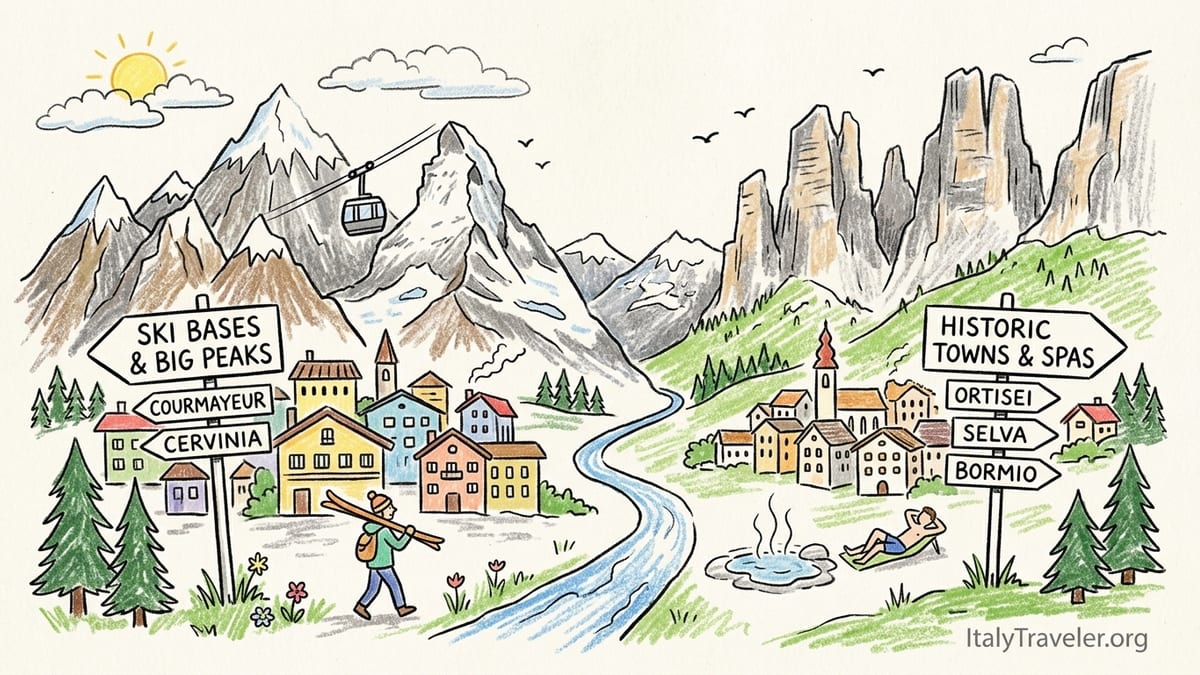
How to Choose Your Base in the Italian Alps
Before comparing individual towns, it helps to be clear on a few practical points. First is budget. Across the Italian Alps, simple guesthouses in less central streets might start around 120 to 160 euros per night for a double in winter high season, while polished four star hotels in the heart of big name resorts can easily run from 280 to 450 euros or more. Peak weeks like New Year and school holidays often sell out months ahead, especially in Cortina, Courmayeur, Livigno and Ortisei, where occupancy is high and last minute bargains are rare.
Second is access to the mountains. Some resorts, such as Livigno and Cervinia, are largely ski in ski out once you are in town, with accommodation clustered near the lifts. Others, including Bormio and Ortisei, are more traditional villages where you may walk 5 to 10 minutes or ride a short shuttle to reach the cable car. In summer, the same lifts become gateways to high alpine hiking, via ferrata and panoramic viewpoints, so proximity still matters even if you are not skiing.
Third is how much you want to rely on a car. Certain valleys are straightforward for self driving from Milan or Venice, but in snowy weeks you may prefer to book a private transfer or shared shuttle instead. Courmayeur, Bormio and Madonna di Campiglio work well both with and without a car, while Livigno’s remote location and winter road closures can make transfers longer and more weather dependent. In Dolomite resorts like Ortisei, Selva and Cortina, a car can help you explore nearby passes, though efficient ski buses and cable car links mean it is not essential.
Finally, atmosphere counts. Courmayeur and Cortina attract a dressed up aperitivo crowd and designer boutiques; Livigno is more about long ski days and nightlife built around pubs and casual restaurants; Bormio and Ortisei balance family friendliness with a relaxed, lived in mountain feel. Matching your own travel style with the character of each resort is just as important as comparing lift statistics.
Courmayeur: Italy’s Gateway to Mont Blanc
Courmayeur, on the Italian side of Mont Blanc, is one of the easiest major Alpine bases to reach from northern Italy. From Milan Malpensa, private transfers typically quote around 280 to 350 euros one way for up to 3 or 4 passengers in winter, with a journey time of roughly two and a half hours depending on traffic and snow. Scheduled coach services from Milan and Turin cost far less per person but run less frequently and add extra time for changes in Aosta or Chamonix.
Once in town, you rarely need a car. The main gondola rises directly from the village edge to the Courmayeur ski area, and local buses link the town to nearby hamlets and to the Skyway Monte Bianco cable car. A day ticket on the Skyway to Punta Helbronner currently costs around 60 euros per adult, a worthwhile splurge on a clear day for views over the Mont Blanc massif and access to high alpine terrain. Courmayeur’s own ski area is not huge by Alpine standards, but a regional pass can add days in other Aosta Valley resorts, and expert skiers often book guiding to explore off piste routes towards Chamonix.
Accommodation prices reflect the resort’s popularity and weekend crowd from Milan and Turin. In winter high season, mid range three star hotels within walking distance of the cable car might start around 220 to 260 euros per night for a double including breakfast, while atmospheric four star properties with spa facilities can easily exceed 350 euros per night. In summer, rates drop significantly, sometimes by 20 to 30 percent, and you can find traditional guesthouses in nearby hamlets for well under peak winter prices, making Courmayeur an appealing base for hikers.
Courmayeur’s compact center has a polished, almost urban feel. The main pedestrian Via Roma is lined with wine bars, pastry shops and smart boutiques, and après ski often revolves around long aperitivo sessions followed by lingering dinners rather than loud clubs. You’ll find everything from casual pizzerias serving thin crust pies and local Valdostan dishes like polenta with fontina, to fine dining restaurants focusing on Piedmontese wines. In winter the village feels lively and glamorous, while summer brings more relaxed walkers and trail runners heading for the Tour du Mont Blanc stages and nearby side valleys.
Cervinia: Skiing Under the Matterhorn
Breuil Cervinia, usually shortened to Cervinia, sits high at around 2,050 meters at the foot of the Matterhorn. Its main selling point is direct access to the vast Cervino Ski Paradise area and, with the right lift pass, the ability to ski over the border to Zermatt in Switzerland. The Italian side alone offers extensive cruising terrain with wide, gentle blue and red runs that suit intermediates perfectly. On good weather days, confident skiers can spend the morning on the Italian slopes and the afternoon exploring the higher, north facing runs above Zermatt.
Lift passes vary according to whether you ski only on the Italian side or buy an international ticket that includes Zermatt. Local passes are more affordable and work well if you prefer to stay mainly in Cervinia and neighboring Valtournenche, while international passes cost noticeably more but open up a much larger area. Cervinia’s altitude gives it one of the longer seasons in the Italian Alps, and glacier skiing above Testa Grigia can extend into late spring or even summer, although conditions and opening dates depend heavily on weather and glacier management.
As with most high profile ski bases, accommodation around the main lifts commands a premium. In peak winter weeks, standard hotel rooms in central three star properties can easily run from 220 to 300 euros per night, with four star ski in ski out hotels often from 350 euros upward. Travelers looking to save often consider staying in Valtournenche, a lower placed village connected to the same ski area by lift and piste, where simple guesthouses and apartments can be noticeably cheaper while still giving direct access to the slopes.
Nightlife in Cervinia is livelier than its concrete architecture might suggest. Expect slopeside bars with loud music and afternoon sun terraces, a good scattering of casual restaurants serving hearty Valdostan fare, and a handful of late night venues that stay open well after midnight in high season. In summer the resort becomes a base for mountain biking, high altitude hiking and glacier skiing when available, but the overall feel is much quieter, and some hotels and restaurants close between seasons. For many travelers Cervinia works best as a focused ski base rather than a year round destination.
Livigno: High-Altitude, Duty-Free and Self-Contained
Livigno sits at over 1,800 meters in a remote valley near the Swiss border and is officially a duty free zone, which means lower taxes on many goods, including fuel, alcohol and some consumer products. Visitors often combine a ski or biking trip with shopping for discounted spirits, perfumes or sportswear, although it is wise to check current customs rules and allowances for bringing goods back across borders. Resort prices themselves are not particularly cheap, but duty free shopping can still soften the blow of a winter holiday budget.
The town stretches for several kilometers along the valley floor, with lifts rising on both sides to create a broad, sunlit ski area. Many hotels and apartment houses are within walking distance of at least one lift, and a free bus system connects the various sectors of the town, so you can comfortably stay without a car once you arrive. In winter, snow reliability is a strong point, and Livigno has become popular with freestyle skiers and snowboarders thanks to a large terrain park and its reputation as a training base for international teams.
Because accommodation demand is high and the valley is relatively isolated, prices can surprise first time visitors. Travelers researching winter stays often report struggling to find simple rooms under 100 euros per night, and in peak weeks it is common for mid range hotels to charge 200 euros or more for a standard double including breakfast. Upscale spa hotels and design properties, particularly those with slopeside locations and wellness centers, can reach 350 to 450 euros per night in high season. Booking early is essential if you want a particular style of lodging or easy lift access.
Reaching Livigno is more involved than other Italian resorts. From Milan, journey times by car or private transfer are typically four hours or more, and winter road closures through nearby high passes can extend routes and force detours via long tunnels. Many travelers opt for door to door transfers from Milan or Zurich airports to avoid worrying about snow chains and mountain driving, especially during heavy snowfall. Summer brings a different crowd, with road cyclists tackling the nearby passes, hikers and trail runners using the extensive trail network, and mountain bikers riding both lift served and cross country routes. Even then, the long shape of the town, big choice of bars and restaurants, and steady flow of visitors give Livigno an energetic, resort like feel rather than the quiet of a traditional village.
Bormio: Skiing Meets Historic Thermal Spas
Bormio, in the Alta Valtellina region, combines a medium sized ski area with a genuine historic town and famous hot springs. The village sits at around 1,200 meters, below slopes that drop from over 3,000 meters, including the steep World Cup downhill course used for international races. In practice, this gives a mix of challenging runs for advanced skiers, long red pistes for confident intermediates, and easier areas for learners either in Bormio itself or at neighboring Santa Caterina and Cima Piazzi, which are accessible by short drives or ski buses.
What truly distinguishes Bormio from many other Alpine bases is its trio of thermal spa centers, which tap hot springs emerging from the mountainside. Two of the best known spa complexes, in historic villas above town and in a modern resort style structure closer to the valley floor, operate as paid day spas with a range of indoor and outdoor pools, saunas and relaxation areas. Entry prices typically vary by length of stay and time of day, with evening sessions often popular after skiing. For many visitors, a classic Bormio day combines morning runs on the slopes with an afternoon soak looking out towards snowy peaks.
Hotel prices in Bormio tend to be more moderate than in the highest profile resorts. Basic three star hotels might start around 140 to 180 euros per night for a double during the main ski season, with family run guesthouses and apartments occasionally undercutting that in quieter weeks. Four star spa hotels, particularly those affiliated with the thermal centers or with large wellness areas of their own, charge more, but still often under the top rates seen in places like Cortina or Courmayeur. Outside peak winter weeks and the August Italian holiday period, it is not unusual to find weekend packages that bundle ski passes or spa entry with accommodation.
The town itself feels decidedly Italian, with a small but authentic historic center, local wine bars, gelaterias and restaurants serving Valtellina specialties such as pizzoccheri and bresaola. Nightlife is low key, focused on aperitivo and relaxed dinners rather than late night clubs, which suits couples, small groups and families. With its location roughly three and a half hours by road from Milan, Bormio works well with a car if you plan to visit nearby passes or link ski days in Santa Caterina and Livigno, but it is also reachable by train to Tirano followed by regional bus.
Madonna di Campiglio: Classic Base for Brenta Dolomites Scenery
Madonna di Campiglio sits in a high valley framed by the dramatic limestone towers of the Brenta Dolomites and the gentler slopes of the Adamello Presanella range. For many skiers and hikers, the main appeal is the blend of serious mountain scenery with a well connected, lift linked ski area that runs across several neighboring villages. Modern gondolas rise directly from the edge of the compact center, and once you are on the mountain you can roam between areas like Grostè and Cinque Laghi without ever taking off your skis.
In winter, Madonna di Campiglio draws both Italian weekenders and international visitors, and accommodation prices reflect this steady demand. Central three star hotels near the lifts often charge around 200 to 260 euros per night for a double in high season, while four star and five star properties with spas, gourmet restaurants and ski in ski out locations can reach 350 to 500 euros or more. In shoulder weeks, particularly early December and late March, rates drop and value improves, especially if you are flexible about staying a short walk from the main lifts.
The town center has a pleasantly upmarket feel, with a car free core lined by boutiques, cafes and wine bars. Après ski is stylish but not excessively loud: think Aperol spritz and Trentino sparkling wines on heated terraces rather than huge nightclubs. In summer, Madonna di Campiglio becomes a hub for hikers tackling classic routes into the Brenta, via ferrata enthusiasts clipping into the area’s famous protected climbing routes, and road cyclists taking on nearby passes. A car can be useful for exploring neighboring valleys and trailheads, but if you plan to stay mainly within the lift network you can manage comfortably without one.
Access is slightly more involved than some Aosta Valley resorts but still manageable. The nearest major airports are Verona, Bergamo and Milan, from which you can either hire a car for a three to four hour drive or prebook a transfer via Trento or the Val Rendena. In heavy snow, road conditions on some approach routes can be slow, so it is wise to allow extra time for weekend arrivals and departures.
Ortisei and Selva: Heart of the Val Gardena Dolomites
Ortisei and Selva di Val Gardena sit in the Val Gardena, one of the most scenic valleys in the Dolomites and a key gateway to the enormous Dolomiti Superski network. Ortisei, lower in the valley, has a handsome, colorful center with a strong sense of local Ladin culture, while Selva, further up the valley, feels more overtly ski focused, with many slopeside hotels and apartments clustered around the lifts and ski runs. Both resort villages are excellent bases for exploring the Sella Ronda circuit and nearby passes in winter, as well as Alpe di Siusi and Seceda in summer.
Lift access from Ortisei is particularly good for hikers and mixed groups. A cable car rises from the center directly to the Alpe di Siusi plateau, a broad, gentle area of pastures and easy walking routes, while another cable car climbs to Seceda, with its highly photogenic ridgeline and access to longer hikes and ski runs towards other parts of the Dolomiti Superski area. Selva’s lifts tie directly into the Sella Ronda, making it ideal for skiers who like to cover distance each day. In winter, efficient ski buses run along the valley linking villages and lift stations, so a car is optional rather than essential.
Accommodation demand in Ortisei and Selva is high throughout winter and again in July and August. Traditional three star guesthouses and smaller hotels often price winter stays from roughly 180 to 240 euros per night for a double including breakfast, but rates climb sharply for central locations, half board packages and properties with wellness facilities. Stylish four star spa hotels, which are common in the valley, frequently charge 300 to 400 euros per night or more in peak periods, especially for rooms with balcony views over the Dolomite peaks. Apartments are widespread and can offer better value for families or groups willing to self cater.
Dining and nightlife tend to be refined but relaxed. Expect a mix of Ladin, Italian and Austrian influences: speck platters and dumplings sit alongside risotto and fresh pasta on many menus. Après ski in Selva is livelier, with slopeside bars pouring drinks from mid afternoon and a handful of venues that remain busy late into the night. Ortisei is quieter in terms of late night noise but has an excellent spread of cafes, bakeries and wine bars that stay open well into the evening. In summer, the overall atmosphere is calmer and more family oriented, with many visitors here for hiking, photography and fresh air rather than nightlife.
Cortina d’Ampezzo: Polished Base for the Eastern Alps
Cortina d’Ampezzo, set in a broad bowl surrounded by some of the most dramatic Dolomite peaks, has long been one of Italy’s most glamorous mountain towns. It is preparing to co host the 2026 Winter Olympics, and that event has further raised demand for accommodation and driven a wave of infrastructure upgrades. The town serves multiple separate ski areas, linked by ski buses and a growing network of lifts, including modern cable cars to Tofana and Faloria Cristallo. In summer, these same lifts provide direct access to high trails, via ferrata routes and panoramic viewpoints for hikers and climbers.
Hotel prices in Cortina reflect both its profile and limited central supply. In peak winter weeks, standard rooms in well located three star hotels can start around 220 to 280 euros per night, while smart four star or boutique properties around the Corso Italia pedestrian street frequently charge 350 euros or more for a double, with top tier suites well above that. During the quieter shoulder seasons of late spring and autumn, rates can drop noticeably, but July, August and Christmas to mid March remain consistently busy periods. Apartments and chalet style rentals are widespread and often book out well in advance for school holidays.
Cortina’s atmosphere is distinctly polished compared with many other Italian resorts. The evening passeggiata along Corso Italia features designer stores, jewelers, patisseries and wine bars, and it is common to see visitors dressed for the occasion even if they have been on the slopes all day. Dining ranges from traditional trattorie serving mountain specialties like casunziei ravioli, to contemporary fine dining restaurants highlighting local ingredients and extensive wine lists. Late night options include stylish cocktail bars and a small number of clubs and lounges catering to a chic crowd.
In practical terms, Cortina works reasonably well both with and without a car. Direct long distance bus services from Venice, Treviso and sometimes Innsbruck and Munich run during the main winter and summer seasons, connecting airports to the town in around two and a half to three hours from Venice under normal conditions. Once in Cortina, ski buses and local buses link the different lift sectors and nearby villages. A car can be useful if you want to explore surrounding passes like Giau and Falzarego or visit neighboring valleys, but parking in the town center can be limited, especially on busy weekends. Summer brings a different rhythm, with a slightly more relaxed feel, but the town still buzzes thanks to hikers, climbers and road cyclists.
Matching Resorts to Different Traveler Types
For travelers who prioritize big mountain scenery and easy access from major airports, Courmayeur and Cortina stand out. Courmayeur offers Mont Blanc views, strong food and wine culture and straightforward transfers from Turin or Milan, though you will pay a premium for central hotels in winter. Cortina, meanwhile, combines world famous Dolomite views with a polished town center and multiple lift sectors. The trade off is high prices and strong demand, which make early booking crucial.
Skiers who care most about snow reliability and extensive piste mileage may gravitate towards Cervinia and Livigno. Cervinia’s high altitude slopes and connection to Zermatt deliver long seasons and hundreds of kilometers of runs, ideal for intermediates and strong skiers keen to cover ground. Livigno’s broad, sunny valley, modern lift system and strong snow record give it the feel of a self contained ski domain, with duty free shopping and busy nightlife as added attractions. Both resorts require longer transfers than some others, especially Livigno, but reward the effort with consistent winter conditions.
Travelers looking for a balance of skiing, spa time and authentic Italian town life often find Bormio a strong choice. The combination of historic thermal baths, atmospheric streets and a demanding World Cup downhill run is unusual in the Alps, and prices are generally friendlier than in the highest profile destinations. For those drawn to Dolomite scenery, Ortisei and Selva work well for mixed groups, thanks to excellent lift access, strong hiking and ski terrain, and an appealing range of hotels and apartments in different price brackets. Families in particular appreciate Ortisei’s walkable center and access to the gentle meadows of Alpe di Siusi.
Madonna di Campiglio sits somewhere between these categories, blending an upmarket village feel with strong ski infrastructure and classic Brenta views. It is a good fit for couples or small groups who want quality accommodation and scenery without the full Cortina price premium, and who like the idea of a single, well organized base from which to ski or hike each day. Ultimately, the best choice comes down to how you weight scenery, skiing, spa options, nightlife, budget and transfer time.
FAQ
Q1. Which Italian Alps resort is best for first time visitors without a car?
Courmayeur, Ortisei, Selva and Cortina all work well without a car thanks to regular airport transfers or coach links and efficient local bus and lift networks. Courmayeur is particularly convenient from Turin and Milan, while Ortisei and Selva are well served from Verona and Innsbruck via train and bus connections.
Q2. Where can I find the most reliable snow and longest ski season?
Cervinia and Livigno generally offer some of the most reliable winter snow conditions due to their altitude, with Cervinia benefitting from glacier access above Testa Grigia and Livigno’s high valley preserving snow well into spring. Conditions still vary by year, but these resorts are popular choices for early and late season skiing.
Q3. Which resort is best if I want spa days as well as skiing?
Bormio is the standout choice for combining skiing with thermal spas, thanks to its historic hot springs and multiple spa centers. Several hotels in Bormio include direct access or discounted entry to the baths, making it easy to alternate mornings on the slopes with afternoons soaking in hot pools overlooking the mountains.
Q4. Is Livigno really more expensive than other Italian ski resorts?
Accommodation in Livigno can be relatively expensive, especially in peak winter weeks, and it is common to see even basic rooms exceed 150 to 200 euros per night. However, the duty free status can make fuel, alcohol and some goods cheaper, and package deals or early bookings sometimes soften overall costs compared with top tier resorts like Cortina.
Q5. Which base is best for Dolomites scenery and varied hiking?
For Dolomites scenery and hiking, Ortisei, Selva and Cortina are outstanding. Ortisei gives direct access to Alpe di Siusi and Seceda, Selva connects easily to the Sella Ronda area, and Cortina places you close to iconic peaks around Tofana, Lagazuoi and the Tre Cime di Lavaredo region, all served by well marked summer trails and lifts.
Q6. How do hotel prices compare between Courmayeur and Cortina?
Both Courmayeur and Cortina sit at the higher end of the Italian Alps price spectrum, especially in winter and August. Courmayeur’s central hotels can be slightly more affordable outside peak weekends, while Cortina’s status as an Olympic and luxury destination often pushes average nightly rates higher for similar categories of accommodation in top locations.
Q7. Which resort has the liveliest nightlife?
Livigno, Cervinia, Selva and Cortina generally offer the liveliest nightlife, with a good mix of après ski bars, pubs and late opening venues in winter. Livigno and Cervinia lean more towards casual bars and music, while Cortina and Selva mix sophisticated wine bars with a handful of stylish lounges and clubs.
Q8. Is it worth paying extra for ski in ski out accommodation?
In large, snow sure areas like Livigno, Cervinia and Selva, ski in ski out properties can save significant time and energy, especially for families and keen skiers. In more compact resorts such as Courmayeur or Bormio, a short walk or shuttle ride from a slightly cheaper hotel can be almost as convenient while freeing up budget for dining or activities.
Q9. Which resort works best for a summer holiday rather than skiing?
Ortisei, Cortina and Madonna di Campiglio are especially appealing in summer, with extensive hiking networks, family friendly walking routes, lift accessed viewpoints and a good spread of open restaurants and shops. Courmayeur also shines in summer as a base for Mont Blanc hiking and the Skyway cable car, though certain ski oriented venues may close between seasons.
Q10. How far in advance should I book accommodation in these resorts?
For peak winter weeks, especially Christmas to early January and February school holidays, it is wise to book at least six to nine months ahead in high demand resorts like Cortina, Courmayeur, Livigno, Ortisei and Selva. For summer hiking seasons and quieter winter periods, booking three to five months in advance usually offers a good balance of choice and price, though popular hotels can still fill quickly.