


Ask an Italian where to go for mountains and you will hear both "Alpi" and "Dolomiti" in the same breath. Geographically, the Dolomites are part of the Italian Alps. In travel planning though, people often use "Italian Alps" to mean the glaciated western and central ranges around the Aosta Valley, Mont Blanc and the Matterhorn, and "Dolomites" for the pale limestone towers east of Bolzano and Cortina. If you are trying to choose between Courmayeur or Cervinia on one side and Cortina d’Ampezzo or Val Gardena on the other, the decision shapes everything about your trip: scenery, activities, how you get there, and even how much you spend on coffee. This guide breaks down the differences with concrete examples so you can match the right region to your style of travel.
Italian Alps vs Dolomites: Understanding the Real Difference
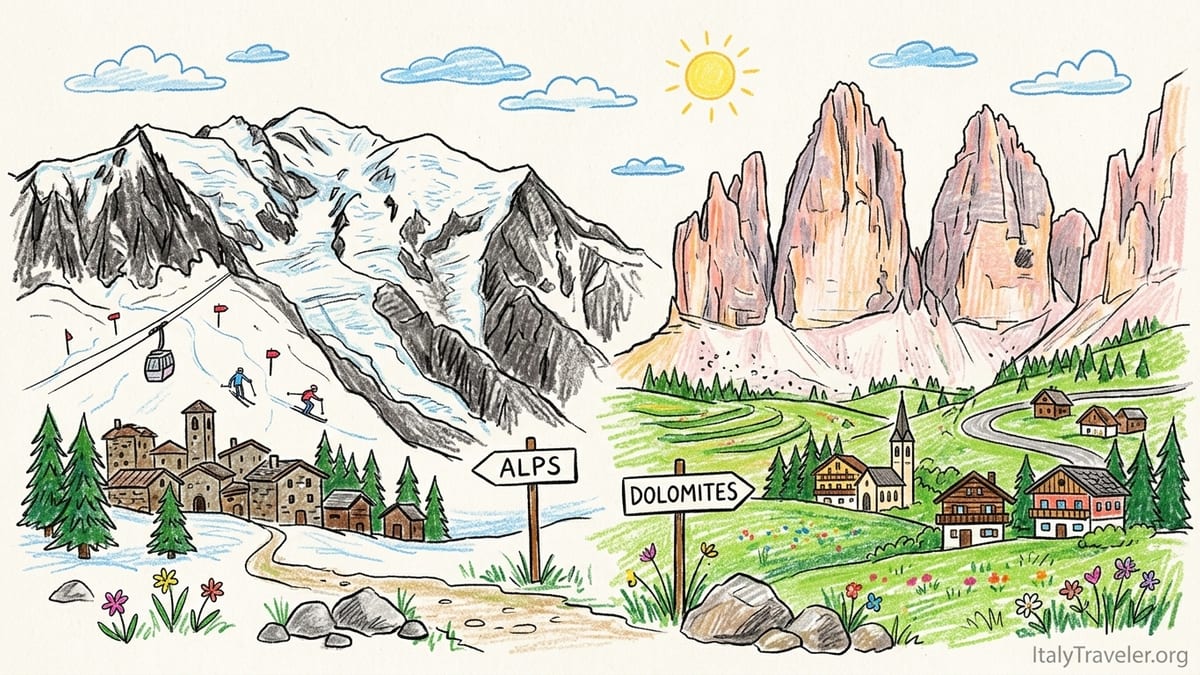
On the map, both the Aosta Valley and the Dolomites sit inside the Alpine arc. In practice, they feel like different worlds. The western Italian Alps around Courmayeur and Cervinia are dominated by granite and metamorphic rock and sculpted by large glaciers, most dramatically in the Mont Blanc massif where ice still spills down broad cirques and valleys. The profiles are jagged but heavyset, with dark rock and long, flowing glaciers clinging to the upper slopes. In clear weather it feels like a true high-alpine environment even when you are standing in a village café.
The Dolomites, stretching roughly between Bolzano and Cortina d’Ampezzo, are made of pale dolomite limestone and look entirely different. Peaks rise as vertical towers and cliff walls that catch the light at sunrise and sunset, turning orange and pink. Instead of a few huge glaciers, you see more bare rock, scree slopes and grass terraces. From villages such as Ortisei, Selva di Val Gardena and Corvara, the mountains feel closer and more theatrical, as if someone built a backdrop around the valley.
For a first-time visitor, this geological contrast matters more than the technical definitions. If you dream of massive glaciers and big, dark granite peaks, the Aosta side of the Italian Alps around Courmayeur and Cervinia fits that image. If you imagine vertical limestone towers, green meadows and picture-book villages linked by pass roads, the Dolomites are closer to what you have seen in photos. Both offer excellent skiing, hiking and road trips, but the visual mood of your holiday will be very different.
Weather and light also play differently on these landscapes. The western Italian Alps tend to feel a little wilder and more severe, especially in poor weather, while the Dolomites often look bright and open thanks to the pale rock and lower, grassy terraces. That means two travelers can visit Italy in the same week, one skiing below the glaciers of the Matterhorn and another hiking between rifugi under the Sassolungo group, and come home with very different impressions of what “the Alps” look like.
Courmayeur and Cervinia vs Cortina and Val Gardena
When travelers compare “Italian Alps vs Dolomites,” they often really mean Courmayeur or Cervinia in the west versus Cortina d’Ampezzo or Val Gardena in the Dolomites. Courmayeur sits on the Italian side of Mont Blanc. The village mixes old stone lanes with stylish bars and boutiques, attracts weekenders from Milan and Turin, and offers direct access to high-mountain terrain via cable cars. From the Skyway Monte Bianco, for example, you can step out at over 3,400 meters and look across the glaciers of the massif even in summer. It feels compact, chic and very alpine.
Cervinia, officially Breuil-Cervinia, lies beneath the Italian face of the Matterhorn and links by lifts to Zermatt in Switzerland. The village itself is purpose-built and open, with many mid-range hotels and apartment blocks aimed at skiers. The ski area is extensive and high, and in winter you can ski from the Italian side to the Swiss side and back in a single day. Off the slopes, the atmosphere is more about sports bars and pizzerias than historic charm, though you still find cozy mountain restaurants on the slopes and above neighboring Valtournenche.
On the Dolomites side, Cortina d’Ampezzo sits in a broad bowl surrounded by limestone towers and has long marketed itself as “the Queen of the Dolomites.” It has a fashionable, slightly old-school resort feel with designer shops and a central pedestrian street, but you are never far from nature. Within a short drive or bus ride you reach trailheads for Tre Cime di Lavaredo, Passo Giau or the Cinque Torri, and in winter several ski areas ring the town. It is a good choice if you want dramatic views and a lively evening passeggiata in one place.
Val Gardena, made up of Ortisei, Santa Cristina and Selva, is quieter on the surface but deeply oriented toward outdoor activities. Selva at the head of the valley is perfect if you want to ski or bike the Sellaronda circuit. Ortisei, slightly lower, blends Ladin culture, woodcarving heritage and easy access to the Alpe di Siusi plateau via gondola. Compared with Cervinia, Val Gardena villages feel more traditional even if tourism is very developed. Compared with Courmayeur and Cortina, they can feel family focused and practical rather than overtly glamorous.
Skiing and Winter: Snow Reliability, Terrain and Atmosphere
For serious skiers and snowboarders, snow reliability and terrain often decide the question. Cervinia sits high and links to the even higher slopes of Zermatt, so its upper pistes hold snow well from early season into late spring. If you visit in February and want the greatest chance of cold snow, especially for on-piste mileage, Cervinia has an edge. Courmayeur has lower lift-served slopes than Cervinia, but catches good snow from passing storms and has a strong reputation for off-piste descents accessible by cable car, with guiding services based in town.
In the Dolomites, the ski areas around Cortina and Val Gardena sit lower on average but compensate with extensive snowmaking and meticulous grooming. The Sellaronda circuit, which links Val Gardena, Alta Badia, Arabba and Val di Fassa, can stay skiable through much of the season even in lean winters because of this investment. If you love long, scenic pistes rather than steep couloirs, the Dolomites’ rolling terrain can be ideal. A typical day might see you skiing from Selva around the Sella massif, stopping in wooden mountain huts for polenta and speck, then returning to your village by late afternoon without repeating many runs.
Atmosphere on the slopes differs as well. In Cervinia and Courmayeur, the vibe is more overtly alpine and international, with a strong presence of Italian, British and sometimes North American skiers. Mountain restaurants often sit on big terraces with glacier views, and the wine lists lean toward Aosta Valley and Piedmont labels. In the Dolomites, many huts are still run by local families who serve Ladin specialties like barley soup, canederli dumplings and kaiserschmarrn. Lunch can easily stretch into a two-hour affair on a sunny deck under limestone walls.
Price-wise, both areas are generally cheaper than major French resorts, but the Dolomites often feel better value for lift passes and on-mountain food. For example, a simple pasta and drink at a slopeside hut in Val Gardena can cost noticeably less than the equivalent dish at a high-traffic restaurant above Courmayeur. Accommodation within walking distance of the lifts in Cervinia or Courmayeur can climb quickly in price during peak weeks, while in Val Gardena you usually find a wider range from guesthouses to upscale spa hotels, though top properties in either region command premium winter rates.
Hiking, Rifugi Culture and Summer Experiences
Summer is where the Dolomites often win hearts, especially among hikers. The region has a dense network of rifugi, or staffed mountain huts, linked by waymarked paths. Classic multi-day routes such as Alta Via 1 use rifugi as overnight stages, so travelers can hike from hut to hut without carrying camping gear. Many rifugi above Cortina and Val Gardena are reachable in two to four hours from a lift top, which makes them realistic goals for moderately fit visitors. Inside you can expect simple rooms or dorms, hearty dinners and breakfast, and a convivial dining room where Italian, German and English mingle.
The western Italian Alps also offer rifugi, but they are often spaced farther apart and sit in wilder terrain. Around Courmayeur, multi-day routes like the Tour du Mont Blanc loop through French and Swiss territory as well as Italy, so the experience feels more international and remote. Rifugi in the Gran Paradiso and Monte Rosa areas can be quite high and oriented toward climbers. If you like the idea of hiking toward glaciers and peaks, then settling into a simple hut with a strong mountaineering flavor, the Italian Alps around Aosta might suit you better.
In terms of day hikes, both regions excel but feel different underfoot. Near Cortina and Val Gardena, many classic walks begin with a cable car or chairlift ride to a balcony path, then traverse under sheer walls to a rifugio or loop around a massif. Well-known examples include routes beneath the Odle peaks from Seceda above Ortisei, or the loop around Tre Cime di Lavaredo above Misurina. Paths are usually well signed and graded, and you are rarely more than a few hours from a hut or lift.
Around Courmayeur and Cervinia, days often involve more elevation gain and a stronger sense of walking into big mountains. From Courmayeur, for instance, you can follow the Tour du Mont Blanc stage to Rifugio Bonatti, walking for several hours with the entire Mont Blanc chain in front of you. Above Cervinia, balcony paths toward the Matterhorn viewpoints give a constant sense of height and glacier scenery. If you are willing to hike longer and are comfortable with a bit of rougher terrain, the reward is a wilder atmosphere than you typically find on the busiest Dolomites routes.
Road Trips, Passes and Scenic Drives
If your dream trip involves a rental car, mountain passes and spontaneous photo stops, the Dolomites are purpose-built for it. The region is threaded by pass roads like Passo Gardena, Passo Sella, Passo Giau and Passo Pordoi. A typical one-week itinerary might split nights between Ortisei in Val Gardena and Cortina, connecting them via the Sella passes and stopping at viewpoints and short walks along the way. Distances between key valleys are short in pure kilometers but slow in driving time due to hairpins and viewpoints that constantly tempt you to pull over.
In good summer weather, it is realistic to build a loop that touches several famous photo spots without driving more than three to four hours in a day. For example, you might drive from Venice to Ortisei on day one, explore Val Gardena and Alpe di Siusi, then cross Passo Gardena and Passo Campolongo toward Alta Badia and Cortina. Each leg might only be 90 to 150 minutes of actual driving, but it feels full because every pass offers cafés, short hikes and cable cars up to panoramic platforms.
The western Italian Alps lend themselves more to radial trips from one base. From Courmayeur, you can drive the tunnel to Chamonix in France, visit Skyway Monte Bianco, or follow the Aosta Valley downriver to Roman sites and castles near Aosta town. From Cervinia, a car helps you reach quieter villages like Valtournenche and mountain lakes such as Lago Blu beneath the Matterhorn. The scenery is grand, but pass roads are fewer and less loopable than in the Dolomites, so itineraries often involve there-and-back routes rather than neat circuits.
One practical point for drivers is seasonal road closures. In the Dolomites, several passes close completely in winter and early spring, and some days in summer they close to cars for cycling events. That means a July or September road trip feels very different from a February ski holiday, when you mainly move by lift or ski bus. Around Courmayeur and Cervinia, the main valley roads stay open year-round, but high side roads can close after snowfall. If your priority is a summer or early autumn road trip focused on varied mountain landscapes, the Dolomites generally make planning easier.
Costs, Crowds and Trip Practicalities
Both regions can be busy and expensive in peak weeks, but they attract slightly different patterns of visitors. The Dolomites, especially Val Gardena and Cortina, have become a major draw for international summer tourism as well as winter sports. It is common to hear English, German and Dutch alongside Italian on the trails, and popular Instagram spots can see steady foot traffic in July, August and early September. In exchange, there is a well-developed infrastructure of hotels, guesthouses, rifugi and shuttle buses that make it easy for first-timers.
Courmayeur and Cervinia receive many foreign visitors too, yet the mix often feels more Italian, especially outside the Christmas and February school-holiday peaks. Weekends can be very busy with city visitors, while midweek stays may feel calmer than the busiest Dolomites valleys. Prices are broadly similar for mid-range accommodation, but everyday costs such as parking, coffee or a simple restaurant meal can sometimes run slightly higher in Courmayeur and around Mont Blanc, reflecting the prestige of the location and the limited flat land for development.
For budget-conscious travelers, the Dolomites offer some practical advantages. There are many small hotels and garni guesthouses in villages like Ortisei, Santa Cristina and Selva that include breakfast and sometimes half board at competitive rates, especially outside August and New Year. Rifugi stays are often cheaper than hotels in the valleys and include dinner and breakfast, though exact prices vary widely. In the Italian Alps around Aosta, rifugi aimed at climbers can be simple but still not cheap due to supply logistics, and village accommodation close to lifts can be priced with ski demand in mind even in shoulder seasons.
Booking strategy matters in both areas. In the Dolomites, rifugi on famous routes such as Alta Via 1 may need to be reserved months in advance for July and August, while valley hotels often have more flexibility outside Italian holiday weeks. Around Courmayeur and Cervinia, premium weeks such as the period between Christmas and Epiphany, late February and Easter can sell out early. If your dates are fixed and you want to keep options open, the Dolomites’ larger stock of villages and properties can make it easier to find something suitable at short notice except in the very busiest weeks.
Airports, Access and When Each Region Makes Sense
Access can be the tiebreaker when the scenery alone does not decide it. For the Dolomites, Venice Marco Polo is the most common international gateway for Cortina and the eastern ranges, with road transfers of roughly two hours in normal traffic. For Val Gardena and the central Dolomites, Verona and Innsbruck are often used, with typical drives of two to three and a half hours depending on the valley you choose. The Brenner motorway corridor makes it relatively straightforward to combine the Dolomites with northern Italy or Austria in one trip.
For Courmayeur and the Aosta Valley, the most convenient airports for many travelers are Milan Malpensa, Milan Linate and sometimes Turin. Drive times usually range around two to three hours to Courmayeur, longer if you arrive during weekend traffic or winter snowfalls. Cervinia sits at the head of a side valley and typically takes around two and a half hours or more from Milan airports. Travelers coming from Switzerland or France sometimes arrive overland by train and bus via Aosta or through the Mont Blanc or Great St Bernard tunnels.
So which region suits which traveler profile in practice. If you want a one-base trip with a mix of hiking, scenic drives and village atmosphere in summer, the Dolomites around Val Gardena or Cortina are very strong options. They combine good public transport links in season, a wide choice of hotels at different price points and access to all levels of hiking from gentle meadow strolls to via ferrata. If you plan to rent a car, you can easily build a circuit that starts and ends at Venice, Verona or Innsbruck while sampling several valleys along the way.
If your dream is to stand under vast glaciers, ride high cable cars and perhaps tag on a visit to Chamonix or Zermatt, then Courmayeur and Cervinia make more sense. They are less about weaving between many compact valleys and more about immersing yourself in a couple of major mountain groups like Mont Blanc, the Matterhorn or Monte Rosa. For dedicated skiers chasing altitude and long seasons, Cervinia’s height and its link to Zermatt are powerful arguments. For hikers who want a sense of big, wild mountains and do not mind longer ascents, Courmayeur is hard to beat.
The Takeaway
Choosing between the Italian Alps and the Dolomites is less about which is objectively better and more about what kind of mountain experience you want. Around Courmayeur and Cervinia you get towering granite and glaciated peaks, deep U-shaped valleys and a slightly wilder, more severe atmosphere, especially in marginal weather. It suits travelers who are drawn to glaciers, classic alpine imagery and the idea of crossing into France or Switzerland for a day trip.
In the Dolomites, around Cortina and Val Gardena, the drama comes from light and shape. Pale limestone towers, green meadows and wooden farmhouses give the region a storybook quality. The infrastructure of rifugi, pass roads and lifts makes it very accessible for first-time mountain travelers, families and anyone who prefers balcony paths and scenic circuits to full-on mountaineering terrain. It is also a natural fit if you want to combine mountains with Venice or Verona in a single itinerary.
In practical terms, if you are planning a primarily winter ski trip and care most about altitude and snow reliability, Cervinia and its link to Zermatt are compelling. If you want a summer or early autumn hiking and road trip with varied routes and lots of rifugi, the Dolomites generally come out ahead. Many mountain lovers eventually visit both and discover that the contrast is exactly what makes each region special. If your time is limited now, use your priorities, your entry airport and your appetite for driving or hut-to-hut travel to decide, and treat the other region as a reason to return to Italy’s mountains.
FAQ
Q1. Are the Dolomites actually part of the Italian Alps?
The Dolomites are geologically part of the Alps, but travelers often use "Italian Alps" to mean the western ranges around Aosta, Mont Blanc and the Matterhorn, and "Dolomites" for the limestone mountains east of Bolzano and Cortina.
Q2. Which region has more dramatic scenery, the Italian Alps or the Dolomites?
Both are dramatic in different ways. The Italian Alps around Courmayeur and Cervinia feel higher and more glaciated, with big granite peaks and large ice fields. The Dolomites impress with vertical limestone towers, bright rock walls and green meadows set very close to villages and road passes.
Q3. For a first-time skier in Italy, is Cervinia or Val Gardena better?
Cervinia offers higher slopes and a link to Zermatt, which is attractive for snow reliability and long on-piste runs. Val Gardena has a vast network of scenic pistes on the Sellaronda circuit and many intermediate-friendly routes. If you want altitude and a simpler ski area layout, pick Cervinia. If you want variety and mountain-hut culture, Val Gardena is often the better introduction.
Q4. Is Courmayeur a good base if I mainly want to hike, not climb?
Yes. Courmayeur works well for hikers thanks to balcony paths along the Mont Blanc chain and access to routes on the Italian section of the Tour du Mont Blanc. Many hikes use cable cars or local buses to reduce ascent, although some trails are steeper and more exposed than typical Dolomites balcony routes.
Q5. How does Cortina d’Ampezzo compare with Courmayeur in terms of atmosphere?
Both are stylish resorts with designer shops and strong Italian weekend crowds. Courmayeur feels more focused on the Mont Blanc massif and has quick access to very high alpine terrain. Cortina feels more like a hub for multiple Dolomites valleys, with dramatic rock walls on all sides and many nearby passes and day hikes.
Q6. Which region is better for a hut-to-hut hiking trip?
The Dolomites usually win for classic hut-to-hut routes that are accessible to strong walkers. Trails like Alta Via 1 string together many staffed rifugi with moderate daily stages and clear signage. The western Italian Alps also have hut networks, but routes are often longer, higher and more mountaineering focused.
Q7. What are the easiest airports for reaching the Dolomites?
Venice Marco Polo is commonly used for Cortina and the eastern Dolomites, while Verona and Innsbruck work well for Val Gardena and other central valleys. Drive times from these airports to major Dolomites bases typically fall between about two and three and a half hours, depending on the valley and traffic.
Q8. What are the easiest airports for reaching Courmayeur and Cervinia?
Milan Malpensa and Milan Linate are the main gateways for many international travelers heading to the Aosta Valley. Courmayeur and Cervinia generally lie around two to three hours from these airports by car in normal conditions, with Turin as a closer alternative for some routes.
Q9. Is the Dolomites or the Italian Alps better value for money?
Both regions can be expensive in peak periods, but many visitors find the Dolomites slightly better value day to day, with competitive lift prices and a wide choice of mid-range hotels and rifugi. Around Mont Blanc, some services and central accommodation can carry a premium due to the prestige of the location and more limited space.
Q10. If I only have five days, which region should I choose?
With five days, choose one region to avoid spending too much time in transit. If you fly into Venice, Verona or Innsbruck and want a mix of hiking, road passes and classic postcards views, focus on the Dolomites around Val Gardena or Cortina. If you arrive via Milan or Turin and dream of glaciers and high peaks, base yourself in Courmayeur or Cervinia and explore the Aosta Valley.