


The Italian Alps are made for road trips: glacial valleys, high passes, cable cars at the end of tiny side roads and little mountain towns with no train station in sight. A rental car can unlock huge flexibility, but it also adds costs, rules and winter-driving responsibilities that many visitors underestimate. This guide focuses on picking up a car in Milan, Bergamo, Turin, Venice, Verona or Bolzano and driving into the Alps, with practical examples of when a car is worth it and when resort shuttles and local buses are the smarter call.
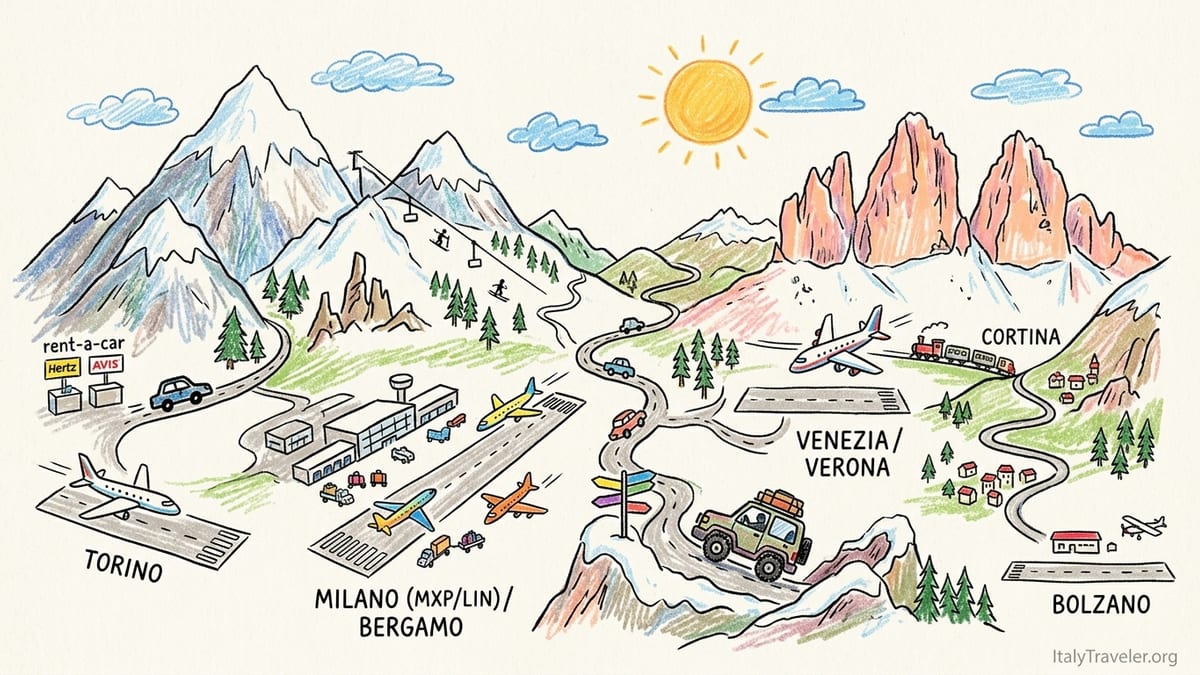
Which Italian airport works best for your Alpine plans
Most travelers heading for the Italian Alps fly into Milan Malpensa, Milan Linate, Bergamo Orio al Serio, Turin Caselle, Venice Marco Polo, Verona Villafranca or Bolzano. All have on-airport car rental desks run by the familiar international brands alongside Italian companies such as Sicily by Car, Maggiore or Italy Car Rent. Milan Malpensa and Venice Marco Polo usually have the widest choice of vehicles and the most competition, which often translates into slightly lower base rates than smaller airports. By contrast, Bolzano’s tiny airport tends to have limited fleets and higher day rates, but it puts you almost directly into the Dolomites.
As a rule of thumb, choose the airport that lines up closest with the valleys you plan to visit. For the central and western Alps, including Courmayeur, Aosta and the Monte Rosa area, Turin Caselle is often the most convenient because you avoid Milan’s ring roads and are on the A5 motorway within minutes. For the Dolomites around Val Gardena, Alta Badia and Cortina d’Ampezzo, Venice and Verona work well, with Venice usually offering a bigger choice of automatics and SUVs, while Verona is slightly closer by road to many ski resorts. If your trip is focused on South Tyrol around Bolzano, Merano or the Brenner Pass, Bolzano itself or Verona save you several hours of backtracking.
Price can also sway the decision. In shoulder seasons it is common to see compact cars from Malpensa priced lower than equivalent vehicles at Innsbruck or Geneva, even after adding winter options. However, smaller airports such as Verona may charge slightly more for the same class but save you 2 to 3 hours of driving on both arrival and departure. For a long weekend ski break, shaving those hours off your transfer can matter more than saving 10 or 15 euros per day.
Availability in peak periods is another crucial factor. During February school holidays or around Ferragosto in August, Milan and Venice can sell out of automatic cars and family SUVs weeks in advance, while Turin and Bergamo sometimes still have stock. If you are travelling at these times and must have an automatic with winter tires, it can be worth paying a bit more to book early at the airport most popular with skiers heading to your chosen region.
City by city: Milan, Bergamo, Turin, Venice, Verona and Bolzano compared
Milan Malpensa is the main international hub and the most common starting point for Italian Alps road trips. Rental counters operate in both terminals, with large fleets from brands like Hertz, Avis, Europcar, Sixt, Alamo, Enterprise and National. This is where you will most easily find station wagons and crossovers suitable for a family plus ski gear. The trade-off is traffic: from Malpensa you need to navigate ring roads around Milan before turning north or east. For example, reaching Bormio in Valtellina can take around 3.5 to 4 hours, mostly on busy roads for the first part of the journey.
Bergamo Orio al Serio is popular with low-cost airlines and sits right on the A4 motorway between Milan and Verona. It is a strong choice if you are heading to the Bergamasque Alps, the Adamello-Brenta area or the western Dolomites. Rentals here are usually slightly cheaper than at Malpensa and the airport is compact, so pickup and drop-off can be quicker. However, fleets are smaller than Milan’s and the variety of automatic cars can be limited in peak weeks, making early booking advisable if you cannot drive a manual.
Turin Caselle serves the western Alps. From here, destinations such as Sestriere, Bardonecchia and Courmayeur are as little as 90 minutes to 2 hours away by motorway. Because Caselle mainly serves domestic and regional flights, car-rental desks can be less crowded, which suits travelers who value a fast exit over the widest possible choice. Venice Marco Polo, on the other hand, serves a huge international market. Its rental center is busy but offers deep fleets and plenty of automatics. From Venice, expect about 2 hours 30 minutes to Cortina d’Ampezzo if traffic and weather cooperate.
Verona Villafranca sits roughly in the middle: smaller and calmer than Venice, yet well placed for the Dolomites, Garda and South Tyrol. Rental brands are clustered in a dedicated car hire area, and roads out of the airport quickly feed onto the A22 north to Bolzano or the SS12 towards Val di Fassa and Val di Fiemme. Finally, Bolzano airport is tiny but ideal if you want to maximize time in South Tyrol. You will pay a premium for the convenience and may find more compact cars than full-size SUVs, but driving time to bases like Ortisei or Castelrotto can be under an hour.
Automatic versus manual: what to book for the mountains
Italian car rental fleets are still heavily weighted toward manual transmissions. In Milan or Venice, you may see manual economy cars advertised at attractive daily rates, while automatics in similar size categories can cost noticeably more. For example, in winter it is common to see a compact manual quoted around one price bracket while a mid-size automatic with similar luggage space sits one or two groups higher. The difference over a week’s rental can easily cover the cost of ski passes for a day.
If you are comfortable driving a manual, it will save money and give you more choice in smaller airports such as Bergamo or Bolzano. Mountain roads involve frequent gear changes, but that works in your favor with a manual when descending long passes because you can use engine braking rather than relying on the brakes alone. That said, if your home country is predominantly automatic and you rarely drive stick, the tight hairpins of the Stelvio Pass or the snowy access road to a village like Arabba are not the place to relearn the skill.
Automatics bring clear benefits in winter conditions. On an icy climb out of a valley or when inching along in a blizzard behind a snowplow, not worrying about clutch control reduces fatigue and stress. This is particularly true if you are jet-lagged after an overnight flight into Malpensa or Venice. Some crossovers and SUVs in the fleets also come with all-wheel drive, which, paired with proper winter tires, gives more confidence on packed snow. However, do not assume that an SUV is automatically four-wheel drive or that winter tires are standard; you must check the booking category and the add-ons offered for your specific car.
Whichever transmission you choose, always reserve the correct category explicitly. If booking through a consolidator, look for wording such as “Guaranteed automatic” rather than “or similar” and double-check the transmission type again when you sign the rental agreement at the airport. In peak weeks it is not unheard of for renters who booked an automatic in Bergamo or Verona to be offered a manual as a “similar” replacement; insisting calmly on the original transmission type usually works better when you can show it clearly on your confirmation email.
Insurance, deposits and real-world costs
Base rental quotes in Italy typically include basic legally required liability insurance and a collision damage waiver with a relatively high excess. A typical excess on a compact car can run to several hundred or a few thousand euros, and rental companies will place a hold on your credit card on pickup, sometimes close to or above that figure. In practice, travelers picking up in Milan or Venice commonly see security deposits in the range that can significantly reduce the available credit on a single card, so it is wise to check your credit limit and bring a backup card.
At the rental counter you will almost always be offered extra coverage to reduce or eliminate the excess. Full “super cover” or “zero excess” options can be expensive when purchased day by day, but they do buy peace of mind if you are new to winter driving. As an example, hitting a concealed curb in an underground car park in Bolzano or scraping a wheel on a tight, icy hotel driveway in Cortina could be treated as damage and charged against your excess. Alternatively, some travelers use independent excess insurance policies purchased in their home country, which can cost significantly less over a year but require you to pay the rental company first and then reclaim.
Fuel and tolls are another large part of the real-world cost. Many Alpine routes rely on motorways managed by companies such as Autostrade per l’Italia or regional operators in South Tyrol, where tolls are payable at barriers and can quickly add up on long trips from Milan to the Dolomites or from Turin to Courmayeur. In addition, several famous tunnels and passes, such as the Mont Blanc Tunnel into France or the Great St Bernard Tunnel into Switzerland, charge substantial separate fees. When comparing car rental with shared transfers, remember to factor in these tolls plus fuel, parking at your accommodation and any city congestion restrictions if you plan to drive into historic centers.
Finally, always check the fuel policy and return condition rules. Many Italian rentals are full-to-full, meaning you must return the car with a full tank or pay a refueling fee. On a Sunday evening drop-off at Bergamo or Turin, petrol stations near the airport may be self-service only, sometimes confusing non-local cards. Allow extra time to refuel and keep the receipt, just in case the rental desk queries the gauge reading.
Winter tires, snow chains and mountain-pass rules
In much of northern Italy, national and local rules require winter equipment between roughly mid November and mid April on designated roads. The general standard is that you must either have winter or all-season tires fitted or carry approved snow chains in the vehicle whenever you travel on roads signed with the blue “snow chains or winter tires mandatory” symbol. The exact dates and roads vary by region, and mountain provinces such as Aosta Valley or South Tyrol can introduce longer seasons or stricter requirements on key routes.
On key Alpine motorways, the rules are explicit. For example, on the A22 Brenner motorway that links Verona with Bolzano and the Austrian border, the operator requires vehicles to have winter equipment between November 15 and April 15 on the Italian side. Many rental companies proactively include chains free of charge during this period on bookings from airports like Verona and Bolzano when you indicate that you are heading into the mountains. Even so, you should always ask at the desk to see the chains, check the size matches your tires and ask staff to show you briefly how they fit.
Winter tires themselves are usually an optional extra at booking and are charged per day with a maximum per rental. Some major brands at Milan Malpensa and Venice Marco Polo quote winter tire packages that can add a noticeable sum to a week’s rental, though the cap can make them more reasonable on longer trips. Others prefer to equip only parts of their fleet and offer vehicles with winter tires “on request,” confirmed only on pickup. If you are travelling in mid-winter and expect to tackle high passes or smaller side roads, booking a category that explicitly includes winter tires, or phoning the local branch before travel, can reduce uncertainty.
Mountain passes themselves come with their own restrictions. High routes such as the Stelvio Pass or the Gavia Pass often close completely in winter and reopen sometime between late spring and early summer, depending on snow. Even when open in summer, heavy rain, hail or late snow can lead to temporary closures. Electronic message boards on approach roads and websites of motorway operators publish this information, but in practice you should always have a lower-altitude alternative planned. Remember that rental insurance usually excludes damage caused by ignoring road-closure signs or attempting to drive on closed or restricted passes.
Cross-border driving to France, Switzerland and Austria
Many itineraries through the Italian Alps naturally cross borders. It is common to drive from Milan to ski in Swiss resorts like Zermatt via the Simplon Pass and shuttle train, or to combine the Dolomites with Austrian Tyrol via the Brenner Pass. However, you cannot assume that your Italian rental car is automatically allowed to leave the country. Most rental contracts specify which neighboring countries are permitted, and some charge an additional daily “cross border” fee or require advance notification so they can adjust roadside-assistance coverage.
In broad terms, major Italian rental companies often permit travel into neighboring EU countries such as France and Austria and into Switzerland, but they may require you to buy a cross-border supplement. The extra cost can be modest on short trips but adds up over a long rental. One set of conditions from an Italy-based rental brand, for example, allows vehicles into EU countries plus Switzerland and the United Kingdom but requires a specific cross-border package to be purchased; driving abroad without that supplement can invalidate assistance if you break down on the Austrian side of the Brenner Pass. Always declare your cross-border plans at the desk, even if a website booking engine did not ask about them in detail.
Some borders also involve road-use stickers or extra tolls. Switzerland, in particular, requires a motorway vignette to use its highways. Many rental cars registered in Switzerland already carry the current-year vignette, but Italian-plated cars usually do not, and you may need to buy one at a border service area if you intend to use Swiss motorways. Austria has a similar vignette system for its motorways, plus additional charges for specific Alpine tunnels and passes. If your plan is only to cross briefly on local roads without using the autobahn network, you may not need the sticker, but you should verify your planned route carefully rather than relying on assumptions.
One-way rentals that end in another country are a separate question. Dropping off a car picked up in Milan or Venice in France, Switzerland or Austria is often either prohibited or subject to steep one-way drop fees that can run into hundreds of euros. In contrast, one-ways within Italy, such as picking up in Turin and dropping in Verona, are much more common and often cost a flat fee that is comparatively modest. When building multi-country road trips, it can therefore be cheaper to end your Italian rental at the border, travel across by train or bus, and pick up a new car in the next country.
When a car adds real value, and when it does not
A rental car shines on multi-valley summer trips, when you want to string together several remote valleys or high passes that public transport barely touches. For example, an itinerary that starts in Milan, loops around Lake Como, climbs into Valtellina, crosses into the Engadin in Switzerland and then returns via the Stelvio region is vastly easier by car than by train and bus. Similarly, exploring the side valleys of South Tyrol, such as Val di Funes, Val d’Ega and the high plateaus around Alpe di Siusi in a single week almost demands the flexibility of your own vehicle, especially if you like to stop spontaneously at viewpoints or small hiking trailheads.
In these scenarios a compact or mid-size car is usually enough, provided it can handle your luggage. Parking in many Alpine towns is time-limited and underground garages often have tight ramps, so a huge SUV can become a liability. In summer, look for accommodation with on-site parking and factor in typical daily parking fees in busy resort centers such as Cortina d’Ampezzo or Madonna di Campiglio. A car also makes it easier to adjust plans around weather: if low cloud sits over one valley, you can simply drive to another.
By contrast, a car is often poor value for a single-base winter ski holiday. If you fly into Verona, take a shared shuttle up to a resort like Val Gardena or Madonna di Campiglio and stay there for a week, you may not touch the car again until departure. Most large ski areas have efficient ski buses linking base villages and lifts, often included in the lift pass or priced modestly per day. In high resorts, car parks can fill quickly on powder days and overnight snow can bury vehicles, leaving you to dig out wheels at the end of your stay.
In such cases, booking a private or shared transfer and then using local buses is usually more economical and less stressful. For example, from Venice or Innsbruck to Cortina, dedicated ski shuttles operate on fixed timetables in winter, and once in the valley, frequent buses link San Vito, Cortina and the various lift stations. The same holds for Sestriere, Cervinia and many Dolomite valleys. Unless you plan significant side trips on rest days, the convenience of door-to-door transfers often outweighs the theoretical flexibility of having a car sitting idle under snow.
Practical tips for driving and parking in Alpine towns
Driving in the Italian Alps is generally straightforward but requires attention. Mountain roads mix local traffic, delivery trucks, cyclists and, in winter, snowplows and buses. On hairpin-heavy roads into resorts like Livigno or Selva di Val Gardena, it pays to take your time, use lower gears on descents and respect local speed limits, which can change quickly when passing through villages. In summer, motorbikes and sports cars enjoying famous passes may appear suddenly in your mirrors; use lay-bys to let faster traffic pass and avoid cutting corners, even if the road ahead looks clear.
Parking rules can be strict and are enforced even in tourist towns. Blue-lined spaces usually indicate paid parking, payable at nearby machines where you display the ticket on the dashboard. White lines often mark free parking, though time limits may apply, while yellow spaces are typically reserved for residents or specific permit holders. Some historical centers operate restricted traffic zones where cameras monitor access and fines are sent later to the rental company, which then passes the cost to you along with an administrative fee. Before driving into old towns like Bormio or smaller Dolomite villages, check with your hotel about which approach roads and parking areas are allowed.
Weather can change quickly in the mountains. A sunny morning drive from Milan or Venice can turn into rain, fog or snow by the time you reach the higher passes. Always carry warm clothing and some water in the car, particularly in winter, in case an accident ahead closes a pass and you are stuck for an hour or more. When you park at a ski resort, fold your mirrors, avoid parking directly under steep roofs that may shed snow, and leave the car in gear with the handbrake securely set. On steep slopes, turning the wheels toward the curb adds another small layer of safety.
Before setting off each day, brush accumulated snow off the roof, lights and license plates, not just the windscreen. Snow sliding off the roof under braking can blind you suddenly, and obscured plates are a fineable offense in many countries. Many rental cars have heated rear windows and mirrors; learning how these work at pickup in Milan, Bergamo or Turin will save time when clearing frost in early mornings at altitude.
FAQ
Q1. Do I really need winter tires for driving from Milan or Venice into the Alps in winter?
In many Alpine areas you must have either winter or all-season tires or carry snow chains between roughly mid November and mid April on signed roads. For trips that include high valleys or the Brenner corridor, winter tires plus chains are strongly recommended for safety and comfort.
Q2. Which Italian airport is best for visiting the Dolomites by rental car?
Venice Marco Polo and Verona Villafranca are the most popular for the Dolomites, with Venice offering the biggest fleets and Verona often slightly closer by road to many valleys. Bolzano is closest to South Tyrol but has smaller fleets and typically higher prices.
Q3. Is it worth renting a car for a one-week ski holiday in a single resort?
Often it is not. If you plan to stay in one resort such as Cortina, Sestriere or Val Gardena and ski every day, airport transfers plus local ski buses are usually cheaper and less hassle than renting a car that will sit unused most of the week.
Q4. Can I drive an Italian rental car into Switzerland, France or Austria?
Usually yes, but only if your rental company permits it and you declare this in advance. Many brands allow cross-border travel to neighboring countries but may charge a daily cross-border fee and require additional roadside-assistance coverage.
Q5. How big are car rental deposits in Italy for Alpine trips?
Security deposits vary by company and car category but commonly run to several hundred or more euros, held as a pre-authorization on your card. Higher categories or luxury SUVs can require significantly larger holds, so ensure your credit limit is sufficient.
Q6. Are automatic cars widely available for Italian Alps rentals?
Automatics are readily available at major airports such as Milan Malpensa and Venice but make up a smaller share of fleets than manuals. They often cost more and can sell out in peak holiday periods, so reserving early is important if you cannot drive a manual.
Q7. What happens if I drive on a closed mountain pass with a rental car?
If you ignore closure signs and get stuck or damage the car, the rental company may treat this as negligence, and standard insurance may not cover recovery or repairs. Always respect local closures and have an alternative route planned.
Q8. Are one-way rentals within Italy expensive for Alpine itineraries?
Domestic one-way rentals, such as picking up in Turin and dropping in Verona, often carry a moderate fixed fee and are widely allowed. One-ways that end in another country, such as Austria or France, can be much more expensive or not permitted at all.
Q9. Is it difficult to find parking at Alpine ski resorts with a rental car?
In busy resorts and on peak weekends, surface parking can fill quickly, and underground garages may be the only reliable option, usually for a daily fee. Booking accommodation with a reserved space simplifies things considerably.
Q10. When is a car clearly the best choice for an Italian Alps trip?
A car is most valuable on summer or shoulder-season road trips linking multiple valleys, passes and small towns, especially when you want to hike in remote areas or stay in villages with limited public transport. In these cases the flexibility outweighs the extra costs and responsibilities.