


Driving the Italian Alps is less about racing from one famous pass to the next and more about choosing a compact region, settling in for several days, and letting the mountains dictate your pace. Rather than trying to cross the entire northern arc of Italy in a long weekend, the smartest itineraries focus on regional circuits: Aosta Valley with Mont Blanc and the Matterhorn, the Livigno–Bormio–Stelvio triangle in Lombardy, and the Trentino–South Tyrol–Dolomites region. With typical pass openings from roughly early June to late October and growing restrictions on where and when you can drive, a successful trip hinges on timing, route choice and a realistic understanding of what is actually possible in a week.
How Long You Really Need in the Italian Alps
Travel brochures often imply you can cruise from Mont Blanc to the Dolomites in two or three days, ticking off the Grand St Bernard, Stelvio and the Sella passes on the way. In practice, that would mean spending most of your holiday on motorways and long transfer days, not on the mountain roads you came for. Distances look small on the map, but average speeds drop sharply once you leave the autostrada and begin climbing a series of 1,500 to 2,000 meter elevation gains, each with hairpins, construction, cyclists and weather to contend with.
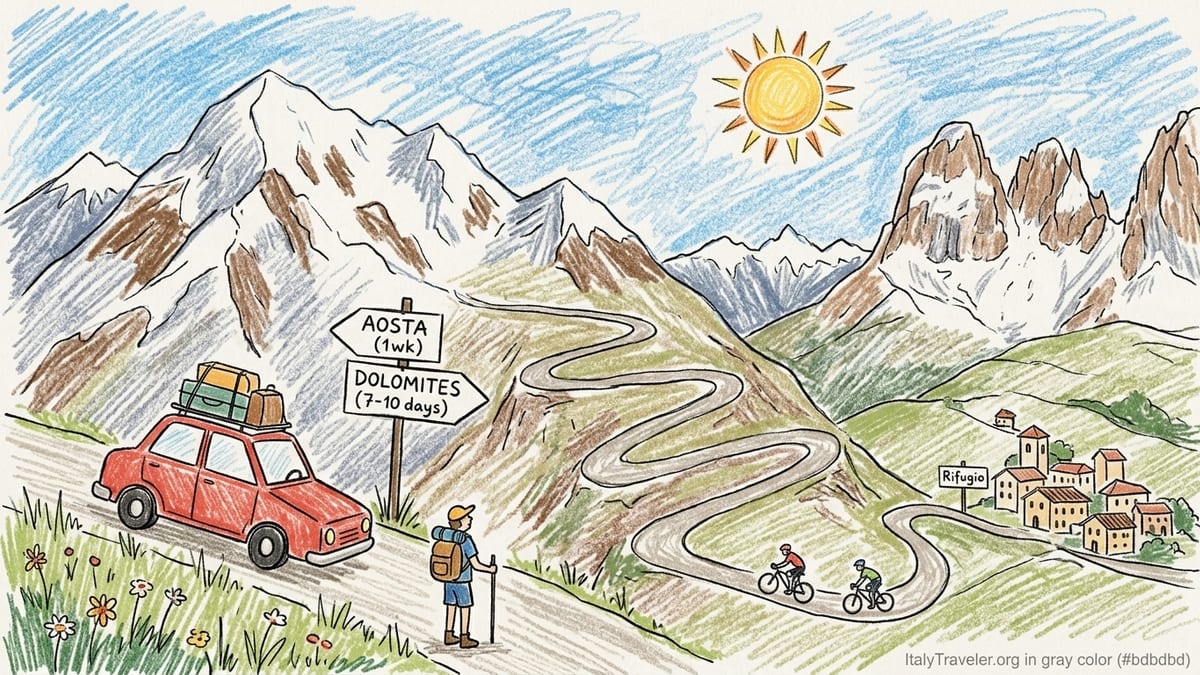
For a focused week, think in terms of one region, not the entire Alpine arc. A 7-night trip could easily be spent entirely in Aosta Valley, basing in Courmayeur and Aosta to explore the Mont Blanc tunnel, Gran Paradiso National Park and the surroundings of the Matterhorn from the Italian side. Likewise, a week in Bormio and Livigno gives you time for Stelvio, Gavia and several side valleys without feeling rushed. The Dolomites can easily absorb 7 to 10 nights split between two bases such as Ortisei and Cortina d’Ampezzo, with at least one non-driving day for hiking or cable cars.
If you do want a west-to-east traverse, plan at least 10 to 14 days and accept that you will sample only one or two passes in each area. A realistic example would be 3 nights in Aosta, 3 in Bormio or Livigno, and 4 to 5 in the Dolomites, with motorway links between the regions rather than trying to string every “famous” road into a single continuous line. That kind of pacing gives you space to sit out a day of bad weather, cope with a tunnel closure or detour, and still enjoy terrace lunches at mountain huts instead of eating every meal at a service station.
Season matters just as much as pacing. Many of the iconic passes in this guide only open once snowplows have cleared several meters of snow from the carriageway and can close again quickly with early storms. For most travelers who want the full range of high roads, the practical driving season is late June through late September, with the shoulder weeks in early June and late October always a gamble.
Aosta Valley Circuit: Mont Blanc, Matterhorn and Gran Paradiso
Aosta Valley is one of the easiest Alpine regions to reach from Milan or Turin and one of the best for combining big-mountain scenery with relatively straightforward driving. From Milan Malpensa, it is roughly a 2.5 to 3-hour run along the A4 and A5 motorways to Aosta itself, almost all on toll roads. A classic 4 to 5-day circuit would base you for two or three nights near Courmayeur at the foot of Mont Blanc, then two nights near Aosta or in a side valley like Cogne or Valtournenche.
From Courmayeur you can drive to the Mont Blanc Tunnel, which connects Italy to Chamonix in France. This is not a casual day trip toll: for a standard car, one-way charges are on the order of 60 to 70 euros, with returns around 80 to 90 euros, depending on current tariffs and seasonal adjustments. The tunnel has strict safety rules, including minimum distances between vehicles and speed limits, and it is periodically closed for maintenance and renovation, so you must check closure calendars before building it into your itinerary. Even if you do not cross into France, the approach road up the Val Veny corridor offers dramatic views of the Mont Blanc massif.
From Aosta, another day can be devoted to the Gran Paradiso area. The drive from Aosta to Cogne is only about 45 minutes, but the last stretch is a narrow mountain road with sharp bends and occasional rockfall protection tunnels. Parking in Cogne is paid and fills quickly in high summer; arriving before 9 a.m. gives you a far better chance of finding a space and catching a shuttle or starting a hike to waterfalls and high meadows. Alternatively, you can drive toward Valtournenche and Cervinia for views of the Italian side of the Matterhorn, keeping in mind that Cervinia itself has a ZTL that restricts traffic in parts of the village core, especially during busy periods.
In terms of timing, Aosta’s valley-floor roads are open year-round, but higher access roads in Gran Paradiso can be affected by late snow in May and early June, as well as localized closures after storms. Winter visitors will generally leave the car in resort parking and move on skis or shuttle buses, so the classic driving circuits described here are best tackled between June and early October.
Livigno, Bormio and Stelvio: High Passes and Border Crossings
The Livigno–Bormio–Stelvio area in Lombardy rewards a slightly more experienced driver with some of Italy’s highest and most technical paved roads. Bormio, reachable in roughly 3.5 to 4 hours from Milan via Lecco and the Valtellina valley, makes an ideal base. From here you can drive the Stelvio Pass, the Gavia Pass and several smaller routes such as the climb to the Cancano lakes. Livigno, by contrast, is a duty-free enclave reached either via the Forcola di Livigno pass from Switzerland in summer or through the Munt la Schera tunnel, a single-lane toll tunnel largely in Swiss territory that operates with alternating one-way traffic and set opening times.
Stelvio is the star attraction: a paved road rising to around 2,750 meters, with more than 40 numbered hairpins on the classic eastern ramp from Prato allo Stelvio and another tight sequence above Bormio. The main SS38 road over Stelvio is typically closed from November through at least late May; in a normal year, the pass opens around early June and closes again by late October, but heavy snow can delay opening into mid-June or force an earlier autumn closure. Conditions vary each year, so you must check local road authority updates or Stelvio-specific information shortly before you drive. Even in July and August, temperatures at the top can be 10 to 15 degrees Celsius colder than in the valley.
Livigno itself is reached via passes that can be affected by snow well into May. The Munt la Schera tunnel, which links the Livigno area with the Engadine valley in Switzerland, is open year-round but has specific hourly patterns and higher tariffs at peak times, and in winter you must have winter tires or carry snow chains. When driving from Italy into Switzerland and back, remember that Switzerland requires a motorway vignette if you plan to use its freeways, and customs officers occasionally perform spot checks around Livigno, which has a special tax status and cheaper fuel and alcohol than surrounding regions.
Because Stelvio, Gavia and the Forcola di Livigno are all high and exposed, it is wise to build in at least two potential “Stelvio days” in your itinerary. That way, if a thunderstorm rolls in or there is fresh snow on your chosen morning, you can swap plans and leave the big drive for the clearer day. For example, you might spend one day on the Bormio–Stelvio–Prato loop and another on the Bormio–Gavia–Ponte di Legno route, keeping a rest day in the hot springs of Bormio in reserve if weather turns.
Trentino, South Tyrol and the Dolomites: Pass Hopping Made Realistic
East of Bolzano, the Dolomites offer some of Europe’s most scenic driving, but also some of its most crowded roads in peak season. The key to enjoying this region is to pick one or two bases and explore specific clusters of passes rather than attempting to cross everything from Passo Sella to Tre Cime in a single frenetic loop. A typical 6 or 7-night trip might divide time between Val Gardena (Ortisei or Selva) and Cortina d’Ampezzo or Alta Badia, with days dedicated to short, focused circuits.
From Selva di Val Gardena, for instance, the classic Sella Ronda loop links four passes: Sella, Gardena, Pordoi and Campolongo. In summer, you can drive this circuit in half a day, but if you stop for a cable car ride or a long lunch at a rifugio, it easily fills the day. Parking at pass summits is usually a mix of free roadside spaces and small paid lots; in high summer, arriving before 9 a.m. often determines whether you secure a scenic pullout or spend 20 minutes circling for a spot. On some particularly busy days or during events, access to key passes may be temporarily restricted or turned into one-way loops to manage traffic, so local tourist boards and road authority sites are essential planning tools.
South Tyrol’s capital, Bolzano, and towns such as Bressanone and Brunico have ZTLs that restrict traffic in historic centers, monitored by cameras that issue automated fines. If you are driving between Dolomite bases, your best strategy is to park at the edge of town in signed car parks and explore the centers on foot. Smaller villages like Ortisei, Corvara and San Cassiano manage traffic mainly through hotel garages and large valley parking lots at lift stations, but in high season even these can fill, leading to overflow parking and shuttle-bus systems for popular spots like the Seceda, Alpe di Siusi and Tre Cime trailheads.
In shoulder seasons such as April or early May, many Dolomite passes are still closed or partially snow-covered, and even if the road itself is open, cable cars, rifugi and local buses may operate on reduced schedules or be shut completely. For a driving-focused itinerary that includes the famous passes around the Sella group and the road to Tre Cime, late June through early October is the most reliable window, with July and August the busiest and September often offering clearer skies and slightly lighter traffic.
Road Conditions, Pass Openings and Seasonal Closures
Unlike valley-floor highways, which are generally open year-round except during severe weather or construction, many iconic Italian passes reach 2,000 to 2,700 meters and are buried under snowpack through much of the year. Authorities typically publish target opening and closing windows, but actual dates can shift by weeks depending on snowfall and spring temperatures. Stelvio and Gavia often open in early to mid-June and close in late October, while passes such as Timmelsjoch, which links South Tyrol and Austria, tend to open around mid-June and close by late October as well. A late snow year can see snowbanks higher than a car lining the road in July.
When planning, treat any date you see in a guidebook as a guideline, not a guarantee. A traveler who books a late May trip to Bormio expecting to drive Stelvio might find the pass still under heavy snow or open only on one side for local traffic and maintenance vehicles. At the other end of the season, a cyclist-focused event or an early storm can see passes closed to private vehicles for a day or more. For example, late August or early September often brings a “bike day” on Stelvio where the road is reserved for cyclists and runners, forcing drivers to adjust by a day on either side.
Conditions can also change within a single day. A sunny morning ascent might turn into a fogbound or thunderstorm-lashed descent by mid-afternoon, with localized hail making hairpins slippery. In practical terms, that means starting major pass drives early, carrying warm layers and rain gear, and not hesitating to turn back if visibility drops. While Italian mountain roads are generally well maintained, rockfall and temporary closures after heavy rain are part of life here, and your rental’s navigation system may not update as fast as local authorities’ alerts.
Winter and early spring driving in these regions bring additional rules: winter tires or snow chains are mandatory on certain stretches and dates, and some access roads, such as those to smaller ski villages or remote hamlets, may be closed entirely after heavy snow. If your road-trip dreams revolve around empty roads and snow walls, it is better to plan a late-June or early-July visit than to gamble on May when much of the high infrastructure may still be in winter mode.
Tolls, ZTLs, Parking and Rental Car Practicalities
Any Italian Alps road trip will include a mix of toll motorways, free regional roads and high passes. The main north–south and east–west spines, such as the A4 from Milan to Verona and the A22 from Verona to Brennero, operate on a ticket-based toll system where you collect a ticket on entry and pay on exit, with charges depending on distance. A run from Milan to Bolzano in a compact rental car might cost in the region of 20 to 30 euros in tolls one way, plus fuel. Tunnels are separate: the Mont Blanc Tunnel, Fréjus Tunnel and some smaller Alpine tunnels have their own toll structures, with single passes for a car often costing the equivalent of an entire day of regular motorway tolls.
Inside towns, Italian ZTLs (restricted traffic zones) and parking rules are where many foreign drivers run into trouble. ZTLs are typically marked by a white rectangular sign with a red circle and wording such as “Zona a traffico limitato,” sometimes with hours of enforcement and exceptions noted below. Cameras record plates and issue fines automatically; your rental company will pass the fine to you with an administrative fee. As a rule of thumb, if you see old stone gates or a compact historic core, assume there is a ZTL and park in a signed car park outside it. In Bolzano, for instance, visitors commonly use large underground or multi-level car parks near the center, walking the final few blocks into the old town.
Parking around major trailheads and cable cars in the Dolomites and Aosta Valley is a mix of free and paid lots. At Lago di Braies in South Tyrol, for example, access has been heavily regulated in recent summers, with pre-booking for parking and caps on daily visitors in peak season. Other popular spots such as Alpe di Siusi use valley parking plus cable cars or shuttle buses to reduce private car traffic on narrow access roads. On high passes like Stelvio or Pordoi, parking is often informal lay-bys and small gravel pullouts; in July and August, these fill quickly with motorcycles, campervans and sports cars, so an early start is again your best strategy.
Rental considerations are equally important. One-way rentals that start in, say, Milan and end in Venice or Innsbruck can incur one-way fees that sometimes exceed the base rental price for a week, especially if you plan to return the car in a different country. Crossing borders into Switzerland or Austria is usually permitted by major Italian rental firms, but you must check the contract; you may also need to purchase a Swiss or Austrian motorway vignette separately if you plan to use their highways. When collecting the car, ask explicitly whether it is fitted with the required equipment for the season, such as winter tires or snow chains if you are traveling in late autumn or early spring.
Connecting Regional Circuits into a Longer Traverse
For travelers with 10 to 14 days, it is entirely feasible to link Aosta Valley, the Livigno–Bormio–Stelvio area and the Dolomites in a single west-to-east itinerary, as long as you treat the links between them as transfer days on major roads, not sightseeing marathons. A realistic sequence might start in Milan, head to Aosta for three nights, then cross back through Lombardy to Bormio for three nights, and finish with four or five nights split between Val Gardena and Cortina.
The segment from Aosta to Bormio is a good example of where expectations and reality diverge. On a map, the distance is about 260 to 300 kilometers, which sounds manageable. In practice, the fastest route often involves returning toward Milan on the A5 and A4 and then heading north on the SS38 Valtellina road, which can take 5 to 6 hours with traffic and stops. Alternative routes over mid-level passes can add even more time. Planning this as a full day, with an early departure and a relaxed lunch stop in a town like Lecco or Sondrio, keeps it from feeling like a forced march.
Similarly, the jump from Bormio or Bolzano to the Dolomite heartland should be counted as a transfer rather than a “pass-collecting” day. From Bolzano to Cortina d’Ampezzo, the most scenic route passes via Val Gardena and the Sella group, but in high summer it can be heavily congested, turning a nominal 2.5-hour drive into a 4 or 5-hour crawl if you add photo stops. An alternative is to use the faster lower-valley roads partially, then dive up to your chosen base. Once you are settled in Val Gardena, Alta Badia or Cortina, you can then tackle nearby passes on half-day loops when you are fresh.
When connecting regions, factor in rest days and bad-weather days. After three or four intense driving days with multiple passes and 800 or more hairpins, most drivers appreciate a non-driving day in a spa town like Bormio or a cable-car-and-hiking day in the Dolomites. Building those pauses into your plan makes the driving days more enjoyable and safer, and it also gives you flexibility if a key pass is closed unexpectedly or if a major tunnel announces a temporary shutdown for maintenance.
The Takeaway
The Italian Alps reward travelers who plan like mountaineers rather than motorway commuters: by regions, seasons and contingencies. Instead of treating Mont Blanc, Stelvio and the Dolomites as a checklist, think in terms of compact circuits, each with its own rhythm, weather patterns and driving style. In Aosta you balance motorway access with big-mountain tunnels and national park valleys; in the Livigno–Bormio–Stelvio triangle you engage with some of the country’s highest and most demanding roads; in Trentino and South Tyrol you dance among limestone towers, passes and growing traffic and environmental restrictions.
Concrete details matter: understanding that Stelvio may not open until early June, that the Mont Blanc Tunnel toll can rival a day’s rental-car cost, that a ZTL sign at the entrance to a medieval center can turn a quick detour into a costly fine. With a week or a bit more in each region, or two weeks to connect them sensibly, you gain the time to adapt to road conditions, savor off-the-main-road villages and still make it to those terrace viewpoints and rifugio lunches that turn a drive into a journey.
In the end, a successful Italian Alps road trip is measured less by how many passes you collect and more by how often you are able to stop the car, step out into thin mountain air and feel that you are exactly where you want to be. Plan conservatively, respect the mountains and local regulations, and you will find that a week-plus behind the wheel here delivers some of Europe’s most memorable days on the road.
FAQ
Q1. When is the best time of year to drive high passes like Stelvio and Gavia?
The most reliable window is from late June through late September. In many years, Stelvio and similar passes only open in early June and can close again by late October, with exact dates shifting depending on snowfall and weather.
Q2. Can I drive the entire Italian Alps from Aosta to the Dolomites in one week?
You can physically cross the country in a week, but you will spend most of your time on motorways and transfers. For enjoyable driving and time to explore, plan one region for a week or at least 10 to 14 days if you want to link Aosta, Bormio–Stelvio and the Dolomites.
Q3. Do I need to worry about ZTLs when visiting mountain villages?
Yes in larger towns like Aosta, Bolzano or Cortina, where historic centers often have camera-controlled ZTLs. Smaller resort villages rely more on hotel garages and lift-station lots, but you should always watch for ZTL signs and park in designated car parks.
Q4. How expensive are motorway and tunnel tolls in the Italian Alps?
Regular autostrada tolls add up to roughly a few tens of euros on a long transfer, for example between Milan and Bolzano. Major Alpine tunnels such as Mont Blanc have separate tolls that can approach or exceed the cost of a day’s car rental, so you should check current prices and decide whether the crossing is essential to your plan.
Q5. Can I visit Livigno and Bormio in winter with a regular rental car?
You can reach both in winter, but you must comply with seasonal rules such as winter tires or snow chains, and some passes will be closed. Access to Livigno may rely on the Munt la Schera tunnel or specific open passes, so it is important to check road status and tunnel opening times close to your travel date.
Q6. Are one-way rentals between Italy and neighboring countries easy to arrange?
They are possible with major rental companies but often come with high one-way fees, especially if you drop the car in another country. Always confirm cross-border permissions, any extra insurance requirements and whether the car is equipped for conditions in countries like Switzerland or Austria.
Q7. How early do I need to start to avoid traffic on popular passes?
In July and August, starting by 8 or 9 a.m. is advisable for passes like Stelvio, Sella or Gardena. Early starts help you find parking at viewpoints and avoid the heaviest mix of tour buses, motorcycles and cyclists that tends to build from late morning into mid-afternoon.
Q8. What kind of car is best for an Italian Alps road trip?
A compact car with a decent engine and good brakes is usually ideal. Small cars such as a Fiat 500X, Volkswagen Golf or similar handle narrow roads and tight hotel garages better than large SUVs, while still giving enough power for steep climbs.
Q9. Is it safe to drive in the Italian Alps if I have little mountain driving experience?
Yes, if you choose routes that match your comfort level, avoid driving in bad weather and take your time. Start with lower and wider passes, avoid night driving on unfamiliar mountain roads and be ready to pull over to let faster traffic pass on narrow sections.
Q10. Can I sleep in my car in the Dolomites or park overnight at trailheads?
Rules vary by municipality. Many areas restrict or fine wild camping and overnighting in cars outside of official campsites or designated motorhome areas. Always check local regulations, pay attention to signage in parking areas and use official camping facilities or accommodations when in doubt.