

The Italian Alps are compact on the map but wildly varied on the ground. Within a few hours’ drive, you can swap the glaciated giants of Mont Blanc and the Matterhorn for the pale cliffs of the Dolomites, or move from spa towns and duty-free shopping to quiet car-free meadows. Choosing a base is less about ticking off sights and more about matching a valley to your travel style. This guide compares Italy’s key mountain hubs and helps you decide where to stay for hiking, skiing, scenery, families, spas, car-free travel, food and first-time Alpine trips.
Understanding the Two Italies of the Alps: Aosta vs Dolomites
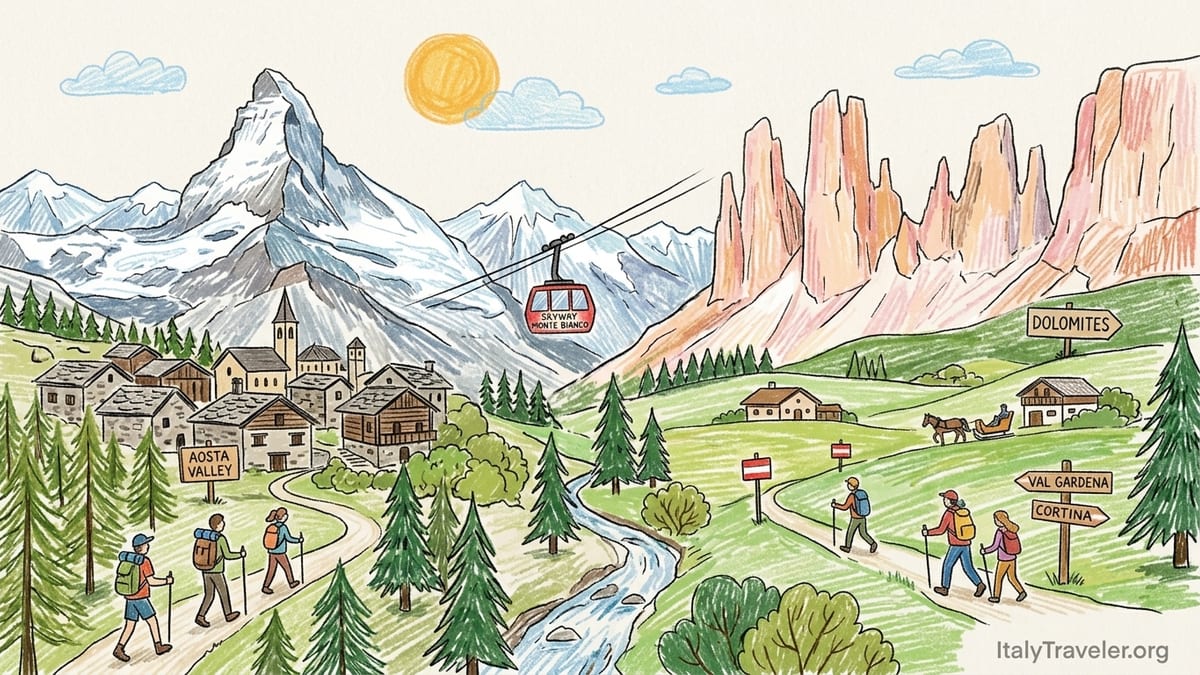
When you plan an Italian Alps trip, you are essentially choosing between two characters. To the west, the Aosta Valley packs an extraordinary skyline into a compact region: Mont Blanc above Courmayeur, the Matterhorn above Cervinia, Monte Rosa further east and the Gran Paradiso massif to the south. These are high, glaciated peaks with a classic, rugged Alpine feel, traditional stone villages and a strong French influence in food and language. It suits travelers who want big-mountain drama, serious skiing and quick access from Geneva, Turin or Milan.
Further east, areas such as Val Gardena, Alpe di Siusi and Cortina d’Ampezzo sit in the Dolomites, a UNESCO-listed range of pale limestone towers that glow pink at sunset. The atmosphere is different: more dramatic rock walls than glaciers, a blend of Italian, Ladin and Austrian influences, and a strong focus on well-marked hiking trails, via ferrata routes and lift-accessible viewpoints. The Dolomites feel slightly softer and more pastoral in many valleys, with rolling meadows beneath sheer cliffs and mountain huts that are destinations in their own right.
Within these two zones the experiences diverge further. The Aosta towns of Courmayeur and Cervinia feel like classic ski resorts, while nearby Gran Paradiso National Park offers quieter, wilder walking. In Lombardy, Bormio and Livigno lean into spa culture, road passes and lifestyle-focused skiing. In the Dolomites, Val Gardena and Alpe di Siusi excel at family-friendly hiking and car-free meadows, while Cortina is the base for ambitious via ferrata and high-end hotels. Deciding where to go starts with knowing what you want most from your time in the mountains.
Courmayeur & Mont Blanc vs Cervinia & the Matterhorn
Courmayeur, at the Italian foot of Mont Blanc, is often described as one of Italy’s best all‑round ski resorts, and that versatility carries into summer. A compact stone-built center, lined with wine bars and boutiques, sits just a short walk from cable cars that rise toward the Mont Blanc massif. The Skyway Monte Bianco rotating cable car gives non‑hikers a near-expedition experience with 360‑degree views and access to high‑altitude terraces. In winter, the Plan Chécrouit and Val Veny sectors provide mostly intermediate pistes with excellent off‑piste for those hiring a guide, while in summer the same lifts serve panoramic hiking trails overlooking glaciers.
Cervinia, by contrast, is a purpose-built village spread along a high, wind-exposed plateau at the Italian base of the Matterhorn. What it lacks in old‑world atmosphere it compensates with altitude and ski area scale. Tied into the cross‑border Matterhorn Ski Paradise network with Zermatt and Valtournenche, the area can offer over 300 km of linked pistes in a good winter and, thanks to access to the Plateau Rosa glacier, one of Europe’s longest ski seasons, with skiing often possible from mid‑autumn through early September most years. In high summer you might ski a morning on groomed glacier runs, then hike or bike the marked trails around Lago Goillet in the afternoon.
For scenery, both resorts deliver big peaks but with different moods. From Courmayeur, the south face of Mont Blanc feels close and vertical; you see serac-filled glaciers dropping toward the valley and hear regular rockfall in warm weather. From Cervinia, you see the Matterhorn in a more blunt, blocky profile than the famous Toblerone angle from Zermatt, but it still dominates the skyline and frames classic intermediate runs such as the long descent to Valtournenche. Food-wise, Courmayeur leans toward slow lunches at slope-side refuges and gourmet dinners in town, where a typical main course in a mid-range restaurant might run 18–28 euros, featuring dishes like venison with polenta or fondue-style raclette. Cervinia’s on-mountain dining is also strong, but its real advantage is vertical: you can ski from the Klein Matterhorn on the Swiss border all the way down to Valtournenche in a single run of roughly 20 km when snow and lift openings cooperate.
For first-time Alpine visitors who value atmosphere, walking streets and easy scenic access without needing to ski, Courmayeur usually wins. The village is human-scale, the bus station is central, and you can ride the Skyway cable car or stroll to nearby hamlets without a car. Cervinia suits skiers who prioritize snow reliability and long blue and red pistes, or those who want to sample both Italy and Switzerland on skis using a combined international pass. In shoulder months like May or October, the glacier above Cervinia may still offer limited skiing while Courmayeur’s main lifts are closed, which can be a deciding factor if skiing out of the main winter season is essential.
Gran Paradiso, Sestriere & the Via Lattea: Quieter Peaks and Classic Ski Circuits
South of Aosta town, the valleys leading into Gran Paradiso National Park feel very different from the ski-focused hubs of Courmayeur and Cervinia. Villages such as Cogne and Valsavarenche serve as gateways to gentler, less-developed mountain landscapes. Here, day hikes lead through larch forests to meadows like Valnontey, where it is common in summer to see ibex or chamois above the tree line. Trails are generally well-marked but far less crowded than popular Dolomite circuits. Accommodation runs from simple family hotels to rifugi that you reach on foot, with half-board prices often a little below the rates in marquee ski towns.
Gran Paradiso is the only 4,000‑meter peak entirely within Italy’s borders, and while climbing it requires glacier travel skills and a guide for most people, the lower-level paths are accessible to fit hikers with standard gear. It is especially appealing for travelers who want multi-day hut-to-hut trekking without the cable car infrastructure that dominates some Dolomite valleys. In winter, Cogne also becomes an ice-climbing hub, with frozen waterfalls that attract experienced climbers, yet the main village atmosphere remains quiet and family-oriented, with cross-country ski loops starting right on the edge of town.
On the opposite side of the Aosta region, Sestriere and the Via Lattea (Milky Way) ski area present a more engineered form of mountain tourism. Built largely in the 1930s and upgraded for the Turin 2006 Winter Olympics, Sestriere sits high on a pass and is surrounded by a web of lifts linking Italian villages such as Sauze d’Oulx with French resorts across the border. The draw here is scale and variety rather than scenery alone. For intermediate skiers on a budget, a week in Sestriere can be good value, with ski school and accommodation packages often coming in below prices in the Dolomites or Courmayeur, and pistes that fan out in almost every direction from the central village.
For hikers and summer travelers, however, Sestriere and the Via Lattea feel quieter and less polished than the Dolomite hubs. Some lifts open for biking and walking, but way-marked itineraries and high-profile events are fewer. If you are mainly interested in ski mileage and do not need postcard architecture, Via Lattea can be a sensible choice. If your priority is summer hiking, picture-perfect towns and via ferrata routes, Gran Paradiso or the Dolomite valleys are usually a better fit.
Livigno & Bormio / Stelvio: Spa Culture, Pass Roads and Lifestyle Skiing
East of the Aosta region, the Valtellina valley in Lombardy offers another cluster of distinct bases, led by Livigno and Bormio. Livigno sits at around 1,800 meters in a long, open valley close to the Swiss border. Thanks to its historic duty-free status, it has become a lifestyle destination where skiing, biking and hiking share space with shopping and wellness. The main street is lined with fashion and sportswear stores, where prices on items like ski jackets or running shoes can be noticeably lower than in Milan or Zurich. In winter, two facing ski areas provide a mix of wide, forgiving pistes and snow parks that attract freestyle skiers and snowboarders. Livigno has been chosen as a venue for the Milan Cortina 2026 Winter Olympics in freestyle and snowboard disciplines, underlining its strength in that niche.
Livigno is also practical for travelers who want to minimize driving once they arrive. In many seasons, the resort and local partners promote a digital card system that can include free use of local buses and discounts on activities, making it easy to treat the valley as semi car-free. Off the slopes, a large wellness complex with multiple pools and sauna areas offers a full afternoon of relaxation for a typical adult entry price that is comparable to a mid-range city spa. In summer, the same valley becomes a base for road cycling on nearby passes and for easier family walks on riverside paths and low-gradient trails that start right from town.
Bormio, about two hours’ drive away, has a different character. The medieval center with its cobbled lanes feels older and more compact, and thermal baths are central to its identity. Three main spa complexes, including historic baths that reuse Roman-era springs and more modern facilities terraced up a valley, give visitors a choice of atmospheres from candlelit stone pools to glass-fronted outdoor baths facing the mountains. A half-day spa session including access to several pools and steam rooms typically costs less than a daily lift pass in high season, making spa days a realistic part of a week-long stay rather than an occasional splurge.
From a skiing perspective, Bormio’s slopes are steeper and more imposing than Livigno’s, known for a long World Cup downhill run that descends in one sustained drop to the edge of town. Nearby Santa Caterina Valfurva and Cima Piazzi extend the local ski offer, and in summer the Stelvio Pass above Bormio becomes one of Europe’s iconic driving and cycling roads. When conditions allow, a glacier area off the pass has historically offered summer skiing for race training, while the asphalt hairpins below attract road cyclists willing to grind up more than 40 numbered bends. For travelers who like to mix mountain sports with historic ambience and serious spa time, Bormio can be more rewarding than higher, more modern Livigno.
Val Gardena & Alpe di Siusi: Families, Car-Free Meadows and Dolomite Icons
On the Dolomite side of northern Italy, Val Gardena is one of the best all‑round bases for both summer and winter, particularly for families and first-time visitors. The three main villages of Ortisei, Santa Cristina and Selva sit along a single valley, each with direct lift access to different parts of the Dolomiti Superski network in winter and to classic hikes in summer. Accommodation ranges from family-run guesthouses to five‑star spa hotels, and many properties offer half-board packages that bundle breakfast and multi-course dinners, which can remove daily restaurant decisions for parents traveling with children.
Alpe di Siusi (Seiser Alm) rises above Val Gardena as one of Europe’s largest high plateaus, a broad meadow dotted with farmhouses and crisscrossed by walking, cycling and winter cross-country trails. A strict traffic management system limits private cars on the plateau during most of the day, which means that once you arrive via cable car from towns such as Ortisei or Siusi, you move on foot, bike, shuttle or horse-drawn sleigh in winter. The result is a genuinely calm, semi car-free environment that suits families pushing strollers, older travelers who appreciate level terrain and anyone seeking gentle walks without steep, rocky sections.
For skiing, Val Gardena and Alpe di Siusi together form a major component of Dolomiti Superski. Intermediates can ski out from Selva onto the famous Sella Ronda circuit, while beginners and children often start on the gentler slopes above Ortisei or on the Alpe di Siusi meadows, where wide, sunny runs cater to first turns. Lift passes can be purchased either for the local area or for the full Dolomiti Superski region, and family offers vary by season, sometimes including free passes for younger children when both parents buy adult passes. Ski schools in Ortisei and Selva routinely offer group lessons where kids spend mornings on snow and afternoons in hotel pools such as the public Mar Dolomit complex.
In summer, Val Gardena and Alpe di Siusi shine for accessible hiking. Examples include taking a cable car from Ortisei to Seceda, then walking along panoramic ridges with minimal technical difficulty, or riding up to Compaccio on Alpe di Siusi and following signposted circuits between mountain huts serving homemade strudel and hearty dumpling soups. Many of these walks can be kept under 8 km and less than 400 meters of ascent, which is ideal for families with school-age children or travelers who want big views without long mountain days. For first-time Dolomite visitors, basing in Ortisei or Selva offers a good balance of infrastructure, scenery and choice of both easy and more demanding trails.
Cortina d’Ampezzo & Madonna di Campiglio: Style, Via Ferrata and Classic Dolomite Skiing
Cortina d’Ampezzo, long branded as the “Queen of the Dolomites,” combines a chic town center with serious mountain terrain. The pedestrian core has upscale boutiques, wine bars and pasticcerie where a morning cappuccino and pastry might cost just a bit more than in smaller towns but comes with the reward of people-watching and mountain views. Above town, several lift systems fan out toward the Tofane, Faloria and Cristallo groups. In winter, these areas provide varied skiing from tree-lined reds to higher, rockier bowls, and are being upgraded ahead of their role in the 2026 Winter Olympics. In summer, Cortina is one of the premier bases in the Alps for via ferrata, with more than 30 equipped routes of varying difficulty in the surrounding mountains.
Via ferrata routes around Cortina range from straightforward ladders and cables suitable for fit, supervised beginners to long, committing trips on historical lines used in the First World War. Equipment such as harnesses, helmets and shock-absorbing lanyards can be rented locally for a modest daily fee, and many travelers book a guide for their first outing. Beyond via ferrata, Cortina offers an array of lift-assisted hikes, mountain bike trails and scenic viewpoints accessible with summer lift passes that can be bought by the day or for several days, sometimes in passes that cover multiple lift companies. For non-hikers, simply riding the cable car to Faloria or the Tofane mid-stations provides café terraces with dramatic rock walls in every direction.
Madonna di Campiglio, further west but still in the Dolomite region for many travelers’ purposes, has a slightly different personality. The village sits in a wooded valley surrounded by the Brenta Dolomites and is heavily ski-focused in winter, with linked lifts spreading toward neighboring Folgarida and Marilleva. The ski terrain is well suited to intermediates, with long red pistes through forest and a more compact, integrated feel than the sprawling Dolomiti Superski network. In summer, hiking and trail running routes lead directly out of town into rocky amphitheaters and to mountain huts such as Rifugio Tuckett, popular with both overnight trekkers and day visitors.
Both Cortina and Madonna di Campiglio appeal to style-conscious travelers, but Cortina stands out for scenery and via ferrata, while Madonna di Campiglio feels more cocooned by forest and oriented to classic ski holidays. For food lovers, both offer solid restaurant scenes, yet Cortina’s size and status mean more choice at the fine-dining level, where multi-course tasting menus highlight regional ingredients. If you plan to visit during peak winter or the Olympic period, booking accommodation many months ahead is prudent, and a car can be helpful for day trips between valleys, although Cortina in particular runs local buses that connect the main trailheads and ski lift bases.
Which Base Is Best For You: Hiking, Skiing, Families, Spas and Car-Free Travel
If hiking is your top priority, the Dolomite hubs of Val Gardena, Alpe di Siusi and Cortina d’Ampezzo are usually the most rewarding. Val Gardena and Alpe di Siusi offer easily accessible, well-signed paths with lift support and plenty of intermediate options, making them ideal for travelers who like clear route choices and frequent hut stops. Cortina provides spectacular, more rugged hiking and the highest concentration of via ferrata routes, which appeals to experienced walkers comfortable with exposure. In the Aosta region, Gran Paradiso’s valleys are less manicured but quieter, great for those seeking wildlife and a sense of remoteness with fewer lifts in view.
For skiing, Cervinia and Val Gardena occupy different sweet spots. Cervinia suits intermediates who dream of very long, high-altitude runs and maximum snow reliability, with the bonus of cross-border skiing into Zermatt for those buying the appropriate pass. Val Gardena, plugged into Dolomiti Superski, offers variation across several connected valleys, including the Sella Ronda circuit that many skiers treat as a must-do in a week-long stay. Courmayeur appeals to strong skiers who want easy access to freeride terrain and off-piste routes, especially when hiring guides for itineraries that include glacier travel or descents into neighboring valleys. Sestriere and the Via Lattea deliver mileage at often more modest prices, targeting intermediates who value kilometers of groomed runs over postcard villages.
Families often gravitate to Val Gardena, Alpe di Siusi and Livigno. Val Gardena/Alpe di Siusi combine gentle ski slopes and meadows with car-restricted areas, hotel kids’ clubs and public facilities like village pools. In summer, routes on Alpe di Siusi allow children to hike between huts where they can play in small playgrounds while adults enjoy coffee or a glass of local wine. Livigno offers a different style of family holiday: more focused on shopping, large hotels with pools and game rooms, and a broad menu of activities from fat biking to easy snowshoe walks along the valley floor. For multi-generational trips where grandparents value spa access as much as grandchildren value slopes, Bormio can work well, as non-skiers can spend days in the thermal baths while others ski or drive scenic passes.
For spa-focused trips, Bormio is the clearest winner thanks to its multiple historic and modern thermal complexes. Courmayeur and several Dolomite resorts offer excellent hotel spas, often included or available as an add-on to room rates, but they remain secondary to the ski and hiking offerings. Livigno’s large wellness center also deserves consideration, especially if you enjoy combining spa visits with shopping and nightlife. On the car-free and low-car front, Alpe di Siusi stands out for its plateau regulations, while parts of Val Gardena and Livigno use effective shuttle and lift systems that allow you to leave your car parked for most of the stay. First-time Alpine visitors who want a straightforward experience without needing to manage many transfers typically do well with Ortisei in Val Gardena, where a single base gives access to meadows, big Dolomite cliffs, family-friendly infrastructure and a pleasant village center.
The Takeaway
Choosing where to stay in the Italian Alps is less about finding the “best” resort than about matching a valley to how you like to travel. The Aosta Valley concentrates Europe’s heavyweight peaks into a small area, offering Courmayeur’s charm under Mont Blanc, Cervinia’s big-mileage skiing under the Matterhorn and the quieter, wilder valleys of Gran Paradiso. Further east, Lombardy’s Livigno and Bormio blend lifestyle, spa culture and road passes, while the Dolomite valleys of Val Gardena, Alpe di Siusi, Cortina and Madonna di Campiglio specialize in lift-assisted hiking, via ferrata and broad ski networks framed by luminous cliffs.
If your ideal day involves long hikes between mountain huts with well-marked routes and plenty of café stops, the Dolomite valleys are usually the best fit. If you care most about big, glaciated scenery and high-altitude snow security, Aosta’s Mont Blanc and Matterhorn areas take the lead. For families and first-time visitors, Val Gardena and Alpe di Siusi deliver the most balanced mix of easy access, facilities and gentle terrain, while spa seekers and road cyclists may prefer Bormio and the Stelvio Pass. Take time to map your own priorities against these strengths, and you will find an Italian Alpine base that feels made for you rather than simply famous by reputation.
FAQ
Q1. Is Courmayeur or Cervinia better for a first winter trip to the Italian Alps?
For a first winter trip, Courmayeur usually feels more welcoming because of its compact, walkable center, good mix of shops and restaurants and easy access to intermediate ski slopes. Cervinia is excellent if you mainly care about long, high-altitude pistes and the possibility of skiing into Switzerland, but the village is more functional and wind-exposed, which some first-time visitors find less charming.
Q2. Where should I stay if I want mostly hiking with a few cable car rides for views?
Val Gardena and Cortina d’Ampezzo are strong choices. From Ortisei or Selva in Val Gardena you can ride lifts to Seceda or Alpe di Siusi and start panoramic hikes on well‑marked trails. In Cortina, multiple lift systems lead into different mountain groups, and you can combine easy walks with one or two via ferrata outings if you feel adventurous and book a guide.
Q3. Which area offers the most reliable snow for a Christmas or New Year ski holiday?
Higher-altitude resorts like Cervinia and, to a lesser extent, Livigno and Val Gardena generally offer more reliable early-season snow than lower, south-facing valleys. Cervinia’s link to glacier terrain above the Plateau Rosa often allows it to open earlier and stay open later than many Italian resorts, though exact conditions vary each year, so it is wise to check current snow reports before booking.
Q4. Are the Dolomites or the Aosta Valley better for families with young children?
For young children, the Dolomites have an edge thanks to gentle meadows, car-restricted areas and a dense network of beginner-friendly slopes and lifts. Alpe di Siusi, in particular, offers wide, sunny runs and easy walking routes with playgrounds near mountain huts. That said, families who prioritize snow reliability and do not mind a more functional village might be very happy in Livigno or certain parts of Aosta with good ski schools.
Q5. Where can I combine serious spa time with mountain activities?
Bormio is the top option for spa-focused stays, with several thermal complexes ranging from historic stone pools to modern glass-fronted baths overlooking the valley. You can spend mornings skiing Bormio’s slopes or cycling the Stelvio Pass in summer, then book afternoon spa sessions that include multiple pools, saunas and relaxation rooms. Many hotels in Dolomite towns and in Courmayeur also have excellent wellness areas, but Bormio makes spas the centerpiece of the experience.
Q6. Is it realistic to travel without a car in these Italian Alpine regions?
Yes, but some bases are much easier than others. Val Gardena, Cortina and Courmayeur are well served by regional buses that connect with train stations in Bolzano, Belluno or Aosta, and local buses plus lifts handle most daily movement. Alpe di Siusi operates with tight car restrictions on the plateau, encouraging visitors to arrive by cable car. Livigno and Bormio also run local buses, yet reaching them from major cities can involve more changes, so travelers with heavy luggage or limited time often appreciate having a car.
Q7. Which destination is best for food lovers?
Cortina d’Ampezzo and Courmayeur are strong contenders for travelers who prioritize dining. Both towns have a range of wine bars, traditional trattorias and higher-end restaurants that highlight local game, polenta, mountain cheeses and Italian classics. Val Gardena also has an impressive food scene, especially in hotel restaurants offering multi-course half-board dinners. In contrast, Livigno and Cervinia focus more on hearty, slope-side meals and après-ski, though you can still eat very well with regional specialties and Italian staples.
Q8. I want car-free meadows and gentle walks. Where should I base myself?
Alpe di Siusi is ideal. Private car access is tightly regulated during the day, so most visitors arrive via cable car and then move on foot, by bike or on shuttle services and sleighs in winter. The plateau’s gentle gradients and extensive path network mean you can walk between mountain huts and viewpoints without tackling steep or rocky terrain, making it suitable for strollers, older travelers and anyone seeking low-effort time outdoors.
Q9. Are via ferrata routes only for experts, and where is the best base for them?
Via ferrata routes span a wide range of difficulties. Many are suitable for fit beginners if they book a certified guide, start on easier lines and use proper equipment. Cortina d’Ampezzo is one of the premier bases for via ferrata, with dozens of routes nearby, rental shops for gear and guides who can suggest outings matched to your ability and comfort with exposure. Val Gardena also offers several via ferrata routes, though with a smaller overall selection than Cortina.
Q10. How far in advance should I book accommodation in these resorts?
For peak winter periods such as Christmas, New Year and school holidays, or for the 2026 Winter Olympics period in and around Cortina and Livigno, booking six to twelve months ahead is sensible, especially if you want specific room types or spa hotels. For summer hiking seasons, three to six months is usually enough in most valleys, although the most popular hotels in Val Gardena, Alpe di Siusi and Cortina can fill earlier in August and on key festival or race weekends.