


Across the Italian Alps more than 200 ski resorts offer everything from family-friendly blues to World Cup downhill courses and high-altitude glacier cruising. For most international visitors, though, the question is not "Where can I ski?" but "Which few places are actually worth my limited days and budget?" This guide focuses on the Italian heavyweights most relevant to English-speaking skiers and snowboarders, comparing them on the criteria that matter in real life: piste size, altitude and snow reliability, terrain mix, village character, après-ski, food, lift-pass cost and airport access.
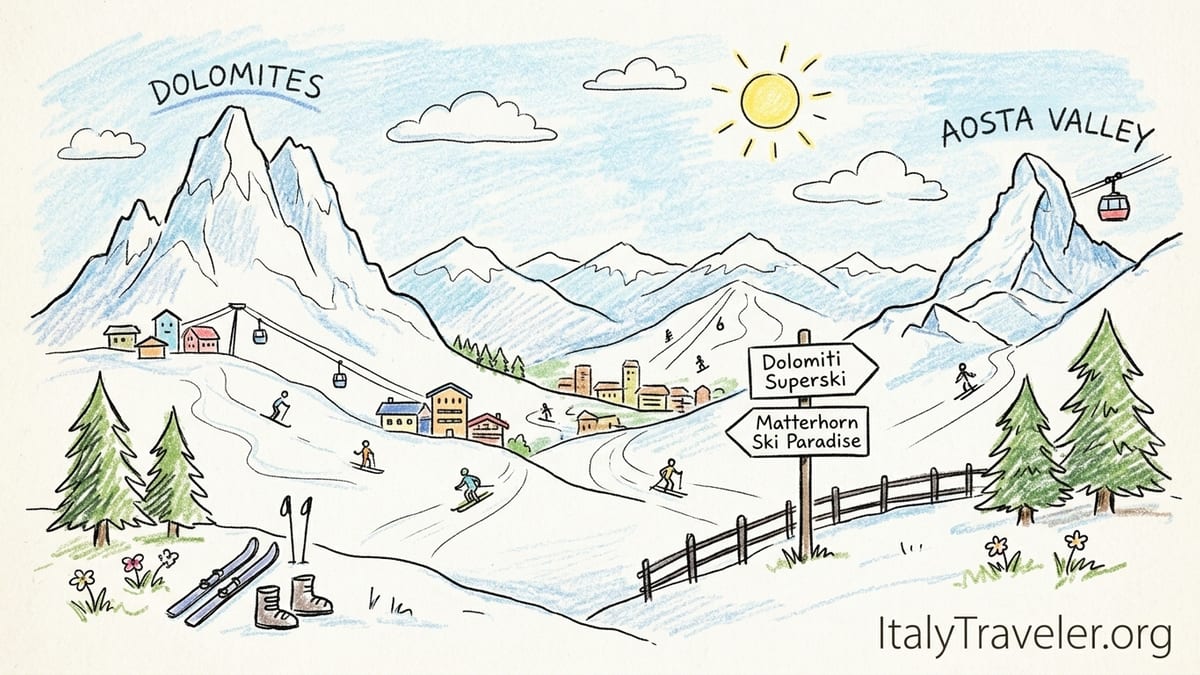
The Italian Alps at a Glance
On current figures, Italy offers more than 200 ski areas spread between the Aosta Valley, Piedmont, Lombardy, Trentino and South Tyrol. Many are small local hills, while a handful of giants stand out for their scale and infrastructure. The very largest interconnected areas, such as Dolomiti Superski around Val Gardena, Alta Badia, Kronplatz and Cortina, reach roughly 400 kilometres of linked pistes, putting them in the same league as the biggest French domains.
For most travellers choosing between Italian destinations, the core options break into two broad families. In the northwest, close to Geneva and Turin, you find high, snowsure resorts like Cervinia and Courmayeur, along with the Via Lattea around Sestriere and the freeride-focused Monterosa Ski around Champoluc. Further east, the Dolomiti Superski network, including Val Gardena, Alta Badia, Kronplatz, Cortina and Madonna di Campiglio, emphasises manicured pistes, mountain-hut dining and spectacular limestone scenery.
Alongside these two blocks sit outliers such as Livigno and Bormio in Lombardy. Livigno is a high, snow-sure duty-free valley with 115 kilometres of pistes and a long winter season typically stretching from late November into early May. Bormio combines a historic spa town with a serious FIS World Cup downhill run and access to neighbouring Santa Caterina and Cima Piazzi, making it attractive to confident skiers who like steeps and thermal baths.
All of these areas now offer modern snowmaking, electronic lift passes and broad ranges of accommodation. The key differences lie not in basic infrastructure but in altitude, snow reliability, terrain layout, atmosphere and what you get for your lift-pass money.
Piste Size, Altitude and Snow Reliability
Cervinia, on the Italian side of the Matterhorn, is one of the highest major ski bases in Europe at around 2,050 metres, with lifts rising to about 3,480 metres on the Plateau Rosa glacier and, via the Swiss link to Klein Matterhorn, close to 3,900 metres. It shares roughly 360 kilometres of pistes in the Matterhorn Ski Paradise area, making it one of Italy’s largest options and a strong choice for midwinter and spring snow reliability. Many regular visitors cite Cervinia precisely because they can ski cruise-style red runs in good snow conditions well into April.
Courmayeur sits lower, with the village around 1,225 metres and lifts reaching roughly 2,755 metres in the main ski area, while the separate Skyway Monte Bianco cable car rises above 3,400 metres on Mont Blanc. The local pistes are more compact, with about 40 to 50 kilometres of groomed runs, plus marked off-piste itineraries bringing the marketed total closer to 100 kilometres. Snowfall here is generally good but less guaranteed at village level than in Cervinia, so many skiers focus their days around the higher Plan Checrouit and Val Veny sectors.
In the Dolomites, Val Gardena offers around 115 kilometres of local pistes between roughly 1,550 and just over 2,500 metres, while Alta Badia adds another 130 kilometres in a similar altitude band. Kronplatz has about 119 kilometres of runs spread from roughly 835 to 2,275 metres and is known for its broad, long cruising pistes. All three plug into the greater Dolomiti Superski area, where a single pass opens up around 1,200 kilometres of pistes, although only some of those are realistically reachable in a day from any one base.
Livigno’s ski area reaches from roughly 1,800 metres in the valley to above 2,700 metres on its Carosello 3000 and Mottolino sides, with about 115 kilometres of piste. Its altitude and inland position typically give a long, cold winter, and local tourism material often highlights a season from late November through early May, helped by extensive snowmaking. Bormio’s slopes run from the town at about 1,225 metres up to nearly 3,000 metres around Bormio 3000, offering a big vertical drop and decent snow security higher up, though lower slopes can soften in a warm March.
Beginner Terrain and Family Friendliness
For nervous first-timers and mixed-ability families, wide, gentle slopes and logical layout matter more than headline vertical. Cervinia scores highly here: its Plan Maison plateau provides an expanse of mellow blue runs at over 2,500 metres, so beginners are learning on reliable snow instead of slushy lower slopes. The long blue and easy red runs back toward Cervinia and Valtournenche let progressing skiers enjoy satisfying top-to-bottom descents without intimidating steeps.
Livigno is another strong beginner and family choice. Its 29 or so blue runs are spread across both sides of the valley, with many hotels offering near-ski-in/ski-out access to nursery areas. Parents often appreciate that the main road and pedestrian zone run along the valley floor while most pistes descend toward the slopes above, so children are not constantly crossing busy traffic to reach lifts. Ski schools on both the Carosello and Mottolino sides operate English-language group lessons, and many packages bundle tuition and lift passes for a predictable weekly cost.
In the Dolomites, Alta Badia may be Italy’s single best destination for timid skiers. Its core area above Corvara, La Villa and San Cassiano is dominated by long blue and easy red runs that interlink comfortably, with multiple ways to avoid steeper pitches. Compared with steeper Dolomite neighbours like Arabba, Alta Badia’s terrain feels forgiving, and mountain restaurants are spaced densely, so beginners can pause often. Val Gardena also offers excellent beginner zones at Ortisei and Santa Cristina, though the famous Saslong World Cup run reminds visitors that expert terrain lies just a few lifts away.
Crowd patterns also influence beginner comfort. Kronplatz, with its wide dome-like summit, disperses skiers efficiently onto long, groomed runs, many of which are blue-grade. This can make it less intimidating on busy holiday weeks than narrow valley resorts. Courmayeur, by contrast, has a more intermediate and advanced feel; while there are blue runs, much of the enjoyable skiing is on fairly steep reds, and lift access from the village involves cable cars rather than walk-out nursery zones.
Advanced Skiing and Off-Piste Potential
Strong skiers weighing the Italian Alps often focus on the quality and variety of demanding terrain rather than just vertical drop. Bormio stands out immediately: its Stelvio piste is a regular stop on the men’s World Cup downhill circuit, offering sustained steepness and a long descent back toward town. In good conditions, advanced visitors can ski the full top-to-bottom route and then soak in Bormio’s historic thermal baths, such as the Bagni Nuovi or Bagni Vecchi complexes, as a distinctly Italian way to end the day.
Cervinia is frequently described as intermediate heaven, but advanced skiers still find challenge, especially when they include Zermatt on the Swiss side. The Italian sector has a handful of black runs and access to off-piste bowls above Valtournenche and toward the Plateau Rosa glacier, best explored with a guide. Crossing into Zermatt opens options like the steeper runs under the Klein Matterhorn lifts and the long descents toward Furi and Schwarzsee. The flip side is wind-related lift closures at very high altitude, which can occasionally limit access to the steepest terrain.
The Monterosa Ski area, anchored by Champoluc and Gressoney, is a favourite among off-piste enthusiasts. While its groomed piste mileage is modest compared to Dolomiti Superski, it offers significant vertical in relatively quiet valleys, with freeride routes dropping toward Alagna Valsesia and hidden couloirs accessible with short hikes. Guided groups frequently target Monterosa in January and February when snow is deepest and avalanche conditions stable, accepting older village infrastructure in exchange for uncrowded slopes.
In the Dolomites, advanced piste skiers gravitate to Val Gardena’s Saslong and Ciampinoi sector, Alta Badia’s Vallon and Gran Risa runs, and Kronplatz’s black descents such as Sylvester and Herrnegg, which fall almost 1,300 vertical metres toward the valley. Cortina d’Ampezzo adds classic steeps like the Olympia delle Tofane women’s World Cup course. While off-piste possibilities exist, the Dolomites are generally better known for groomed, scenic cruising than for deep powder, and the complex limestone cliffs make professional guiding and local knowledge essential for any serious backcountry itinerary.
Village Atmosphere, Après-Ski and Food
Cervinia’s village was largely purpose-built for skiing, with concrete apartment blocks mixed with newer chalets. It offers a functional, lively base with bars and pizzerias lining the main street, and a noticeable focus on British and Northern European package guests. Après-ski tends to centre around a few popular spots near the base lifts, with live music and happy-hour deals, then mellows into restaurant dinners and hotel bars. Those seeking a chocolate-box village might find Cervinia visually plain but will appreciate the convenience of walking from accommodation to lifts within minutes.
Courmayeur, in contrast, is one of Italy’s most atmospheric ski towns. Its traffic-limited Via Roma is lined with boutiques, wine bars and gelaterie set against old stone buildings, giving it the feeling of a fashionable mountain village rather than a pure resort. Après-ski begins with aperitivo in town and high-quality dining both on and off the mountain, from rustic refuges serving polenta and carbonade to contemporary restaurants showcasing Aosta Valley wines. The overall feel is less rowdy than major Austrian or French après hubs, appealing to adults and couples who prioritise food and ambience.
In the Dolomites, Alta Badia and Val Gardena are renowned for their culinary standards. Mountain huts routinely serve dishes like homemade tagliatelle with speck, venison stews or apple strudel that would pass for serious restaurant food in many cities, yet are eaten on sun terraces overlooking the Sella massif. Some huts operate as fine-dining destinations in their own right, occasionally featuring in international food media. Village life in places like Corvara, San Cassiano, Selva and Ortisei is relaxed, with family-run hotels, wine bars and small spas rather than big nightclubs.
Livigno combines a lively, youthful centre with a long, linear layout along the valley floor. Its duty-free status means shopping is a significant part of the scene, with stores selling everything from electronics to sportswear at often competitive prices compared with the rest of Italy. Après-ski ranges from simple slope-side bars on the Carosello side to late-night venues and clubs closer to the pedestrian zone, making it one of the more energetic Italian options for groups of friends. Bormio, by comparison, feels like a real mountain town that happens to have a ski hill, with a medieval centre, thermal baths and a more low-key, Italian clientele.
Lift-Pass Costs and Value for Money
Lift-pass prices in Italy are generally lower than in the flagship French or Swiss mega-resorts, although exact figures change each season and vary between low, mid and high season. As of the 2024 to 2025 period, typical high-season adult daily pass prices in major Italian resorts tend to cluster in the approximate range of 65 to 80 euros for a full-area ticket, with multi-day passes bringing the per-day rate down. Families can often take advantage of children’s discounts and promotions such as free passes for very young kids when an adult buys a ticket of the same duration.
Within this broad band, some destinations stand out for value. Livigno typically positions itself at the more affordable end of the big-resort spectrum, especially when combined with competitively priced accommodation and duty-free shopping that can lower overall trip costs. Bormio and nearby Valtellina resorts also tend to undercut the highest-profile Dolomite and Aosta Valley names, particularly in January and March shoulder weeks outside Italian school holidays, making them appealing to budget-conscious advanced skiers.
Dolomiti Superski passes, covering interconnected areas like Val Gardena, Alta Badia, Kronplatz and Cortina, usually sit toward the upper part of the Italian price range, but the sheer number of accessible kilometres makes the euro-per-piste ratio attractive. A six-day Dolomiti Superski pass typically gives access to multiple valleys, enabling itineraries such as skiing the full Sella Ronda one day, exploring Kronplatz on another, then busing to Cortina for a day on its Olympic slopes. Travellers should, however, factor in potential transfer costs between valleys when planning to exploit the full reach of the pass.
Cervinia offers both a local Italian-side pass and a more expensive international version that includes Zermatt. Many visitors opt for the Italian-only ticket on shorter trips, then pay for one or two upgrade days if the weather is calm enough to cross into Switzerland. Via Lattea around Sestriere often advertises discounted packages and early-booking deals, while smaller or less internationally known areas in Monterosa Ski can offer substantial savings on both passes and lodging compared with marquee names like Courmayeur or Cortina.
Airport Transfers and Accessibility
From the perspective of a traveller flying into northern Italy or nearby hubs, transfer times can significantly influence resort choice. Cervinia is typically around two hours by road from Turin Caselle Airport in good conditions, with Milan Malpensa and Milan Linate providing alternative gateways roughly two and a half to three hours away. Shared shuttle services operate on peak days, though many groups still opt for private transfers or rental cars, particularly if they plan to visit Aosta Valley thermal spas or other nearby resorts.
Courmayeur is one of the easiest Italian resorts to reach from Geneva Airport, usually in around one and a half to two hours via the Mont Blanc Tunnel, traffic permitting. From Turin or Milan, expect a similar transfer time to Cervinia, though road conditions over winter weekends can add delays around major junctions. The resort’s proximity to Chamonix and other Mont Blanc-side villages also allows ambitious itineraries that mix Italian and French skiing on the same trip.
Eastern Dolomite resorts involve somewhat longer road journeys but benefit from good motorway access once you clear the airports. Innsbruck, Venice and Verona all serve as common gateways to Val Gardena, Alta Badia, Kronplatz and Cortina, with typical transfer times between two and three and a half hours depending on snow and traffic. For instance, many tour operators schedule around three hours from Venice to Cortina or Val Gardena under normal winter conditions, using a mix of motorway and mountain roads.
Livigno and Bormio, located in Lombardy near the Swiss border, can be more remote. Getting to Livigno usually involves driving via mountain passes such as Foscagno or using the one-way Munt la Schera tunnel from the Swiss side, with total transfer times from Milan airports commonly in the region of four hours. Bormio is somewhat quicker, often reachable in about three hours from Milan by car. Travellers should factor in potential weather-related road closures and the need for winter tyres or chains when planning self-drive trips to these higher, more enclosed valleys.
How the Major Italian Resorts Compare
Putting the main resorts side by side highlights clear profiles that suit different types of trips. Cervinia excels for high-altitude, snowsure cruising, with an extensive piste map and the option to link into Zermatt. It suits intermediate skiers, mixed groups that include beginners who want predictable snow, and late-season holidays when lower areas may be getting thin. The trade-offs are a relatively modernist village environment and the occasional wind closure affecting the highest lifts.
Courmayeur offers a smaller, more concentrated ski area but compensates with sophisticated village life, outstanding dining and access to Mont Blanc scenery. It is ideal for long weekends where food, shopping and ambience are as important as ski mileage, and for groups keen to mix resort skiing with experiences like the Skyway Monte Bianco or guided Vallée Blanche descents toward Chamonix. Advanced skiers comfortable with off-piste can find plenty of challenge with guiding, while pure mileage hunters may prefer larger ski domains.
Livigno and Bormio represent good value and contrasting characters within Lombardy. Livigno is perfect for energetic groups and families who want snow-sure slopes, lively après-ski and the budgeting advantage of duty-free shopping, accepting the relatively long transfer. Bormio suits confident skiers who relish steep pistes and want to combine challenging skiing with spa culture in a genuine Italian town, possibly adding day trips to Santa Caterina for extra variety.
Within Dolomiti Superski, Val Gardena and Alta Badia shine for scenery, grooming and food, while Kronplatz adds modern lifts and long fall-line runs, and Cortina brings a blend of heritage, fashion and Olympic-level slopes. Madonna di Campiglio, linked with Folgarida, Marilleva and Pinzolo in the Brenta Dolomites, offers around 150 kilometres of interconnected pistes and a polished, upscale village atmosphere. Via Lattea around Sestriere and Monterosa Ski around Champoluc round out the picture as more affordable or freeride-oriented alternatives that still deliver serious Alpine terrain without the congestion of some French mega-resorts.
The Takeaway
Choosing among Italy’s flagship ski resorts starts with an honest look at your group’s priorities. If high altitude and snow reliability top the list, especially for Easter or late-March trips, Cervinia and Livigno deserve close attention. For a short, stylish escape built around Italian food, wine and mountain atmosphere, Courmayeur or Cortina pair uplifting scenery with lively but not overwhelming nightlife. Serious piste skiers who enjoy long, groomed descents and hut-to-hut itineraries will find Val Gardena, Alta Badia, Kronplatz and Madonna di Campiglio particularly satisfying.
Budget, too, plays a clear role. While all of these resorts can be enjoyed in mid-market style, Livigno, Bormio, Via Lattea and parts of Monterosa Ski often undercut the Dolomite flagships and high-profile Aosta resorts on both accommodation and lift passes. Travellers coming from long-haul destinations may find the broader value proposition in Italy especially appealing when compared with top-tier Swiss or French prices, without sacrificing scenery or infrastructure.
Ultimately, there is no single “best” Italian ski resort, only the best match for a particular trip. Families, food lovers, hard-charging experts and mixed-ability friend groups can all find their ideal base by weighing snow reliability, terrain mix, atmosphere, costs and transfer times. With thoughtful planning, it is entirely possible to ski world-class slopes, eat memorably well and experience authentic Alpine culture, all within a single Italian holiday.
FAQ
Q1. Which Italian ski resort is best for beginners?
Alta Badia, Cervinia and Livigno are among the most beginner-friendly, thanks to wide blue runs, well-organised ski schools and reliable snow on gentle slopes.
Q2. Where in Italy has the most extensive interconnected ski area?
The Dolomiti Superski network, which includes Val Gardena, Alta Badia, Kronplatz and Cortina, offers around 1,200 kilometres of pistes covered by a single lift pass.
Q3. Is Cervinia snow-sure in late March and early April?
Yes, Cervinia’s high altitude, with skiing up to around 3,500 metres on the Italian side, usually provides good on-piste conditions well into April most seasons.
Q4. How expensive are lift passes in the Italian Alps compared with France or Switzerland?
Italian lift passes are generally more affordable, with typical high-season daily adult prices in major resorts often lower than equivalent passes in leading French or Swiss mega-resorts.
Q5. Which resort is best for advanced skiers who enjoy steep pistes?
Bormio for its World Cup downhill run, Val Gardena, Kronplatz and Cortina for their black runs, and Monterosa Ski for off-piste routes are all strong choices for advanced skiers.
Q6. What is the easiest Italian resort to reach from Geneva Airport?
Courmayeur is usually the most convenient, with transfer times commonly around one and a half to two hours by road through the Mont Blanc Tunnel in normal conditions.
Q7. Are Italian ski resorts good for food-focused trips?
Yes, especially Dolomite resorts like Alta Badia, Val Gardena and Cortina, and Aosta Valley’s Courmayeur, where mountain huts and village restaurants have a strong culinary reputation.
Q8. Which resorts are best for lively après-ski in Italy?
Livigno and Cervinia have some of the liveliest après-ski scenes, with multiple bars and clubs, while Cortina and Madonna di Campiglio offer a more upscale, lounge-style nightlife.
Q9. Is a car essential for skiing the Dolomiti Superski area?
It is not essential, as many valleys are linked by lifts and ski buses, but having a car can make it easier to day-trip between bases such as Val Gardena, Alta Badia and Kronplatz.
Q10. Which Italian resort offers the best balance of value and quality for families?
Livigno, Bormio and parts of Via Lattea around Sestriere often offer a strong balance of reasonable prices, family-friendly terrain and decent village facilities for a week-long stay.