


The Italian Adriatic coast is one of Europe’s great slow-travel drives: long sandy beaches, low-key fishing towns, dramatic headlands and baroque port cities. Yet it is also lined with busy resorts, toll motorways and Limited Traffic Zones that can quickly turn a dream road trip into a stressful slog. This guide breaks the Adriatic into northern, central and southern self-drive sections, then shows how to link them into a longer route from Veneto to Puglia without treating the journey as a race from Trieste to Otranto.
How to Structure Your Adriatic Coast Road Trip
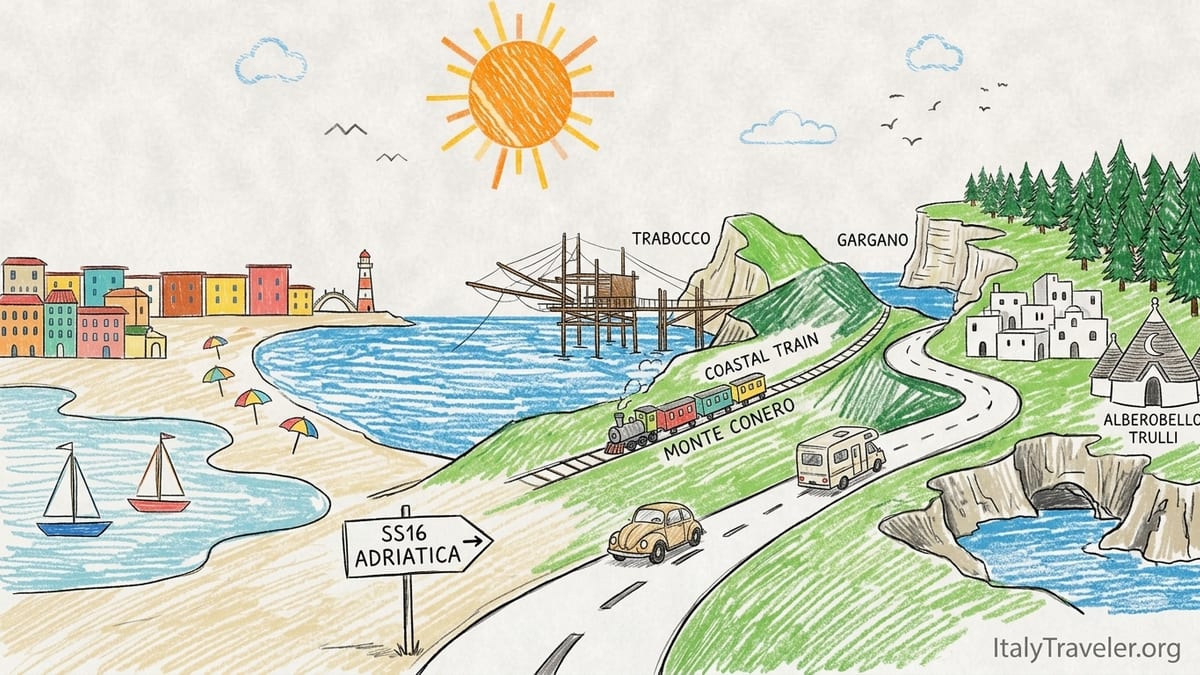
Instead of thinking of the Adriatic as one monster drive, imagine three distinct sections that you can mix and match. The northern stretch runs from Veneto’s flat lagoon landscape past Ravenna and Rimini, ideal for first-time visitors who want easy driving and plenty of seaside towns. The central stretch takes you around Monte Conero and through Abruzzo and Molise, where the coast becomes more dramatic and traffic thins out. The southern stretch covers Gargano and Puglia, a region with enough depth to support at least a dedicated nine-day road trip on its own, as highlighted by official tourism itineraries that link Bari, Polignano a Mare, Alberobello, Ostuni, Lecce, Otranto and Gallipoli.
A practical way to use this guide is to pick the section that matches your time and interests. With four to five days, you might simply shuttle between a beach base near Rimini and the art cities of Ravenna and Ferrara. With a week, add Monte Conero and Abruzzo’s Costa dei Trabocchi. With 10 to 14 days, you can link Veneto, Emilia-Romagna, Marche, Abruzzo, Molise and Puglia in sequence, using the A14 Autostrada Adriatica for fast jumps and the SS16 coastal road for scenic detours.
Most travelers will not drive every kilometer from the northern lagoon to the heel of Italy in one go. Many fly into Venice or Bologna, drive as far as Pescara or Bari, then return the car and continue by train to another region. Others do the opposite: arrive by train on the coast, then rent a car specifically for the more rural southern stretches like Gargano and Salento where public transport is thinner. The point is to build a route that supports lazy swims and hillside lunches, not just a line traced down a map.
When estimating driving times, remember that Italian routes come in layers. The A14 motorway, which runs from Bologna to Taranto roughly parallel to the sea, is the fastest option, with a complete end-to-end run cost for cars of roughly 60 euros. The SS16 Adriatica, a national coastal highway, often passes closer to beach towns but can slow to a crawl in August when every family in northern Italy appears to be headed for the same stretch of sand.
Northern Route: Veneto to Rimini and Ravenna
The northern Adriatic is defined by flat horizons, long sandy beaches and lagoon landscapes. If you are starting in Venice, many travelers pick up a rental car on the mainland at Mestre or at Venice Marco Polo Airport to avoid driving into the lagoon city. From here, it is an easy run south along the A13 and A14 or the older SS309 and SS16, passing through areas like Chioggia, Comacchio and the Po Delta wetlands before reaching Ravenna and the Riviera Romagnola.
Ravenna makes a convenient two-night base, combining UNESCO-listed Byzantine mosaics with relatively low-stress driving and parking. Several city-center garages charge day rates in the 15 to 25 euro range, and you can often leave the car and explore on foot. From Ravenna, the coast south toward Cervia, Cesenatico and Rimini is lined with resort towns where beach clubs rent umbrellas, loungers and a changing cabin for around 25 to 35 euros per day for two in peak summer, less in June or September. If you are mainly interested in beach time, consider staying in a smaller town like Cesenatico and day tripping to Rimini for its historic center and nightlife.
Driving in and around Rimini is straightforward if you pay attention to Limited Traffic Zone signs, known locally as ZTL. Parts of the historic center, Borgo San Giuliano and the redeveloped Parco del Mare seafront are controlled by cameras, with access reserved for residents, hotel guests and authorized vehicles. Hotels inside or near these ZTLs often request your license plate in advance and register it with the municipality so you can drive in temporarily to unload bags. If you accidentally enter without permission, fines typically start around 80 euros and can multiply quickly if you pass several cameras, something that has surprised many visitors in cities such as Bologna and Florence.
Parking pressure is real in these resorts, especially on July and August weekends. In Rimini and nearby towns you will find blue-lined paid street spaces, public park-and-walk lots just inland from the beach and private hotel garages. Expect to pay 1.50 to 2.50 euros per hour for public spaces near the sea, often with higher flat day rates in high season. In shoulder months like May, June and late September, you may be able to park one or two streets back from the beachfront for free and simply walk to the umbrellas and restaurants.
Central Route: Rimini, Conero and the Costa dei Trabocchi
South of Rimini, the coast bends gently through Marche, and this is where the Adriatic gains more variety. A classic central route is Rimini to Ancona, with a detour to the Conero peninsula, then on to Abruzzo and the Costa dei Trabocchi before reaching Molise and northern Puglia. Many drivers combine fast hops on the A14, which runs inland, with scenic loops on the SS16 closer to the sea. For instance, you might drive Rimini to Senigallia on the motorway in under an hour, then exit and follow the coast road around Monte Conero with stops in Sirolo and Numana.
Monte Conero is a limestone promontory that breaks the line of flat sand with steep cliffs and coves. Towns like Sirolo and Numana sit above the sea, with parking areas on the edge of the historic centers and shuttle buses down to beaches such as San Michele, Sassi Neri or Spiaggia dei Frati in season. Here, parking lots often charge a flat daily fee, for example around 10 euros for a full day in high season, and spaces can fill by mid-morning in August. If you plan to kayak along the cliffs or book a boat taxi to secluded coves, it pays to arrive early and reserve in advance through local operators rather than hoping to grab the last spot.
Continuing south, the Costa dei Trabocchi in Abruzzo is one of the most atmospheric segments of the Adriatic coast. Trabocchi are old wooden fishing platforms that jut out into the sea, many of which now host small seafood restaurants. The main inland motorway bypasses this stretch, but the SS16 threads between villages like Fossacesia, Rocca San Giovanni and San Vito Chietino with frequent sea views. Parking for trabocco restaurants is often limited to small gravel lots or roadside spaces, and summer evenings can see a line of cars squeezed onto the verges. It is common for travelers to park at a larger lot near the coastal cycleway and walk or bike between several platforms rather than constantly hunting for roadside spaces.
This is also where the coastal railway comes into its own. Regional trains run parallel to the sea, with stations often much better placed than car parks for accessing the beaches and trabocchi. For example, it can be more convenient in July to leave the car in a bigger inland town like Lanciano, then take a short train ride down to San Vito Chietino or Fossacesia-Torino di Sangro, walk or rent a bike along the waterfront and enjoy lunch on a trabocco without worrying about traffic or breathless searches for a legal parking spot. Ticket machines are usually available on station platforms, and regional fares are modest compared with fuel and parking.
Southern Route: Gargano, Bari Coast and Salento
Once you cross from Abruzzo and Molise into northern Puglia, the Gargano promontory rises abruptly from the coastal plain. Here, the A14 continues inland, while the SS89 and smaller local roads spiral around the peninsula to towns like Vieste, Peschici and Mattinata. The driving is more demanding, with hairpins, cliffside bends and slow-moving traffic behind campervans, but the rewards include pine forests, white limestone cliffs and sea stacks that feel a world away from the flat beaches of Romagna. Many visitors base themselves for three or four nights in Vieste, which offers boat trips to sea caves, ferries to the Tremiti Islands and access to Gargano National Park.
In Gargano, parking and access rules vary widely by beach. Some coves lie at the bottom of steep lanes or dirt tracks, often with private parking fields charging a few euros for the day. Others are served by shuttle buses from larger car parks inland, particularly in peak summer when local authorities cap vehicle access to fragile areas. It is common to pay 5 to 10 euros to park near sought-after beaches like Baia delle Zagare and then walk or ride a shuttle down, while beach clubs charge separately for sunbeds and umbrellas. Travelers on forums often note that using smaller local cars rather than oversized SUVs makes these roads and parking lots much less stressful.
South of Gargano, traffic flattens out as you rejoin the A14 or SS16 toward Barletta, Trani, Bisceglie and Bari. This corridor mixes working ports and refineries with polished old towns that have become popular long-weekend destinations. Bari, the regional capital, is a major transport hub where many travelers start or end their Puglia trip. Official and independent itineraries commonly outline nine or more days exploring Puglia by car, connecting Bari with Polignano a Mare, Monopoli, the trulli country around Alberobello, the white town of Ostuni, the baroque streets of Lecce and the fortified seaside of Otranto.
Between Bari and Polignano a Mare, the coastal railway often beats driving for day trips. Trains run fairly frequently, and the stations in places like Polignano and Monopoli are a 10 to 15 minute walk from historic centers and beaches. In summer, this means you can leave the car parked at an apartment or hotel in Bari, avoid the pressure of hunting for a legal space in Polignano’s crowded streets, and still arrive in time for a swim at Lama Monachile or a boat excursion beneath the cliffs. Many travelers report using a hybrid approach: a rental car for rural areas like Valle d’Itria and Salento, and trains or local buses for dense coastal towns with tight parking and ZTLs.
Linking the Sections: From Veneto to Otranto
If you have two weeks or more, you can stitch the northern, central and southern segments into an extended journey that still respects the need for downtime. One way to do this is to treat Veneto to Rimini as one leg, Rimini to Abruzzo as a second, and Gargano to Salento as a third. For example, you might spend two nights near Chioggia or in the Po Delta, three around Ravenna and Rimini, three on the Conero and Costa dei Trabocchi, three in Gargano and three split between Bari coast and Otranto, adjusting the ratios depending on whether you are more drawn to beach time, food or historic towns.
The A14 Autostrada Adriatica is your main north-south spine for these longer hops. This toll motorway runs roughly 780 kilometers between Bologna and Taranto, with junctions for major Adriatic cities including Rimini, Ancona, Pescara, Foggia and Bari. Tolls on the A14 are calculated based on the distance travelled and your vehicle class, with rates set by the motorway operator under national regulations. As a rough benchmark, driving the full Bologna to Taranto length in a standard car costs just under 60 euros in tolls, while shorter hops like Rimini to Ancona can cost in the range of 10 euros depending on your entry and exit points.
Fuel costs and travel times can add up, so consider where you really want to prioritize the scenic coast. Many travelers choose to blast south from the north via the A14 to somewhere around Conero or Pescara, then slow down and weave along the SS16 and minor coastal lanes between Conero, Abruzzo and Gargano. Another common strategy is to drive as far as Gargano or Bari, then drop the car and use trains or buses to move between Bari, Polignano, Monopoli, Lecce and Otranto, particularly if you are ending your trip in a bigger city like Rome or Naples and want to avoid returning north by car.
Linking routes also involves planning your one-way fees if you are not looping back to your starting point. Major rental companies often charge extra for returning a car in a different city, but the difference between dropping at Bologna, Bari or Brindisi may be small compared with the value of not retracing hundreds of kilometers. In practice, a traveler might pick up a car in Venice or Bologna, head down the coast to Gargano and Bari, spend a final few days in Otranto without a car, then catch a train back to Rome or Naples for a flight home, thus turning the Adriatic into a gentle arc rather than an out-and-back line.
Driving Practicalities: Tolls, ZTLs, Parking and Beach Traffic
Italian autostrade are toll motorways, and on the A14 system you typically collect a ticket at the entrance barrier, then pay on exit by card or cash. The toll is calculated using a regulated per-kilometer tariff that varies by vehicle class and whether a stretch is in flat or mountainous terrain. For most visitors driving a standard rental car, this translates into steady costs that can be estimated by distance: a 200 kilometer segment might cost in the low 20 euro range, while a full coast-spanning day could easily top 40 or 50 euros if you cover several regions. Electronic passes such as Telepass allow automatic payment at dedicated lanes, but many short-term visitors simply use regular credit or debit cards.
Limited Traffic Zones are one of the biggest stress points for international drivers. ZTL boundaries in historic centers and some waterfront areas are signposted and monitored by cameras. Unlike autostrade tolls, which you pay on the spot, ZTL violations generate fines that may reach you weeks or months later via your rental company. Typical fines start at around 80 to 100 euros per infraction, sometimes reduced if paid promptly, and passing multiple cameras can multiply the cost. To avoid this, study the ZTL maps provided by municipalities like Rimini, check your hotel’s instructions carefully, and resist the temptation to follow your navigation system blindly into old towns when a “Zona Traffico Limitato” sign appears.
Parking etiquette and pricing differ from town to town but a few patterns repeat. Blue-lined spaces are paid, usually via meter or mobile app; white lines are generally free unless otherwise signed; yellow is reserved. In high-season beach resorts on the Romagna and Abruzzo coasts, you might pay 1 to 3 euros per hour close to the sea, or 10 to 15 euros for a full day. Many hotels in places like Rimini, Vieste or Polignano a Mare offer private garages or courtyards for an overnight fee, often between 10 and 20 euros. Where spaces are tight, a smaller rental car not only makes parking easier but can reduce the risk of scrapes in underground garages and narrow alleys.
Beach-town traffic is highly seasonal. On a Saturday in early April you might cruise through Riccione or Pescara with barely a pause. On the same route in late July, the final five kilometers heading into a popular lido can take half an hour or more, especially around late morning when Italian families converge for their pre-lunch swim. To keep your sanity, plan early starts, consider a long lunch inland rather than queuing at beachfront restaurants, and where possible arrive at your overnight base before late afternoon. Many repeat visitors deliberately book shoulder-season dates, such as May, June and September, to enjoy warm sea temperatures with easier parking and fewer queues.
When the Train Beats the Car on the Adriatic Coast
Although this guide focuses on driving, the Adriatic coast is one of the few Italian regions where the railway often runs closer to the water than the main highway. The result is a long string of towns where the station lies within walking distance of the beach and historic center. In these cases, leaving the car parked and using the train for local hops can save both money and frustration, especially in high season when every curb near the sea seems occupied.
Concrete examples include the stretch between Rimini and Pesaro, where frequent regional trains link smaller resorts like Cattolica and Riccione, allowing you to base in one town and day trip along the coast without ever moving the car. Further south, the coastal railway through Abruzzo stops near key access points for the Costa dei Trabocchi. Many visitors report parking in an inland town such as Lanciano or Ortona, then riding the train down to Fossacesia or San Vito Chietino to avoid inching along the SS16 hunting for a legal spot. From Bari, the line heading toward Brindisi and Lecce gives easy access to Polignano a Mare, Monopoli and other beach towns that can be difficult to navigate by car during summer weekends.
Rail travel also comes into its own for longer intercity links at the end or beginning of your road trip. For instance, if you finish a southern Adriatic drive in Otranto or Lecce, you can return your rental car in Lecce or Brindisi, then take a train back to Bari, Rome or Naples rather than retracing your steps by road. This strategy is particularly attractive for travelers who are comfortable driving regional roads but prefer not to negotiate multi-lane ring roads and heavy urban traffic at the tail end of a vacation. It also lets you combine a focused car-based exploration of Puglia with a rail-based visit to big cities elsewhere in Italy.
Tickets for regional trains are generally inexpensive, though you should always validate or activate them according to current rules before boarding. Modern Intercity and high-speed services on the trunk lines inland can be booked with seat reservations, which is useful if you are catching a same-day flight. For coastal hops, however, most travelers simply use regional services and adjust their plans if a particular train is delayed, treating the journey itself as part of the Adriatic experience rather than a rigid schedule to be endured.
The Takeaway
Driving the Italian Adriatic coast is not about conquering a set distance from north to south. It works best when you treat the route as a series of overlapping coastal worlds: the lively beaches and art cities of Veneto and Emilia-Romagna, the cliffs and fishing platforms of Conero and Abruzzo, the pine forests and limestone headlands of Gargano, and the whitewashed towns and baroque cities of Puglia. Within this framework, you can build a short northern loop, a central escape focused on the Costa dei Trabocchi, a deep dive into Puglia alone, or a longer journey that ties them all together.
On a practical level, success comes down to a few habits. Respect ZTL signs and plan parking in advance, especially in historic centers and resort towns. Use the A14 when you need to cover ground, then slow down on the SS16 and minor roads where scenery improves and time matters less. Do not hesitate to leave the car behind for a day and use the coastal trains when they make more sense. Most of all, allow slack in your schedule for long lunches, unscheduled swims and evenings watching the Adriatic turn pink from a trabocco or a Puglian terrace. The coast rewards those who treat the journey not as a race but as a chain of lingering stops.
FAQ
Q1. How many days do I need for an Italian Adriatic road trip? For a focused section, such as Rimini to Conero or Gargano to Otranto, five to seven days is comfortable. To link Veneto, Rimini, Conero, Abruzzo, Gargano and Puglia into one journey, aim for 12 to 16 days so you are not driving every day and can spend multiple nights in key bases like Ravenna, the Conero area, Gargano and the Bari coast.
Q2. Is it better to drive the whole way or combine driving with trains? A hybrid approach works best. Many travelers drive the more rural and scenic stretches, such as Conero, Costa dei Trabocchi, Gargano and inner Puglia, then use trains for dense coastal towns and longer jumps back to major hubs. For example, you might drive from Rimini to Bari with stops in Abruzzo and Gargano, return the car in Bari, and continue to Lecce and Otranto by train.
Q3. How expensive are tolls on the A14 Adriatic motorway? Tolls depend on distance and vehicle class, but as a rough guide a standard car travelling the full length of the A14 between Bologna and Taranto pays just under 60 euros. Shorter sections, such as Rimini to Ancona or Pescara to Foggia, typically cost between 10 and 25 euros. You can pay by card or cash at exit booths, and there is no need for a special tag unless you prefer the convenience of an electronic pass.
Q4. How worried should I be about ZTL zones and fines? ZTL zones are common in historic centers and some waterfront districts and are enforced by cameras. Fines can start around 80 to 100 euros per violation and may arrive weeks later via your rental company. To avoid them, always watch for “Zona Traffico Limitato” signs, program your GPS to avoid city centers where possible, and ask your accommodation whether you are allowed to enter by car and, if so, how to register your license plate in advance.
Q5. When is driving on the Adriatic coast most enjoyable? Shoulder seasons such as May, June and late September are often ideal. The sea is usually warm enough for swimming, many beach clubs and restaurants are open, and traffic and parking pressure are lighter than in late July and August. Winter can be atmospheric in cities like Bari and Ravenna but some smaller coastal resorts feel quiet and a few beach services close.
Q6. Do I need a car for Puglia, or can I rely on public transport? You can see major towns such as Bari, Polignano a Mare, Monopoli, Lecce and Otranto by train and bus, but a car makes it much easier to explore rural areas, scattered beaches and hilltowns like Alberobello and Ostuni. Many travelers follow official or suggested nine-day Puglia road-trip itineraries that loop between Bari, the Itria Valley and Salento, combining car days with occasional train excursions to avoid parking headaches in busier towns.
Q7. What size of rental car is best for this trip? A compact car is usually ideal for the Adriatic coast. Narrow streets in old towns, tight underground garages and small clifftop parking lots in places like Gargano and Conero can be challenging with large vehicles. A smaller car is easier to park, often uses less fuel and may come with lower rental and toll costs, while still handling luggage for two or three people.
Q8. Is it difficult to park near the beach in high season? In July and August, parking near popular beaches can be difficult, especially late in the morning or on weekends. Expect to use paid lots, walk a short distance or rely on shuttle buses and coastal trains in hot spots such as Rimini, the Costa dei Trabocchi, Gargano and Polignano a Mare. Arriving early, choosing less famous stretches of coast and staying in accommodations with reserved parking all help reduce stress.
Q9. Can I safely drive the coastal roads around Gargano and Conero? The roads are generally well maintained but can be narrow and winding, with occasional steep drop-offs and tight bends. If you are comfortable driving on rural roads and take your time, most drivers manage without problems. It helps to avoid driving these stretches in the dark or during heavy storms, to keep your speed moderate, and to pull into lay-bys to let local drivers pass if they are in a hurry.
Q10. How should I plan fuel, food and rest stops along the A14 and SS16? Service areas on the A14 are frequent and usually include fuel, restrooms and cafeterias where you can grab an espresso, sandwich or hot meal. On the SS16 and smaller coastal roads, you will pass regular fuel stations and plenty of roadside bars and trattorias, though opening hours can be more variable on Sundays or in low season. A good practice is to refuel when your tank drops to around one-third and to combine rest stops with visits to inland towns for lunch, which often offer better value and a break from the heat and crowds on the seafront.