


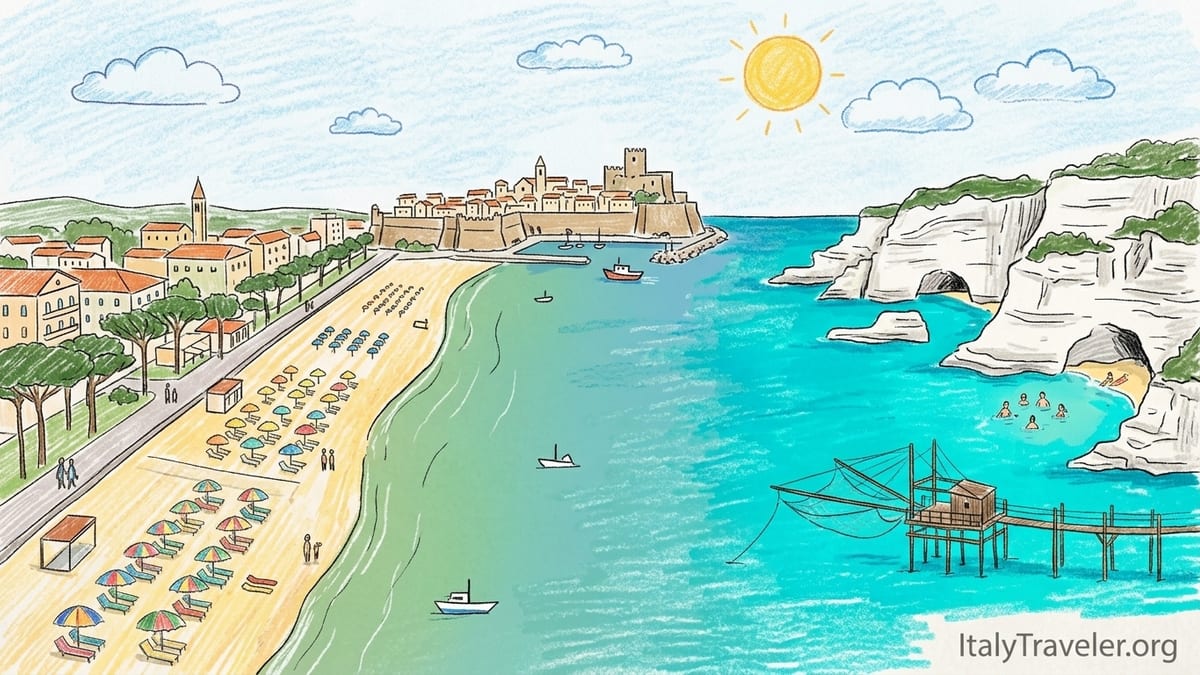
The Italian Adriatic coast stretches for hundreds of kilometers from the lagoon landscapes near Grado and Lignano down through the fun-focused Riviera Romagnola, the quieter shores of Marche, Abruzzo and Molise, and finally the dramatic cliffs and whitewashed towns of Puglia. First-time visitors often underestimate both its variety and its size. This guide breaks the coastline into northern, central and southern sections, highlights how scenery, prices and travel style change as you move south, and shows how to choose one or two bases rather than trying to cover everything in a single trip.
Northern Adriatic: Grado, Lignano and the Veneto & Romagna Resorts
The northern Adriatic coast, from Grado and Lignano Sabbiadoro down to the long beaches of Veneto and Emilia-Romagna, is classic Italian beach-holiday territory. Expect wide, gently shelving sandy beaches, long rows of organized lidos with sun loungers, family-friendly shallow water and resort towns that feel built around summer. Places such as Lignano, Caorle, Jesolo, Cattolica, Rimini and Riccione are particularly convenient for a first trip focused on easy seaside downtime.
In resorts like Lignano Sabbiadoro the beach is a continuous band of fine golden sand, with sections of paid lidos and marked stretches of free beach where you can bring your own umbrella and chairs. A typical daily package for two loungers and an umbrella in high season might cost around 20 to 30 euros, slightly less in June or early September. Behind the sand you find bike paths, playgrounds, casual seafood spots serving fried calamari and grilled branzino, and evening passeggiata promenades.
Further south around Rimini and Riccione, the atmosphere mixes beach holiday and nightlife. Rimini is a mid-size city with a historic Roman bridge and an old town that feels surprisingly local once you step away from the seafront. Riccione is more compact and upmarket, with stylish beach clubs and shopping on Viale Ceccarini. Families appreciate easy connections: regional trains and Intercity services along the Bologna to Ancona line stop in both Rimini and Riccione, and a dedicated bus rapid-transit route known locally as Metromare links their stations to the beachfront areas in roughly 20 to 25 minutes, with multiple stops near hotels and beach entrances.
Prices in the north are relatively moderate by Italian seaside standards, especially if you avoid the peak week around the mid-August Ferragosto holiday. You can still find simple two-star or three-star family-run hotels in Rimini and Lignano from roughly 90 to 140 euros per night for a double in shoulder season, including breakfast, while four-star spa and design properties in Riccione or Jesolo can run from 220 euros and up in July. This stretch suits first-time visitors who like organized facilities, good train connections, nightlife options and plenty of activities like bike rental, mini-golf and water parks.
Central Adriatic: Marche, Abruzzo and Molise
Move into Marche, Abruzzo and tiny Molise and the feel of the Adriatic coast starts to change. Beaches are often narrower, with a mix of sand and pebbles, and the green Apennine foothills come closer to the sea. The coastline becomes more varied, with headlands, old fishing piers, and towns that feel like real year-round communities rather than purely resort developments. This is a good area if you want a balance of beach time and low-key historic towns at generally lower prices than in the north.
In Marche, resort towns such as Pesaro, Senigallia and San Benedetto del Tronto still have classic lidos, but you are never far from hill towns like Urbino or Ascoli Piceno for day trips. Abruzzo offers a 120-kilometer stretch of coast where sandy resorts such as Giulianova and Montesilvano alternate with the so-called Trabocchi Coast south of Pescara, named for traditional wooden fishing platforms that jut out into the sea. Many of these trabocchi now operate as simple seafood restaurants where you might order spaghetti alle vongole and enjoy views straight over the water in the evening light.
Molise has only about 35 kilometers of Adriatic shoreline around Termoli and Campomarino, but this short segment is appealing precisely because it feels less discovered internationally. Termoli combines a long sandy beach with a historic center perched on a small promontory, and its harbor is the departure point for boats to the Tremiti Islands off the Gargano coast in neighboring Puglia. Campomarino Lido, just south of Termoli, offers a quieter family-friendly beach environment with pine woods behind the sand and a handful of simple hotels and campsites.
Central Adriatic prices are generally lower than in the better-known northern and southern sections. A seafront three-star hotel in an Abruzzo town like Roseto degli Abruzzi or Francavilla al Mare in June might cost around 80 to 120 euros per night, with umbrellas often discounted or bundled into half-board packages. Food tends to be hearty and good value: you are in regions where traditional dishes like brodetto fish stew, arrosticini lamb skewers and local wines such as Montepulciano d’Abruzzo are everyday staples rather than luxury items. For first-time visitors, this middle stretch suits those seeking a quieter, more local feel while still relying mostly on train connections along the coastal main line.
Southern Adriatic: Gargano, Bari, Polignano and Otranto
South of Molise, the Gargano promontory in northern Puglia marks another distinct shift in scenery. Here the coast becomes wilder, with white limestone cliffs, forested headlands and small coves mixed with longer sandy arcs near towns such as Vieste and Peschici. Some beaches are accessible only by car and short walks or by boat tours that explore sea caves and secluded inlets. Compared with the north, this area feels more road-trip oriented and rewards travelers comfortable driving narrow, winding coastal roads to reach viewpoints and small beach bays.
Continuing south past the flat Tavoliere plain, the coast near Bari becomes a mix of working ports and pretty old towns. Bari itself has a revitalized historic center where locals still gather in the evenings, while nearby Polignano a Mare and Monopoli offer photogenic clifftop streets and coves. Polignano’s main cove, set between cliffs and lined with whitewashed houses above, is pebbly rather than sandy and can get crowded in high summer. Many visitors choose Polignano, Monopoli or coastal towns slightly inland such as Ostuni as bases from which to explore both the sea and Puglia’s trulli villages and olive groves.
Farther south in the Salento peninsula, Otranto sits on a transparent turquoise bay with a stone-walled old town and a small harbor. Just outside town, coves such as Baia dei Turchi or Porto Badisco showcase Puglia’s trademark combination of clear water, white rock and Mediterranean scrub. Local advice often emphasizes that in August especially, these coves fill quickly, so arriving early or booking spaces at private lidos can be important. From Otranto, it is an easy drive down the scenic coast road toward Santa Maria di Leuca, where the Adriatic meets the Ionian Sea.
Southern Adriatic prices can be quite seasonal. In early June or late September, a good mid-range hotel in Polignano or Otranto might cost 140 to 220 euros per night, while in late July and the Ferragosto week prices often rise significantly and availability tightens. Car rental is common here because while the main coastal rail line between Bari, Polignano, Monopoli, Brindisi and Lecce is reliable, the branch lines and local buses that reach smaller beach coves and inland trulli towns are less frequent. For first-time visitors, the southern Adriatic suits a trip that mixes swimming, scenic drives, and slow evenings in whitewashed historic centers.
Beaches, Scenery and Atmosphere: How the Coastline Changes
From north to south, the beaches along Italy’s Adriatic coast evolve from broad, gently shelving sands to a patchwork of smaller sandy and pebbly coves set against cliffs. In the north, particularly around Lignano, the Veneto resorts and Rimini, you can walk for kilometers along continuous sandy shore with shallow water that is ideal for young children. Beach clubs are tightly spaced, each with its own color-coded umbrellas and a bar serving espresso, Aperol spritz and panini. Free sections exist but are relatively limited in some built-up areas, so first-timers should expect to budget for at least occasional lido days.
In the central stretch, sands remain common but are often backed by low dunes, hills or palm-lined promenades rather than dense lines of high-rise hotels. On Abruzzo’s Trabocchi Coast or near Termoli in Molise, beaches feel more varied in size and texture, occasionally with pebbles or rocky sections that make water shoes useful. The presence of trabocchi and historic promontories gives the scenery a more intimate feel, and you are rarely far from countryside landscapes of vineyards and olive groves.
Once in Puglia, the coastline becomes more dramatic. Around Gargano and between Polignano and Otranto, white cliffs and rocky shelves alternate with small sandy inlets that can feel almost like natural swimming pools. The sea shifts from the softer greens of the northern Adriatic to intense turquoise shades on calm days. This geography favors smaller lidos, cliff-jumping spots in designated areas, and boat trips that allow access to coves you cannot easily reach by foot. The trade-off is that families with strollers or travelers who need flat access may find some southern beaches more challenging than the wide, level sands up north.
Atmosphere also shifts as you move south. Northern resorts have a distinctly holiday-town energy with beach sports, organized entertainment on the sand and nightlife geared to young Italians and families. Central regions feel more relaxed and neighborly, with a strong sense of local life continuing around the tourism season. In the south, especially in Salento, evenings in towns like Otranto or Polignano feel more like a blend of fishing village and fashionable small-city nightlife, with wine bars set under stone arches and people strolling until late.
Getting Around: Trains, Driving and Boat Trips
For a first-time visitor, it helps to understand the basic transport spine of the Adriatic side. A major railway line runs almost continuously along the coast from the northeast near Trieste and Venice down past Rimini, Ancona, Pescara, Termoli, Foggia, Bari and on to Lecce. On this axis, frequent regional and long-distance trains link resort towns and cities. For example, the short hop between Rimini and Riccione by regional train takes around 10 to 15 minutes, with tickets costing only a few euros. This makes it realistic to stay in one base and take day trips to nearby towns without renting a car in the northern and central segments.
Driving becomes more attractive as you move south and want to explore the Gargano promontory or the smaller coves between Bari, Polignano and Otranto. For instance, a traveler based in Bari who wants to swim at an out-of-town cove in the morning, visit an inland trulli village such as Alberobello in the afternoon, and return to the coast for dinner will find that a rental car provides much more flexibility than trying to align infrequent branch-line trains and buses. Roads are generally good but can be narrow and winding around headlands, and parking in popular coastal towns in high season can require patience or paid lots.
Boat trips are a key part of the Adriatic experience, particularly in lagoon and cliff areas. In the north, excursions by motorboat connect Lignano Sabbiadoro and Grado across the lagoons, offering views of sandbars, fishing huts and birdlife that you do not see from the main roads. Farther south, Gargano is known for sea-cave tours from Vieste and Peschici, where small boats thread in and out of rock formations, and many operators along the Puglia coast run half-day trips that stop for swimming in otherwise inaccessible coves. In central areas like Termoli, regular ferries cross to the Tremiti Islands, creating an easy day trip or overnight extension focused on hiking and swimming.
For most first-time visitors, a mix of trains and occasional car rental can work well. One common pattern is to arrive by train into a northern or central base such as Rimini, Pesaro, Ancona or Pescara, enjoy a mostly car-free stay, then rent a vehicle later in the trip for a few days in Gargano or Salento to reach the more remote coves and inland villages. This approach keeps costs down, reduces parking hassles in bigger towns, and still allows access to the most scenic stretches.
Trip Styles: Family Holidays, Culture, Food and Nightlife
The Italian Adriatic coast can support very different trip styles depending on where you choose to base yourself. Families with young children often gravitate to the north, where shallow, gently sloping beaches, lifeguards, playgrounds and structured kids’ clubs at lidos are common. A week in a family-friendly hotel in Riccione, for example, might include half-board meals, a reserved umbrella, and discounts at nearby theme parks, making the trip feel more like a traditional seaside package holiday.
Travelers interested in history and culture might prefer bases that combine beaches with substantial old towns. Examples include Rimini, with its Roman bridge and Tiberius Arch alongside the beachfront; Ancona, which pairs a working port and beaches with a cathedral overlooking the sea; Pescara as a gateway to Abruzzo hill towns; or Bari, Polignano and Otranto in the south, where medieval walls, Romanesque churches and small museums nestle close to the water. From a central Adriatic base, day trips into the Apennines can bring you to fortified hill towns and national parks within an hour or two of the sea.
Food-focused travelers will find strong regional identities along the whole coast. In the north you might snack on piadina flatbreads stuffed with prosciutto and squacquerone cheese on the promenade in Rimini, or order a fritto misto of local fish at a Lignano beach bar. In Marche and Abruzzo, menus highlight brodetto fish stews, grilled Adriatic sardines, and arrosticini skewers cooked over coals, paired with local wines from small producers. Further south in Puglia, seaside dinners center on raw and marinated seafood, orecchiette with cime di rapa, burrata from nearby dairy farms and olive oil tastings in converted masseria farm estates.
Nightlife and evening atmosphere vary widely. In the Veneto and Romagna resorts, beach clubs morph into venues with DJs and dance floors, attracting Italian and European visitors in their twenties and thirties. In many Abruzzo and Marche towns, evenings are more about family strolls, gelato and outdoor tables at trattorie. In Puglia, nightlife often concentrates in old-town streets in Bari Vecchia, Polignano or Otranto, where wine bars and small cocktail lounges stay open late but the vibe leans more toward sociable than high-energy clubbing. Matching your base to the evening style you prefer can make a big difference to how your trip feels.
When to Go and How Long to Stay
Seasonality along the Adriatic is pronounced. The main beach season runs from roughly late May to late September, peaking from mid-July through the Ferragosto holiday around 15 August, when many Italians take vacation. In that peak window, lidos are at their busiest and advance booking is highly advisable for accommodation and often for beach services in the most popular spots, particularly in Salento and Polignano, where smaller coves have limited capacity. Shoulder seasons in June and September usually offer warm sea temperatures, more manageable crowds and lower prices, making them ideal for many first-time visitors.
Outside summer, the coast changes character. From October to April some lidos dismantle their structures and smaller seasonal hotels close, especially in purely beach-oriented resort towns. However, larger cities such as Trieste, Ancona, Pescara, Bari and coastal historic centers like Rimini or Otranto remain active year-round, with a stronger focus on local life, food and culture rather than swimming. If your trip is outside the high season, choose a base that doubles as a regional hub rather than a resort that exists mostly for summer.
Given the length of the coastline, it is not practical to attempt the full stretch from Grado to Otranto in a single short vacation. For a first visit of about one week, many travelers choose one main base and perhaps a short two-night add-on somewhere contrasting. For example, you might combine five nights in Rimini or Riccione with two nights in an Abruzzo or Molise town like Pescara or Termoli, linked entirely by train. Alternatively, you could split your time between a central base in Marche or Abruzzo and a southern base in Puglia, flying into Bologna or Venice and out of Bari or Brindisi.
On a longer 10 to 14 day trip, covering one region thoroughly often proves more rewarding than racing down the coast. That might mean focusing on the Riviera Romagnola and Marche with rental bikes and hill-town day trips, or concentrating on Puglia alone, dividing your time between a northern base near Gargano or Bari and a southern base around Otranto or Lecce. The key is to embrace the idea that the Adriatic coast is a series of distinct experiences and that you can always return for a different stretch on a future trip.
FAQ
Q1. Do I need to drive to enjoy the Italian Adriatic coast on a first visit?
Many visitors explore the northern and central Adriatic entirely by train, using the coastal rail line to reach towns like Rimini, Pesaro, Ancona, Pescara and Termoli. Driving becomes most useful in the Gargano area and around Bari, Polignano and Otranto, where branch-line trains and buses are less frequent and many smaller coves are easiest to access by car.
Q2. Which part of the Adriatic coast is best for a classic sandy beach holiday with children?
For wide, shallow sandy beaches with lifeguards and play areas, the northern resorts such as Lignano Sabbiadoro, Jesolo, Cattolica, Rimini and Riccione are excellent choices. Facilities are set up for families, with stroller-friendly promenades, playgrounds, and many hotels offering kids’ clubs and half-board options.
Q3. Where should I go if I want both beaches and historic towns?
Good bases that combine swimming with culture include Rimini, Ancona, Pescara, Bari, Polignano a Mare and Otranto. From these towns you can walk to beaches or take short transfers and also spend time in old quarters with churches, castles and local markets.
Q4. Is the southern Adriatic around Bari and Otranto more expensive than the north?
Prices in Puglia can be higher in peak summer, especially in small historic centers like Polignano and Otranto where accommodation is limited. However, traveling in June or September and choosing slightly inland bases can bring costs closer to or even below northern resort levels.
Q5. How long should a first-time visitor plan for the Adriatic coast?
A week is enough for a relaxed stay in one main area, with perhaps a short side trip to a second nearby destination. If you want to experience both a central stretch such as Abruzzo or Marche and a southern stretch in Puglia, 10 to 14 days allows a more comfortable pace.
Q6. Can I swim comfortably outside July and August?
Sea temperatures along the Adriatic are usually pleasant for swimming from roughly mid-June to late September, though this can vary slightly from year to year. Early June and late September often offer warm enough water for most swimmers, with the benefit of fewer crowds and softer prices.
Q7. Are there quieter areas suitable for travelers who dislike big resort towns?
Yes. Parts of Marche, Abruzzo and Molise have a more low-key feel, especially smaller towns along the Trabocchi Coast or near Termoli and Campomarino. In Puglia, choosing bases slightly inland from the coast or smaller seaside villages outside peak dates also helps avoid the busiest scenes.
Q8. What kind of budget should I expect for beach services?
In most organized resorts, a daily rental of two loungers and an umbrella typically runs in the range of about 20 to 30 euros in high season, sometimes less in June or September or when bundled into hotel packages. In smaller or less developed areas, prices can be lower and more stretches of free beach are available.
Q9. Is it realistic to visit both Gargano and Salento in one trip?
It is possible on a longer itinerary of around two weeks, but you should factor in driving times and avoid packing in too many bases. Many travelers find it more rewarding to focus either on Gargano and northern Puglia or on the Bari to Otranto stretch, rather than trying to see every coastal area in one go.
Q10. Do I need to see the entire Adriatic coast on my first visit?
No. The coastline is long and diverse, and most travelers enjoy their trip more by concentrating on one or two regions that match their interests, such as family-friendly northern resorts, quieter central stretches or scenic southern Puglia. You can always return to explore a different section on a future trip.