


Seen from the water, Italy’s Adriatic coast is a different country. White cliffs glow against turquoise shallows, sea caves open like hidden doors and pocket coves appear where the road never reaches. Boat tours are the way to unlock these angles, but not every stretch of coast rewards the same kind of outing. Along the central and southern Adriatic you can choose between half-day cave runs, lazy swimming cruises, proper mini-cruises between ports or simple water taxis. The art is matching the right boat experience to each place.
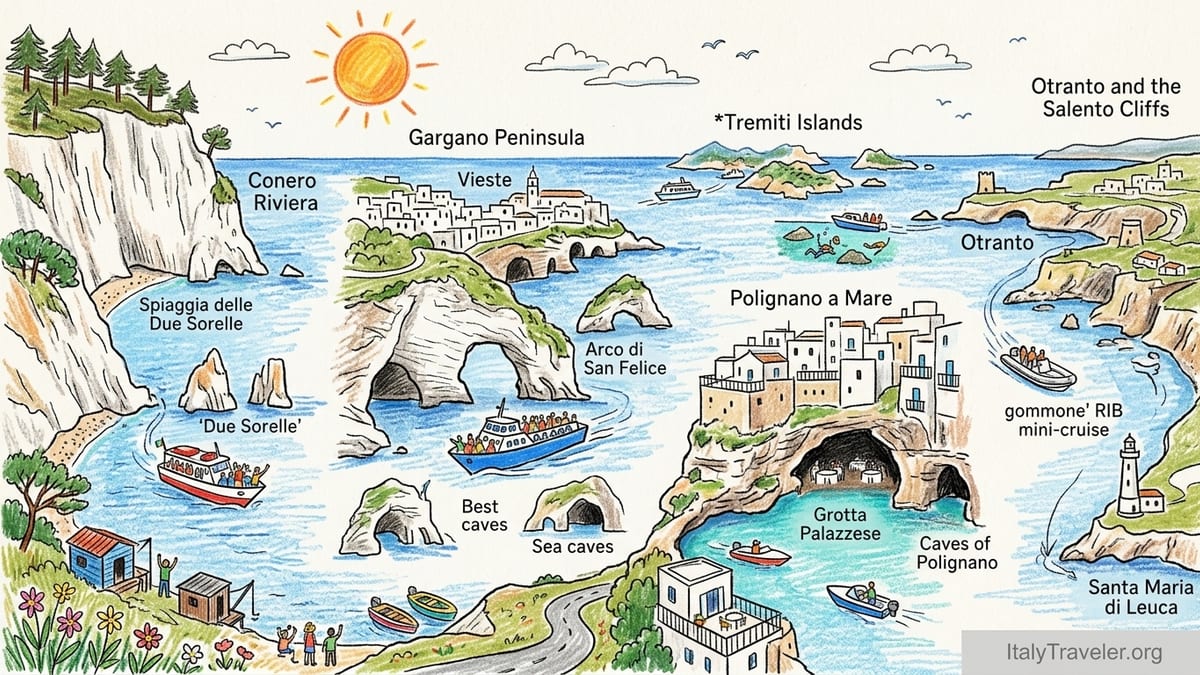
Why the Adriatic Coast Looks Better From a Boat
The central and southern Adriatic are defined by limestone. From the Conero Riviera in Marche to Gargano and the Salento cliffs near Otranto, this soft white rock has been carved by waves into arches, caves and overhangs that you simply cannot appreciate from shore. Even where there are beach roads, the dramatic parts of the coastline face the sea. That makes certain stretches almost purpose-built for boat tours rather than road trips.
In practice, this means some outings have a clear added value: Gargano’s long chains of sea caves south of Vieste, the isolated coves of the Conero Riviera, the small but rugged Tremiti archipelago and the cliffside town and grottoes of Polignano a Mare. Others, like some ferry hops between Tremiti islands or the low coastline around Bari, may be better handled as simple transport unless you are combining them into a longer cruise.
Most regional operators now run a spectrum of products. On Gargano, for example, you will find shared three-hour cave excursions from Vieste’s port, small RIBs with skippers for private groups and full-day mini-cruises that push out to the Tremiti Islands with lunch and snorkeling stops. On the Salento coast around Otranto, gommone mini-cruises trace the cliffs all the way down toward Santa Maria di Leuca, stopping to swim in coves beneath watchtowers and fishing hamlets. Choosing among these options comes down to the scenery, the sea conditions and how much time you have on shore.
Conero Boat Trips: Cliffs and Hidden Beaches
The Conero Riviera, south of Ancona, is one of the first truly dramatic sections of the Adriatic southbound. Monte Conero rises abruptly from the sea, cutting off the coastal road and leaving a run of pale cliffs, pine-topped headlands and pocket coves that are best reached by boat. Here the classic outing is a half-day cruise to the famous Spiaggia delle Due Sorelle, a white-pebble beach backed by cliffs and fronted by two rock stacks that are only accessible from the water.
From small ports like Numana and Portonovo, local skippers run shared or private motorboat trips that skirt the coastline, often including a swim stop off Due Sorelle or in nearby coves. A typical shared excursion might last three to four hours, with morning departures to catch calmer seas and softer light. Private tours arranged through villa estates in the area, such as those that include aperitivo service on board, often stretch into sunset and can run as flexible half-day charters rather than fixed routes, focusing purely on cliff views and secluded swims.
Because some Conero beaches are either hike-in or technically closed to foot traffic due to rockfall risk, the boat makes a practical difference. In summer, sea conditions on this section of the Adriatic are often manageable in the morning but can become choppier in the afternoon as breezes build. If you are prone to seasickness or traveling with children, favor early departures and avoid days with strong north or northeast winds. When the sea is rough, local operators will usually cancel or shorten trips and may offer a simple shuttle service to more sheltered beaches instead of scenic cruising.
For Conero specifically, a boat tour is more than just a nice-to-have. If you want to see the signature cliffs, the twin stacks of Due Sorelle and the continuous sweep of white rock broken by caves and arches, the view from the water is the main event. Simple ferry-style shuttles from Numana to Due Sorelle are worthwhile if budget is a concern, but they will not give you as much time tracing the coastline itself.
Gargano from Vieste: Sea Caves and Arches
Further south in Puglia, the Gargano Promontory juts into the Adriatic like a limestone thumb. Between Peschici in the north and Mattinata in the south, the coastline is dense with sea caves, arches and stacks, especially along the stretch immediately south of Vieste. Local operators and even holiday villages promote the “grotte marine” excursions as a signature experience, loading passengers at Vieste’s port or directly from holiday village bays such as Sfinale and running daily trips along the coast.
Typical shared cave excursions from Vieste use medium-sized motorboats with seating for several dozen passengers and last about three hours. They run in the morning and early afternoon, glide under the famous Arco di San Felice and duck in and out of named caves with evocative titles like Grotta dei Contrabbandieri or Grotta Sfondata. Many itineraries include a swim stop in a sheltered bay such as Vignanotica or Baia di Campi, where passengers can jump from the stern or descend swim ladders into clear green water.
Smaller outfits offer six-guest RIBs or wooden gozzi with skippers, trading capacity for intimacy. A private RIB out of Vieste typically offers more flexibility to linger in narrow grottoes when conditions allow, to slide onto small shingle coves or to add a longer swimming pause. These boats command higher per-person costs but feel less crowded and are better suited if you want to photograph sea arches, because you are closer to the waterline and not peering over a rail.
When is a simple water transfer enough on Gargano? If your main goal is to reach a specific beach, such as hopping from Vieste to a larger cove like Pugnochiuso for a day at a lido, a small ferry or water-taxi service can do the job with less narration and fewer cave detours. However, the scenic payoff of Gargano truly lies in the caves and arches. On calm mornings, the way the light filters into the white limestone chambers is one of the most memorable visual experiences on the Adriatic, and it justifies a full cave-focused excursion rather than pure transport.
Tremiti Islands: Mini-Cruises and Snorkeling
About 20 kilometers off the Gargano coast, the Tremiti Islands form a compact archipelago that is a national marine reserve. The main islands of San Domino and San Nicola, along with smaller Capraia, Cretaccio and Pianosa, are ringed by cliffs, small bays and translucent water. Here, the boat is not optional. Aside from a single principal beach on San Domino, most of the appealing spots are best accessed from the sea, and guided boat tours are the default activity.
On the islands themselves, small motor launches carrying around a dozen passengers circuit the archipelago on two to three hour trips. These often include multiple swimming stops at spots like the stacks off San Domino, the therapeutic mud near Cretaccio or the area around the submerged statue of Padre Pio. Other operators focus more heavily on snorkeling, with itineraries branded with names that emphasize underwater exploration, providing masks and guiding guests over shallow reefs and rock formations where fish congregate.
Day-trippers coming from the mainland have another layer of choice. Mini-cruises depart from ports such as Rodi Garganico and Foce Varano on the Gargano coast, taking around an hour to reach the islands, then allowing several hours for guided swimming and snorkeling stops before returning in late afternoon. Some packages are structured almost like small ship excursions, with lunch on board or reserved time ashore on San Nicola for walking up to the fortified abbey, then rejoining the boat for more coves in the afternoon.
Because of the marine reserve regulations and the distances involved, Tremiti is one area where shared excursions often make more sense than private hires. Private charters are available, but boat numbers are controlled and the expertise of local skippers in reading currents and permitted zones is valuable. A simple ferry between Tremiti islands can work if you only want to shuttle from San Domino to San Nicola for a stroll, but if you hope to reach tucked-away caves or snorkel above cliffs that plunge straight into blue water, a proper boat tour provides the real benefit.
Polignano a Mare: Caves Beneath the Cliffs
Polignano a Mare is one of the Adriatic’s most photographed towns, a cluster of white houses balanced on low cliffs above a pebbly cove. From above, the view is dominated by balconies and terraces, but from the water you see another layer: a chain of grottoes carved into the rock, including the famous dining cave of a cliffside restaurant and a sequence of blue-lit chambers and arches. Boat tours here focus less on long-distance navigation and more on close-up exploration of these caves.
Operators working from Polignano’s small harbors and nearby marinas run short shared trips, often about 90 minutes to two hours, that hug the town’s waterfront and nearby coastline toward San Vito and Monopoli. The boats are usually open-deck motor vessels or medium RIBs that can nose in and out of grotto entrances, with names like Grotta delle Rondinelle, Grotta Azzurra and Grotta Ardito. Almost all tours include at least one swim stop in clear water away from the urban bay, where you can float beneath the cliffs with a view back to Polignano’s skyline.
Prices vary, but as a broad example, shared cave excursions promoted locally might start in the range of a few dozen euros per person for a daytime sailing, with sunset departures and boat sizes influencing the upper end. Private use of a similar vessel, often arranged through local agencies or hotel partnerships, typically bundles extras like prosecco, soft drinks and flexible departure times. High-end hospitality brands in the region offer “exclusive use” Polignano grotto experiences where guests board at a private marina, cruise past the caves, stop for an aperitivo at anchor and return along the coast toward Monopoli.
For most travelers, the scenic highlight at Polignano is the juxtaposition of town and sea, so even budget-conscious visitors should consider at least a short shared boat tour rather than only viewing from the public bridge above the main beach. A simple water taxi is less common here because the distances are small; the product on offer is very much about the caves themselves. That said, if the sea is choppy or if you are visiting in shoulder seasons when storms roll in, some operators may limit entry to narrower grottoes or cancel outright, in which case a clifftop walk and a swim from the main beach are a reasonable backup.
Otranto and the Salento Cliffs: Longer Coastal Cruises
South of Otranto, the coastline runs for many kilometers toward Santa Maria di Leuca without significant interruption from large towns. The cliffs are lower than Gargano’s but every bit as striking, punctuated by watchtowers, fishing hamlets, spa towns and fjord-like inlets. Routes like the provincial road from Otranto to Leuca are celebrated drives, yet the same route from the water reveals caves below the road, narrow inlets beneath bridges and swim spots under villages perched on the rock.
Boat experiences from Otranto fall into two main categories. The first are half-day or slightly longer cruises that focus on a specific stretch of coast, for example from Otranto up to Torre dell’Orso or down to Santa Cesarea Terme and Castro. These often use mid-sized boats or RIBs, with shaded seating and ladders for swim stops. Guests might leave Otranto’s harbor mid-morning, follow the cliffs past Punta Palascia, pause to swim in a sheltered cove under a watchtower, then continue to a spa town like Santa Cesarea Terme for a view from the sea before looping back.
The second category resembles a true mini-cruise. Some operators and tour brokers package a full-day inflatable-boat journey that runs from Otranto all the way south, touching points such as Porto Badisco, Santa Cesarea, Castro, the fjord-like inlet of Marina di Novaglie and finally Santa Maria di Leuca, where the Adriatic and Ionian Seas meet. These longer excursions may include several swim stops, a break for lunch on board or ashore and commentary on coastal villages, watchtowers and the nature park that protects much of this shoreline.
Compared with the more compact cave circuits of Polignano or Vieste, the Otranto route rewards travelers who enjoy a sense of distance and changing scenery. You might start the day under pale, chalky cliffs near Otranto, then see darker rock and deeper inlets near Castro, and finally glide into the harbor of Santa Maria di Leuca with its lighthouse above. Where a simple ferry or taxi might be enough is on short hops, such as shuttles between Leuca and nearby caves for a quick swim, or local transfers in peak season when small boats run as sea taxis between closely spaced coves. For visitors staying inland in Lecce or in the Salento countryside, however, a structured Otranto-based cruise is often the most efficient way to see this whole coast without a car.
Shared vs Private Boats, Durations and Practical Tips
Across the Adriatic, from Conero to Gargano, Tremiti, Polignano and Otranto, the same practical questions come up: join a shared excursion, book a private boat with skipper or use simple ferries and water taxis. Shared tours are usually the best value and the simplest to organize. In Vieste, for example, you can often walk up to kiosks on the harbor and book a same-day cave excursion, while in Polignano a Mare, tourist offices list several operators running frequent departures in summer. These boats may carry anywhere from a dozen to several dozen passengers, with fixed itineraries and commentary in Italian and sometimes English.
Private boats with skippers, whether small gozzi in Conero, six-passenger RIBs in Gargano or mid-range motorboats in Otranto, provide flexibility. They allow you to adjust the schedule for photography, linger at a favorite cove or avoid the busiest mid-day slot. Costs depend on boat size, fuel and duration, but in practice they can make sense for families or small groups who would otherwise occupy several seats on a shared tour. In many destinations, your hotel or agriturismo can recommend a known skipper and include the cost in your stay as a packaged experience.
Durations are relatively consistent along the coast. Expect 90 minutes to two hours for compact cave-focused outings like Polignano’s grotto runs, around three hours for standard Gargano cave trips or Conero coastal cruises and full-day programs for Tremiti mini-cruises or Otranto-to-Leuca journeys. Swimming and snorkeling stops are standard on most tours in warm months, but the emphasis differs by area. Tremiti and the Salento coast see more snorkeling-oriented itineraries, with gear provided or rentable, while Polignano’s short trips are more about the caves, with just a quick dip.
Weather is the main variable. On the Adriatic, morning departures are usually calmer, particularly in high summer when breezes pick up after midday. Operators across all these destinations reserve the right to cancel or shorten trips in case of strong wind, heavy swell or thunderstorms. Cancellations are more common in shoulder seasons such as late September or spring. When trips are canceled, refunds or rebooking are standard practice, but policies vary, so it is worth checking terms when you reserve, especially for private charters with deposits.
When a Simple Ferry or Water Taxi Is Enough
Not every stretch of the Adriatic coast justifies a full-blown scenic excursion. In some cases, practical transport is enough, and recognizing when this is the case can save both time and money. On Tremiti, for instance, if your priority is to visit the historic fortified island of San Nicola from San Domino, the regular boat shuttles between the two do the job without the structure of a guided tour. You can always add a short shared island-circumnavigation later if you decide you want more time in coves.
Similarly, along the Puglian mainland, there are places where you may opt for ferries or road travel instead of costly boat hours. The low coastline between Brindisi and Bari, for example, is dotted with beaches, working ports and modern seaside suburbs. While there are boat outings from ports like Monopoli or Bari, many travelers find that this part of the coast is more conveniently explored by car or train, saving their boat budget for sections where cliffs and caves dominate the shoreline.
Water taxis and short ferries also shine at the micro level. On Gargano, small launches sometimes act as shuttles between holiday villages and nearby coves, sparing you a drive on winding roads. Around Santa Maria di Leuca, many small operators offer fast runs to nearby grottoes on either the Adriatic or Ionian sides, ideal if you simply want a quick cave swim rather than a structured commentary-heavy excursion. In Conero, dedicated beach ferries shuttle hikers and sunbathers to coves with limited land access, functioning more as transport than as a scenic cruise.
A useful rule of thumb is to ask whether the coastline you are considering has features that are invisible or inaccessible from land. If the answer is yes, as with the sea caves of Gargano and Polignano, the arcs of the Conero cliffs and many of the coves south of Otranto, then a dedicated boat tour is usually worth the time. If the shoreline is mostly flat, road-accessible and lined with conventional beaches, ferries and land travel may be all you need.
Following Puglia’s Adriatic Boat Route
Puglia’s regional tourism authorities now promote the idea of an Adriatic boat route that runs from Otranto north along the coast past Brindisi, Monopoli, Bari, Trani and on to the Gargano. In practice, this is not a single scheduled service that you ride from end to end, but rather a loose network of excursions, small ferries and private charters that together support the concept of discovering Puglia by sea. For travelers, the most realistic way to use this idea is to connect a series of local boat experiences into an itinerary.
One approach is to start with a half-day coastal cruise out of Otranto, seeing the cliffs of eastern Salento from the water. From there, move north by land to stay in or near Polignano a Mare or Monopoli, then take a short cave-focused boat tour to experience the town’s famous seaside setting from below. Further north again, you might stop in Trani or Bari primarily for their historic centers, saving your next major boat investment for Gargano, where you can combine a Vieste cave excursion with a day trip to the Tremiti Islands.
Along this route, the role of the boat alternates between main event and supporting act. In Otranto, Polignano, Vieste and Tremiti, the water-based perspective is a highlight and justifies setting aside specific days. In more urban stretches like Bari’s harbor or Brindisi’s industrial approaches, a quick harbor cruise or short crossing to a nearby beach may be pleasant but not essential. Identifying these priority segments helps structure a balanced week or ten-day itinerary in Puglia that includes both sea and land without overcommitting to boat time.
As infrastructure and marketing around this Adriatic route develop, expect more bundled products, such as packages that combine train travel between cities with discounted boat tours in each port. Even now, many local agencies in Lecce, Bari and coastal resorts can stitch together multi-stop experiences, arranging transfers to Otranto for a cruise, reservations for a Polignano cave outing and tickets for a Tremiti mini-cruise, turning the concept of an Adriatic-by-boat journey into an achievable reality.
The Takeaway
The Adriatic coast from Conero to Otranto lends itself unusually well to travel by boat. Limestone cliffs, pocket coves and hollowed-out grottoes mean that some of the most dramatic scenery is oriented toward the sea, not the road. In Conero, the boat unlocks beaches like Due Sorelle that would otherwise be accessible only with difficulty. On Gargano, three-hour cave excursions from Vieste reveal a carved coastline of arches and chambers. The Tremiti Islands compress snorkeling, coves and marine reserve scenery into a single compact archipelago, while Polignano a Mare’s cave tours bring you under a town that most visitors only see from a bridge. South of Otranto, longer cruises turn the Salento cliffs into a rolling panorama of watchtowers and coves.
Choosing how to experience these places is largely a question of matching ambitions to conditions. Shared boats are easy and affordable, private charters bring flexibility, and simple ferries or water taxis cover functional hops where the scenery does not demand more. Pay attention to sea conditions, travel light, favor morning departures in summer and be ready with a land-based backup plan in case of cancellations. Approach the Adriatic this way and your days on the water will become the through line of a coastal journey that feels shaped by the sea itself.
FAQ
Q1. Do I need to book Adriatic boat tours in advance in summer?
In July and August, advance booking is strongly recommended for popular routes like Vieste’s sea caves, Polignano grotto tours and Tremiti mini-cruises. Outside peak season, same-day reservations are often possible, especially for shared boats, but private charters still benefit from early planning.
Q2. Which destination offers the best sea caves: Gargano, Polignano or Otranto?
Gargano and Polignano are the most cave-focused, with itineraries built around entering multiple grottoes along short stretches of coast. Otranto’s cruises cover a longer coastline with fewer discrete caves but more variety in cliffs, inlets and small towns, so it is better if you want a broader scenic journey rather than a cave-only experience.
Q3. Are boat tours suitable for young children and older travelers?
Short, calm-water outings such as Polignano’s 90-minute cave runs or gentle Conero shuttles can be suitable, but longer Gargano or Otranto cruises may be tiring for toddlers or those with limited mobility, especially in strong sun. Check in advance about shade, toilet facilities on board and the ease of using ladders for swim stops.
Q4. What should I bring on a typical Adriatic boat excursion?
Pack light but include a swimsuit, quick-drying towel, reef-safe sunscreen, sunglasses with a strap, a hat, water shoes if you have sensitive feet for pebble coves and a light cover-up or windbreaker. Many operators provide drinking water and sometimes soft drinks, but carrying your own reusable bottle is a good idea.
Q5. Can I rely on card payments when booking local boat tours?
Larger operators in Vieste, Polignano and Otranto increasingly accept card payments, especially for online reservations, but small kiosks and on-the-day bookings may still prefer cash. If you are arranging a last-minute shared tour at the harbor or paying a water taxi, it is wise to have some euros on hand.
Q6. How often are tours canceled due to weather?
In peak summer, outright cancellations are not common but do occur during strong wind events or storms. In shoulder seasons such as late spring and early autumn, conditions are less predictable and cancellations or itinerary changes are more frequent. Operators generally offer refunds or rebooking, so keeping one flexible day in your schedule is helpful.
Q7. Is snorkeling equipment usually included on these tours?
On Tremiti and some Salento cruises from Otranto, basic snorkeling gear may be included or available to rent, particularly on itineraries marketed around underwater exploration. On shorter cave-focused trips from Polignano or Vieste, you are more likely to find simple swim stops without dedicated snorkeling equipment, so bringing your own mask is advisable if that matters to you.
Q8. Are there food and drink options on board, or should I eat beforehand?
Short excursions often provide only water or a small drink, while longer mini-cruises, especially to Tremiti or on full-day Otranto routes, may include snacks, fruit or simple lunches by prior arrangement. It is sensible to eat a light meal beforehand and carry a small snack, particularly if you are prone to seasickness.
Q9. How do prices generally compare between shared and private tours?
Shared tours usually cost a modest per-person amount, making them the best option for solo travelers or couples on a budget. Private tours carry a higher total cost but can be good value for families or groups of four to six, since the flat charter price is divided among more people and includes flexibility on timing and route.
Q10. When is a scenic road drive a better choice than a boat?
On flatter stretches of the Adriatic, such as parts of the coast around Bari and Brindisi, or where beaches are easily reached by road, driving or taking the train may be more efficient and economical. Reserve boat time for cliffy, cave-rich segments like Conero, Gargano, Tremiti, Polignano and the Salento coast south of Otranto, where the view from the water genuinely transforms the experience.