


The Italian Adriatic coast stretches from the lagoons near Trieste down to the rocky heel of Puglia, offering everything from classic sandy resorts and family-friendly promenades to whitewashed clifftop towns and wild headlands. Rather than ticking off sights, most travelers will get more out of this coast by choosing the right base or stringing together a few contrasting stops. This guide compares key destinations from north to south and explains which work best for sandy beaches, nightlife, families, dramatic scenery, historic centers, food, road trips and car-free escapes.
How to Choose Your Ideal Adriatic Base
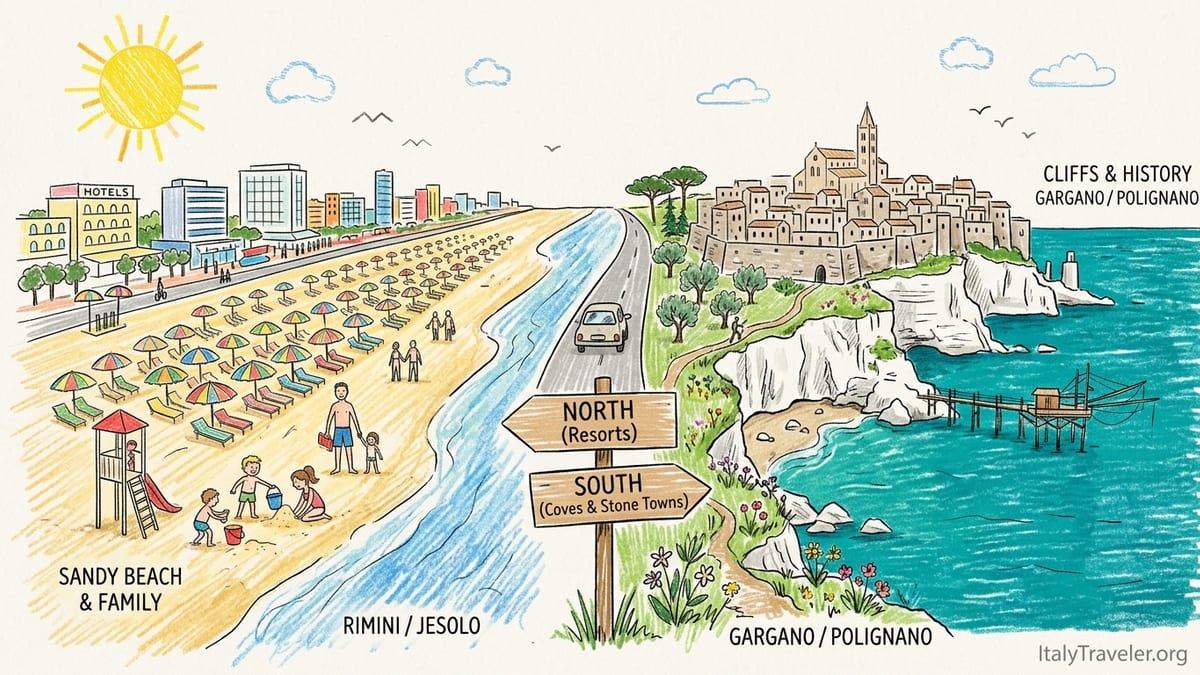
The Adriatic is not one single experience. Grado and Caorle feel like mellow, old-world seaside towns; Rimini and Riccione are big, busy playgrounds for both families and nightlife; the Conero and Gargano headlands deliver cliffs and coves that feel surprisingly wild for such a popular coastline; Polignano a Mare and Trani are all about stone, history and dining by the water rather than long sandy strips. Before locking in a base, it helps to decide whether you want an easy beach week without a car, a multi-stop road trip, or a mix of both.
Costs vary but as a rough guide in high season a midrange double room near the water in a major resort such as Jesolo, Rimini or Polignano a Mare can easily sit around the equivalent of 150 to 250 euros per night, while smaller places like Termoli or Vasto can come in noticeably cheaper outside August. Beach services also differ: in many resorts you pay a daily fee for a pair of sunbeds and an umbrella, which might be 20 to 35 euros in August at a private stabilimento, while more low-key stretches, especially along the Costa dei Trabocchi and Gargano, offer free sections where you just bring your own towel.
Getting around is another key factor. Places like Jesolo, Rimini, Riccione, Ravenna, Polignano a Mare and Monopoli have rail or dedicated bus links from larger hubs such as Venice, Bologna and Bari, making them practical for car-free trips. Others, particularly the Conero Riviera around Sirolo and Numana, much of Gargano beyond Vieste, and the more scattered coves of the Costa dei Trabocchi, are far easier with a car, both for reaching beaches and for moving between villages and viewpoints.
What follows is a destination-by-destination comparison, grouped broadly from north to south, with an eye on what each place does best in real life: where families naturally gravitate, where night owls stay out late, where you go for hikes and sea caves rather than sun loungers, and where the atmosphere lends itself to long meals and slow evenings.
Grado, Caorle and Jesolo: Northern Sands and Family Classics
Grado sits on a low island within a lagoon in Friuli Venezia Giulia, with around ten kilometres of south-facing sandy shoreline that shelves very gently into the sea. The main GIT beach stretches for nearly 2 kilometres and is packed with orderly sunbeds, children’s play areas and shallow water that makes it particularly reassuring for families with younger kids. Many hotels and the official beach organisation promote “family beach” services such as animation, playgrounds and baby-friendly facilities, and the pedestrian old town is steps from the sand, so you can go from gelato in the historic alleys to your umbrella in a few minutes.
Caorle, further west in Veneto, offers a slightly different personality. Its compact historic center, painted in bright pastel colors, sits directly behind a long sandy beach. The town manages to feel both family-friendly and atmospheric: you can spend the day on the broad Ponente or Levante beaches, which are fully serviced with lifeguards and rows of umbrellas, then wander to the waterfront church and sea wall at sunset. For a typical day, many visitors rent a pair of sunbeds and an umbrella for around 20 to 30 euros in summer, have a simple seafood lunch such as grilled sardines or fritto misto at a beachside trattoria, then head into the car-free alleyways in the evening.
Jesolo, especially Lido di Jesolo, is the most overtly resort-like of this northern trio. Think 15 kilometres of straight sandy beach backed by hotels, beach clubs and a commercial strip with mini-golf, family amusement parks and late-opening bars. It is enormously practical for sandy-beach holidays and works well as a base for families and groups who want predictable facilities, lots of restaurant choice and easy access to Venice by bus and boat for day trips. The trade-off is that it feels more modern and less historic than Grado or Caorle, with most of the character in the long pedestrianised Via Bafile, which comes alive after dinner.
For car-free travelers focused on simple beach time, Grado and Jesolo are both excellent bases, with reliable public transport connections and everything within walking or cycling distance. Grado edges ahead for those who value a preserved historic core and a calmer, more local atmosphere; Jesolo excels if you want sheer choice in hotels and entertainment. Caorle splits the difference, suiting couples and families who like traditional architecture but still want a full-service beach scene outside their front door.
Rimini, Riccione and Ravenna: Nightlife, Theme Parks and Culture
The Riviera Romagnola around Rimini and Riccione is where Italy does seaside at full volume. Rimini’s beach runs on for kilometres, divided into numbered bagni, or beach clubs, each with its own bar, loungers and games. The sand is soft and wide, and in July and August the shore is a sea of umbrellas. Families appreciate the shallow water and organized kids’ activities, including mini-clubs, playgrounds and beach sports, while teenagers and young adults come for the beach parties and music into the night. Public beach sections exist for those who prefer to lay a towel for free, but the classic experience involves renting a base at one of the bagni for the day.
Riccione next door doubles down on the nightlife side. It has long been famous for beach parties and big-name clubs, including venues that draw international DJs in summer. The town’s Viale Ceccarini serves as a stylish shopping and strolling street, with aperitivo bars that spill onto the pavement every evening. At the same time, Riccione has a huge range of family hotels, plus nearby water parks and amusement parks reached by short bus rides, making it surprisingly good for multi-generation groups where some want late nights and others early-morning beach walks.
Ravenna, slightly inland from the coast, is a very different proposition and works best as a cultural counterpoint rather than a beach hub. It is renowned for Byzantine mosaics in its UNESCO-listed churches and mausoleums, which you can tour in a compact historic center without needing a car. The nearby seaside area of Marina di Ravenna and adjacent resorts has a long sandy shore and modern beach clubs, but if your main goal is days on the sand, Rimini or Riccione are more convenient bases. Where Ravenna shines is as a stop on a road trip: you might spend two nights in the city to see the mosaics, then drive on to Sirolo, Vasto or Vieste for the more scenic coastal stretches.
Travelers choosing between Rimini and Riccione can think of Rimini as broader, a little more relaxed and varied in budget, while Riccione feels more concentrated, polished and youth-oriented in peak season. Both are extremely easy without a car, thanks to rail links to Bologna and beyond, and both support trips where you split your days between sandy beaches, theme parks like water slides and dolphin excursions, and evening promenades lined with gelaterie and piadinerie selling the region’s flatbread stuffed with salumi and squacquerone cheese.
Conero, Sirolo, Numana and Senigallia: Dramatic Cliffs vs Classic Lidos
South of Ancona, the Monte Conero headland breaks up the Adriatic’s long line of sand with limestone cliffs, wooded slopes and small coves. Sirolo and Numana perch on the hillside, with historic stone centers that look west to vineyards and east to the sea. The beaches below, such as Spiaggia Urbani and the coves near the Due Sorelle sea stacks, are pebbly or shingly rather than sandy, and often reached by steep paths, stairways or seasonal shuttle buses. The reward is a far more dramatic setting than the flat northern resorts, with clear water under white cliffs and views that feel more like a Mediterranean postcard than a typical Adriatic lido.
Sirolo and Numana suit travelers who prefer smaller hotels, guesthouses and self-catering apartments over big complexes, and who are happy to walk or take short bus rides down to the shore. A typical day might involve starting in town with a cappuccino in a small piazza, hiking down a forested path to a cove, renting a kayak to explore sea caves or the base of cliffs, then returning uphill for an evening of seafood in a stone-built restaurant. Because much of the coastline is protected, new construction is limited, so the area retains a more natural feel.
Senigallia, a little further north, brings back the wide sandy beach but with a softer vibe than Rimini or Jesolo. It is known for its “velvet beach” of fine sand and a long promenade backed by Liberty-style villas and hotels. The town center has a Renaissance fortress and atmospheric streets, and each summer it hosts events that fill the streets with classic cars and music, giving it appeal beyond the beach itself. Families who want sand underfoot but do not need the full-on energy of the Romagna Riviera often find Senigallia a comfortable middle ground.
For car-free travelers, Senigallia is much easier to use as a base because it sits on the main rail line and you can walk from the station to both town and beach. Sirolo and Numana are better with a car, particularly if you want to explore multiple coves and viewpoints or visit inland wine villages producing Verdicchio and Rosso Conero. In terms of priorities, pick Sirolo or Numana for dramatic scenery and hiking, Senigallia for classic beach days with a side of local town life.
Vasto, Costa dei Trabocchi and Termoli: Road Trips and Rustic Charm
As you move into Abruzzo and Molise, the Costa dei Trabocchi marks a more fragmented, interesting shore. This coastal stretch, roughly between Ortona and Vasto, is named for trabocchi, traditional wooden fishing platforms on stilts that jut out over the water. Many have been converted into simple seafood restaurants where you eat grilled fish and antipasti above the sea, sometimes reaching them via a narrow wooden bridge. The coastline itself alternates between short sandy sections, pebble coves and low cliffs, with a former railway line in places repurposed as a cycling and walking path.
This area is ideal for a road trip: you can base yourself in a town like Vasto, whose upper historic center sits on a bluff with views over a broad bay, then explore different beaches by car each day. One day might see you swimming off a pebble cove below San Vito Chietino, another having lunch on a trabocco near Fossacesia, and another on the longer sands near Casalbordino or San Salvo. Accommodation ranges from small hotels and B&Bs in the old towns to agriturismi in the countryside, often with on-site restaurants serving regional dishes like arrosticini skewers and pasta with local seafood.
Termoli, further south in Molise, is a compact town whose old quarter sits on a headland enclosed by walls, with a sandy beach curving on either side. It works excellently as a short stop on an Adriatic drive, breaking the journey between Abruzzo and Gargano, or as a relaxed, less touristy base for a few beach days. From Termoli, ferries serve the Tremiti Islands in season, making it possible to add a day of snorkelling and boat trips to your itinerary without moving base. Prices for accommodation and dining tend to be a bit lower than in the more famous Puglia towns further south, particularly outside the busiest August weeks.
For car-free visitors, Vasto and Termoli both have rail stations on the main coastal line, but you will have a richer experience with a car or at least a willingness to use local buses and taxis to hop between beaches and trabocchi. These destinations are less about a single long promenade and more about variety: different coves and viewpoints each day, long lunches in simple family-run restaurants, and sunsets over wooden fishing platforms silhouetted against the water.
Gargano: Vieste, Peschici and the Wild Promontory
The Gargano promontory juts into the Adriatic like a white spur, and its coastline between Peschici and Vieste is one of the most scenic stretches on the Italian Adriatic. Here, sandy bays alternate with rocky headlands and sea caves, backed by pine forests and, further inland, the beech woods of the Gargano National Park. The main beaches near Vieste, such as the long Scialmarino strip, offer wide sands and equipped lidos, while many smaller coves tuck into the cliffs and are reached by narrow side roads or boat.
Vieste works well as a base if you want a mix of beach variety and a livelier town. Its whitewashed old center climbs a rocky spur above the sea, with restaurants and bars in alleyways that are busy until late in summer. Day-to-day, many visitors choose a beach club on one of the long sandy bays for ease, then take boat tours to see sea caves and rock stacks or to swim in more secluded coves. The atmosphere is casual and beachy rather than high-end, with family-run hotels and apartments making up much of the accommodation stock.
Peschici, further west, is smaller and perched more dramatically above the sea, with an old town of white cube-like houses and lanes that drop down toward coves below. Around this part of Gargano, you find both fine-sand beaches with shallow water and more rugged spots backed by macchia and rocky cliffs. Traditional fishing structures called trabucchi stand on many headlands, some still used for fishing and others adapted into simple eateries where you can book a table for grilled fish at sunset. This makes Gargano particularly rewarding for food-minded travelers who appreciate simple, ultra-fresh seafood in evocative settings.
Gargano is squarely in road-trip territory. While buses connect some towns, many of the best coves, viewpoints and agriturismi lie along winding coastal and inland roads that are slow but memorable to drive. Those who dislike driving can still enjoy Vieste or Peschici as single-stop bases and use boat trips and organized excursions to explore; however, if you want maximum freedom to chase the light or to find that perfect cove you spotted from the road, having your own wheels is a major plus.
Trani, Polignano a Mare, Monopoli and Otranto: Stone Towns and Southern Light
As you reach Puglia, the character of the coast changes again. Trani, north of Bari, places its emphasis on architecture and atmosphere rather than beaches. The town’s Romanesque cathedral rises directly above the sea beside a small harbor filled with boats, and the streets behind are packed with stone palazzi, wine bars and seafood restaurants. There are small bathing areas nearby, including stretches of rocky shoreline and lidos, but most travelers treat Trani as a base for strolling, eating and exploring rather than for long days stretched on sand.
Polignano a Mare has become one of the Adriatic’s iconic images: a compact white town perched on cliffs above a narrow cove beach of pebbles and clear turquoise water. The main beach, set in a rocky inlet under a bridge, is visually striking but small and can be crowded in high season. Many visitors therefore reserve beach clubs on nearby stretches of coast reachable by short drives or use Polignano primarily as a scenic base for exploring. The town itself is rich in clifftop viewpoints, with terraces over the water, and at night its restaurants and gelato shops create a busy but charming atmosphere.
Monopoli, just down the coast, offers a more lived-in, less postcard-perfect vibe but is excellent as a car-free base. The old town curls around a small harbor and fort, with low-key bathing platforms and small coves within walking distance. A short taxi or train ride brings you to larger lidos with sandy or mixed sand-and-rock beaches. Monopoli’s strengths lie in its combination of daily-life atmosphere, good transport connections, and an abundance of bars and restaurants where you can eat seafood crudo, orecchiette with cime di rapa or grilled octopus in both traditional and modern settings.
Otranto, near the tip of the Salento peninsula, brings together beaches, history and scenery in one small package. Its walled historic center sits above a clear, sheltered bay whose water is famously turquoise on sunny days, with both free areas and lidos where you can rent loungers. The cathedral with its mosaic floor testifies to Otranto’s layered history, while just outside town longer beaches and more rugged stretches are an easy drive or bike ride away. The surrounding coast, especially heading toward the easternmost point of mainland Italy at Punta Palascia, feels more exposed and wild than the built-up Adriatic further north.
Among these southern stops, choose Trani for an elegant historic town and leisurely evenings on the waterfront, Polignano for dramatic cliff views and a strongly photogenic base, Monopoli for a practical car-free hub with solid food and access to a range of beaches, and Otranto for a fusion of small-town charm, swimmable central bay and access to some of Puglia’s best coastal drives.
Putting It Together: Sample Combos and Who Each Place Suits
First-time visitors often underestimate travel times along the Adriatic. Distances that look short on the map can translate into multi-hour drives once you factor in traffic around major towns or winding sections like Gargano. It is usually better to choose two or three well-placed bases that match your priorities and explore locally rather than trying to overnight in every town on this list. A typical 10-day trip might pair a northern sandy base, a central scenic stretch and a southern stone town for contrast.
For a family-focused holiday heavy on sand and shallow water, a combination such as Grado or Jesolo at the start and Rimini or Senigallia in the middle works very well. In each of these, you can walk out of a midrange seaside hotel directly onto a wide beach with lifeguards, playgrounds and snack bars. From Rimini or Riccione you can add day trips to theme and water parks, while from Grado you can tack on lagoon boat tours or short drives to nearby castles and villages. If you want to introduce a hint of wild scenery without overwhelming logistics, consider adding a couple of nights in Sirolo or Numana at the end.
For couples and friends interested in food, scenery and atmosphere rather than structured beach clubs, an excellent route might be Ravenna, Vasto or the Costa dei Trabocchi, and then Polignano a Mare or Monopoli. You could spend two nights in Ravenna for mosaics and city dining, three around Vasto exploring different trabocchi for lunch and sunset drinks, then four nights based in Polignano or Monopoli for cliffside walks, boat trips under sea caves, and long dinners on terraces overlooking the water. Renting a car for the middle section gives freedom, while using trains between major hubs keeps driving times manageable.
Those seeking a more adventurous, road-trip style holiday can start in Termoli or Vasto, circuit the Gargano via Peschici and Vieste, and finish in Otranto. This route strings together sandy family bays, hidden coves, cliff roads and inland detours into national parks and hill towns. Accommodation can be a mix of seaside guesthouses, agriturismi and small hotels; many travelers find that booking only the first and last nights in advance, then filling in the middle as they go, allows them to respond to weather and personal preference. The key is to keep legs reasonably short, with two or three nights in each base rather than moving every day.
If you are traveling without a car and want to keep things simple, the most straightforward bases include Grado, Jesolo, Rimini, Riccione, Senigallia, Trani, Polignano a Mare, Monopoli and Otranto, all of which can be reached by train or bus from major cities and explored mostly on foot. In these places, you can realistically combine a car-free stay with day trips by rail or organized tours, saving the more car-dependent stretches like Conero’s hidden coves, Costa dei Trabocchi’s scattered beaches and Gargano’s interior for a future road trip.
FAQ
Q1. Which Adriatic destination is best for long sandy beaches?
Rimini, Riccione, Jesolo, Grado and Senigallia all offer extensive sandy strands with shallow water and full-service beach clubs, ideal for classic beach holidays.
Q2. Where should I stay for lively nightlife on the Italian Adriatic?
Riccione and Rimini are the main nightlife hubs, with beach parties, clubs and late-opening bars, while Polignano a Mare and Monopoli offer busy but more relaxed evening scenes.
Q3. What are the best bases for families with young children?
Grado, Jesolo, Rimini, Riccione and Senigallia stand out for shallow beaches, playgrounds, family hotels and easy promenades with plenty of kid-friendly dining options.
Q4. Which areas offer the most dramatic coastal scenery?
The Monte Conero area around Sirolo and Numana, the Gargano coast between Peschici and Vieste, the Costa dei Trabocchi and the cliffs around Polignano a Mare and Otranto are top picks for scenery.
Q5. Where can I find the most atmospheric historic towns by the sea?
Trani, Otranto, Polignano a Mare, Monopoli, Vieste and Peschici all combine historic centers with sea views, making them strong bases for travelers who prioritize character over big beaches.
Q6. Which destinations are easiest to enjoy without a car?
Grado, Jesolo, Rimini, Riccione, Senigallia, Trani, Polignano a Mare, Monopoli and Otranto have good public transport links and compact centers that are walkable from train or bus stops.
Q7. Where should I go for great food and seafood experiences?
Polignano a Mare, Monopoli, Trani, Otranto, the Costa dei Trabocchi with its trabocco restaurants, and the Gargano towns of Vieste and Peschici offer especially rewarding seafood and local cuisine.
Q8. What parts of the Adriatic coast are best for a scenic road trip?
The Costa dei Trabocchi, the Gargano promontory, the stretches around Conero and the coastal roads south of Otranto are particularly good for multi-stop drives with varied landscapes.
Q9. Which destinations work well for quieter, car-free stays focused on relaxation?
Grado, Caorle, Senigallia, Trani and Monopoli are well suited to slower-paced trips where you walk to the beach, linger in historic streets and keep day trips short.
Q10. How many bases should I plan for a 10-day Italian Adriatic trip?
Two or three bases are usually ideal for 10 days, for example a northern sandy resort, a central scenic stretch like Costa dei Trabocchi or Gargano, and a southern town such as Polignano a Mare or Otranto.