


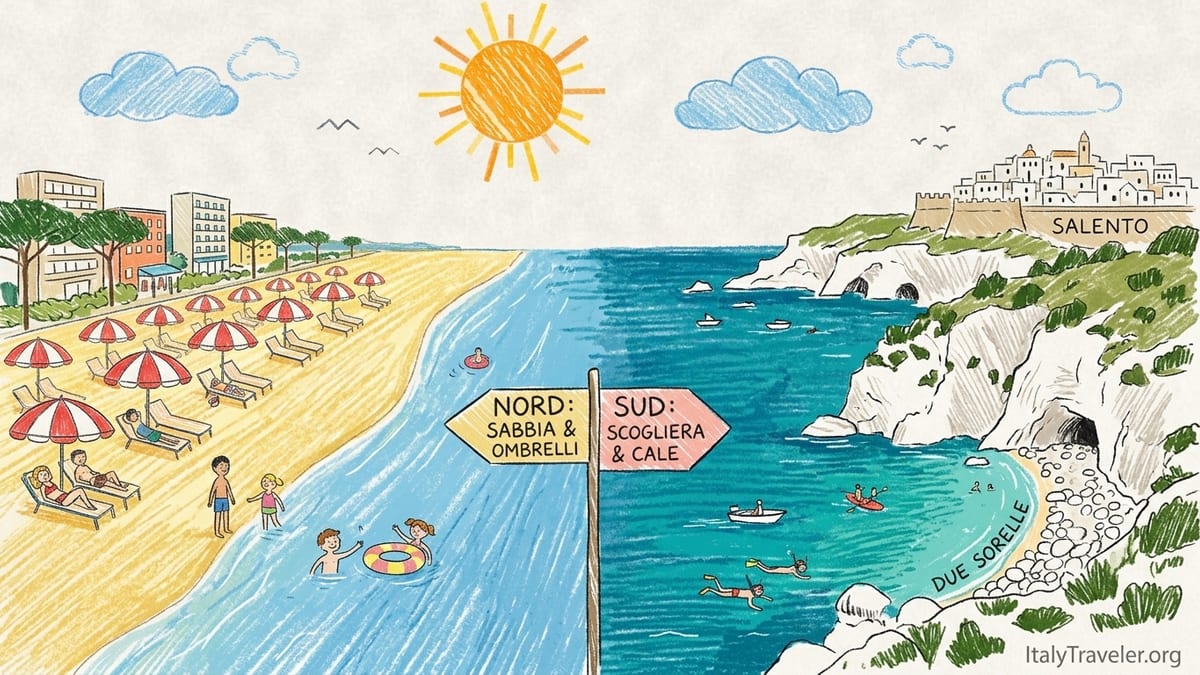
Italy’s Adriatic coast runs for more than 1,200 kilometers, but the beaches along it could almost belong to different countries. In the north you find huge, shallow carpets of sand designed around kids, sunbeds and beach bars. Travel south and the coast hardens into white cliffs, pebbly coves and transparent water that attracts snorkellers as much as sunbathers. For travelers trying to choose between Bibione and Gargano, Jesolo and Salento, understanding these contrasts is the key to planning the right seaside holiday.
Understanding the Geography of the Italian Adriatic
The Italian Adriatic stretches from the lagoons near Venice all the way down to the heel of the boot in Puglia. That distance spans different climates, landscapes and travel styles. In the north, around Bibione, Lignano and Jesolo, the coast is low and sandy, protected by barrier islands and lagoons. The sea is shallow for a long way out, the beach is wide, and almost every stretch is organized with neat rows of umbrellas and sun loungers. Families from Austria, Germany and northern Italy drive in for week-long stays at large resort hotels, campsites and apartment complexes behind the dunes.
Continue south past the flat Riviera Romagnola and, around Ancona, the landscape changes abruptly at Monte Conero. Here cliffs rise straight from the sea, and beaches like Sirolo’s Due Sorelle and San Michele are made of white pebbles and rock rather than fine sand. The water becomes clearer and deeper near the shore, which appeals to swimmers and kayakers more than toddlers with inflatables. Farther down, central Adriatic regions such as Abruzzo mix long sandy strands with pockets of pebble and rock, while the Gargano promontory and the Adriatic side of Salento offer a patchwork of sandy bays, limestone caves and rocky shelves that feel closer to Greece than to northern Italy.
This enormous geographic range means that “going to the Adriatic” can mean very different trips. One traveler might picture a stroller-friendly promenade in Jesolo lit by neon signs and gelato stands open until midnight. Another is thinking of parking above a cliff in the Conero Riviera, hiking down a steep path with a backpack cooler, and swimming over a rocky seabed. Knowing which kind of coast you prefer, and how far you are willing to drive, is the first decision to make.
Bibione, Jesolo and Lignano: Northern Sand and Shallow Seas
Bibione, Jesolo and Lignano Sabbiadoro form a long, almost continuous ribbon of sand north and east of Venice. The beach here is textbook “Adriatic north”: very wide, very flat and made of compact, fine golden sand that is easy to walk on with bare feet and beach trolleys. The sea stays shallow for tens of meters, which means adults often wade waist-deep while children play closer to shore. On a typical August afternoon you will see families standing in the warm water chatting, teenagers playing paddleball near the waterline and toddlers digging in the sand under the shade of rental umbrellas.
The coast in this area is heavily organized into stabilimenti balneari, the Italian term for privately run beach clubs that manage a section of sand. A standard day here involves renting a package of one umbrella and two sunbeds in a specific row. In summer 2024, typical prices for a front-row set in places like Bibione or Jesolo ranged from about 25 to 40 euros per day, with cheaper options in the back rows and discounts for multi-day bookings. Many hotels include a reserved umbrella as part of the room rate. Facilities usually include changing cabins, lifeguards, kids’ play areas, bars serving spritz and sandwiches, and sometimes pools or small water parks attached to the beach.
Free beach (spiaggia libera) still exists between concessions, but the most convenient sections are often taken by stabilimenti. Parking is usually structured and paid, with large lots behind the beach; day rates can easily reach 10 to 15 euros in high season near Jesolo’s central stretches. In exchange, you are within a short walk of family-friendly promenades lined with pizzerias, mini-golf, bike rental shops and late-opening gelaterie. For travelers with small children or those who want a social, easy beach experience without worrying about currents or rocks, this northern trio is hard to beat.
Rimini, Riccione and the Riviera Romagnola: Classic Resort Coast
Further south, Rimini and Riccione are the heart of the Riviera Romagnola, perhaps the best-known stretch of the Italian Adriatic internationally. The geography here is similar to the Veneto coast: long, flat, sandy beaches with gently shelving seabeds. Rimini’s sand is slightly darker and the water can appear less clear than in rockier southern regions, but it is warm, shallow and usually calm in summer. That makes it attractive for families, people who like to walk long distances along the surf line and anyone who wants to combine city life with easy sea access.
What sets Rimini and Riccione apart is their density of services and nightlife. Beach clubs stretch for kilometers, offering everything from basic umbrella and sunbed rentals to upscale stabilimenti with pools, DJ sets and table service. A typical mid-range beach club might charge around 25 to 35 euros for a daily umbrella and two loungers in July or August, with weekly packages that bring the per-day cost down. Many clubs let you reserve specific rows online or through hotel reception, which can matter in peak weeks when front rows sell out.
The towns behind the sand are full-scale resorts with hundreds of hotels from simple pensions to renovated design properties, as well as budget-friendly apartment rentals. It is common for a three-star hotel in Rimini to bundle half-board meals and a reserved umbrella for a week-long stay, aimed at families who want a predictable routine. Parking can be the main pain point; beachfront hotels may offer small paid lots, underground garages or rely on street parking that fills quickly. Travelers arriving by train often choose hotels within walking distance of the sea to avoid using a car altogether, then rent bikes to get around.
Rimini and Riccione are the right choice if you want a sociable atmosphere, nightlife, big theme parks nearby and reliable sandy beaches that suit children just learning to swim. They are less ideal if your priority is crystal-clear water, quiet coves or wild scenery, in which case you may prefer Conero, Gargano or Salento.
Senigallia and the Central Adriatic: Between Sand and Pebble
Moving into the Marche region, Senigallia marks a transition between the classic flat sandy resorts of Romagna and the more dramatic landscapes around Monte Conero. Senigallia’s main attraction is its “velvet beach,” a long stretch of very fine, soft sand. The sea here is still shallow and generally suitable for children, though the look and feel is a little more relaxed and less intensely urban than Rimini’s central seafront. A wide pedestrian promenade and cycling path run behind much of the beach, with seafront hotels, small campsites and family-run pensioni set just across the road.
Like farther north, most of Senigallia’s shore is divided between stabilimenti and smaller sections of spiaggia libera. Prices for sunbed and umbrella rentals tend to be slightly lower than in top Venetian or Romagnol resorts, especially outside of the central weeks of August. Travelers who value a walkable town with a historic center and decent nightlife but who do not need the high energy of Riccione often find Senigallia a comfortable compromise.
Farther south along the central Adriatic, in Abruzzo, the coastline blends long sandy beaches with pebbly sections backed by low hills and pine groves. Towns like Roseto degli Abruzzi are promoted in regional tourism materials as child-friendly thanks to their gently sloping seabeds and calm waters, along with playgrounds and shaded promenades behind the sand. Many visitors stay in family-run hotels or apartment residences along the seafront, where weekly rates are often more affordable than the northern Adriatic in peak season. Parking here tends to be easier, with a mix of free and paid street spaces and small lots near the beach, although central areas can still fill up on August weekends.
Conero Riviera: Sirolo, Numana and Due Sorelle
South of Ancona the character of the coast changes suddenly at the Conero Riviera, where Monte Conero drops into the sea in a series of cliffs, coves and pebble beaches. Sirolo and Numana sit above this shoreline and act as gateways to some of the most scenic spots on the entire Adriatic. Here the beaches are typically composed of white pebbles and small stones rather than sand, and the water is notably clearer and deeper close to shore. On sunny days, swimmers can easily see the rocky seabed and schools of small fish beneath them.
Due Sorelle, often shown on postcards as the symbol of the Conero Riviera, is a small cove framed by white limestone cliffs and two distinctive rock stacks offshore. The shore is made up of smooth white pebbles and boulders, and the beach has no built-up facilities. Access is usually by boat from Numana or Sirolo’s port, with excursion boats running on a timetable in high season. This creates a very different rhythm from the northern resorts: visitors pack water, food and shade, disembark onto a wild beach and rely on the sea for cooling off rather than on bars and showers.
Other beaches such as San Michele, Sassi Neri and Mezzavalle combine pebble or coarse sand with rocky sections and pockets of stabilimenti. In places like San Michele, you might rent a lounger and umbrella at the back of the beach but still walk a few meters into the water and find a stony seabed that is ideal for snorkeling. Paths down from parking areas can be steep; it is common to find paid shuttle buses running between hilltop parking and the coast in peak season. Accommodation generally clusters in Sirolo and Numana’s historic centers, in small hotels, B&Bs and apartments rather than in large resort complexes. Travelers who do not mind a short drive often stay inland in agriturismi among vineyards and olive groves, then head down to different coves each day.
The Conero area rewards visitors who travel light and wear sturdy sandals instead of flip-flops. Families with very young children may find the pebbles and steeper drop-off less comfortable, but older kids who enjoy snorkeling, paddleboarding or kayaking generally love the sense of adventure here. Compared with the flat northern sands, the trade-off is clear: fewer services underfoot, more natural drama and water that feels closer to the color and clarity of the Croatian coast opposite.
Gargano and the Adriatic Side of Salento: Coves, Cliffs and Clear Water
Further south, the Gargano promontory in northern Puglia juts into the Adriatic as a forested limestone spur. Its coastline is carved into bays, caves and rocky headlands, with sandy crescents such as Peschici and Vieste backed by white cliffs and pine-covered hills. Many beaches alternate soft sand near the shore with rockier zones toward the ends of the bays, where small coves and sea caves are best explored by boat. The water here generally deepens more quickly than on the flat northern Adriatic but remains calm on many summer days, with good visibility for swimming and snorkeling.
Rodi Garganico, highlighted in official tourism promotions as family-friendly, offers a compromise between shallow waters and scenic surroundings. Its main beaches have fine sand and a gradual seabed, making them suitable for young children, while the old town and harbor add character beyond the beach. Accommodation ranges from large holiday villages and campsites with pool complexes and entertainment to small guesthouses perched above the sea. Parking varies widely: some resorts provide on-site lots, while day visitors to popular bays often rely on paid, privately run car parks set back from the cliffs, with shuttle vans to the sand.
Continue down to the Adriatic side of Salento, and the coast becomes a patchwork of low cliffs, rocky platforms and small sandy inlets. Around towns like Otranto, Torre dell’Orso and San Foca, travelers find many free-access rocky shelves where locals spread towels on the flat rock and climb down ladders or natural steps into very clear, relatively deep water. Sandy coves do exist, but they are smaller and can be crowded in August. Stabilimenti in Salento often build wooden platforms and stairs over uneven rocks, renting sunbeds placed on decks rather than directly on sand. A day with two loungers and an umbrella in a popular Salento club can cost in the range of 35 to 50 euros or more in mid-summer, reflecting high demand and limited flat space.
The reward for negotiating parking, crowds and rocks is water that many Italians consider among the most beautiful on the Adriatic. Even close to shore, swimmers often look down through several meters of clear turquoise sea to rocky seabeds. This makes Salento better suited to confident swimmers and teenagers than to toddlers who like to sit at the water’s edge. Families with smaller children often choose the gentler sandy bays on the Ionian side of Salento, then visit the Adriatic for day trips focused on cliff walks, coastal drives and snorkeling.
Fine Sand vs Pebbles, Shallow vs Deep: Matching Beaches to Travelers
One of the most important choices on the Adriatic is between fine sand and pebbles. Fine sandy beaches, like those at Bibione, Jesolo, Lignano, Rimini, Riccione, Senigallia, Grado, Sottomarina and Roseto degli Abruzzi, are forgiving underfoot and ideal for children who spend hours digging and building. Sand also makes it easier to set up beach tents, volleyball nets and beach toys, and it tends to feel warmer and softer when you lie directly on it. The trade-off is that the sea can be more turbid when waves stir up the sandy seabed, so the water often looks less transparent than at pebble or rock beaches.
Pebble and rocky beaches, characteristic of the Conero Riviera, parts of Abruzzo, Gargano and much of the Adriatic side of Salento, offer clearer water because there is less fine material suspended in the sea. The seabed is usually visible from the surface, especially on calm days, which is attractive for snorkelers. However, walking barefoot can be uncomfortable, and entering the water may require water shoes, particularly for young children or older travelers with sensitive feet. On hot days pebbles store heat and can be quite warm by late afternoon, another reason to bring proper footwear and perhaps lightweight beach mats instead of thin towels.
Depth is the other big distinction. Official tourism boards often promote shallow, child-friendly beaches at places such as Grado, Sottomarina, Roseto degli Abruzzi and Rodi Garganico, where a gradual slope allows children to play in knee-deep water while adults stand nearby. These areas work well for families and less confident swimmers. In contrast, beaches at Sirolo’s Due Sorelle, some coves in Gargano and many stretches of the Salento coast reach deeper water more quickly, which is better for swimming laps or diving from rocks but requires stronger swimming skills and closer supervision.
When planning, think about your daily routine. If you imagine toddlers playing with buckets while adults read under an umbrella, northern and central sandy strands might be best. If your group consists of strong swimmers who enjoy snorkeling, kayaking and exploring coves, prioritize pebbly or rocky areas like Conero, Gargano or Salento, even if it means carrying gear down stairs or paths and wearing water shoes.
Free Beach vs Stabilimento: How Access and Costs Work
Throughout the Italian Adriatic, the shoreline is legally public, but access and services are often managed by stabilimenti balneari. These beach clubs typically control a rectangular section of sand or rock, within which they set up rows of umbrellas, loungers and sometimes cabanas. Visitors pay for the use of these services, not for the sea itself. Prices vary according to location, date, row and level of service. In a busy resort like Jesolo or Rimini in August, a front-row umbrella with two loungers might cost around 30 to 40 euros per day, while a back-row set might be closer to 20 to 25 euros. In quieter Abruzzo or outside high season those figures often drop noticeably.
Free beach areas, labeled “spiaggia libera,” exist in every coastal town, but their size and quality differ. In some places, like parts of the Conero Riviera or around smaller Abruzzo towns, large portions of the shore remain free and relatively wild, with visitors bringing their own umbrellas, chairs and coolers. In heavily developed resorts, spiaggia libera may be narrower or located between two large concessions, and can still be busy because budget-conscious travelers and locals concentrate there. A common pattern is to use spiaggia libera but still buy food, coffee or toilet access from the nearest beach bar, which usually welcomes non-rental customers.
Parking is a major part of the real cost of a beach day. In dense resorts such as Jesolo, Rimini and Riccione, drivers rely on municipal lots, private garages and hotel parking. Day rates commonly range from about 10 to 20 euros near the sea in high season, and spaces close to the sand fill early. Smaller towns like Sirolo, Roseto degli Abruzzi or Vieste often push parking back from the immediate shore, especially near protected or scenic areas. There you might leave your car in a paid lot on the edge of town for a modest hourly or daily fee, then walk or take a shuttle minibus to the beach. Remote coves in Gargano and Salento sometimes have improvised private car parks in fields or olive groves, where local operators charge a flat fee and include a ride down to the water.
Accommodation interacts closely with beach access. Many seafront hotels in northern resorts own or partner with stabilimenti, so a booked room includes a reserved umbrella, sunbeds and sometimes parking, turning the upfront room rate into a better value. In more natural areas like Conero or parts of Gargano, apartments and agriturismi may not have their own beach clubs; guests drive to different coves each day and decide between spiaggia libera and renting from a stabilimento on arrival. When comparing locations, it is useful to look not only at nightly rates but also at whether beach services and parking are included, as these can add significantly to the cost of a week at the sea.
FAQ
Q1. Which Adriatic beaches are best for small children who cannot swim yet?
Beaches with fine sand and very gradual seabeds work best for non-swimmers. Areas like Bibione, Jesolo, Lignano, Rimini, Riccione, Senigallia, Grado, Sottomarina, Roseto degli Abruzzi and Rodi Garganico are all promoted for their shallow, child-friendly waters. Look for stretches where adults can walk far out while still standing, and where beach clubs provide lifeguards, play areas and easy stroller access.
Q2. Where can I find the clearest water on the Italian Adriatic coast?
The clearest water is usually found where the shore is pebbly or rocky rather than sandy. The Conero Riviera around Sirolo and Numana, the Gargano promontory in northern Puglia and many parts of the Adriatic side of Salento are known for transparent water with good visibility. These areas often have small coves, rocky seabeds and deeper water close to shore, so they suit confident swimmers and snorkelers.
Q3. Do I need to book a stabilimento balneare in advance?
In July and August, especially in popular resorts like Jesolo, Rimini, Riccione and parts of Salento, it is wise to reserve at least for weekend days and front-row spots. Many beach clubs allow reservations through hotel reception, by phone or via booking platforms. Outside peak dates or in less crowded regions, you can usually walk up in the morning and find space, particularly in back rows or in stabilimenti farther from town centers.
Q4. How much should I budget per day for beach services on the Adriatic?
Costs vary by region and season, but a typical summer day in a mid-range stabilimento with one umbrella and two loungers might run from about 20 to 25 euros in quieter areas to 30 to 40 euros in peak season at busy resorts. Add parking, which can range from a few euros in small towns to around 10 to 20 euros near major seafronts, plus food and drinks. Using spiaggia libera reduces costs but means bringing your own shade and seating.
Q5. Are pebble and rocky beaches suitable for families?
Pebble and rocky beaches can be very enjoyable for families with older children who like snorkeling and exploring coves. However, they are less comfortable for toddlers and anyone with mobility issues. Water shoes are almost essential, and parents need to watch children carefully because the water often becomes deep more quickly. Many families choose to spend most days on sandy beaches and visit pebbly spots like Conero’s coves or Gargano’s inlets for shorter excursions.
Q6. What is the difference between Grado, Sottomarina and Conero for a beach holiday?
Grado and Sottomarina are northern Adriatic resorts with wide sandy beaches and shallow, child-friendly waters, backed by promenades, hotels and campsites. They are designed for easy, family-oriented holidays. The Conero Riviera, by contrast, has pebble and mixed beaches at the foot of cliffs, with clearer, deeper water and more demanding access via paths or boats. Conero suits travelers who prioritize scenery and swimming quality over convenience and long sandy walks.
Q7. Can I always access the sea for free even where there are beach clubs?
Yes, the sea and shoreline are public, and Italian regulations require that people be able to reach the water even where stabilimenti operate. In practice, free-access corridors and spiaggia libera sections may be narrow or busy in some resorts, but you can always walk along the water’s edge. You are not obliged to rent a sunbed, though you will need your own towel, umbrella and supplies if you use only the free areas.
Q8. Which Adriatic areas combine beach time with interesting towns or culture?
Several Adriatic zones offer more than just sun and sea. Rimini has a Roman arch and old town alongside its famous beach. Senigallia and nearby inland Marche towns offer historic centers and food-focused festivals. The Conero Riviera sits close to Ancona and hilltop villages. Gargano has forested national parkland and small coastal towns, while Salento’s Adriatic side is near baroque Lecce and historic Otranto, making it easy to combine cultural visits with swimming.
Q9. Is a car necessary to enjoy the best Adriatic beaches?
In major resorts like Jesolo, Rimini, Riccione and Senigallia, you can arrive by train or bus and walk or cycle between hotel, beach and town. A car becomes more useful if you want to explore smaller coves in Conero, multiple villages along the Gargano coast or less-developed stretches in Abruzzo and Salento. In those areas, public transport can be limited, and having a car allows you to visit different beaches, adjust to wind conditions and reach hilltop towns for dinner.
Q10. How far in advance should I book accommodation for August on the Adriatic?
For stays in early to mid-August, especially in family resorts like Bibione, Jesolo, Rimini, Riccione, Roseto degli Abruzzi, Gargano and Salento, it is sensible to book several months in advance. Many Italian families return to the same hotel or apartment every year and reserve their preferred weeks early. June, early July and September are generally easier, with more availability and lower prices, while still offering warm sea temperatures and open beach services.