


The Italian Adriatic coast runs from lagoon-fringed Venice to the whitewashed towns of Puglia, with efficient trains skimming along much of the shoreline. Yet some of its most rewarding corners remain stubbornly awkward without a car. Knowing where a rental is genuinely worthwhile, which airport to choose, and how to dodge Italy’s rental and driving pitfalls can save you money, stress and precious holiday time.
Do You Really Need a Car on the Italian Adriatic Coast?
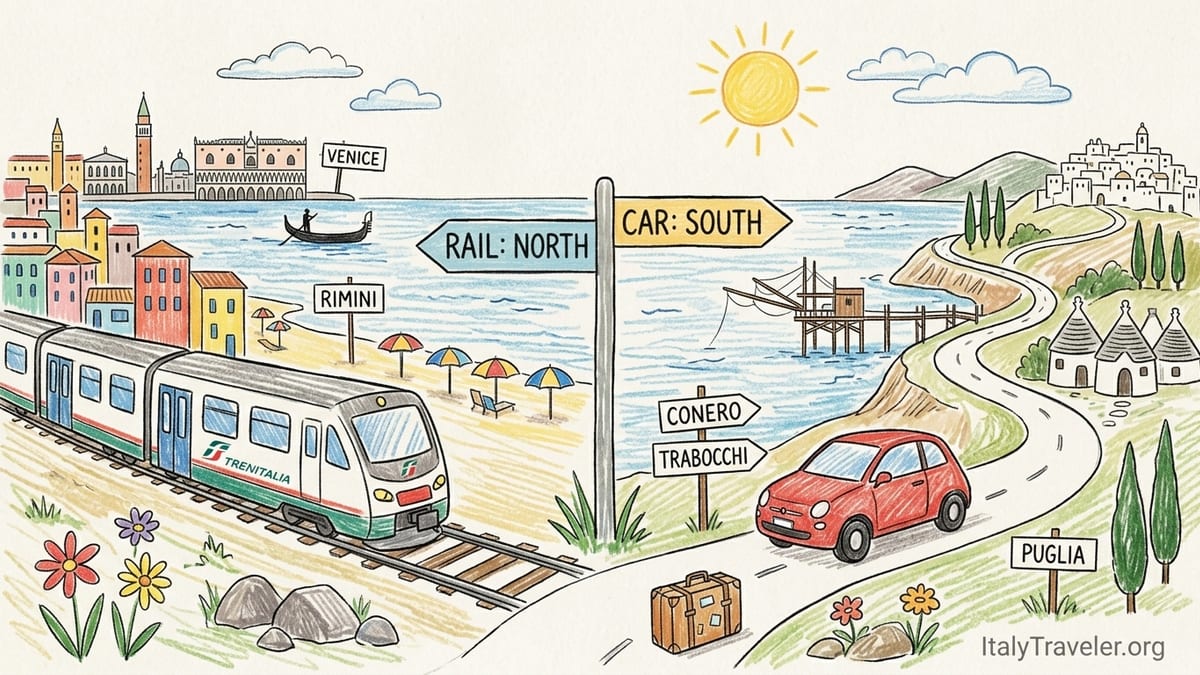
The first decision is whether you need a car at all. From Venice through Emilia-Romagna and much of Le Marche, the Adriatic corridor is stitched together by frequent Trenitalia and Italo trains. Venice to Rimini typically takes around two and a half to three and a half hours with a change in Bologna, while Bologna to Ancona can be under two hours on a fast service. For classic seaside resorts such as Rimini, Riccione, Cattolica and Pesaro, stepping off the train often puts you a short walk or taxi ride from your hotel and the beach.
That picture changes south of Ancona. Reaching the Conero Riviera villages like Sirolo and Numana usually involves a change in Ancona then a bus or taxi along winding coastal roads. On the Costa dei Trabocchi in Abruzzo, trains serve towns like Ortona and San Vito Chietino, but the most scenic trabocco fishing platforms and little coves are often several kilometres from the nearest station, with limited buses and steep walks back up to the SS16 road. Here, a compact rental car turns an awkward transfer into an easy series of short hops.
Further south, the Gargano peninsula in northern Puglia and the dispersed towns of central and southern Puglia are even more car-friendly. You can reach hubs such as Foggia, Bari, Brindisi and Lecce by rail, but heading to Vieste on Gargano, to small inland towns like Cisternino or Locorotondo, or to quieter Ionian and Adriatic beaches almost always means slow, infrequent buses or private transfers. Many visitors now travel down the Adriatic coast by train as far as Ancona, Pescara or Bari, then pick up a car specifically for Gargano, Costa dei Trabocchi or a Puglia road trip.
In practice, a sensible approach is often to stay car-free in the north, using trains between Venice, Bologna, Rimini and Ancona, and only rent for the central and southern stretch where public transport thins out. That strategy also avoids paying to park a car in Adriatic cities you will mostly explore on foot.
Where to Pick Up: Venice, Bologna, Rimini, Ancona, Pescara, Bari or Brindisi?
All seven airports along this stretch of coast have on-site car rental, but they serve different styles of trip. Venice Marco Polo and Bologna are major international gateways with large fleets and lots of competition. It is common to see headline prices around 25 to 35 euros per day for a small manual in shoulder season at Venice, with larger deposits in the 1,200 to 2,500 euro range held on your credit card. Automatics are widely available but cost more and sell out earlier in summer.
Venice Marco Polo works well if you are skipping the city itself and heading straight out along the coast or inland. You collect your car at the dedicated rental car parking area, drive 15 to 20 minutes to reach the mainland motorway network, and avoid the headache of parking at Piazzale Roma or Tronchetto, where garages can run 30 to 40 euros per day in season and higher in August. If you plan several nights inside Venice, it is usually cheaper and calmer to visit car-free then return to the airport or mainland to collect a car on departure day.
Bologna airport is often a better pickup point if your itinerary also includes Emilia-Romagna cities such as Ferrara, Modena or Parma or if you want a straight motorway run to the coast at Rimini or to the Marche. Car rental prices and fleets are similar to Venice, though Bologna’s city centre has an especially strict ZTL, so most travellers pick up and drop off at the airport to avoid it. Trains between Bologna and the Adriatic cities are fast enough that some travellers simply rail to Rimini or Ancona, then collect a car locally for the onward coastal or inland section.
Rimini, Ancona and Pescara airports are small but practical for those targeting nearby beach towns, Conero or Costa dei Trabocchi. You may find slightly higher day rates due to smaller fleets, especially in high season, but the airport locations are straightforward and close to the main SS16 and A14 routes. At the southern end of this guide, Bari and Brindisi airports are the natural gateways for Puglia road trips. Both sit within a short drive of the main highways that fan out toward Gargano, the Valle d’Itria, Matera and the Salento coast, and they offer a good mix of local and international rental brands.
Automatic vs Manual: What to Expect and What It Costs
Italy remains a manual-first market. At Adriatic airports such as Venice, Bologna and Bari, the majority of economy and compact cars have manual gearboxes. Automatic vehicles are becoming more common every year, particularly in SUV and crossover categories, but they typically make up only a minority of the fleet and command a significant price premium.
In concrete terms, you might see a small manual hatchback from a mid-range brand advertised around 30 euros per day in May from Venice or Bari airport, while the same class with an automatic transmission could easily be 45 to 55 euros per day or more, especially in July and August. That 40 to 60 percent premium is typical across much of Italy. Availability is also tighter. At peak dates, automatic categories are often fully booked weeks in advance, so last-minute renters may be left choosing between a manual they are not comfortable with or a much more expensive automatic from a premium category.
If you usually drive an automatic at home and are unsure about handling steep coastal roads, hill starts in medieval hill towns or heavy traffic around cities like Bari, the extra cost of an automatic can be worthwhile. It also reduces stress at roundabouts and toll booths, both of which are frequent along the Adriatic highway network. However, confident manual drivers can save several hundred euros over a one or two week rental, money that can easily be redirected to coastal hotels or a boat trip to the Tremiti Islands or Gargano sea caves.
Whichever you choose, book early for summer and double check that your reservation explicitly states “automatic” if that is what you need. Many Italian bookings default to manual unless the automatic transmission is clearly listed. At pickup, verify the gearbox before you sign the inspection sheet and drive away.
Insurance, Deposits and Excess: Minimising Surprises
Across Venice, Bologna, Rimini, Ancona, Pescara, Bari and Brindisi, the basic pattern for car rental insurance is the same. Standard rates include mandatory third-party liability plus a collision and theft waiver with a sizable excess. For a typical compact car, that excess might be in the 800 to 1,500 euro range. To secure that excess, rental companies place a security deposit hold on a credit card in the main driver’s name, often in the 1,200 to 2,500 euro band at larger airports like Venice and Bologna. The hold is released several days after return, which can temporarily reduce your available credit.
At the counter you will be offered additional cover to reduce this excess, often called Super CDW, Zero Excess or similar. Buying it from the rental company can double the daily rate but reduces or removes the amount you would pay in case of damage. An alternative is to purchase a standalone excess policy from a third-party insurer before you travel. These policies typically cost significantly less per day, but in the event of damage you must pay the rental company then claim reimbursement later. Travellers who are risk-averse or on a tight schedule often find the simplicity of the rental company’s full cover worth the extra cost.
Credit cards issued in North America may come with collision damage benefits for car rentals in Italy, though there are exceptions, so it is essential to check your card’s terms carefully and obtain written confirmation. Even when valid, card cover usually does not reduce the deposit amount the rental company holds at pickup, and it never covers fines or administrative fees. Basic policies also exclude damage to tyres, glass and underbody, all of which can be at higher risk on narrow rural roads in areas like Gargano or inland Puglia.
On top of insurance, travellers should budget for potential extras: one-way drop fees if returning the car to a different airport, out-of-hours pickup or drop-off charges and refuelling fees if you return the car without a full tank. Some Venice and Bologna rentals, for example, charge a significant per-litre markup plus a fixed service fee for refuelling, so filling up at a petrol station near the airport and keeping the receipt is a simple way to avoid an unpleasant surprise on your final bill.
Toll Roads, Parking and ZTLs Along the Adriatic
The Adriatic backbone is formed by the A14 Autostrada and the parallel SS16 state road. Much of the distance between Bologna and Bari on the A14 involves tolls. Italian motorway tolls are calculated per kilometre based on vehicle class and route. Recent published tariffs indicate that for a standard car the average is a few euro cents per kilometre on flat routes, with mountain stretches costing slightly more. Over a 300 kilometre drive, such as Bologna to Ancona or Pescara to Bari, this usually works out to several tens of euros in tolls. Tickets are taken when entering the motorway and paid on exit at staffed booths or card machines.
Toll payment lanes are clearly marked. Normal cash and card lanes show a ticket icon; Telepass-only lanes display a yellow “T” and are reserved for vehicles with an electronic tag. In a rental car you should avoid Telepass-only lanes unless the car is equipped with a device and your contract says it is activated. Driving through a Telepass lane without authorisation can trigger violation processing fees on top of the toll itself. For many coastal journeys you can choose between toll-free SS16 sections and the faster A14; the SS16 often runs close to the sea but can be slower due to roundabouts, local traffic and speed limits.
Parking and ZTLs are the other big considerations. ZTL stands for Zona a Traffico Limitato, or Limited Traffic Zone, a restricted area usually covering historic centres. Cameras scan plates at access points, and unauthorised entry typically results in fines in the tens or low hundreds of euros per infraction, which are then passed on by the rental company with an additional administrative fee. Bologna and Bari both operate ZTLs in their centres. Ancona, Pescara and many smaller cities and towns along the coast also have variations around old quarters or waterfront promenades.
The simplest strategy is to park outside historic cores in paid public car parks or in clearly signed blue-line street bays, then walk or take local transport in. For example, if you are staying in Bari Vecchia, you might book a hotel that offers a private guarded parking lot outside the ZTL and shuttle you in, or use a seafront car park and walk 10 to 15 minutes into the centre. In smaller coastal towns of Abruzzo and Marche, look for signed parcheggio lots just off the SS16 and walk the final stretch into the historic centre or seafront. Always watch for circular ZTL signs and electronic boards indicating active hours, and avoid any lane marked as ZTL attiva or ZTL closed.
One-Way Rentals and North–South Itineraries
The linear nature of the Adriatic coast makes one-way rentals particularly attractive. Many travellers start in Venice or Bologna, travel south by a mix of train and car, then fly home from Bari or Brindisi. For example, one popular pattern is to arrive in Venice, spend three nights car-free in the city, take a fast train via Bologna to Ancona, then pick up a car at Ancona airport or station to explore the Conero Riviera, Costa dei Trabocchi and Gargano before dropping the car in Bari and flying out.
Another option is to take trains all the way from Venice to Bari, stopping in Rimini and Pescara without a car, then rent for a loop through Puglia’s countryside. From Bari or Brindisi airport you could spend a week driving to Polignano a Mare, Monopoli, Alberobello, Ostuni and the Salento peninsula, returning the car to the same airport. This approach concentrates the rental days where the car genuinely adds value and keeps you off the hook for parking costs in big cities.
Most major rental brands allow domestic one-way rentals between Venice, Bologna, Rimini, Ancona, Pescara, Bari and Brindisi, though smaller franchises may limit which airports you can drop at. Fees vary widely. A straightforward one-way from Venice to Bologna or Rimini might carry a modest surcharge baked into the daily rate, while a Venice to Brindisi or Bologna to Brindisi drop can add a more noticeable fixed fee. Since these charges are not always transparent in the first search results, it is worth stepping through to the final pricing page during booking to confirm the total.
When planning a one-way, factor driving times into your itinerary. Venice to Bari by road along the A14 is a long haul that can run to eight or more hours of wheel time depending on breaks and traffic. Breaking the journey with overnight stops in places like Conero, the Abruzzo coast and Gargano not only makes it more pleasant but also allows you to use the car as intended, reaching beaches and headlands that are awkward by public transport.
When a Car Transforms the Trip: Conero, Costa dei Trabocchi, Gargano and Puglia
Some Adriatic highlights are dramatically easier with a car. The Conero Riviera just south of Ancona is one of them. Bus links from Ancona and the rail station at Osimo-Castelfidardo exist, but they can be sparse outside peak season and take time. With a rental car, you can drive from Ancona airport to Sirolo or Numana in around 30 to 40 minutes, stopping at panoramic viewpoints over the cliffs or detouring inland to small wine towns. Reaching trailheads for walks to secluded beaches like Mezzavalle or the access roads to parking for the Due Sorelle boat departures also becomes straightforward.
On Abruzzo’s Costa dei Trabocchi between Ortona and Vasto, a car lets you hop between the old fishing platforms converted into seafood restaurants, small pebbly coves and hilltop villages just inland. While there is a new coastal cycle path and a handful of rail stations, many of the most atmospheric trabocchi sit at the end of narrow lanes dropping from the SS16, with no convenient public transport and long uphill walks back. Driving this section slowly over two or three days, stopping at a different trabocco for lunch or dinner and pausing at viewpoints, is one of the coast’s underrated pleasures.
Gargano in northern Puglia is another case where a car unlocks the best of the region. Trains reach Foggia and Manfredonia, but the dramatic sea cliffs, beaches and white town of Vieste, the forested Umbra area and small coves like Baia delle Zagare are scattered around a mountainous peninsula threaded by curving roads. Local buses exist but are infrequent. With a compact car you can stitch together sea cave boat trips from Vieste, sunset drives along corniche roads and daytime excursions into the cool forest interior at your own pace.
Further south, central and southern Puglia’s appeal lies largely in its dispersed towns and beaches. From Bari or Brindisi airport, a car makes it easy to base yourself in one whitewashed town, such as Ostuni or Locorotondo, and day trip to nearby spots like Alberobello, Polignano a Mare, Monopoli and the Ionian or Adriatic coasts. Beaches near Torre dell’Orso, Otranto, Porto Cesareo or Gallipoli are all reachable by bus, but services can be patchy in shoulder season or on Sundays. With a car you can adjust plans if the wind makes one coast choppy, driving 45 minutes across the Salento to find calmer water on the opposite shore.
The Takeaway
A car is not essential for every Adriatic itinerary. If your plans focus on Venice, Bologna, Rimini and a handful of well-served beach towns, Italy’s rail network will get you there comfortably, often faster than driving and without the stress of toll booths, parking or ZTL fines. Visiting these cities with a car can feel like a burden, as you pay for garages and worry about restricted zones while spending most of your time on foot.
Where a rental car genuinely shines is in the central and southern stretch: Conero’s dramatic cliffs, Abruzzo’s Costa dei Trabocchi, Gargano’s peninsula and the patchwork of Puglia’s inland hill towns and scattered beaches. For these areas, a modest manual car from an airport like Ancona, Pescara, Bari or Brindisi can transform your freedom to explore, turning “maybe” viewpoints and coves into easy, spontaneous stops.
The sweet spot for many travellers is to travel south by train from Venice or Bologna and only rent a car once trains thin out and distances between sights grow. Combine that with careful booking of automatics if you need them, a clear plan for insurance and deposits, respect for ZTL signage and realistic expectations about toll and fuel costs, and an Adriatic road trip becomes an enjoyable highlight rather than a logistical headache.
FAQ
Q1. Is it worth renting a car from Venice Airport for an Adriatic coast trip?
It is worth renting at Venice Airport if you plan to leave the lagoon area immediately and drive toward Emilia-Romagna, Marche or Puglia. If you will spend several days staying inside Venice first, it is usually better to remain car-free, then return to the airport or continue by train to somewhere like Bologna, Rimini or Ancona to collect a car later.
Q2. Which Adriatic airports are best for starting a Puglia road trip?
Bari and Brindisi airports are the most practical gateways for Puglia. Both have multiple rental companies, straightforward access to main highways and easy routes toward the Valle d’Itria, Gargano or the Salento coasts. Many travellers fly into Bari, loop through central Puglia and Salento, and fly out of Brindisi or vice versa.
Q3. Are trains enough for visiting northern Adriatic beach resorts?
Yes, for classic resorts like Rimini, Riccione, Cattolica and Pesaro, trains are usually sufficient. The stations sit near the seafront, local buses and taxis are readily available and you can move between towns without worrying about parking. A car adds little value here unless you are staying in more remote countryside accommodation.
Q4. How much extra does an automatic car typically cost in Italy?
Automatics in Italy often cost around 40 to 60 percent more than an equivalent manual. For instance, if a small manual is around 30 euros per day in shoulder season, the automatic equivalent might be 45 to 50 euros or more, especially in July and August. Availability is also more limited, so booking early is important.
Q5. Do I need special insurance when renting a car on the Adriatic coast?
Standard rentals include third-party liability and basic collision and theft waivers with an excess, but many travellers choose extra cover to reduce that excess. You can either buy the rental company’s full protection at the counter or use a separate excess policy. Check any credit card insurance you have in advance, and be aware that no policy covers traffic fines or ZTL penalties.
Q6. How expensive are motorway tolls between Bologna and Bari?
Motorway tolls on the A14 between Bologna and Bari add up to several tens of euros, depending on the exact route and exits. The total is noticeable but usually still less than the cost of multiple long-distance rail tickets for several people. If you are on a tight budget, you can mix toll-free SS16 stretches with paid motorway sections to balance speed and cost.
Q7. How can I avoid ZTL fines in cities like Bologna, Ancona or Bari?
The safest way is to keep your car outside historic centres and avoid following navigation directly to an old-town address. Look for signed public car parks or blue-line street parking outside the ZTL, then walk or take local transport in. Always watch for circular ZTL signs and electronic boards showing active times, and never drive into lanes marked as ZTL attiva or ZTL closed unless you are sure your hotel has registered your plate.
Q8. Is it easy to drive on the Costa dei Trabocchi and Gargano?
Driving these areas is generally manageable for confident drivers. Roads can be narrow and winding, especially on Gargano’s cliffs and in older villages, so a smaller car is often more comfortable than a large SUV. With a car you can reach trabocco restaurants, small coves and hilltop viewpoints that are hard or time-consuming to access by public transport.
Q9. Can I rent a car in one Adriatic city and drop it in another?
Yes, domestic one-way rentals between airports such as Venice, Bologna, Rimini, Ancona, Pescara, Bari and Brindisi are common. You will usually pay a one-way fee, which may be modest for short hops and higher for long north–south routes. Always check the final booking page for the total cost, including any one-way surcharge, before you confirm.
Q10. What is a good strategy if I want to use both trains and a rental car?
A practical strategy is to use trains between major Adriatic cities in the north, such as Venice, Bologna, Rimini and Ancona, and only rent a car from Ancona, Pescara, Bari or Brindisi for the central and southern sections. That way you avoid driving and parking costs where trains are convenient and reserve your rental days for exploring Conero, Costa dei Trabocchi, Gargano and Puglia, where a car offers a clear advantage.