


On 18 October 2026 I set out from the A2 junction at Lagonegro Nord towards Maratea, expecting a routine one-hour hop to Basilicata’s “Pearl of the Tyrrhenian.” Instead, my journey along the SS585 Fondo Valle del Noce and down towards the SS18 ended up absorbing most of the afternoon, reshaped by lane closures, temporary traffic lights and a nervous wait at the infamous “sottofrana” section near Castrocucco. By the time I finally pulled into a cramped parking bay above Fiumicello beach, nearly two and a half hours had passed since I left the motorway. That gap between postcard promise and practical reality became the lens through which I evaluated whether Maratea is really worth the detour in 2026.
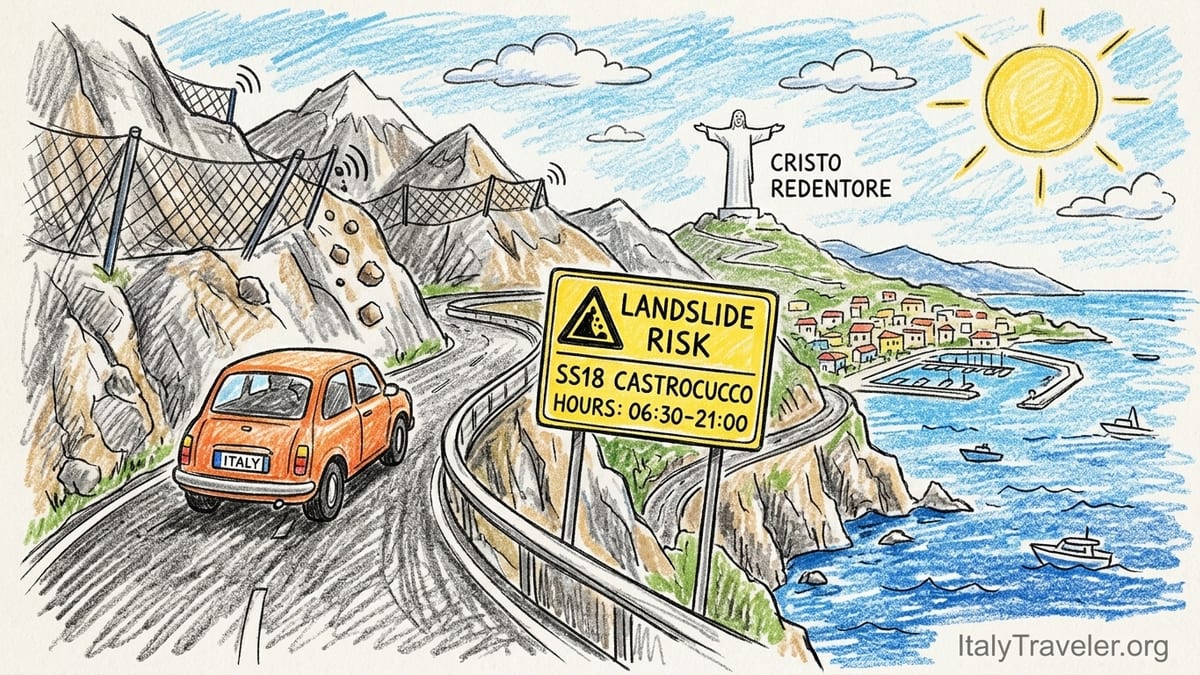
The 2026 Reality of Reaching Maratea
I chose to approach Maratea the way many international visitors do: rental car collected near Salerno, A2 southbound, then exit at Lagonegro Nord and follow the SS585 down the Noce valley towards the Tyrrhenian. On 18 October 2026, that meant dropping from the smooth dual carriageway of the A2 onto a narrower mountain road and into the heart of Basilicata’s infrastructure crisis. Signage warning of landslide risk appeared long before the coast, and navigation apps were at best cautious, at worst confused, about which stretches were actually open.
Officially, the municipal guidance that came into force on 15 October 2026 states that access to Maratea is possible from two sides: from the south, along the SS18 “Tirrena Inferiore” through Castrocucco with time limits between 06:30 and 21:00, and from the north, via the SS18 through Acquafredda with no time restrictions. At the same time, the SP3 in the Colla area and the temporary Castrocucco bypass remain closed because of rockfall. In practice, this means the town currently depends on a fragile mix of an old cliffside road under a monitored landslide and a northern access still affected by long term tunnel works.
The cumulative effect for a visitor is uncertainty. When I reached the junction where the SS585 meets the coastal network, flashing boards repeated the hours for the “sottofrana” section, and local drivers timed their runs. I arrived comfortably within the daytime window, but the simple fact that a missed turn, a late lunch, or a wrong lane could push you towards a road that physically closes at night casts a shadow over trip planning. You are not simply driving to a beach town; you are threading a timetable through active geology.
Locals are by now accustomed to this dance, but for travelers it can be disorienting. Accommodation owners speak in the language of detours and windows: “Arrive from the north after dark, not from Castrocucco,” or “If you plan to go to Calabria for the day, remember you must be back before the southern SS18 closes.” The romance of arriving by the old coastal road is still there, with the Tyrrhenian flashing between rock spurs, yet it is undermined by the very real awareness that one more rockfall could shut the route again without warning.
Beautiful Topography, Difficult Everyday Geography
The irony of Maratea is that the same topography that created its fame now complicates every movement. Wedged between the Tyrrhenian and the steep flanks of the Apennines, the municipality stretches over multiple levels: historic hilltop center, mountain ridge crowned by the Cristo Redentore statue, scattered hamlets like Acquafredda and Cersuta on terraces, and a string of coves down at sea level. It is visually spectacular, with viewpoints that justify every tourism slogan, but it is not an easy resort in the conventional sense.
From the road, cliffs plunge toward narrow pebble beaches. The landslide at Castrocucco, which destroyed part of the SS18 in November 2022, was dramatic precisely because the road here runs at the very base of a high rock wall. Scientific papers and monitoring reports now use Castrocucco as a textbook case for coastal rockfall, and driving this section today you can see why. Protective nets and sensors cling to the slopes, and temporary traffic controls remain part of the landscape. This is not a broad coastal plain that can absorb a detour with a simple inland bypass; one compromised slope immediately cuts a main artery.
That verticality continues inland. To move between the centro storico and the port, you follow serpentine roads or long staircases. The Cristo Redentore, a 22 meter statue in Carrara marble on Monte San Biagio, rewards you with panoramic views from Calabria to Campania, but getting there involves a steep access road that feels like a miniature mountain pass. Buses and shuttle vans do run in peak periods, yet hairpins and gradients remain daunting for less confident drivers, especially those in underpowered rental cars carrying luggage and family.
The result is a destination made of fragments. Unlike a flat resort where one promenade links everything, Maratea offers disjointed jewels: a romantic piazza in the old town, a working marina at the port, a windswept belvedere near Cristo, and coves like Fiumicello, Macarro and Cala Jannita separated by cliffs. Each piece requires thought, transport and time. For some travelers this patchwork is a delight; for others, used to rolling a suitcase from car to hotel to beach, it feels like friction.
Road Closures, Time Windows and the Psychology of Access
The bluntest question I carried with me was simple: does the current 2026 access situation materially change whether Maratea is worth it? After several days zigzagging between the SS18 from north and south, speaking with hoteliers and watching evening queues at traffic lights, my answer is yes. The patchwork of landslides and restrictions has turned what was always a slightly remote destination into a place that requires active risk tolerance.
On paper, the rules sound manageable. From 15 October the municipality confirms that the southern SS18 at Castrocucco is open daily from 06:30 to 21:00, under continuous monitoring of the unstable rock face. The northern SS18 via Acquafredda is available at all hours, though subject to ongoing construction related to new tunnels. The SP3, which once offered a more direct inland link to Trecchina, is closed after another large rockfall, and the brand new Castrocucco bypass, inaugurated in mid September to bypass the landslide, had to be shut after a further mass detached above it in early October.
The problem is not simply one of extra minutes behind the wheel. It is the constant possibility that circumstances will change mid trip. In the weeks before my visit, regional news bulletins carried images of fresh rocks on asphalt and repeated phrases like “viabilità in ginocchio,” the road network on its knees. Each report was followed by promises of urgent technical tables, new monitoring campaigns, and reassurances from Anas and the regional government. For residents these are matters of daily life and school runs. For a visitor planning a three night stay, they introduce a harder to quantify concern: what happens if I cannot leave when I planned.
This uncertainty feeds directly into decision making about bookings and day trips. A boutique hotelier in the historic center told me they had a cluster of late cancellations in early October from families who simply did not want to juggle a car, young children and a road that shuts after dark. Another owner in Marina di Maratea said guests from Naples called repeatedly in the days before arrival, asking whether their route via Sapri was still viable. Some came anyway, treating the frayed road network as part of the adventure. Others shifted their reservation to the Ionian coast, swapping dramatic cliffs for flat sand and easier access from the SS106.
Parking, Stairs and the Micro Logistics of Daily Life
If the strategic access picture is complicated, the micro logistics on the ground are just as influential. Arriving late afternoon, I followed signs to a public parking area just above Fiumicello beach. The lot was already crowded with local cars, and the remaining spaces required tight maneuvering between concrete walls. Payment machines accepted coins and some cards, but the instructions were faded and the interface in Italian only, something to bear in mind for foreign visitors.
From car to shore, the route involved descending a staircase and a steep lane, the sort of access that feels picturesque with a beach bag and oppressive with a stroller or limited mobility. Other coves are similar. At Macarro I counted multiple short but sharp ramps from parking bays down to the pebbles. Cala Jannita, the so called Black Beach, is accessed via another narrow road with limited parking, where drivers were informally “helped” into spaces by a man clearly used to coaxing every possible car into the strip of asphalt. There was nothing unsafe about the scene, but it reminded me that here, space is always at a premium.
In the old town the constraints take a different form. Parking is concentrated in designated areas outside the most historic lanes. From there, you climb. The labyrinth of alleys and steps is undeniably charming, lit by warm lamps at night and framed by views over tiled roofs to the sea. Yet each movement involves a calculation: can I carry this luggage, this shopping, this tired child, up and down these stairs. Some boutique properties offer limited on site parking or arrange small shuttle transfers from larger lots, but capacity is low and cannot absorb peak demand in August or on holiday weekends.
Taxis and local buses do exist but operate on modest scales. On my October visit, the small urban buses that in summer link the port, beaches and center were running at reduced frequency, and information boards at stops were sparse. Hotel staff were the most reliable source on which routes were operating that day. Taxis from the port up to the Cristo Redentore parking area offered a welcome alternative to driving the narrow road yourself, but fares added up quickly compared with a simple seafront resort where your car only moves at the start and end of the stay.
Beaches in Pieces: Coves Versus the Ionian Plain
The landscape of Maratea’s coast is one of rocky inlets and small coves rather than long continuous sand. This is central to its appeal. From the belvederes above the port, you look down on tight crescents of pebbles lapped by unusually clear water, framed by headlands and pine. For swimmers and snorkellers, this can be far more interesting than an endless straight beach. The price is fragmentation and capacity.
Each of the named beaches has its own access story. Fiumicello, one of the most popular, combines a narrow shingle strand with a modest beachfront cluster of bars and lidos, and a mix of pay and free zones. At mid season, umbrellas already filled much of the space. Further out, Macarro offers white pebbles and a wilder feeling, but the descent roads are narrow, and in summer they often operate as informal one way systems in practice as drivers negotiate who will reverse. Cala Jannita’s black sand is striking in photographs, yet the strip itself is small, squeezed between rocky slopes that limit expansion.
Compare this with Basilicata’s Ionian coast, an hour and a half away by road when the network is fully functional. There, wide sandy beaches near places like Metaponto and Policoro stretch inland on a shallow gradient, backed by campsites and holiday villages set on flat land. Parking is more straightforward, beach clubs have room to space out umbrellas, and the sea entry is often easier for small children. The trade off is aesthetic and atmospheric: less drama, more space.
Who benefits from choosing Maratea then. In my view, travelers who prioritize scenery and seclusion over ease. A couple willing to accept that they may need to drive ten or fifteen minutes, park above a cove and walk down steps will find coves that feel almost private out of peak season. A multi generational family seeking simple logistics, pushchair friendly promenades and sandy shallows may find the Ionian side more forgiving, especially in the current period of unstable access to the Tyrrhenian.
Historic Center, Port and Cristo Redentore: Highlights With Caveats
Despite the strain on its roads, the core attractions of Maratea still work their magic. The historic center, perched inland with views that reach the sea, retains an authentic, lived in feeling even as boutique hotels and wine bars multiply in side streets. On a warm October evening in Piazza Buraglia, I watched a mix of residents and visitors share the same benches and bars, the kind of scene that draws people precisely because it is not a purpose built resort.
Reaching that center from the port or from coastal accommodation is where the effort begins. The main access road curls up the hill in a series of bends that require patience and low gears. There is nothing technically dangerous in dry weather, but at night or in rain the drive demands concentration, and parking near the piazza is limited. I ended up leaving the car in a larger lot slightly below the center and walking up, a pleasant stroll for me but one that will not suit every traveler, especially after a long day of driving coastal roads already affected by closures.
The port itself is perhaps the most immediately accessible part of Maratea. It sits in a deep natural inlet, protected from the open sea by cliffs and breakwaters. Cafes and restaurants line the quayside, and in good weather the atmosphere is effortlessly Mediterranean. Yet here too, topography and limited space intrude. Parking climbs up terraces behind the harbor, and a wrong turn can leave you on a steep dead end with no room to turn. Boat excursions along the coast, advertised with glossy brochures, look idyllic. I hesitated, not because of the sea, but because any additional commitment felt risky while the land routes remained so contingent.
Up above, the Cristo Redentore is as impressive as every photograph suggests. Completed in the 1960s and standing 22 meters tall on Monte San Biagio, the statue commands a viewpoint that ties together the complexity of the local geography in a single sweep: the snake of the SS18 along the coastline, the broken cut of the SP3 up the valley, the tight bowl of the historic center and the scattered houses on wooded slopes. Standing there in the late afternoon breeze, I felt both awe and a certain fatigue. Reaching this point involved another narrow road, another search for limited parking, and the knowledge that every descent would return me to the same contested arteries below.
Bookings, Buses and Day Trips in an Uncertain Network
Over several days I tracked how the compromised road system filters into travelers’ concrete choices. One mid range hotel above the port told me they now warn every prospective guest about the time window on the southern SS18 and the closure of the SP3 and bypass. They have added explicit arrival advice to their confirmation emails and suggest that anyone planning to come from Calabria time their trip during daylight and avoid cutting things close to 21:00. They also noticed a new pattern: more guests arriving from the north via Acquafredda, even if that means a slightly longer journey, simply to avoid the sense of driving under an active landslide.
Beach hopping, once a major selling point of Maratea, has become harder to recommend unreservedly. In the past, travelers might have plotted a leisurely circuit of coves in a single day. In autumn 2026, every move in a car begins with the question of whether you will re encounter construction queues, temporary closures or sudden restrictions. For visitors staying only two or three nights, the opportunity cost of a misjudged drive is high. Several people I met limited themselves to the nearest one or two beaches within walking distance of their accommodation, accepting less variety for more certainty.
Bus services, already modest compared with larger coastal regions, struggle to offer a reassuring alternative. Seasonal beach shuttles that run in high summer cannot fully substitute for the flexibility of a car when an entire regional road is removed from the map. Where buses do exist, they too are bound by the same fragile network of tunnels, bypasses and “sottofrana” sections, and are vulnerable to the same last minute disruptions after heavy rain. Hotel staff repeatedly advised guests to check the municipality’s latest notices on the day of travel, not simply rely on printed timetables from earlier in the season.
Day trips from Maratea to destinations like Praia a Mare, Scalea or inland villages in the Noce valley remain theoretically possible but now require more conservative planning. A loop that once felt like an easy excursion can begin to look like a chain of dependencies. If you are visiting in shoulder season, with shorter daylight hours and a time limited southern access road, the margin for error narrows. For some, that sense of managing around risk is invigorating. For others, especially those who measure holidays in uncluttered, low stress days, it undermines the appeal.
The Takeaway
By the end of my stay, I found myself split between admiration and exasperation. Maratea in October 2026 is still one of Italy’s most dramatic small coastal destinations. The views from Monte San Biagio, the evening light over the port, the narrow coves that feel carved from volcanic glass remain extraordinary. Yet the logistical effort required to enjoy them has risen sharply in the wake of recurrent landslides, rockfalls and the partial closure of key routes like the SP3 and the Castrocucco bypass.
For certain travelers, the scenery will absolutely justify that effort. If you are fit, flexible, comfortable with mountain and cliff roads, and willing to adapt plans day by day in response to municipal notices and weather, Maratea offers a combination of sea, mountains and small town life that the flatter Ionian resorts cannot match. Photographers, hikers, and couples seeking atmosphere rather than convenience will still find deep satisfaction here, particularly outside the most crowded summer weeks.
For others, the calculus is more sobering. Families with very young children, travelers with limited mobility, or anyone who equates a beach holiday with simple parking, flat promenades and guaranteed access may be better served, at least for now, by the broad sands of Basilicata’s Ionian coast or neighboring regions less dependent on a single cliffside highway. That is not a criticism of Maratea’s inherent qualities, but a recognition that its fragile transport infrastructure currently places an extra layer of strain on every stay.
If there is one practical conclusion, it is this: in 2026, checking the latest municipal and regional road notices is not optional when planning Maratea, it is mandatory. Before locking in non refundable bookings, verify the current status of the SS18 from both north and south, the SP3 and any provisional bypasses. Build slack into your itinerary, avoid hard commitments that require precise arrival or departure times, and consider sequencing your route so that you exit via the more stable side of the network. Only by treating access as a live variable, not a fixed assumption, can you fairly weigh whether Maratea is worth the detour for you personally.
FAQ
Q1. Is it currently possible to reach Maratea by road from both north and south?
As of mid October 2026, access is possible from the north via the SS18 at Acquafredda without time limits, and from the south via the SS18 at Castrocucco only between 06:30 and 21:00, with the SP3 and the Castrocucco bypass closed due to landslide and rockfall issues. These conditions may change, so always check up to date official notices before travel.
Q2. How much extra travel time should I expect because of the road situation?
Travel times vary with works and traffic, but many travelers report at least 20 to 40 additional minutes compared with pre landslide conditions on routes from the A2 or from neighboring coastal towns, especially when construction, temporary traffic lights and reduced speed zones are in place.
Q3. Is Maratea suitable for visitors with limited mobility?
Maratea’s steep terrain, frequent staircases and sloping access to many beaches pose challenges for visitors with limited mobility. Some hotels and the port area offer more accessible facilities, but moving between the historic center, Cristo Redentore and most coves usually involves climbs or descents that are not easily avoided.
Q4. Are local buses a reliable alternative to driving in Maratea?
Local buses provide some connections between the center, port and main beaches, especially in summer, but they operate on relatively limited schedules and are affected by the same road closures and diversions as private cars. They can reduce parking stress but do not fully compensate for the current fragility of the road network.
Q5. How does Maratea compare with the Ionian coast for a family beach holiday?
Maratea offers dramatic scenery and small coves, while the Ionian coast generally provides wider sandy beaches, flatter terrain and easier access by road. For families prioritizing simple logistics, pushchair friendly promenades and more predictable driving, the Ionian side is usually less demanding than Maratea’s cliff based geography.
Q6. Is it safe to drive the “sottofrana” section of the SS18 at Castrocucco?
The “sottofrana” section is monitored and opened only within specified hours when authorities judge conditions acceptable. While many residents and visitors continue to use it, the very need for time windows and monitoring reflects ongoing risk related to the unstable rock face. Drivers should follow official guidance, respect closures and proceed cautiously.
Q7. Can I still visit Cristo Redentore despite the road issues?
Yes, the access road to Cristo Redentore remained reachable during my visit, and the viewpoint is a highlight of any trip to Maratea. However, the approach is steep and narrow, parking is limited near the top, and reaching the statue generally requires additional walking from parking areas.
Q8. Do hotels in Maratea help guests manage transport complications?
Many accommodation owners have become proactive in explaining current road conditions, advising on best arrival routes and suggesting safe time windows for travel. Some arrange local transfers or share day by day updates, but guests still need to accept a higher than usual level of uncertainty.
Q9. Is it realistic to use Maratea as a base for wider day trips in 2026?
It is possible, but travelers should plan conservatively. Routes to nearby towns in Calabria or inland Basilicata may involve diversions and delays, particularly if further rockfalls occur. Allow generous time margins, avoid very tight same day commitments and be prepared to shorten or cancel excursions if conditions deteriorate.
Q10. Who should still prioritize Maratea in their 2026 itinerary?
Maratea remains a strong choice for travelers who value dramatic landscapes, small scale atmosphere and are comfortable with mountain style driving, stairs and flexible planning. Those seeking straightforward, low stress beach access and fixed timings may prefer destinations with more robust and redundant transport infrastructure.