


I first saw a photo of Cala Goloritzé years ago, the famous limestone needle of Punta Caroddi spearing the sky above turquoise water. It looked unreal, almost staged. In September 2026 I finally decided to find out what it really takes to stand on that pebble beach, with my own legs as transport and not from the deck of a boat.
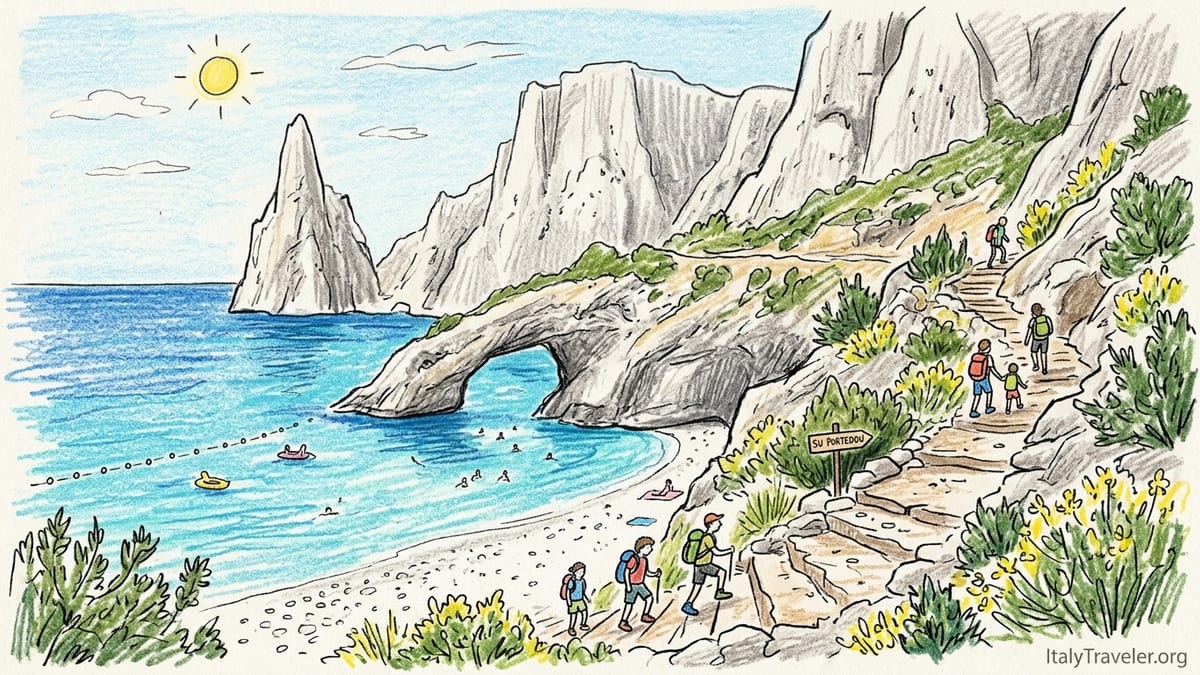
Getting to the Golgo Plateau and Su Porteddu Trailhead
I hiked to Cala Goloritzé on 17 September 2026, at the tail end of summer when the sea is warm but the crowds are starting to thin. I was staying in Santa Maria Navarrese, about 20 minutes south of Baunei on Sardinia’s east coast, and I left town just after 7:00 in the morning. The sky was clear, the forecast for Baunei promised sun and a high around 29 degrees, and the first light was just touching the upper walls of the Gulf of Orosei.
From Santa Maria Navarrese I drove up the SS125 towards Baunei. The climb is steep and twisty, with views back over the coast and the village below, and it already hinted at what the hiking terrain would be like. After passing through Baunei I followed the signs for Golgo and San Pietro, leaving the main road for a smaller one that crosses a high karst plateau. The asphalt eventually turned to a well used dirt track, signposted for Cala Goloritzé, which I followed for roughly 1.5 kilometres until the buildings and wooden sign of Su Porteddu appeared.
I parked in the gravel area at Su Porteddu around 7:40. There were already a dozen or so cars and a couple of scooters, but spaces were still easy to find this mid September weekday. The air at the plateau, roughly 400 to 450 metres above sea level, was pleasantly cool. A light breeze moved the junipers and I was grateful to be starting in shade before the sun rose high enough to hit the limestone walls.
The Su Porteddu area is more than just a parking lot. There is a small bar restaurant with toilets, shaded outdoor tables and clear signage explaining the rules for Cala Goloritzé. This is where the official system for accessing the trail and the beach begins, and where the 7 euro ticket becomes a very real part of the experience.
Tickets, Reservations and What the 7 Euro Fee Really Includes
Cala Goloritzé is no longer the kind of beach you can simply wander down to on a whim. In 2026 access is regulated through a limited capacity system, with a maximum of about 250 visitors at one time and a mandatory ticket that costs 7 euros per person, free for children up to 5 or 6 years old and for residents of the municipality of Baunei. The ticket covers both the naturalistic trail and the cove, and is tied to a single time window that runs from 7:30 to 16:00.
I had reserved my ticket online a couple of days before, using the Heart of Sardinia booking portal linked from Baunei’s official tourism information. On a weekday in mid September there was still availability 48 hours in advance, but on peak July and August weekends tickets often sell out shortly after they are released a few days before. Having the QR code already on my phone meant check in at Su Porteddu was quick. At a small wooden booth next to the bar, a staff member scanned my code, handed me a paper wristband and confirmed that my 7 euro fee included parking at Su Porteddu and use of the toilets there.
Several travelers around me had not booked in advance and were queuing at the same booth. Staff were selling remaining same day spots, but they were clear that once the 250 person limit is reached, no more people are allowed to start the trail. Another sign reminded everyone that the last admission of the day is in the early afternoon, usually around 14:00, and that it takes on average about 1.5 hours to hike down and up to 2 hours to return. Reservations are not just bureaucracy here; they genuinely control the flow of people onto a fragile stretch of coastline.
There were also clear rules about what to bring and what not to expect. Closed shoes with good grip are mandatory and flip flops are explicitly discouraged. Official information boards recommend carrying at least two litres of water per person, plus food and sun protection, because there is no bar, café or freshwater source at the beach itself. Reading these notices while sipping an espresso at Su Porteddu, it was obvious that the municipality is trying to reframe Cala Goloritzé as a hike with a beach at the end, not a casual seaside stop.
Gear, Water and My First Mistake Before Setting Off
I considered myself reasonably prepared, but I still made a mistake that I felt later. For footwear I wore light low cut hiking shoes with decent tread, which turned out to be the right call on the rocky sections. I packed a small daypack with a microfiber towel, mask and snorkel, a simple picnic lunch and some fruit, plus sunscreen and a hat. I also wore a light technical T shirt and quick dry shorts, with a thin long sleeve layer rolled up in case of wind that I never needed.
Where I went wrong was water. The official advice is at least two litres per person. I carried one and a half, telling myself that it was September not August, that I usually hike fast, and that I could ration my drinking on the way back. At 7:50 in the morning, with the air still under 20 degrees and the trailhead in shade, it felt reasonable. It did not feel reasonable three hours later halfway back up the slope when the white rock was throwing mid day heat back in my face.
Just before 8:00 I tightened my pack straps, checked that my ticket wristband was secure and walked through the wooden gate at the start of the trail. A sign marked the route to Cala Goloritzé as 3.6 kilometres one way with roughly 470 to 500 metres of elevation difference between Su Porteddu and sea level. Average walking times were given as about 90 minutes down and two hours up. I tend to be quicker than guidebook times on moderate terrain, and I was curious to see how these numbers would compare to my own pace on a hot day.
The first few hundred metres followed a wide, sandy path flanked by low Mediterranean scrub. The sun was still low enough that the surrounding holm oaks and junipers cast long shadows over the white soil, and the only sounds were bee-eaters overhead and the crunch of other hikers’ boots as they spread out along the trail.
Descending Through Mediterranean Scrub and Limestone
The character of the trail changed soon after the initial easy stretch. The path entered denser Mediterranean vegetation, with patches of fragrant thyme, lentisk and cistus lining the way, and the surface underfoot became rockier and more irregular. At several points the route wound between weathered limestone blocks, using ancient shepherd tracks that had been mildly improved for tourism but not tamed into a smooth walkway. There were more stones and dust than soil, and my ankles were immediately grateful for proper shoes.
The descent is steady rather than terrifyingly steep, but its cumulative effect is significant. The trail alternates between short switchbacks on loose gravel, sections across exposed limestone slabs and stretches on dusty earth where roots form natural steps. During the first half I moved comfortably, almost casually, stopping occasionally to let slower groups pass and to read the small wooden markers indicating distance to the beach. At the 1 kilometre point I checked my watch; I had been walking for just over 20 minutes.
As the trail drew nearer the edge of the limestone escarpment, the landscape began to open. Through gaps in the scrub I caught my first partial glimpses of the Gulf of Orosei, a flat streak of silver blue far below. Heat was already radiating from the white rock, even though the clock had only just passed 8:30. Shade became patchy and I understood why local guides recommend avoiding the spine of summer in the middle of the day, especially on the return climb.
The most technically awkward sections of the descent came closer to the cove. Here the path dipped into a dry gully, threaded between boulders and then scrambled across tilted slabs. In a couple of places I used my hands for balance on polished limestone where thousands of soles have smoothed the rock. None of it is difficult in mountaineering terms, but for anyone in sandals or with unstable knees the combination of dust, small rolling stones and the relentless downward gradient would be uncomfortable. I reached a large wooden sign announcing Cala Goloritzé and the boundary of the protected area after 1 hour and 5 minutes of walking, including photo stops.
The First View of Punta Caroddi and the Pebble Beach
From that sign the path narrowed further and dropped into thick shade under ancient junipers. The air shifted from dry and dusty to unexpectedly cool and damp, carrying a faint smell of salt and seaweed up the ravine. The last few minutes felt like moving through a green tunnel, with the sound of waves growing louder and the light ahead taking on that peculiar high Mediterranean brightness that reflects off limestone and water at the same time.
When I stepped out from the trees onto the final rocky slope above the beach, Cala Goloritzé looked almost exactly like the iconic photographs, yet more three dimensional and wilder. On the left the sharp limestone pillar of Punta Caroddi, around 148 metres high, rose almost vertically from the top of the cliffs, its pale grey surface catching the sun. To the right, the natural rock arch curved out from the cliff and dipped into water that shifted from electric turquoise over white stones to deep sapphire farther out. The beach itself was not sand but a fan of pale, rounded limestone pebbles, surprisingly soft under my shoes.
I reached the actual shoreline at 9:15, making my total descent time from Su Porteddu about 1 hour and 15 minutes. A ranger sat at a shaded spot by the entrance to the cove, checking wristbands. There were perhaps 80 to 100 people already spread across the pebbles, with more arriving behind me, yet the beach did not feel crowded in the way an urban strand does. Instead, small clusters of hikers had claimed their own patches of pebbles under the scattered shade of leaning junipers and rock overhangs, while a couple of early risers were already in the water near the arch.
What surprised me most at that first moment was the scale. The beach is small, perhaps 80 metres across at the waterline and narrowing quickly towards the cliffs, and it sits in a high walled amphitheatre of limestone that focuses sound and light. Every splash or shout bounced around the rocks, and the contrast between the white stones and the blue sea was almost hard on the eyes after the muted tones of the scrubby descent.
Swimming, Snorkeling and Sharing the Cove with Boats
The water was too tempting to resist. I found a spot of partial shade near the cliff, spread my towel and changed into swimwear. Because Cala Goloritzé is a protected site with no services on the beach, there are no sunbeds, kiosks or rubbish bins. Everything you bring in you must carry out, and everyone was tucking their waste into backpacks rather than leaving anything behind. The pebbles close to the tide line are small and mobile, and they make awkward footing as you enter the sea. Within two or three steps the bottom drops enough that you can float, still above a carpet of rounded white stones.
Mid September water temperature in this part of Sardinia is usually around 24 to 25 degrees. The first immersion felt cool after the heated walk but not shocking. Once fully in, the sea was simply refreshing, that kind of enveloping, body temperature neutral water that lets you forget about sweat and dust in seconds. Visibility was very good, easily ten metres or more, and with a simple mask and snorkel I could watch small fish weaving between the stones and the darker patches where seagrass begins farther out.
Boats are a constant but distant presence here. By municipal ordinance, ordinary tour boats and rental inflatables cannot land on the beach itself, nor can they cross the line of buoys that marks a protected nearshore area. Instead they stop outside the barrier, roughly a couple of hundred metres offshore, where passengers can swim or snorkel in deeper water with a clear view of the arch and Punta Caroddi. From the pebbles I watched a series of craft from Santa Maria Navarrese and Arbatax swing in, engines cut, guests drop briefly into the water for photos, then move on towards other coves like Cala Mariolu and Cala Luna.
Swimming inside the buoyed zone felt safe. There are no powered craft to worry about, just human noise, the slap of waves on rock and the occasional shout from someone testing their courage closer to the foot of the arch. I swam parallel to the beach for about 20 minutes, then out towards the inner side of the arch where the shade made the water shift to an almost milky turquoise. The light filtering through the gap between rock and sea surface created flickering patterns that looked unreal even from the inside. If you come primarily for snorkelling, note that there are pretty fish and clean water, but this is not a coral reef; the magic is in the colours and the geology, not the biodiversity.
Shade, Crowds and the Reality of a Regulated Paradise
By late morning the character of the beach had shifted. Around 11:00 the sun reached almost directly overhead and the usable shade on the pebbles shrank to narrow strips at the extreme edges of the cove. Hikers arriving later struggled to find cover and some retreated to the undergrowth beyond the official beach area for an early lunch. I was grateful for my hat and for having reached the shoreline before 9:30. On a high season day, when up to 250 people are allowed at once, this lack of shade could quickly become the most uncomfortable aspect of the visit, especially for families with small children.
Crowding, though controlled by the quota, is still perceptible. At the peak late morning period I counted rough clusters and estimated around 180 to 200 people present. The atmosphere remained civilized; many were clearly hikers rather than casual beachgoers, carrying proper backpacks and boots. Conversations were in Italian, German, French and English, a mix of day trippers and longer term travelers. Rangers moved discreetly among the groups, reminding a few smokers that the area is non smoking and asking people not to climb onto fragile ledges.
One clear benefit of the reservation system is that it eliminates the possibility of arriving to an overrun, chaotic scene. Knowing that there is a cap, that no motorboats will suddenly disgorge dozens more people on the pebbles, and that the site is being actively managed changes your perception. It still felt busy, but it also felt cared for. The pebbles were remarkably clean, with barely a plastic bottle cap in sight, and there were no beach vendors or loudspeakers to break the natural mood.
I spent just over three hours at the cove in total, including two swims, a slow picnic lunch of pane carasau and pecorino on the pebbles, and long periods simply watching the changing light on the arch and on the point of Punta Caroddi. By 12:30 I started to feel the press of the mid day sun and the weight of the upcoming climb, so I packed up, refilled my hat and buff with seawater for a cooling effect, and steeled myself for the ascent.
The Climb Back: Heat, Elevation and Running Low on Water
I left the beach a few minutes before 12:45. Within ten minutes I was sweating more than at any point on the descent. The first shaded section under the junipers passed quickly, but as soon as the path rose out of the ravine and onto more open slopes, the sun hit me full in the face. The white limestone and pale soil acted like a reflector. The air temperature was probably in the high twenties, but the radiant heat felt significantly higher.
On the way down I had been able to maintain a fluid pace with only short stops. On the way up I immediately shifted to a slower rhythm, using the limited patches of shade under larger trees as fixed goals. It took me about 35 minutes to reach the wooden pointer that I had passed roughly 20 minutes after starting the descent in the morning. My heart rate was high, my shirt soaked and my 1.5 litres of water had already shrunk to less than a third of a bottle. Every step I took on those gravelly switchbacks reminded me that ignoring the two litre per person guideline had been complacent.
There were plenty of reminders around me of how challenging the climb can be for the unprepared. A couple wearing thin canvas sneakers without tread were inching their way up dusty stone steps, slipping regularly and leaning heavily on each other. Another group had to redistribute water because one friend had started with less than a litre and was already empty. A local guide leading a small party paused under a tree and, in patient but firm Italian, explained again why the municipality insists on minimum equipment for what is classified as an "E" level hiking trail, not a beach stroll.
I adopted a pattern of 15 to 20 minutes of slow, steady climbing followed by a 2 minute rest in shade. The elevation gain of around 470 to 500 metres is nothing extreme by alpine standards, but concentrated over 3.6 kilometres and under strong Mediterranean sun it feels much more serious. My legs were still responsive, but my mouth grew dry and my head pulsed if I pushed the pace. By the last half hour, I was rationing my final mouthfuls of water, taking tiny sips and wetting my lips rather than drinking freely.
I reached the Su Porteddu gate at 14:35, almost exactly 1 hour and 50 minutes after leaving the beach. My total hiking time, including brief rests and photo stops, had been around 1 hour and 15 down and 1 hour and 50 up. My first action back at the bar was to buy a large bottle of cold water and another of a local lemon soft drink, which I finished embarrassingly fast in the shade. The return climb is the part of this outing that people underestimate most, and looking at the flushed faces and salt stained shirts at Su Porteddu that afternoon, I knew I was not the only one who had misjudged their water needs.
Trail Access vs Boat View: Cost, Effort and Swimming Reality
Hiking is the only way to actually set foot on the pebbles of Cala Goloritzé under the current regulations. Ordinary boat tours cannot land on the beach or cross the buoyed line, and there is no designated landing lane for motorized craft. A few specialized operators, such as local cooperatives working closely with the municipality, may be authorized to pick up tired hikers in emergencies or as part of longer trekking itineraries, but for an independent visitor the rule is simple: if you want to touch that water from the shore, you must use the inland trail.
Boats remain a valid way to see Cala Goloritzé from the sea, and for many people it will be the more comfortable option. In 2026, full day boat trips along the Gulf of Orosei from Santa Maria Navarrese or Arbatax generally cost somewhere in the range of 50 to 70 euros per adult on larger excursion boats, and around 120 to 180 euros for a small self drive rubber boat rental split between a group. These tours usually include multiple swimming stops at other coves, and they cruise past Cala Goloritzé for photo opportunities, sometimes pausing just outside the buoys so passengers can jump in for a brief swim.
However, the nature of that boat based swim is fundamentally different from wading in from the pebbles. You enter the water from a ladder or by slipping off the side of a boat into deep blue, with the beach and arch as a spectacular backdrop but still at a distance. Stronger swimmers can head towards the buoy line for a closer look, but there is always the awareness of current, boat traffic and the need to stay within the time limits set by the captain. It feels more like a scenic stop on a cruise than a destination in its own right.
The hike, by contrast, concentrates cost and effort differently. My out of pocket expenses for the day, excluding accommodation and car rental, were straightforward. The 7 euro access ticket covered my parking at Su Porteddu and use of the toilets there. I spent about 5 euros at the bar on coffee in the morning and about 4 euros on water and a soft drink after the hike. Food came from a local supermarket in Santa Maria Navarrese the day before, costing another 6 to 7 euros for bread, cheese, fruit and snacks. In total I spent under 25 euros for an entire day that revolved around this single beach.
The trade off is physical. Boat passengers step off the gangway in the evening a little tired from sun and salt but not exhausted from a 500 metre climb. Hikers return to Su Porteddu with aching calves, dust in their shoes and salt on their skin that has been earned the hard way. For me, the intangible value of approaching such a photogenic, heavily publicized place under my own power was significant. It reframed Cala Goloritzé not as a trophy photo, but as an endpoint to a real effort that made the water feel more deserved.
The Takeaway
Looking back on the day as I drove down from the Golgo plateau towards Baunei in the late afternoon, with the light slanting across the supramonte and the first shadows lengthening in the canyons, one moment stands out above all others. It was not the first step onto the pebbles, nor even my first swim. It was a quieter instant, sitting alone near the edge of the cove around 10:30, when the main rush of arrivals had slowed and I could watch Punta Caroddi reflected in the glassy water beyond the pebbles. For a few minutes I could almost tune out the human presence and imagine the cove as it might have been before any list of "world’s best beaches" put it on so many bucket lists.
I also clearly remember my main preparation mistakes. I underestimated my water needs and overestimated the moderating effect of a September date. If I were to hike Cala Goloritzé again, I would carry at least two and a half litres, wear the same sturdy shoes, and consider starting even earlier, aiming to leave the beach no later than noon. I would also bring a light, reflective beach umbrella or a compact sun shelter if visiting with anyone sensitive to heat, because shade on the pebbles is truly limited after mid morning.
Was it worth it? For me, yes, but with caveats. The combination of the limestone needle of Punta Caroddi, the rock arch, and the exceptional clarity and colour of the water justified the physical effort and the careful logistics. The 7 euro fee felt fair given that it includes parking, services at Su Porteddu and, most importantly, active protection of a fragile coastline. The hike turned a famous, often romanticized image into a full body experience: dust underfoot, salt on skin, heart pounding on the way back up.
If your primary goal is a relaxed day of easy swimming with children, abundant shade and a beach bar, then Cala Goloritzé reached by hike might not be your ideal choice. A boat tour that passes by for photographs while focusing on more accessible coves could suit you better. But if you are reasonably fit, comfortable walking on rocky paths in the heat, and willing to respect the rules that keep this place from being overrun, the inland approach offers something that a distant boat view never will. It lets you arrive tired, thirsty and very aware of the landscape that cradles that thin line of pebbles, and in doing so, it makes one of Sardinia’s most famous beaches feel fully, undeniably real.
FAQ
Q1. Do I really need a reservation to hike to Cala Goloritzé in 2026?
Yes. Access to both the trail and the beach is controlled by a reservation system with a daily capacity limit, and tickets are required for all non resident visitors.
Q2. How much does the ticket cost and what does it include?
The ticket costs 7 euros per person in 2026, is free for young children and Baunei residents, and includes access to the trail, the beach, parking at Su Porteddu and use of the toilets there.
Q3. How long does the hike take each way?
On my visit the descent from Su Porteddu to the beach took about 1 hour and 15 minutes, while the return climb, with heat and short rests, took around 1 hour and 50 minutes.
Q4. Is the trail suitable for children or inexperienced hikers?
The path has loose stones, uneven limestone and a significant elevation change, so it is best for reasonably fit hikers and older children used to walking on rocky terrain, not for strollers or very young kids.
Q5. Can boat tours drop me directly on the beach?
No. Ordinary boats are not allowed to land at Cala Goloritzé and must remain outside a buoyed off protected zone, so you can only reach the pebbles via the inland trail.
Q6. What kind of footwear and gear should I bring?
Closed shoes with good grip, ideally light hiking shoes, at least two litres of water per person, sun protection, swimwear, food and a small towel are strongly recommended.
Q7. Is there shade or any kind of beach service available?
Shade is limited to narrow bands near the cliffs and trees, especially after mid morning, and there are no bars, rentals or lifeguards on the beach, only staff at the trailhead and rangers.
Q8. What are the swimming and snorkelling conditions like?
The water is usually very clear and around the mid twenties Celsius in late summer, with a pebble bottom, gentle entry, some fish to see and no motorboats inside the protected nearshore area.
Q9. When is the best time of day to hike to avoid heat and crowds?
Starting from Su Porteddu between 7:30 and 8:30 generally means descending in cooler air, reaching the beach before the main mid morning rush and beginning the return climb before the most intense afternoon sun.
Q10. Is hiking to Cala Goloritzé worth it compared to seeing it from a boat?
If you enjoy walking and want to stand on the actual pebbles, the hike offers a far more immersive experience; if you prefer minimal effort and multiple swimming stops, a boat tour that passes in front may be better for you.