

Gargano National Park and the Tremiti Islands form one of Italy’s most varied coastal landscapes, where pale limestone cliffs plunge into turquoise coves, ancient beech forests crown a mountainous interior and whitewashed fishing towns look out toward offshore islands. This is not simply an add‑on to a Salento holiday. It is northern Puglia’s main event, deserving its own dedicated trip and careful planning around roads, ferries, park rules and marine protection.
Understanding Gargano National Park and the Tremiti Islands
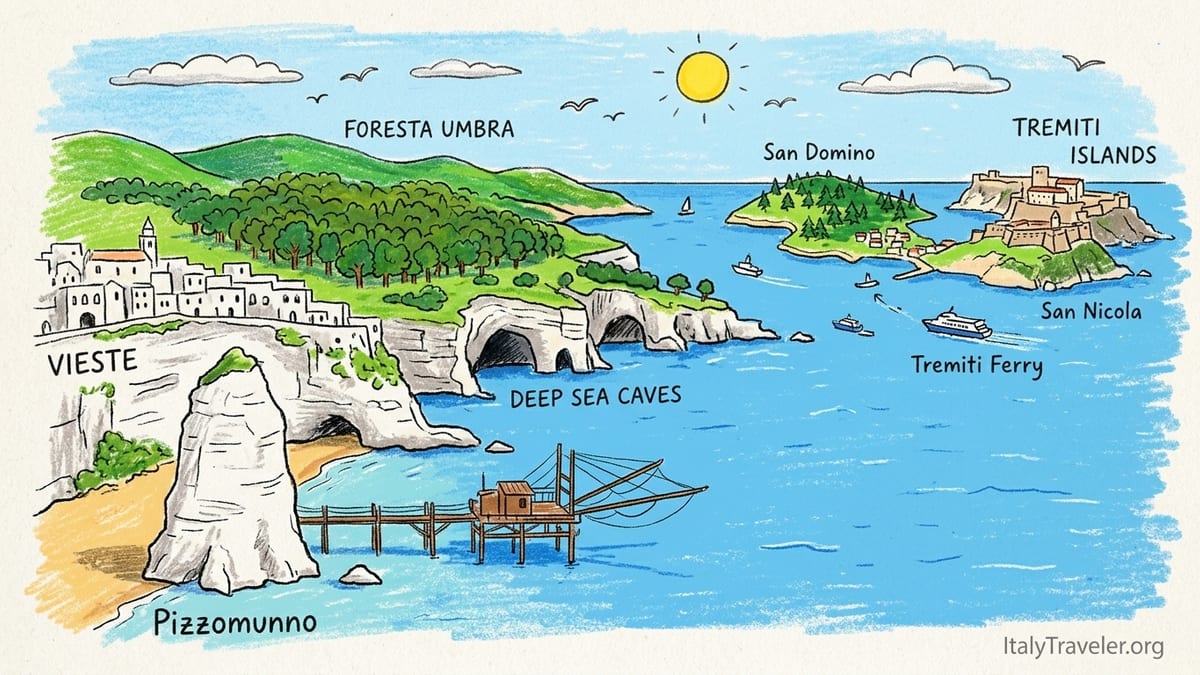
Gargano National Park occupies the “spur” on Italy’s boot, a compact peninsula of mountains that juts into the Adriatic. Within a relatively small area you move from steep limestone cliffs to long sandy beaches, from citrus groves and olive terraces to an interior of oak and beech forest. The coastline is deeply indented with sea caves and stacks such as Vieste’s famous Pizzomunno, while the Tremiti Islands lie about 40 kilometers offshore in the Adriatic, protected as both a national park zone and a marine reserve.
The park combines several distinct landscapes. Along the northern and eastern coasts you find bright limestone cliffs riddled with grottoes, pocket beaches like Vignanotica and Baia delle Zagare, and low fishing piers used by traditional trabucchi. Inland, the uplands of the Foresta Umbra preserve some of the last old‑growth beech woods of southern Europe. The western and northern coasts flatten into long sandy strands around Rodi Garganico and Lido del Sole, framed by lakes and citrus orchards. High on a ridge, Monte Sant’Angelo adds a spiritual, historical dimension with its sanctuary and medieval streets.
The Tremiti Islands form an offshore extension of the park. San Domino and San Nicola are the inhabited cores, with low cliffs, pine forest and crystal‑clear shallows that attract divers and swimmers. The smaller islets of Caprara and Cretaccio are mostly uninhabited, while Pianosa is entirely designated as an integral marine reserve where navigation, swimming and landing are strictly limited. Because of this zoning, every marine activity, from a simple snorkel stop to a technical dive, must respect detailed rules that are actively enforced.
For most visitors, exploring Gargano means combining a coastal base such as Vieste or Peschici with day trips into the Foresta Umbra and optional ferries out to the Tremiti. This guide is organized around the main Gargano bases and attractions: Vieste, Peschici, Mattinata and Baia delle Zagare, Monte Sant’Angelo, Vico del Gargano, Rodi Garganico, the Foresta Umbra and finally the Tremiti Islands, with precise notes on ferries, protection rules and sample budgets.
Vieste: Sea Caves, Pizzomunno and a Gateway to Tremiti
Vieste is the natural hub for a Gargano trip, perched on a white limestone promontory between two sweeping bays. Its old town of tight alleys, simple trattorie and sea‑view terraces sits just above Pizzomunno, a 25‑meter limestone stack that has become the symbol of the town. South of here, cliffs shelter dozens of sea caves that can only be reached by boat. Daily grotto excursions run from the port in season, navigating through tunnels and wide vaults with descriptive names like Grotta Smeraldo and Grotta dei Contrabbandieri.
Beaches in and around Vieste work for different styles of trip. Families often choose the long, shallow Spiaggia del Pizzomunno or San Lorenzo beach north of town, where you can rent a pair of sunbeds and an umbrella from around 25 to 35 euro per day in July and August, less in June and September. Travelers who prefer wilder coves combine a car and short walks to reach Vignanotica, an arc of white shingle backed by cliffs, or Baia delle Zagare, famous for its offshore stacks. Both lie along the coastal road toward Mattinata and require either stairs or a descent path from the parking areas.
Vieste has one of the best concentrations of eating and sleeping options on the peninsula. In the old town you find seafood‑focused osterie serving grilled Adriatic fish, orecchiette with cime di rapa and simple fried anchovies; along Lungomare Europa beach clubs stay open late for aperitivo. For mid‑range stays, small hotels and B&Bs a short walk from the center typically start around 80 to 140 euro per double in shoulder months, rising higher in August. Apartment rentals and camping villages outside town suit longer stays. With a car you can base yourself in the countryside among olive groves and still reach Vieste in 10 to 15 minutes.
Allow at least three nights if Vieste is your main base. That gives time for a grotto boat trip, one or two beach days taking in Pizzomunno, Vignanotica and Baia delle Zagare, and a half‑day in the old town. Driving in and out involves winding coastal or mountain roads. From the A14 motorway exits at Poggio Imperiale or Cerignola, expect roughly 1.5 to 2.5 hours of driving on curvy routes. Parking inside Vieste can be tight in August; many travelers choose accommodations that include a reserved space or use paid municipal lots just outside the center.
Peschici and the Northern Coast: Whitewashed Clifftop and Quiet Bays
Peschici lies on the northern side of the Gargano peninsula, a compact whitewashed town balanced on a cliff above a sandy bay. Its historic center mixes Moorish hints, narrow stairways and sea views, and is smaller and more relaxed than Vieste’s. Below the town, Spiaggia di Peschici and the adjacent San Nicola beach stretch westward, lined with lidos and family‑run hotels. To the east and west, the coastline breaks into small coves framed by trabucchi, many of which have been restored as informal seafood eateries.
Local attractions combine simple pleasures and short excursions. A typical day might start with a swim from the main beach, continue with an afternoon drive to a quieter bay such as Calalunga or Zaiana, and finish with dinner in the old town. Some trabucchi operate as seasonal restaurants where you can eat plates of marinated anchovies, octopus salad and grilled prawns while watching the wooden fishing arms extend over the water. Peschici is also an occasional departure point for grotto boat tours that cover the more northerly caves and small inlets between Peschici and Vieste.
Accommodation around Peschici is dominated by small family hotels, agriturismi and camping villages. Simple double rooms outside August often start in the 70 to 120 euro range, while sea‑view boutique hotels and resort‑style camping villages with pools cost more. Many places cluster along the coast road rather than in the compact centro storico. If you are relying on public transport, try to stay within walking distance of the town or main beach because rural bus services are limited, especially in the evening.
Two to three nights in Peschici fit well into a Gargano itinerary, either as a contrast to busier Vieste or as a base focused on the northern beaches and Tremiti ferries. Driving conditions are similar to the rest of Gargano; reaching Peschici from the motorway exit at Poggio Imperiale involves around 1.5 hours on single‑carriageway roads. The advantage of staying here is easier access to the long sand strands toward Rodi Garganico and the option to board seasonal hydrofoils to the Tremiti Islands without detouring as far as Vieste.
Mattinata, Baia delle Zagare and the Southern Cliffs
On the southern flank of Gargano, Mattinata and the surrounding coastline offer a combination of olive‑clad hillsides, white limestone walls and pebble coves. The village itself lies inland on a slope, while its seafront, the so‑called Mattinatella, is a strip of beach clubs and small hotels separated from the main town by a few kilometers of switchback road. This area is ideal if you want coastal scenery with a calmer atmosphere than Vieste, and are comfortable driving to reach both beaches and mountain viewpoints.
Baia delle Zagare, one of the signature images of Gargano, lies between Mattinata and Vieste. Two limestone stacks stand just offshore, framed by a narrow white shingle beach and high cliffs. Access is managed through hotel elevators or stairways from the plateau and spaces are limited, so in 2026 many independent travelers choose to admire the bay from sea on a grotto excursion or from the panoramic viewpoints along the road, combining it with a swim at less restricted coves nearby. Vignanotica, slightly further north, remains more accessible via a steep path or seasonal shuttles from designated parking areas.
Restaurants in and around Mattinata emphasize local oil, almonds and seafood. Inland masserie serve set menus with antipasti spreads of grilled vegetables, burrata, fava purée and roasted lamb, often at fixed prices around 35 to 45 euro per person excluding wine. Down by the beach you find simpler spots for grilled fish, panini and salads. Hotels range from small boutique properties overlooking the bay to family‑run guesthouses in the village; nightly rates in shoulder season often fall between 90 and 160 euro for doubles, with premium sea‑front options higher.
Mattinata works best with a car, both because public transport is limited and because many of the finest views involve short detours to lookout points or trailheads. If you plan to combine Mattinata with the Tremiti Islands, it is practical to drive to Vieste, Peschici or Manfredonia for an early hydrofoil departure. For a coastal‑scenery‑focused itinerary, two or three nights are ideal, leaving time for Baia delle Zagare, Vignanotica, at least one grotto boat tour, and a driving loop that climbs inland toward Monte Sant’Angelo.
Monte Sant’Angelo, Vico del Gargano and Rodi Garganico
Monte Sant’Angelo stands over 800 meters above sea level on a ridge overlooking the Adriatic. Known for the Sanctuary of Saint Michael the Archangel, a UNESCO World Heritage site, it combines religious history with sweeping views over the Gargano massif and coastline. The sanctuary itself is cut into the rock and has been a pilgrimage destination for centuries, linked to Monte Sant’Angelo’s network of medieval streets and simple stone houses. Many travelers visit on a day trip, combining the sanctuary with a walk through the old town and a meal in a local trattoria.
Vico del Gargano, inland from Peschici and Rodi Garganico, is one of Italy’s “Borghi più belli,” with stone lanes, citrus gardens and a compact historic center. It sits slightly back from the sea, so you drive 10 to 15 minutes to reach the coast, but it rewards visitors with a slower pace, traditional bakeries and small, atmospheric guesthouses. In February the town celebrates a well‑known orange festival, but in summer it works mainly as a quiet base for exploring the northern beaches and the Foresta Umbra.
Rodi Garganico, by contrast, directly faces the sea, backed by orange and lemon groves. Its modern marina serves as a departure point for ferries to the Tremiti Islands and coastal excursions along Gargano’s northern shoreline. The town’s broad sandy beach, lined with lidos, is convenient for families, while the historic wedge of white houses above the harbor offers more character. Accommodation includes basic seaside hotels, apartment rentals and some mid‑range options, often at slightly lower prices than Vieste in high summer.
Each of these inland or northern towns works well as a one‑night or two‑night stop if you are touring Gargano by car. Road distances look short on the map but mountain curves add time; from Vieste to Monte Sant’Angelo you should plan roughly 1.5 hours of driving, and Vico del Gargano to Rodi Garganico usually takes 20 to 30 minutes. None of these are ideal bases without a vehicle. Bus options exist but are oriented to school and local needs, and can be sparse on weekends or in the evening.
Foresta Umbra and the Ancient Beech Woods
The Foresta Umbra forms the wooded heart of Gargano National Park, a plateau of mixed beech, oak and maple that climbs to around 800 meters. In summer the forest offers a cool contrast to the hot coastline, with filtered light, leaf‑strewn paths and occasional viewpoints over the sea. The name “Umbra” refers to the shade under the dense canopy rather than any historical connection to Umbria. For travelers based in Vieste, Peschici or Vico del Gargano, reaching the forest usually involves a 45 to 60 minute drive up switchbacks into the interior.
Within the Foresta Umbra there is an important distinction between normal walking routes and strictly protected zones. Several areas of ancient beech forest are inscribed by UNESCO as part of the “Ancient and Primeval Beech Forests of the Carpathians and Other Regions of Europe.” These core zones preserve trees that are centuries old and unique ecological processes. Access to these sectors is restricted to scientific use and highly regulated visits, if permitted at all; ordinary hikers do not freely roam among the oldest stands. Instead, most visitors follow marked trails and forestry tracks around Lago d’Umbra and other recreational zones that sit outside the strictest protection areas.
Typical walks start from the visitor area near Lago d’Umbra, where you find an information point, picnic tables and some short nature trails. Family‑friendly circuits might be 2 to 4 kilometers on gentle gradients, suitable for a half‑day excursion combined with a picnic. Longer routes follow forest tracks and old mule paths used historically by charcoal burners and shepherds, but it is important to pick up a current trail map or ask at the park office for recommended loops that stay within permitted zones. Signage is improving but can still feel sparse away from the main paths, so GPS mapping apps help experienced hikers keep their bearings.
Wildlife includes wild boar, deer, many bird species and a rich understorey of ferns and spring flowers. Because this is a protected area within a national park, you should stay on marked routes, avoid lighting fires and carry out all litter. A full day in the Foresta Umbra works well if you enjoy walking and want to experience Gargano’s inland character; otherwise, a half‑day combined with a coastal swim gives a good taste. If you are visiting in early spring or late autumn, bring an extra layer, as temperatures can be 5 to 8 degrees Celsius cooler than on the beaches.
Practical Ferry Guide to the Tremiti Islands
Ferry and hydrofoil links tie Gargano and nearby Molise to the Tremiti Islands, but they follow strongly seasonal patterns that shape how you plan your visit. Termoli, on the Molise coast, is the only port with year‑round connections. Services from Vieste, Peschici and Rodi Garganico operate mainly from roughly May to late September, aligned with the main Adriatic holiday season. Manfredonia occasionally has seasonal departures as well, mainly aimed at visitors in the Gulf of Manfredonia who want a direct route without driving around the peninsula.
From Termoli, fast vessels usually reach San Domino or San Nicola in roughly 50 to 75 minutes, depending on the operator and the specific sailing. In recent 2026 examples, adult fares have been around 26 euro one way and roughly 48 to 50 euro return in standard seats, with children’s tickets discounted by about a third. Termoli departures are concentrated in the morning, often between 8:00 and 9:00, with returns mid‑afternoon to early evening. This pattern allows a full day trip on the islands for those not staying overnight. Termoli’s role as the main port means it offers the safest choice for early or late season travel.
From Vieste, a dedicated local company operates the main seasonal link. In 2026, crossings of around 1 hour 40 minutes typically depart Vieste around 8:30, reaching the Tremiti archipelago mid‑morning and returning around 16:30. Return fares for adults often sit in the 45 to 55 euro range, so an example of approximately 44 to 50 euro return from Vieste for a summer promotional fare is realistic, with extras such as port taxes and a small environmental contribution included. Peschici and Rodi Garganico have similar hydrofoil services with slightly shorter sailing times, often between 70 and 80 minutes, and prices in a comparable band.
All these ferries are for foot passengers only; bringing cars to the Tremiti Islands is heavily restricted and not part of normal tourism. Operators generally allow standard luggage, such as one suitcase and a small backpack, included in the ticket, while oversized sports gear may require a small supplement. Pets are permitted on many routes if kept on a leash and muzzle where required. Seats on upper open decks are unassigned, so arriving 20 to 30 minutes early improves your chances of a good view along Gargano’s north coast. It is important to note that a ferry ticket simply covers transport between the mainland port and one island port, usually San Domino or San Nicola. It does not include island‑hopping by boat, snorkeling excursions or guided cruises among the smaller islets; those are separate services booked locally.
San Domino vs San Nicola, Marine Rules and Pianosa Restrictions
The two main Tremiti Islands offer distinct atmospheres. San Domino is the greener and more geared to leisure stays, with pine forest, walking paths and most of the archipelago’s hotels, guesthouses and restaurants. Its coast features rocky coves and small shingle inlets such as Cala Matano and Cala degli Inglesi, where swimmers enter via ladders or small slipways rather than broad sandy strands. Boat hire, kayak rental and snorkeling excursions usually depart from jetties and small ports on San Domino, focusing on the clear waters and sea caves along the southern and western coasts.
San Nicola, by contrast, is dominated by a compact historic settlement and extensive fortifications. The abbey and fortress walls rise directly from the rock above the harbor, and narrow stone stairways lead up to churches, terraces and viewpoints. There are fewer beaches and less greenery, but a stronger sense of history, with traces of monastic life and centuries of strategic use guarding the Adriatic routes. Some ferries call at San Domino first and then continue for a brief hop to San Nicola; others focus on one island with separate launches covering the short crossing.
The entire Tremiti archipelago sits within a marine protected area established in 1989, divided into zones with different rules. Around San Domino, San Nicola and Caprara there are sectors where swimming, snorkeling and recreational diving are allowed, sometimes subject to permits and the use of licensed operators. Other sectors limit motor navigation speed or prohibit anchoring to protect seagrass beds. Pianosa, the low rocky islet at the edge of the group, is even more tightly regulated. It is classified as an integral reserve zone where ordinary visitors cannot freely land, walk or swim. Access is reserved for scientific and authorized activities, and navigation may be limited to outside boundary buoys marking the protected perimeter. For a typical tourist, Pianosa is something you may glimpse from a distance on a permitted boat route, not an island you explore in person.
In 2026, enforcement of these marine rules continues to tighten in response to environmental pressures. Tour operators adapt their itineraries by concentrating snorkeling stops and dives within designated buffer or general use zones, while explaining to guests why certain coves or stretches of coast are off limits. When you book a boat tour or dive, reputable operators will clarify which areas are accessible under the current rules, what is included in the price and which additional permits or park fees, if any, are already covered. Travelers should avoid informal offers that appear to promise landing on Pianosa or swimming inside strictly protected corridors, as such activities fall outside normal regulations and risk significant fines.
Day Trip or Overnight on the Tremiti Islands
Choosing between a day trip and an overnight stay on the Tremiti Islands changes both the pace of your visit and the budget. A classic day trip from Vieste might involve taking an early hydrofoil, arriving on San Domino mid‑morning, joining a three‑hour coastal boat tour with a couple of swim stops, having lunch at a simple trattoria and then returning to Gargano on the late afternoon ferry. Factoring in a sample return ticket of around 48 to 50 euro per adult from Vieste, 30 to 40 euro for a shared boat excursion and 25 to 40 euro for lunch, a reasonable day‑trip budget per adult lands around 110 to 150 euro, plus any extras such as ice creams, sunbed rentals or snorkel gear hire.
Staying overnight opens quieter times of day and more nuanced experiences. With at least one night on San Domino you can swim or walk at sunrise and sunset, when day‑trippers have left, and you have time to split activities across two days. Accommodation on the islands ranges from simple guesthouses and older family hotels to a handful of more polished properties. In high season, a basic double room can easily cost 120 to 180 euro per night, with mid‑range options higher, especially if you want sea views and air conditioning. Dining is predominantly fish‑based, with many restaurants offering set menus or à la carte choices of grilled catch of the day, seafood pastas and mixed fried platters.
Boat transfers between San Domino and San Nicola are short and relatively inexpensive, but they are not automatically included in your mainland ferry ticket. Small shuttle boats and water taxis connect the two inhabited islands throughout the day in summer, typically for a modest charge paid on board. Dedicated sightseeing cruises that circle all the islands charge more, especially if they include snorkeling stops and a guide. For an overnight stay you might realistically allocate around 250 to 350 euro per person for a two‑day, one‑night visit from Gargano, including mainland–island ferries, hotel, meals and at least one organized boat tour, depending on travel dates and comfort level.
Marine activities available to non‑specialist visitors include guided snorkeling trips, beginner‑friendly dives with local dive centers, kayak and stand‑up paddleboard rentals and glass‑bottom boat tours. All of these must respect the zoning of the marine reserve. Before booking, ask explicitly where the activity takes place, whether the operator has the necessary authorization and what equipment is included. Snorkeling, for instance, often includes mask and snorkel, sometimes fins, but wetsuits may be extra. None of these activities grant access to the strictly protected waters around Pianosa; they focus on the accessible reefs and caves of San Domino, San Nicola and Caprara.
Itineraries, Budgets and a Booking Checklist
A focused three‑day trip works if you want an introduction to Gargano without too much moving around. One practical plan is to base entirely in Vieste. Day one is arrival, a stroll through the old town and sunset near Pizzomunno. Day two includes a morning sea‑cave excursion followed by beach time at San Lorenzo or Pizzomunno. Day three is for a half‑day foray into the Foresta Umbra, returning via viewpoints on the mountain roads. For a mid‑range couple driving from elsewhere in Italy, a sample three‑day budget might include two to three hotel nights at 100 to 150 euro per night, fuel and tolls, 100 to 150 euro for meals and around 30 to 40 euro per person for a cave tour, giving a total roughly in the 600 to 900 euro range depending on season.
With five days you can add variety and a higher chance of stable weather. One option is three nights in Vieste followed by two nights in Peschici or Vico del Gargano. This combination allows time for multiple beaches around Vieste, a Tremiti day trip from Vieste or Peschici, a coastal drive along the Baia delle Zagare stretch and a half‑day in the Foresta Umbra. A mid‑range budget for two might see accommodation costs of 800 to 1,200 euro across five nights, 250 to 400 euro for meals, 150 to 250 euro for ferries and island activities, and 100 to 200 euro for fuel, parking and incidentals. Travelers using public transport and carefully chosen guesthouses can trim these amounts, while peak August stays at upscale hotels will push them higher.
A seven‑day itinerary lets Gargano and the Tremiti unfold at a slower rhythm. You might start with three nights in Mattinata or near Baia delle Zagare for the southern cliffs, switch to three nights in Vieste for sea caves and a Tremiti excursion, and finish with one night inland in Monte Sant’Angelo or Vico del Gargano. This structure mixes beaches, forest walking, history and island time. A comfortable weekly budget for two in 2026, excluding flights, might reasonably span from about 1,800 to 2,800 euro, covering mid‑range accommodation, a Tremiti day trip or overnight, a rental car with insurance, fuel, food and several paid activities.
When booking, a simple checklist helps avoid surprises. First, confirm your car rental pickup and drop‑off locations, and check that your vehicle category is suitable for narrow coastal roads and village streets; compact hatchbacks are often easier to handle than larger SUVs. Second, choose your main base or bases and secure accommodation that includes parking if staying in or near historic centers. Third, check ferry schedules for your exact travel dates and pre‑book Tremiti tickets in high season, especially from Vieste, Peschici or Rodi Garganico where services are seasonal and may sell out on peak days. Fourth, review Gargano National Park and Tremiti marine reserve rules, noting which areas are strictly protected and thus off limits.
Finally, factor in weather. Summer along this stretch of the Adriatic tends to be hot and dry, with sea temperatures suited to extended swimming from roughly late June to early September. May and late September into early October often bring milder temperatures and fewer crowds but also a higher chance of wind or short storms that can affect ferry operations and boat tours. When you plan specific sea excursions or Tremiti visits, allow a modest buffer day in case conditions require rescheduling. With realistic expectations about roads, protection rules and seasonality, a dedicated Gargano and Tremiti journey rewards you with one of Italy’s richest combinations of cliffs, forest, fishing towns, beaches and offshore islands.
FAQ
Q1. How many days do I need for Gargano National Park and the Tremiti Islands? Three full days give you a first taste based in one town, five days allow a Tremiti day trip and forest visit, and a week lets you combine multiple bases, an overnight on the islands and inland villages without rushing.
Q2. Do I need a car to explore Gargano properly? A car is strongly recommended. Key sights such as Baia delle Zagare, Vignanotica, the Foresta Umbra and Monte Sant’Angelo are linked by winding roads with limited public transport, and having your own vehicle makes it far easier to reach trailheads, viewpoints and smaller coves.
Q3. Can I visit the Tremiti Islands as a day trip from Vieste or Peschici? Yes. Seasonal hydrofoils usually leave in the morning and return in late afternoon, giving you several hours on San Domino or San Nicola. From Vieste the crossing often takes around 1 hour 40 minutes, while from Peschici and Rodi Garganico it is slightly shorter.
Q4. Is island‑hopping between San Domino and San Nicola included in the ferry ticket? No. The mainland ferry ticket covers only the route from your departure port to the Tremiti, normally landing on San Domino or San Nicola. Small shuttle boats and sightseeing cruises between the islands are separate services paid locally.
Q5. Are there restrictions on swimming and snorkeling around the Tremiti Islands? Yes. The archipelago is a marine protected area divided into zones. Swimming, snorkeling and diving are allowed only in designated sectors and often under the guidance of authorized operators, while some areas completely prohibit access to protect habitats.
Q6. Can ordinary visitors land on Pianosa or swim in its waters? No. Pianosa is an integral reserve zone within the Tremiti marine area. In practical terms this means normal tourists cannot freely land, walk or swim there, and most excursions simply point it out from a distance if navigation near the boundary is permitted.
Q7. How difficult are the walking routes in the Foresta Umbra? Around Lago d’Umbra and the main visitor areas, walking routes are generally easy to moderate, with short loops suitable for families. More demanding trails exist for experienced hikers, but access to the strictly protected ancient beech core zones is not open for casual visits.
Q8. When is the best time of year to visit Gargano and the Tremiti Islands? Late May, June and September usually balance pleasant temperatures and open services with fewer crowds than peak August. July and early August offer reliably warm seas but busier beaches and higher prices, while shoulder months may see reduced ferry schedules and more variable weather.
Q9. How much should I budget per person for a Tremiti day trip from Gargano? As a rough guide in 2026, combining a return hydrofoil ticket, a simple restaurant lunch and a shared coastal boat or snorkeling excursion, many visitors spend somewhere in the region of 110 to 150 euro per adult for the day.
Q10. Is Gargano suitable for travelers who do not like very winding roads? The peninsula’s coastal and mountain roads involve frequent bends and some steep sections, especially between Mattinata, Vieste, Monte Sant’Angelo and the Foresta Umbra. If you are sensitive to motion, consider shorter driving days, choose one or two main bases to reduce transfers and carry motion sickness remedies for longer stretches.