


On 14 August 2026, the day before Ferragosto, I paid 96 euro just to lie on the sand at Lido Punta della Suina, south of Gallipoli. That figure did not include parking, lunch, drinks, fuel or the toll of inching through traffic to reach what brochures describe as "paradise". By the time I drove back to town that evening, my supposedly simple beach day had cost more than 150 euro for two people. It was the moment I realised how easily a holiday built around Salento’s famously public coastline can turn into a string of premium invoices for sunbeds, parking and crowded strips of sand.
Starting From One Day: What I Actually Paid in Gallipoli
I chose 14 August 2026 on purpose. On the Ionian coast, the weekend of Ferragosto is treated almost like a stress test for the summer season. I reserved online at Lido Punta della Suina, one of the most promoted names around Gallipoli, selecting a standard umbrella in the main sector with two sunbeds. The price shown on the 2026 list for peak days between 8 and 24 August was 96 euro per day for two adults and two teenagers, and 60 euro for the basic set for two adults. I was travelling as a couple but booked the higher option to avoid the last rows. The resulting 96 euro was confirmed by email, to be paid on arrival.
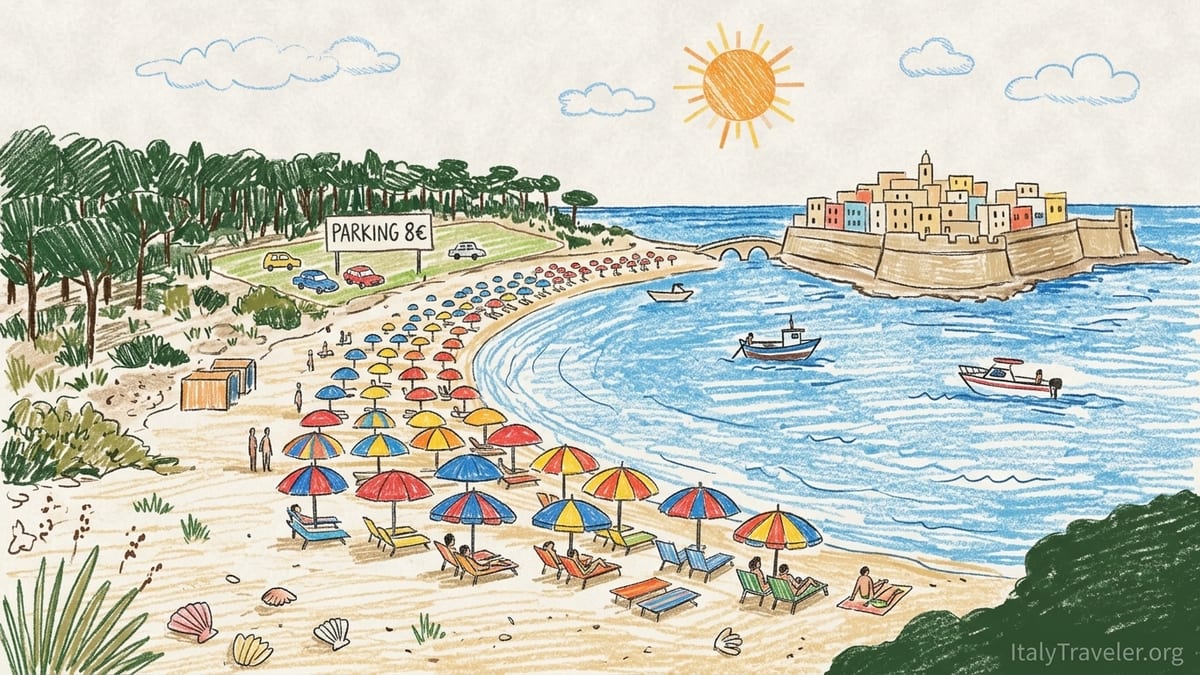
The first extra came before I saw the sea. The access road to Punta della Suina is lined with private parking areas and the official lot used by the lido. None of them displayed a detailed tariff when I arrived just after 9 a.m., but attendants quoted flat daily prices of between 7 and 10 euro depending on how close the space was to the path to the beach. I paid 8 euro in cash and received a handwritten slip for the dashboard. There was no public alternative nearby without a longer walk along the provincial road in full sun.
Once down at the beach, the numbers kept climbing quietly. Two coffees and two bottles of water at the bar cost 9 euro. At lunchtime, a salad, a panino with grilled fish and two soft drinks added just under 30 euro. During the afternoon heat, two bottled beers and an ice cream brought the total food and drink bill for the day to almost 45 euro. None of these prices were extreme by tourist standards, yet they built on top of the fixed beach-club fee.
When I added everything up that evening, the cost of that single day at Punta della Suina for two adults looked like this: 96 euro for umbrella and loungers, 8 euro for parking, 45 euro for food and drinks, and roughly 12 euro in fuel for the 40-kilometre round trip from my accommodation near Porto Cesareo. The total was about 161 euro. The sea was beautiful, the pines were fragrant and the staff were courteous, but the purely practical value of that expenditure, especially on a crowded pre‑Ferragosto day, was far from convincing.
How Prices Have Climbed: What the Data Says About Gallipoli
My personal bill was not a one-off. In late May 2026, consumer organisation Altroconsumo published its annual investigation into beach-club prices in Italy. Based on anonymous calls to 222 stabilimenti in ten seaside destinations, including Gallipoli, the group calculated that the national average for an umbrella and two loungers in the first four rows rose by about 6 percent compared with 2025, and by roughly 24 percent in the past five years. Within that picture, Gallipoli stood out with an estimated 10 percent year‑on‑year increase in 2026, one of the sharpest jumps among the surveyed locations.
Altroconsumo’s figures are weekly averages for the first week of August and refer to a standard configuration: one umbrella and two sunbeds in the first four rows. For Gallipoli in 2026, the investigation reported an average weekly cost in the low three hundreds of euro, putting the town among the most expensive seaside spots included in the study, ahead of well‑known Adriatic resorts and trailing only a handful of Ligurian and Sardinian locations. In parallel, other associations such as Codacons and Federconsumatori have highlighted that in some parts of Puglia, weekend daily tariffs for prime sea‑front positions can reach levels equivalent to 80 to 120 euro per day.
Local operators, however, have pushed back against the broad conclusions. In interviews with regional newspapers, several lido owners in Baia Verde and other parts of Gallipoli argued that they had not applied across‑the‑board increases in 2026. One owner insisted his list remained unchanged from the early post‑pandemic seasons, while another said that only specific services, such as private cabanas or spa‑style add‑ons, saw modest adjustments. Their objections underline an important nuance: no single investigation can perfectly capture the diversity of offers within a town, and not every stabilimento in Gallipoli has suddenly become extortionate.
Yet my experience at Punta della Suina and the price lists I saw elsewhere match the overall direction of the Altroconsumo findings. Daily rates close to or above 50 euro for standard umbrella‑and‑sunbed sets are no longer unusual at peak times in the most sought‑after bays around Gallipoli. Added to that are reservation fees, minimum‑spend requirements at some beach clubs and the multiplication of “premium” zones that push travellers towards the upper end of the price spectrum if they want shade and a front‑row view of the water.
Baia Verde, Lido Pizzo and the Hidden Costs of a “Simple” Beach Day
After my day at Punta della Suina, I decided to look more closely at how costs accumulate in other parts of the Gallipoli coastline. Baia Verde is marketed as the youthful, beach‑party heart of the town, a long curve of pale sand south of the centre where beach clubs play music until sunset and rows of umbrellas stretch almost uninterrupted. Along this lido‑lined shore there are interspersed stretches of free public beach, where you can put down your own towel at no charge. In theory, this makes Baia Verde a democratic option.
In practice, the choice between paying and staying free is shaped by several less visible costs. First is parking. With traffic restrictions along the seafront in high season, visitors in cars are pushed to pay‑and‑display areas or private fields that can easily cost between 4 and 15 euro per day depending on proximity to the sand and the time of arrival. Second is shade. On a typical August day, the unserved strips between beach clubs fill up quickly after 9 a.m., leaving latecomers with little chance of finding space for large umbrellas or family groups. Third is convenience: beach‑club clients enjoy dedicated toilets, showers, changing cabins and waiter service, while those on the free beach rely on limited public facilities or on consumption at kiosks and bars.
Further south, Lido Pizzo sits inside the Isola di Sant’Andrea and Punta Pizzo regional natural park, at the end of a pine forest that opens onto a low cliff and pockets of sand. Here the main private establishment operates in what feels like a more secluded, less urban setting than Baia Verde. For that privilege, prices again reflect the demand peaks of July and August. While weekly rates vary by row and month, daily tariffs in high season for an umbrella and two loungers can easily move into the 40 to 60 euro bracket for central positions, and more for first‑row options with wooden platforms and extra space. The official car park close to the entrance road is paid, and visitors who prefer free access must park further away along secondary routes and walk through the pine trees, often carrying bags, umbrellas and coolers in the heat.
My own calculations for a notional August Saturday for one adult in this part of the coast, using observed prices and Altroconsumo averages, look like this: around 40 to 60 euro for a standard lido set, 8 to 12 euro for parking, 15 to 25 euro for a light lunch and drinks at the bar, plus 5 to 10 euro for extra coffees, water and ice creams over the day. Even without including transport from your accommodation, the total easily lands between 70 and 100 euro for a “simple” solo beach day in Baia Verde or near Lido Pizzo. For couples, just double almost every line of that informal budget.
Beyond Gallipoli: Porto Cesareo, Torre Lapillo, Punta Prosciutto, Pescoluse and Torre San Giovanni
The pattern I observed in Gallipoli extends, with local variations, to other heavily promoted Salento beaches. Porto Cesareo and its satellite areas of Torre Lapillo and Punta Prosciutto appear in nearly every online ranking of Puglia’s best sands. They also sit inside a marine protected area, which has encouraged a dense network of beach clubs alternating with stretches of free beach. Here the range of prices broadens. Some basic stabilimenti advertise daily rates in the 15 to 25 euro band for an umbrella and two sunbeds in mid‑season, especially on weekdays, while more upgraded clubs in prime spots apply 40 to 60 euro in the heart of August.
Parking is again a decisive factor. Along the roads leading to Torre Lapillo and Punta Prosciutto, private car parks in olive groves or sandy lots have become small businesses in their own right. Local tourism guides point to 8 to 10 euro as a typical daily rate in summer for a guarded space within walking distance of the shore. It is not unusual to find offers of combined parking plus discount on rented umbrellas, an implicit acknowledgment that travellers are sensitive to the total combined cost of getting to the sea and staying there comfortably for a full day.
Further south along the Ionian side, Pescoluse, sometimes branded as the “Maldives of Salento,” and Torre San Giovanni near Ugento follow similar scripts. Long runs of sand are broken into alternating sections of public shoreline and commercial stabilimenti. In peak season, front‑row setups at the most photogenic clubs can reach figures in line with the higher Puglia examples mentioned earlier, in the 80 to 120 euro range for premium packages that may include reserved parking, welcome drinks or access to restricted lounge areas. It is important to stress that these premium rates are not universal, even in these locations. They coexist with more modest options and generous free stretches, but marketing images and social media posts typically highlight the most exclusive setups, conditioning expectations.
From a cost‑of‑holiday perspective, what matters is not just the singular day of indulgence at a high‑end beach club, but the effect of repeating that choice. A couple spending 5 days alternating between Gallipoli, Porto Cesareo, Pescoluse and Torre San Giovanni, consistently opting for private parking and mid‑range beach clubs with bar lunches, can easily spend between 600 and 900 euro purely on sunbeds, umbrellas, parking and casual food. For a family of four, those figures can rise to well beyond 1,000 euro, before counting accommodation, evening meals or any cultural excursions inland.
Public Shoreline Versus Beach Clubs: Understanding What You Pay For
The legal framework on the Italian coast is clear: the shoreline itself is public, and even where concessions exist, sections of free access must be preserved. Around Gallipoli, this means that in Baia Verde, along Lido San Giovanni, near Punta della Suina and towards Punta Pizzo, there are genuinely free stretches where you can spread a towel or plant your own umbrella without paying a cent to a stabilimento. The same holds in the long arcs of sand at Torre Lapillo, Punta Prosciutto and Pescoluse, where dune systems and low scrub separate the sea from inland roads.
What you buy when you pay a beach club is not the sea but a package of services that cluster conveniently around one spot. At a typical lido this includes a fixed, reserved area with umbrella and loungers, monitored by staff; lifeguard presence; toilets, changing cabins and showers; waste collection; and, at higher price points, extras such as beach‑side waiter service, lockers, play areas for children, massage gazebos or live‑music aperitivi at sunset. For families with young children, older travellers or anyone with limited mobility, these comforts can mean the difference between a pleasant day and an exhausting one.
On my Ferragosto‑weekend day at Punta della Suina, for example, the reserved loungers meant I did not have to arrive at sunrise to secure a patch of shade, nor guard my space when going for a swim. I could shower the sand off before getting back in the car and change into clean clothes. If I had chosen the free cove further along the same coastline, which I visited on another day, I would have traded that convenience for a shorter list of fixed costs, plus the effort of carrying all equipment by hand from a more distant, partly informal parking area.
The real problem arises when travellers feel that the stabilimento model has become the only practical option. In the busiest weeks of August, some clubs close online bookings days in advance, while beach‑front municipalities limit car access to central zones. The psychological effect is strong: a visitor arriving late in the morning, confronted with “full” signs at beach clubs and unaffordable or unavailable parking close to free stretches, can easily conclude that paying high lido rates is the necessary admission fee for experiencing Salento’s famous seas. Legally, this is not true. Logistically, during peak times, it can feel dangerously close to reality.
Ferragosto Crowds, Last‑Minute Bookings and the Price of Convenience
The week around 15 August concentrates many of these dynamics. In 2026, on the days around Ferragosto, I tried to book beach clubs in Baia Verde and near Porto Cesareo with less than 48 hours’ notice and repeatedly encountered “sold out” notifications for standard umbrellas. Only back‑row or side‑zone packages were available in some places, often at prices not dramatically lower than better‑positioned options. A few establishments required a minimum spend at their restaurant or bar in addition to the rental fee, justifying this with the pressure on their front‑line staff during the busiest turnover of the year.
On the ground, the mood in the car parks and along the access roads confirmed what the digital interfaces hinted at. By 9.30 a.m., attendants were waving cars into ever more distant lots, while queues formed at shuttle stops. Free beaches between the stabilimenti filled quickly, creating dense checkerboards of umbrellas where personal space and noise control disappeared. Some families I spoke to near Torre Lapillo said they had toyed with the idea of staying on a free section but moved to a lido primarily to secure shade and a slightly wider buffer between groups, accepting the additional expense almost as an inevitability.
For last‑minute travellers, this environment multiplies the cost of any impulsive decision. A couple arriving without a reservation in Gallipoli on 13 or 14 August might accept a remaining front‑row package at a fashionable club that pushes 100 euro or more for the day, rationalising it as a special‑occasion splurge. But the same couple, if properly informed and organised in June, could design their stay around mid‑week, non‑Ferragosto days in June or early July, when the same establishments publish much lower tariffs and when public transport options, such as regional trains and coastal shuttles, make it easier to reach decent free stretches without a car.
My regret, thinking back to that 161‑euro day at Punta della Suina, lies less in the absolute number and more in how little planning I had done. By travelling at the absolute peak of demand and confirming the reservation just a few days before arrival, I allowed price, crowding and lack of alternatives to dictate my choices. The same landscape, visited two weeks earlier or four weeks later, or approached with a detailed look at free‑access points and public transport timetables, would have yielded an entirely different cost profile and experience.
What a Beach Day Really Costs: Solo, Couple and Family Scenarios
To understand how these pieces fit together over a typical holiday, it helps to spell out three simple day‑trip budgets based on the prices I observed and on the ranges reported by consumer organisations in 2026. These are not precise formulas, but they give a realistic sense of scale. All examples assume high‑season days between late July and around 20 August.
For a solo traveller at a mid‑to‑upper‑range lido in the Gallipoli area or around Porto Cesareo, a likely breakdown could be: 35 to 50 euro for a sunbed and shared umbrella space, 8 to 12 euro for parking, 15 to 20 euro for a light lunch and drink, 5 to 10 euro for coffees, water and snacks through the day, and 8 to 12 euro in fuel if driving from a base within 30 to 40 kilometres. Put together, the total moves between roughly 70 and 100 euro for one person.
For a couple seeking a standard umbrella and two loungers in a well‑positioned row at a popular beach club in Gallipoli, Baia Verde, Punta della Suina or Pescoluse, 50 to 80 euro for the setup is a realistic band in peak season. With 10 euro for parking, 30 to 40 euro for two modest lunches and drinks, 10 to 20 euro for extra refreshments and 10 to 15 euro for fuel, a day’s total fairly sits somewhere between 110 and 160 euro. That range includes my own 161‑euro Punta della Suina day as an upper‑end reference, not as a universal rule.
For a family of four, with two adults and two children or teenagers, costs scale faster than many first‑time visitors anticipate. Beach‑club packages for four often involve either a more expensive large umbrella set or two standard umbrellas. In the Gallipoli and Porto Cesareo areas in August, that can mean 80 to 120 euro per day for shade and loungers alone at the more in‑demand clubs, again using high but real examples from the region, not fixed prices for every establishment. Parking for a larger vehicle can push towards 12 to 15 euro. Lunch, drinks and snacks easily run to 60 to 80 euro across the day, even without ordering full restaurant meals, and fuel can add another 10 to 15 euro. The total quickly approaches or exceeds 180 to 230 euro for a full‑service beach day.
By contrast, a family or couple willing to use free public shoreline, bring their own umbrellas and chairs and pack a picnic can drastically cut these totals. Removing the lido fee entirely and replacing lunch with supermarket supplies reduces the daily outlay mainly to parking, fuel and perhaps a couple of coffees or ice creams. Even with the same travel distances, such a strategy can bring a couple’s day down towards 40 to 60 euro and a family’s to 70 to 100 euro, at the cost of more preparation, earlier starts and fewer on‑site comforts.
The Takeaway
Looking back on my Salento summer, the services that felt genuinely poor value were not the existence of beach clubs themselves, but specific combinations of high prices, crowding and a sense of obligation. Paying nearly 100 euro for an umbrella and loungers at Punta della Suina made little sense on a day when sunbeds were so densely packed that I could hear my neighbours’ phone calls, and when the bar and facilities, although efficient, offered nothing significantly superior to less expensive stabilimenti along the same coast. Likewise, being charged close to 10 euro for unshaded parking on dusty ground, with no clear tariff exposed at the entrance, added to the impression of a system calibrated more for extraction than for hospitality.
There were, however, contexts in which a lido still made clear sense. On a breezy early‑September morning at a smaller, family‑run beach club near Torre San Giovanni, I paid under 30 euro for an umbrella and two loungers, parked for 5 euro in a shaded lot, and spent a further 20 euro on simple sandwiches and drinks. The structure was modest but clean, the staff knew most customers by name and the rows of sunbeds left generous space between groups. That day, the combined package of reserved shade, services and atmosphere felt reasonable and even welcome, removing logistical friction and allowing me to read, swim and rest without thinking about where to put my bag or whether the car was safe.
If I were to plan a cheaper Salento beach holiday now, I would start by shifting the calendar, avoiding the ten days around Ferragosto entirely and favouring late June or early September. I would map, in detail, the free public stretches near Baia Verde, Lido San Giovanni, Punta della Suina, Punta Pizzo, Torre Lapillo, Punta Prosciutto, Pescoluse and Torre San Giovanni, using local tourism offices and up‑to‑date regional guides rather than purely promotional social media posts. I would invest once in good foldable chairs, a solid beach umbrella and a cool box, and accept that on many days I would wake early to secure a spot on the free shoreline, using beach clubs sparingly for the occasional treat or for days when accompanying older relatives or small children.
Above all, I would treat the sea itself as the main attraction again, not the curated snapshot of a front‑row sunbed under a thatched parasol. Gallipoli and the rest of Salento still offer long, legally accessible stretches of coast where sitting on a towel and listening to the waves costs nothing more than the effort to get there. The real shift required is mental: recognising that the true luxury, in an era of 10 percent annual increases for umbrella and sunbed packages, may be a quiet cove, a packed picnic and the awareness of exactly what, and why, we choose to pay for when we head towards the water.
FAQ
Q1. Are beach clubs mandatory on Gallipoli and Salento beaches, or can I always use the shoreline for free?
Italian law treats the shoreline as public property, and around Gallipoli, Porto Cesareo, Torre Lapillo, Punta Prosciutto, Pescoluse and Torre San Giovanni there are always free-access stretches where you can sit without paying a beach club. What changes from place to place is how easy those sections are to reach, how early they fill up and how comfortable they feel at peak times.
Q2. How much should I realistically budget for a mid-August beach day for two in Gallipoli?
For a couple using a mid-range lido in Baia Verde, Punta della Suina or Lido Pizzo during high season, a realistic total is between about 110 and 160 euro, including umbrella and loungers, parking, simple lunch, drinks and fuel from nearby accommodation. Using a free beach and bringing your own equipment can reduce that figure by more than half.
Q3. Are the 80–120 euro daily prices for umbrellas and sunbeds common in Gallipoli?
Those higher figures exist in parts of Puglia, particularly for premium front-row packages at fashionable clubs in peak August, but they are not universal Gallipoli prices. In the Gallipoli area many stabilimenti charge less, especially outside Ferragosto and for back rows or midweek days.
Q4. What did Altroconsumo actually find about Gallipoli prices in 2026?
Altroconsumo’s 2026 investigation, based on 222 beach clubs in ten Italian locations, reported an average 6 percent national increase over 2025 and estimated about a 10 percent rise for Gallipoli, placing it among the more expensive towns surveyed. Individual operators in Gallipoli have disputed the generalisation, saying their own lists did not increase across the board.
Q5. When does it really make sense to pay for a lido instead of using the free beach?
A beach club can be good value if you need easy access to shade, toilets, showers and lifeguards, if you are travelling with young children or older relatives, or if you simply want a low-effort day without carrying much gear. Outside the Ferragosto peak and in less hyped locations, the price difference between a basic lido and a fully DIY setup narrows.
Q6. How bad are the Ferragosto crowds on Salento’s most famous beaches?
In the ten days around 15 August, Gallipoli, Porto Cesareo, Torre Lapillo, Punta Prosciutto, Pescoluse and Torre San Giovanni experience very dense crowds. Free stretches can fill by mid-morning, online reservations for beach clubs are often closed days in advance, and parking near the sand becomes expensive and competitive.
Q7. Can I avoid high parking costs near popular Salento beaches?
You can reduce parking costs by arriving very early, using more distant but still legal roadside spaces, or combining public transport and walking. Some municipalities, including Gallipoli, support seasonal shuttles and encourage trains and buses to limit private cars in coastal zones, but these services require advance checking and some flexibility in timing.
Q8. Is it still possible to find good value beach clubs in Salento?
Yes. Away from the most photographed spots and peak dates, many family-run stabilimenti near places like Torre San Giovanni or quieter sections of Porto Cesareo offer umbrella-and-sunbed packages in the 20 to 35 euro range, with reasonable parking fees and modest food prices. The key is to compare several options and, where possible, visit outside the busiest weeks.
Q9. How can a family with children keep costs down without sacrificing safety and comfort?
A practical approach is to alternate: use free beaches with your own equipment on several days, bringing picnics and plenty of water, and choose beach clubs only for selected days when you need extra convenience. Booking midweek, bringing reusable bottles and setting a clear snack budget all help keep total costs manageable while still enjoying some structured facilities.
Q10. If I’m planning a Salento holiday now, what is the single best way to avoid regrets about beach costs?
The most effective step is to plan both timing and locations in detail. Avoid the days around Ferragosto if possible, map free-access stretches near your accommodation, book any lido days in advance at transparent prices and arrive with your own basic equipment so that using a beach club is a choice, not a perceived obligation.