

Southern Italy’s coastline is a tapestry of cliff-backed coves, long sandy crescents and sleepy fishing villages that still feel blissfully local. Yet not every famous bay is ideal if you are chasing soft sand, easy swimming or a quieter day by the sea. This guide focuses on the best beaches in the Amalfi Coast, Puglia, Calabria, Sicily and Basilicata, with an eye on three things most travelers care about: sand quality, scenery and how crowded or calm each spot feels in real life.
How Southern Italy’s Coasts Compare
From the Tyrrhenian to the Ionian and Adriatic seas, Southern Italy’s beach experience changes dramatically from region to region. The Amalfi Coast is visually dramatic, with pebble and coarse-sand coves squeezed beneath vertical cliffs, reached by steep staircases and boat shuttles. Puglia and parts of Basilicata offer wider, flatter beaches with pale sand and shallow water, while Calabria and Sicily mix postcard-perfect coves with wilder stretches and protected reserves.
If you want long, sandy beaches and easy wading for children, focus on Puglia’s Salento peninsula, Calabria’s Coast of the Gods around Tropea and Capo Vaticano, Sicily’s San Vito Lo Capo and Fontane Bianche, plus the wide town beach in Maiori on the Amalfi Coast. Maiori’s shore, close to one kilometre of dark volcanic sand, is the longest sandy beach on Amalfi and is notably more spacious than the pebbly coves in Positano or Praiano.
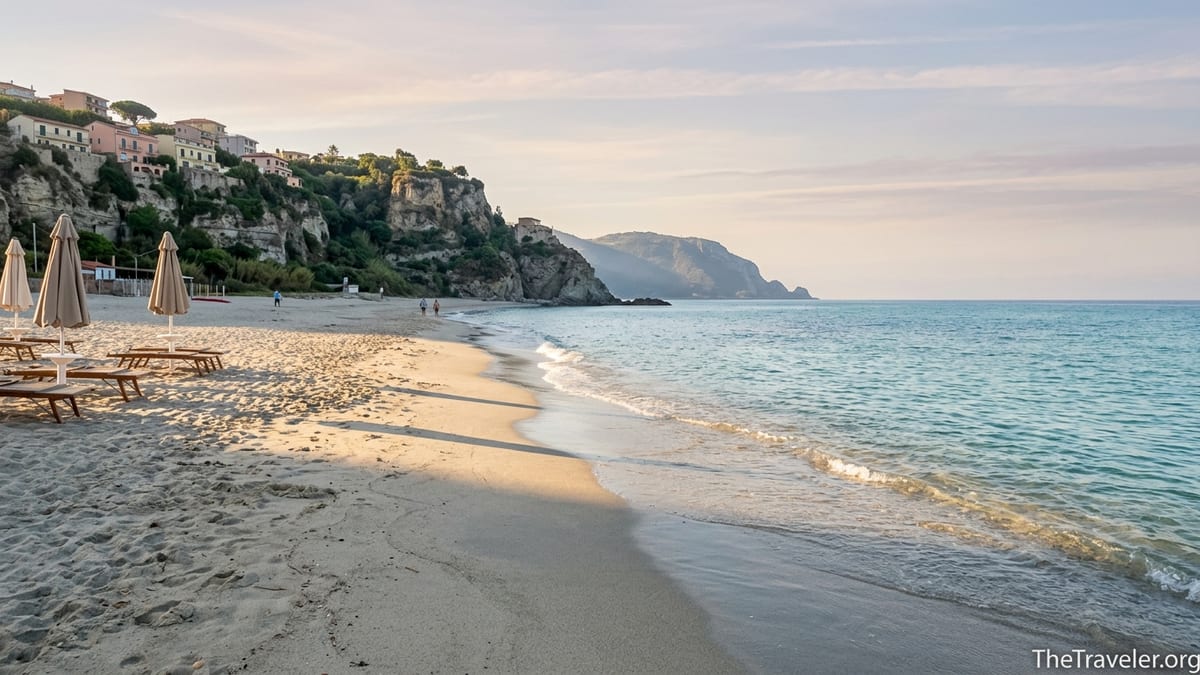
For scenery, Amalfi’s fjord-like inlets, Calabria’s granite promontories and Sicily’s mix of white sand backed by craggy headlands stand out. Tropea, perched on cliffs above sandy bays, and San Vito Lo Capo, a ribbon of white sand under the Monte Monaco massif, are both regularly cited among Italy’s most striking coastal landscapes. Puglia’s appeal is subtler: low dunes, olive groves and clear turquoise water that locals liken to the Maldives, especially around Pescoluse on the Ionian side of Salento.
On the question of crowds, assume that anywhere famous on Instagram will be very busy from late June through August. To find quieter escapes without sacrificing beauty, look for secondary towns next to star destinations: Minori instead of Positano, Marina di Zambrone instead of central Tropea, Macari and Santa Margherita bays just outside San Vito Lo Capo, and less-known access points along the Ionian coast between Otranto and Santa Maria di Lequile. Arriving before 9 am or after 5 pm can noticeably change your experience even on a busy beach.
Amalfi Coast: Small Beaches, Big Scenery
The Amalfi Coast is not a classic “lie on a huge sandy beach all week” destination, but it does have a few sandy options and some quieter pockets if you choose carefully. Maiori, east of Amalfi town, offers the coast’s longest sandy stretch, with family-friendly, gently shelving dark sand, public sections at the ends and several stabilimenti (beach clubs) renting two sunbeds and an umbrella typically from around 25 to 40 euros per day in high season. Minori next door has a smaller, more intimate sandy beach, popular with families who prefer a village feel and slightly lower prices.
Vietri sul Mare, at the eastern gateway to the coast, combines a ceramics-focused town with one of the region’s broader, sand-and-shingle beaches. It is a practical choice if you want easier road and train access from Salerno and a less rarefied atmosphere than Positano. Marina di Vietri’s main lido area is backed by casual seafood trattorie where grilled local fish and a carafe of house white wine can still feel reasonably priced compared with the more famous towns further along the coast.
If you are willing to trade sand for scenery, some of the coast’s signature spots are tiny coves under sheer cliffs. Marina di Praia near Praiano, the pebble cove of Fiordo di Furore under its arched bridge, and Conca dei Marini’s sheltered bay draw visitors more for dramatic surroundings and deep, turquoise water than for space to spread out. These beaches often have just a few narrow lines of sunbeds plus a sliver of free area, and in peak summer it is common for loungers to sell out by late morning.
For quieter escapes, consider basing yourself in Minori or Cetara rather than Positano or Amalfi town. These villages have their own small sandy or mixed-sand beaches, more locals than day-trippers, and good ferry connections so you can still reach the main sights. Even on the busier stretches, you can often escape by renting a small boat with skipper for a half-day, typically from around 120 to 180 euros for a couple or small group, and asking to visit lesser-known inlets that are accessible only from the water.
Puglia: Salento’s Sandy “Maldives”
Puglia is Southern Italy’s most reliable region for long, soft, family-friendly beaches, particularly along the Salento peninsula that separates the Ionian and Adriatic seas. On the Ionian side, Spiaggia di Pescoluse, often marketed locally as the “Maldives of Salento,” stretches in a wide, pale-gold arc with shallow, crystal-clear water and low dunes behind. Families like it because the sea stays shallow for many metres, making it easy for children to splash under supervision, and because a series of beach clubs and free-access patches provide choices for different budgets.
At Pescoluse, a pair of sunbeds and an umbrella in high summer can range from roughly 20 to 35 euros per day depending on proximity to the water and services such as showers and snack bars. Free sections between the clubs require bringing your own umbrella, but nearby parking fields, often run by locals, offer day rates that are usually cheaper than on the Amalfi Coast. Away from the busiest weekends in late July and August, weekdays in June or early September can still feel relatively relaxed, especially early or late in the day.
Further up the Ionian shore, the area between Gallipoli and Porto Cesareo is lined with sandy beaches and pine-backed dunes. Well known spots like Baia Verde and Punta della Suina can be lively, with music and aperitivo bars attracting a younger crowd, while sections closer to Torre Lapillo or the protected area of Porto Selvaggio tend to be quieter, especially if you are willing to walk a little from the nearest car park. On the Adriatic side, between Otranto and Torre dell’Orso, you will find a mix of long sandy sweeps and rocky coves with startlingly clear water.
Travelers looking for quieter escapes should focus on less built-up stretches just beyond major resort towns. For example, south of Otranto there are smaller access points to sandy coves with only a kiosk and simple parking, and between Marina di Ugento and Torre San Giovanni you will find dunes and low-key lidos without big hotels behind them. Arriving with a rental car opens up many of these options; rural roads can be narrow, but traffic is usually more manageable than along the Amalfi Coast, and paid parking is often in the range of 5 to 10 euros for the day in smaller lots.
Calabria: Coast of the Gods and Hidden Coves
Calabria’s Tyrrhenian coast between Tropea and Capo Vaticano, often branded as the Costa degli Dei or Coast of the Gods, is one of Southern Italy’s most rewarding areas if you want a balance of beautiful sand, clear water and comparatively fewer international visitors. Tropea itself sits high on cliffs above several sandy coves that can be reached by staircases and elevators from the historic center. The main town beach has fine, light-colored sand and dramatic views of the Santa Maria dell’Isola sanctuary on its rocky outcrop.
Just south of Tropea, the granite headland of Capo Vaticano shelters a series of small bays such as Grotticelle and Praia i Focu. Local and regional tourism bodies often describe these as among the most beautiful beaches in Calabria, with white sand, intense turquoise water and views across to the Aeolian Islands on clear days. Access can be via steep paths or boat shuttles, which naturally filter crowds compared with more urban strands. Simple beach clubs rent sunbeds often at slightly lower prices than in Campania, and small kiosks serve panini, granita and locally grown Tropea red onion dishes.
For genuinely quieter stays, look at bases such as Santa Maria, Zambrone or Ricadi, smaller hamlets scattered between Tropea and Capo Vaticano. Many family-run B&Bs and agriturismi here include access paths to semi-private feeling stretches of beach used mostly by guests and a handful of locals. Even in high summer, you are more likely to share the shoreline with Italian families on holiday than with coach tours, and outside August you may have large sections of sand almost to yourself during the week.
Calabria’s Ionian coast, on the opposite side of the region, offers very long, mostly undeveloped beaches of coarse sand and pebbles where you can walk for kilometres with little infrastructure. These are not as photogenic as the Coast of the Gods but are ideal if your priority is space and solitude rather than perfectly framed Instagram shots. As with other regions, a car is extremely useful, since public transport along the coast can be sparse and infrequent, especially on weekends and in the shoulder seasons.
Sicily: Iconic Bays and Protected Nature
Sicily is large enough to offer multiple beach personalities, from iconic resort towns to wilder reserves. On the northwestern coast, San Vito Lo Capo has a broad, white-sand beach roughly one and a half kilometres long, backed by a low-rise town and framed by the limestone bulk of Monte Monaco. The sand here is very fine, with some fragments of coral giving it a particular hue, and the shallow water makes it a favorite with families and Sicilian holidaymakers. In high season, organized lidos line much of the shore, and prices for a daily umbrella and two loungers are broadly in line with Puglia’s more popular spots.
Just beyond San Vito, the smaller bays of Santa Margherita and Macari are often described as quieter, natural inlets with sandy and mixed-sand beaches. Simple beach services, such as food trucks or seasonal kiosks, appear in summer, but there is noticeably less building and evening noise than in town. Adventurous travelers can also head into the nearby Zingaro Nature Reserve, where paths drop down to pebbly coves with unusually clear water suitable for snorkeling. These involve a hike and no formal facilities, so they are best approached with sturdy sandals, water and snacks.
On Sicily’s southeastern side, near Syracuse, Fontane Bianche is a well-known beach hamlet with pale, fine sand and shallow, calm water that is particularly suitable for children. Summer crowds of both locals and tourists can be intense in August, but in June and September it is possible to enjoy relatively relaxed days if you book accommodation within walking distance. South of here, the Vendicari Nature Reserve protects a string of beaches such as Marianelli and Calamosche, which are celebrated for their unspoilt character, dunes and lack of major development.
Vendicari’s beaches have limited services, typically just informal parking areas, a kiosk at some trailheads and perhaps a lifeguard in high season. Reaching the sand involves a walk of 10 to 20 minutes along paths that can be hot in mid-afternoon. In return you gain a far more tranquil setting than resort beaches, with space to spread out and water that is usually exceptionally clear. These spots, along with less-promoted stretches of the southern coast near Porto Palo di Capo Passero, are ideal for travelers who prioritize nature and quiet over nightlife and easy access.
Basilicata: Between Two Seas
Basilicata has only a sliver of Tyrrhenian shoreline around Maratea and a longer Ionian coast between Metaponto and Nova Siri. What it lacks in length it makes up for in variety. Maratea, sometimes called the “Pearl of the Tyrrhenian,” is a cliff-backed stretch dotted with small coves and mixed-sand beaches reached by staircases from the coastal road. The scenery here is dramatic, with forested mountains rising steeply behind the sea, but beaches are small and can feel crowded in August weekends despite relatively limited international tourism.
On the Ionian side, the coastline around Metaponto, Marina di Pisticci and Policoro offers broad, flat beaches of sand and fine gravel backed by pine forests and low, modern resorts. The atmosphere is family-oriented and practical rather than glamorous: many Italians from inland regions such as Basilicata and Apulia come here for affordable seaside holidays, renting apartments for a week or more. Beach clubs are less design-focused than those in Campania or Puglia but often charge slightly lower day rates for loungers and umbrellas, and free sections are usually generous.
For quieter escapes, look for accommodation in small agriturismi just inland from the Ionian shore, where you can reach the beach by car in ten to fifteen minutes but escape the evening buzz of the promenades. The flat terrain makes cycling feasible outside the hottest weeks, and some properties lend bicycles to guests. While the Ionian water here is usually calm and warm in summer, it can become choppy in windy conditions, so families with small children should keep an eye on local flags and lifeguard advice.
Basilicata’s beaches are less visually iconic than those of Amalfi or Sicily, but they are a strong option for travelers who want space, straightforward access by car and better value for money. They also pair well with inland visits to Matera or the Pollino National Park, allowing you to combine a cultural or hiking trip with several relaxed days by the sea without committing to an all-beach itinerary.
Planning Your Trip: Families, Beach Clubs and Quiet Corners
For families with younger children, the key factors are gentle entry into the water, available shade and nearby services. In that sense, Pescoluse and other Salento beaches on Puglia’s Ionian side, Fontane Bianche in Sicily, Tropea’s town beaches and Maiori or Minori on the Amalfi Coast stand out. All offer relatively calm water on typical summer days, options to rent umbrellas and loungers, and easy access to cafés, toilets and supermarkets just behind the promenade. Booking front-row loungers in advance where possible, especially in August, can save stress on arrival.
If your priority is scenery and swimming rather than sand underfoot, then the cliff-backed coves of Amalfi, the granite inlets of Capo Vaticano and the wilder bays inside Zingaro and Vendicari reserves should be on your list. These often require more effort to reach, through stairs, footpaths or short boat rides, and generally have limited space for free towels. Bringing water shoes can make entering over pebbles or rocks much easier, and a lightweight dry bag or waterproof phone case is useful when swimming in and out of small caves or rocky points.
Travelers specifically seeking quieter escapes should consider timing as much as location. Late May, June and late September are consistently calmer than July and August, with lower prices for accommodation and beach services. Within a single day, early morning and late afternoon will be cooler and less busy, ideal for travelers who prefer to avoid peak sun or crowds. Using a car or scooter unlocks dozens of second-row beaches: side-by-side with Tropea you have Marina di Zambrone and small Ricadi hamlets; just beyond San Vito sit Macari and Santa Margherita; south of Otranto or Torre San Giovanni you will find access tracks to far less frequented dunes.
Budget-wise, plan for a daily beach spend that can vary widely depending on your choices. A couple using free sections, bringing their own umbrella and buying picnic supplies from supermarkets might spend under 25 to 30 euros per day on food and parking in many parts of Puglia, Calabria or Basilicata, but considerably more if they rely on sit-down lunches in Amalfi or Capri. At the other end, a pair of premium loungers in a fashionable Amalfi Coast or San Vito beach club, plus lunch and drinks, can easily exceed 80 to 100 euros for the day. Balancing a few “treat” beach-club days with simpler, quieter ones in less expensive areas can help keep a longer trip affordable.
The Takeaway
Southern Italy offers a remarkable range of coastal experiences within a relatively compact area, from cliff-hugging Amalfi villages to the low-lying, dune-backed shores of Puglia and the wilder promontories of Calabria and Sicily. If your idea of a perfect beach day is soft sand, slow-building waves and plenty of space, Puglia’s Salento, Calabria’s Coast of the Gods and selected stretches of Sicily and Basilicata will likely suit you more than the constrained coves of Amalfi. If you care more about spectacular views and atmospheric towns, basing in the Amalfi Coast or Maratea, with day trips to nearby sandy options, can offer a satisfying compromise.
The practical differences between these coasts matter in real travel planning. Sand quality, depth of the water, presence of beach clubs and ease of access can shift your experience from tiring to effortlessly relaxing, especially if you are traveling with children or older relatives. By pairing famous names like Positano or San Vito Lo Capo with nearby, less publicized alternatives, and by traveling in shoulder seasons where possible, you can enjoy Southern Italy’s celebrated seas with more comfort and fewer crowds.
Ultimately, there is no single “best” beach in Southern Italy, only the right match for your priorities. Families may gravitate toward Pescoluse, Tropea or Fontane Bianche, couples toward quieter coves in Zingaro, Vendicari or Capo Vaticano, and first-time visitors toward the drama of Amalfi’s small but unforgettable bays. With a little research and flexibility, it is entirely possible to find sandy shores, clear water and peaceful corners that live up to the promise of the Mediterranean dream.
FAQ
Q1. Which region in Southern Italy has the best sandy beaches overall?
Puglia and Calabria generally offer the most consistent sandy beaches, especially Puglia’s Salento peninsula and Calabria’s Coast of the Gods around Tropea and Capo Vaticano.
Q2. Where should families with young children base for easy, safe swimming?
Families often do well in Maiori or Minori on the Amalfi Coast, Pescoluse or Torre San Giovanni in Puglia, Tropea in Calabria, and Fontane Bianche or San Vito Lo Capo in Sicily.
Q3. Are there quiet alternatives to Positano on the Amalfi Coast?
Yes. Minori, Cetara and Vietri sul Mare are typically quieter, with more local life, smaller sandy or mixed-sand beaches and easier access to ferries and buses.
Q4. When is the best time to visit Southern Italy’s beaches to avoid crowds?
Late May, June and late September usually offer warm sea temperatures, functioning services and significantly fewer crowds than July and August.
Q5. Do I need a car to reach the quieter beaches in Puglia and Calabria?
A car is not essential but is highly recommended, as many of the quieter and more scenic beaches sit beyond regular bus routes or require short drives down rural roads.
Q6. Are beach clubs worth paying for, or can I rely on free sections?
It depends on your comfort level. Beach clubs provide shade, loungers and facilities, while free sections cost nothing but require bringing your own gear and sometimes walking further.
Q7. Which Sicilian beaches combine scenery with relatively calm water?
San Vito Lo Capo, Fontane Bianche and the bays within the Vendicari reserve usually offer clear, swimmable water, with Zingaro’s coves adding particularly scenic backdrops for stronger swimmers.
Q8. Is the Amalfi Coast a good choice for a pure beach holiday?
Not usually. The Amalfi Coast excels in views, villages and boat trips, but most beaches are small and pebbly; sand seekers often add Puglia, Calabria or Sicily to their itinerary.
Q9. How expensive are sunbeds and umbrellas in Southern Italy?
Prices vary, but in high season expect roughly 20 to 40 euros per day for two loungers and an umbrella at many beach clubs, with top Amalfi and trendy Sicilian spots at the upper end.
Q10. Can I find truly unspoilt beaches without development?
Yes. Look to protected areas like Zingaro and Vendicari in Sicily, undeveloped stretches of Calabria’s Ionian coast, and quieter dune-backed sections in Salento away from the main resorts.