


If you only have one beach holiday to spend on Italy’s Adriatic coast, trying to drive from the Romagna Riviera all the way to Puglia in a week can feel ambitious at best and exhausting at worst. The eastern shore of Italy is long, diverse and surprisingly varied, from flat resort towns with shallow water to limestone headlands, pine-backed sands and cliff-hugging villages. Focusing on one section instead of chasing the entire coastline can give you a deeper, more relaxed experience. The real decision is not whether the Adriatic is worth it, but which part matches the trip you want.
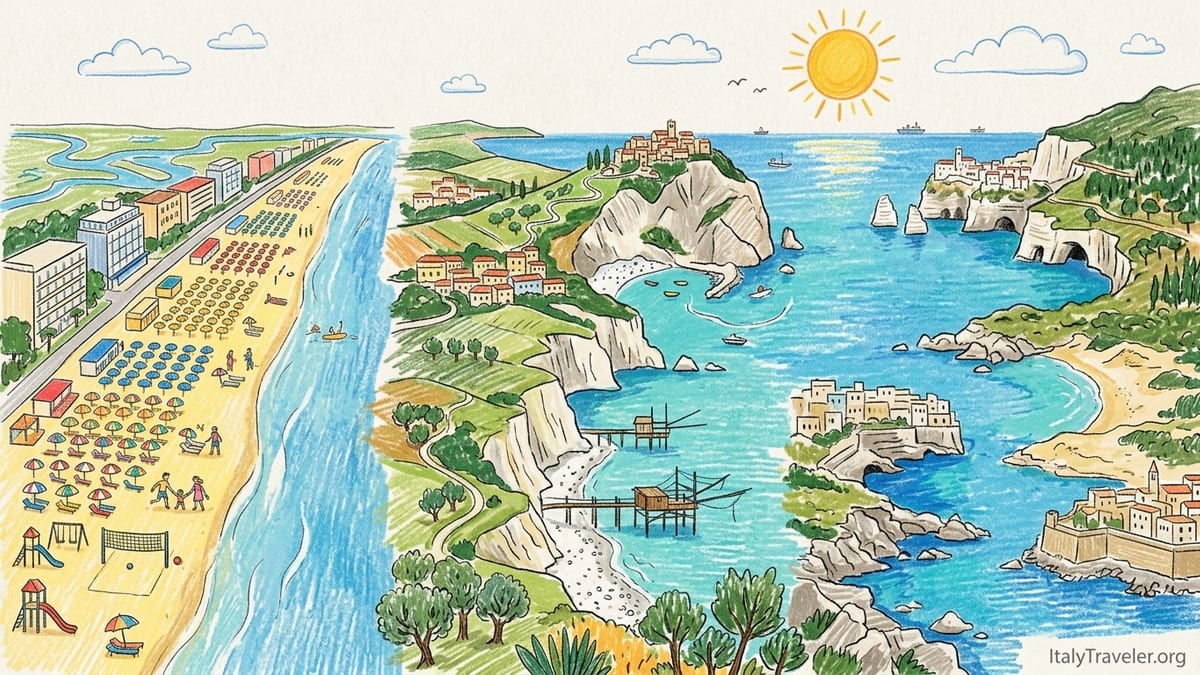
How the Italian Adriatic Coast Breaks Down
For practical trip planning, the Italian Adriatic coast falls into three distinct personalities. The Northern Adriatic runs roughly from the Po Delta through Emilia Romagna and southern Veneto down to the border with Marche, with resort towns such as Rimini, Riccione, Cattolica and Milano Marittima. Official tourism bodies often describe this stretch as the Riviera of Fun, highlighting long, flat beaches, shallow water and dense rows of stabilimenti balneari with sunbeds, play areas and pools designed around families and nightlife in equal measure.
Central Adriatic usually refers to the coast of Marche and Abruzzo, where the Apennines drop closer to the sea. Here you find a mix of pebble and sand, low-key resort towns like Senigallia, Grottammare and Giulianova, and the dramatic limestone cliffs of Monte Conero above Sirolo and Numana. South of Ancona, the Conero Riviera in particular looks and feels nothing like flat Romagna: white-pebble coves under sheer cliffs, hilltop historic centres and protected parkland just behind the shore.
Southern Adriatic is dominated by Puglia, with its 780 to 860 kilometres of coastline depending on how you count the Tremiti Islands and minor inlets. The region’s official tourism agencies emphasise just how varied this shore is, from the forested Gargano promontory in the north, with Vieste and Peschici perched above sea caves, to the low, limestone Salento peninsula around Otranto, Torre dell’Orso and Santa Maria di Leuca. Much of this coast feels wilder in shape, with rocky coves, karst cliffs and scattered sandy bays rather than one long uniform beach.
Because each zone has its own geography and tourism history, they now attract distinct crowds. Northern resorts are well known to Italian and European families, central stretches remain relatively under the radar for international visitors, and Puglia’s Adriatic, especially Gargano and Salento, has become a favourite for travellers who prioritise clear water, scenery and characterful coastal towns.
Beach Geography and Sea Conditions: Flat Sands vs Cliffs and Coves
The northern Adriatic is the easiest for anyone who wants classic, wide sandy beaches and gently shelving sea. Along the Emilia Romagna coast, resort platforms such as Cattolica and Riccione describe two kilometre long strands of fine sand with shallow water and lifeguard coverage that are marketed explicitly to parents with small children. The seabed generally deepens slowly, which means toddlers can paddle close to shore and even reluctant swimmers feel comfortable. Facilities are dense and consistent: showers, changing cabins, rental umbrellas, play areas, beach volleyball and beach clubs are lined up one after another.
Move into the central Adriatic and the shoreline grows more varied. Around Ancona, Sirolo and Numana on the Conero Riviera, limestone cliffs drop directly into the sea, creating coves such as San Michele, Sassi Neri and Due Sorelle accessed by steep paths or boat shuttles. Official guides highlight white pebbles and remarkably clear water at these beaches, a consequence of the rockier seabed and protection from heavy development. Further south in Marche and Abruzzo, sections such as the Trabocchi Coast between Ortona and Vasto mix shingle beaches, rocky platforms and shorter arcs of sand, often backed by low cliffs, rail lines and old wooden fishing structures reaching into the water.
In the south, Puglia’s Adriatic adds another level of contrast. The Gargano promontory, known as the spur of Italy, combines high, forested slopes with a scalloped coastline of bays, stacks and sea caves near Vieste, Mattinata and Peschici. South of Bari, the coast around Polignano a Mare and Monopoli is mostly rocky, with small coves cut into limestone terraces, while Salento’s Adriatic side near Otranto and Castro Marina is famous for clear, intensely coloured water and dramatic cliffs that drop straight into the sea. Sandy options do exist on the Adriatic side of Puglia, such as Torre dell’Orso or the protected dunes of Torre Guaceto near Brindisi, but travellers looking for long, flat sandy ribbons will find more choice either in northern Romagna or along Puglia’s Ionian shore.
Water clarity tends to improve as you move south, thanks to the rockier seabeds and fewer major river mouths. In practice, this means that swimmers who care about visibility for snorkelling or photography often gravitate to Conero and Puglia, while families who prefer easy wading and soft sand often feel happiest on the northern Romagna and Veneto beaches.
Who Each Region Suits: Families, Couples and Nightlife
For families, the northern Adriatic is the most straightforward choice. Emilia Romagna’s tourism boards actively market the Romagna Riviera as a nest for families, with environmental quality checks, fine sand, space between umbrellas and especially shallow water used as selling points. In towns like Cattolica or Milano Marittima you can find family-run inns, mid-range seafront hotels and full-service holiday villages, many of which bundle kids’ clubs, half board and beach packages. Large theme parks such as Mirabilandia between Ravenna and Cesenatico add rainy day and teenager-friendly options that you simply will not find on the wilder central or southern coasts.
Couples looking for romantic scenery and quieter evenings often prefer the central Adriatic or parts of Puglia. Hilltop Sirolo, overlooking Monte Conero’s cliffs, offers medieval streets, sea views and small pebble beaches that feel worlds away from the neon of Rimini. In Abruzzo and southern Marche, places like Grottammare Alta or the old town of Vasto provide historic centres perched above the sea with relaxed trattorie and promenade life rather than clubs. In Puglia, the walled old town of Otranto, the lanes of Polignano a Mare above its cove and whitewashed Vieste on Gargano deliver particularly atmospheric bases for sunset strolls and long dinners.
For nightlife, the scale and concentration are still strongest in the north. Rimini and Riccione are national symbols of summer partying, with beach clubs that transform into dance venues after dark and a dense grid of bars where aperitivo often blurs into late-night DJs. Nearby Milano Marittima has a more fashion-conscious scene with lounge bars and clubs oriented toward younger Italian and northern European visitors. Central Adriatic towns usually have a more low-key nightlife, centred around evening promenade walks, gelato and a handful of bars, while Puglia’s hotspots are more scattered. Gallipoli on the Ionian side is famous for big clubs, but on the Adriatic coast you will find a patchwork of beach bars and summer festivals rather than an unbroken strip of discos.
Travellers who want some nightlife without full-scale clubbing can split the difference by staying in a mid-sized town such as Senigallia, Pesaro or Pescara, where you get cocktail bars, concerts and lively seafronts in July and August, but the overall tone is still more local and relaxed than the northern party capitals.
Costs, Hotels and Practical Value
In broad terms, prices tend to be highest in the best-known northern resorts in peak season and in the most fashionable pockets of Puglia. In July and August, a mid-range seafront hotel with breakfast and access to a private beach club in Riccione or Rimini can cost significantly more per night than a comparable property a few blocks inland in a central Adriatic town. Many northern beaches charge for chair and umbrella rentals by the day or week, but they often offer family packages or seasonal deals that provide decent value if you plan to stay put and use the facilities heavily.
Central Adriatic destinations in Marche and Abruzzo can feel like a sweet spot between price and quality. Outside of the most famous Conero spots in high season, you often find better room rates for similar comfort, plus more space on the beach. Self-catering apartments a short walk from the sea in towns such as San Benedetto del Tronto or Pineto can be particularly good value for families or groups. Abruzzo’s quieter coastline, including parts of the Trabocchi Coast, offers modest family-run hotels and agriturismi slightly inland where dinner and breakfast add a strong food value to a beach stay.
In southern Puglia, prices vary widely depending on how close you are to global name towns and how concentrated the season is. In August, cliff-top rooms in Polignano a Mare or boutique hotels in Otranto’s old town command premium rates, especially if they offer direct sea access or views. However, if you base yourself in a less hyped inland village ten to fifteen minutes from the coast, you can often secure more spacious accommodation, such as a converted masseria or country B&B, at a lower nightly rate while driving to different coves by day.
Restaurant and daily costs follow a similar pattern. Eating on the seafront in major northern resorts almost always costs more than a trattoria a few streets back or an osteria in a less touristed central Marche town. Across all three regions, seafood is central and can be excellent, but prices for mixed grilled fish platters or crudo are generally higher in fashionable Puglian hotspots and in northern party towns than in under-the-radar Abruzzo or inland Marche.
Road Trips vs Car-Free Travel
If you plan to arrive without a car and rely on trains and buses, the northern Adriatic is by far the easiest section. The main coastal rail line runs frequently through Ravenna, Rimini, Riccione, Cattolica and Pesaro, and many stations are a short walk or quick bus ride from the beach. Regional buses supplement the trains, and airports at Bologna and Rimini offer seasonal links from across Europe. For a week of beach time without driving, choosing a medium-sized northern town with a station and good promenade, then exploring nearby resorts by local train, is smooth and stress free.
Central Adriatic travel without a car is still feasible but slightly more fragmented. Larger towns such as Ancona, Civitanova Marche, San Benedetto del Tronto, Pescara and Vasto have train stations on the main line, but many of the most scenic beaches require short bus rides, shuttle services or boat transfers. Reaching Conero’s signature coves such as Due Sorelle typically involves boat shuttles from Numana or Sirolo, while some cliff-backed beaches have steep paths unsuitable for travellers with limited mobility. This adds adventure and beauty but also complexity, so central stretches suit travellers who do not mind a mix of trains, buses, walking and occasional boat services.
Puglia’s Adriatic shore is ideal for a road trip. While there is a coastal railway connecting cities such as Foggia, Bari, Ostuni and Brindisi, many of the best coves, viewpoints and small towns lie between main stations or at the end of peninsulas. Driving the Gargano coastal road between Vieste and Mattinata, stopping at belvederes and small beaches, or following the Salento coastline from San Cataldo to Otranto and south to Castro allows you to hop between limestone coves and historic centres in a way that public transport cannot easily match. That said, car-free travellers can still enjoy base towns such as Bari, Polignano a Mare and Otranto using regional trains and buses for day trips, accepting that they will see fewer hidden spots than drivers.
Parking and traffic are also part of the equation. Northern resorts are used to high volumes of domestic visitors and typically have well organised parking areas just behind the seafront, though congestion around weekend peaks is normal. In Conero and Gargano, by contrast, summer drivers may find narrow, winding access roads and limited bay parking near the most photogenic beaches, making early starts or shuttle use important in July and August.
Beach Quality, Atmosphere and Crowds
When travellers talk about beach quality, they tend to mean slightly different things. For some, it is soft sand and easy access. For others, it is clear water, scenery and a sense of place. The northern Adriatic excels in comfort and infrastructure. Umbrella rows, playgrounds, pools, beach bars and showers are everywhere, and the beach surface is usually soft and level. This is ideal if you want to know exactly what you are getting and prefer not to think about logistics. The trade off is that truly wild feeling stretches are rare around major resorts, and crowded conditions in late July and August are the norm rather than the exception.
The central Adriatic balances facilities and nature. Conero’s beaches, many repeatedly awarded environmental quality marks, feel wild in shape even when serviced by beach clubs or shuttle boats. Pebble coves such as Sassi Neri or Mezzavalle, backed by parkland and reached by steep paths, will not suit everyone but reward effort with a more natural atmosphere and noticeably clear water. In Abruzzo, the Trabocchi Coast stands out for its blend of shingle beaches, greenery and historic fishing platforms, some converted into atmospheric seafood restaurants, which gives the shore a character that is hard to replicate on the more homogenised northern sands.
Southern Puglia’s best Adriatic beaches combine high scenic value with generally clear water. Gargano offers sandy bays such as Spiaggia di Vignanotica framed by white cliffs and pines, as well as rocky coves accessible by boat tours that explore sea caves around Vieste. Further south, Castro Marina and the stretch between Otranto and Santa Maria di Leuca feature deep blue water, grottos and platforms cut into the rock for swimming. These spots are unforgettable for confident swimmers but less convenient for families who need shallow entry and constant lifeguard coverage. Sandy exceptions like Torre dell’Orso or the protected dunes near Torre Guaceto offer more classic family beach days with the bonus of a relatively undeveloped backdrop.
As for crowds, the entire Adriatic gets busy from mid July to around the third week of August, particularly over the mid August Ferragosto holiday. However, the northern coast near major resorts feels the most intensely used, central Marche and Abruzzo towns see a more Italian family crowd with fewer overseas visitors, and Puglia’s load is concentrated in the best known beauty spots. Travellers who can come in June, early July or September generally find all three regions far more pleasant, with warm enough sea temperatures and easier last minute bookings.
Choosing Just One: Matching Regions to Different Travelers
For first time beach travellers to Italy who want an easy, low stress week with children, the northern Adriatic is hard to beat. Towns like Rimini, Riccione and Cattolica provide everything on the doorstep: train access, multiple hotel categories, beach clubs that loan toys and organise kids’ activities, and plenty of rainy day options from aquariums to amusement parks. If you like to unpack once and settle into a comfortable routine between sea and promenade without worrying about transport, this is the best fit.
If you are a couple or group of friends who enjoy a mix of sea, scenery and small historic towns without intense nightlife, the central Adriatic delivers. Basing in Sirolo or Numana on the Conero Riviera, in a coastal Marche town like Senigallia, or in Abruzzo around Vasto or the Trabocchi Coast gives you access to interesting day trips inland, varied beaches and a more local atmosphere. This is also a smart choice for travellers who have already visited Tuscany or the Amalfi Coast and now want something less internationally famous but still beautiful.
For travellers who prioritise clear water, photogenic limestone coves and strongly distinctive coastal towns, southern Puglia stands out. A road trip that strings together Vieste and Peschici on Gargano, Polignano a Mare and Monopoli near Bari, and the Otranto and Castro stretch in Salento can feel like a highlight reel of coastal Italy. You will trade some logistical simplicity and possibly pay more for peak season waterfront rooms, but the variety of scenery and the quality of swimming and coastal walks can be remarkable.
If you only have a week, trying to drive from Rimini to Otranto will add many hours on the motorway and constant packing and unpacking. In that scenario, it is wiser to choose the zone that best matches your priorities, accept that you cannot see it all, and lean into depth over distance. You can always return for a dedicated week in a different section on a future trip.
The Takeaway
The Italian Adriatic is not one uniform beach but three quite different coasts stitched together. In the north, the Romagna and Veneto shores are flat, sandy and built for classic resort holidays with children, complete with shallow water, big hotels and a near continuous strip of beach clubs and entertainment. Central Marche and Abruzzo offer a more varied and often quieter mix of cliffs, pebble coves and relaxed towns that still remain relatively unknown to many international visitors. Southern Puglia, from Gargano down to Salento, trades uniformity for drama, delivering limestone coves, clear water and historic towns that reward travellers willing to move around a little more.
Choosing the best part of the Adriatic comes down to honest priorities. If you want easy logistics, sand underfoot everywhere and zero planning beyond picking your preferred beach club, the northern Adriatic will serve you well. If you like hiking, boat trips to hidden coves and evenings in small, characterful towns, the central coast and Conero are a natural fit. If your ideal holiday is a road trip between cliff-backed bays and whitewashed old towns with turquoise water below, then southern Puglia’s Adriatic should sit at the top of your list.
Whichever zone you pick, focusing on a single stretch rather than racing down the entire coastline will make your trip more relaxed. The Adriatic is long and diverse enough to justify several different holidays over the years. Starting with the region that best matches your travel style is the smartest way to fall in love with Italy’s eastern shore.
FAQ
Q1. Which part of the Adriatic coast is best for families with young children?
For young children, the northern Adriatic around Rimini, Riccione and Cattolica is usually best, thanks to wide sandy beaches, shallow water, lifeguards and extensive family facilities.
Q2. Where is the clearest water on Italy’s Adriatic coast?
Water clarity is generally best around the Conero Riviera in Marche and along Puglia’s Gargano and Salento coasts, where rockier seabeds and limestone cliffs create very transparent conditions.
Q3. Is the central Adriatic a good choice if I want fewer crowds?
Yes, central stretches in Marche and Abruzzo often feel calmer than the big northern resorts and the trendiest parts of Puglia, especially outside the mid August holiday period.
Q4. Do I need a car to enjoy Puglia’s Adriatic coast?
You can visit larger towns like Bari, Polignano a Mare and Otranto by train and bus, but a car makes it much easier to reach coves, viewpoints and smaller beaches along Gargano and Salento.
Q5. Can I visit both the northern and southern Adriatic in one week?
It is technically possible but involves long motorway drives and frequent hotel changes. Most travellers enjoy their holiday more by focusing on one section per week.
Q6. Are there good options for a car free beach holiday on the central Adriatic?
Yes, towns such as Ancona, Civitanova Marche, San Benedetto del Tronto and Pescara have train stations and nearby beaches, though reaching some of the most scenic coves may require local buses or boats.
Q7. How do prices compare between Romagna and Puglia in peak season?
In July and August, popular northern resorts and fashionable Puglian towns can both be expensive, but you may find better value in central Adriatic towns or inland bases a short drive from the coast.
Q8. Which area is best for combining beaches with historic towns and villages?
All three offer history, but the central Adriatic around Conero and the southern Adriatic in Puglia are particularly strong for pairing beaches with hilltop villages and characterful old towns.
Q9. When is the best time to visit the Adriatic coast to avoid crowds but still swim?
June, early July and September usually offer warm sea temperatures with fewer crowds and more reasonable prices across the northern, central and southern Adriatic.
Q10. Is the Adriatic coast suitable for travellers who prefer natural, undeveloped beaches?
Yes, but you should look beyond the main northern resorts. Conero’s coves, Abruzzo’s Trabocchi Coast and many stretches of Gargano and Salento offer a more natural, scenic feel.