

For many families, the Italian lakes are that dream combination of safe swimming, mountain views and gelato at every turn. Yet not all lakes work equally well with buggies, nap schedules and children who want a beach in the morning and a castle or theme park by afternoon. This guide compares Lake Garda, Lake Como, Lake Maggiore, Lake Iseo and Lake Orta specifically from a family perspective, with Lake Garda as the benchmark many current guides consider the strongest all-round choice for a first lake holiday with kids.
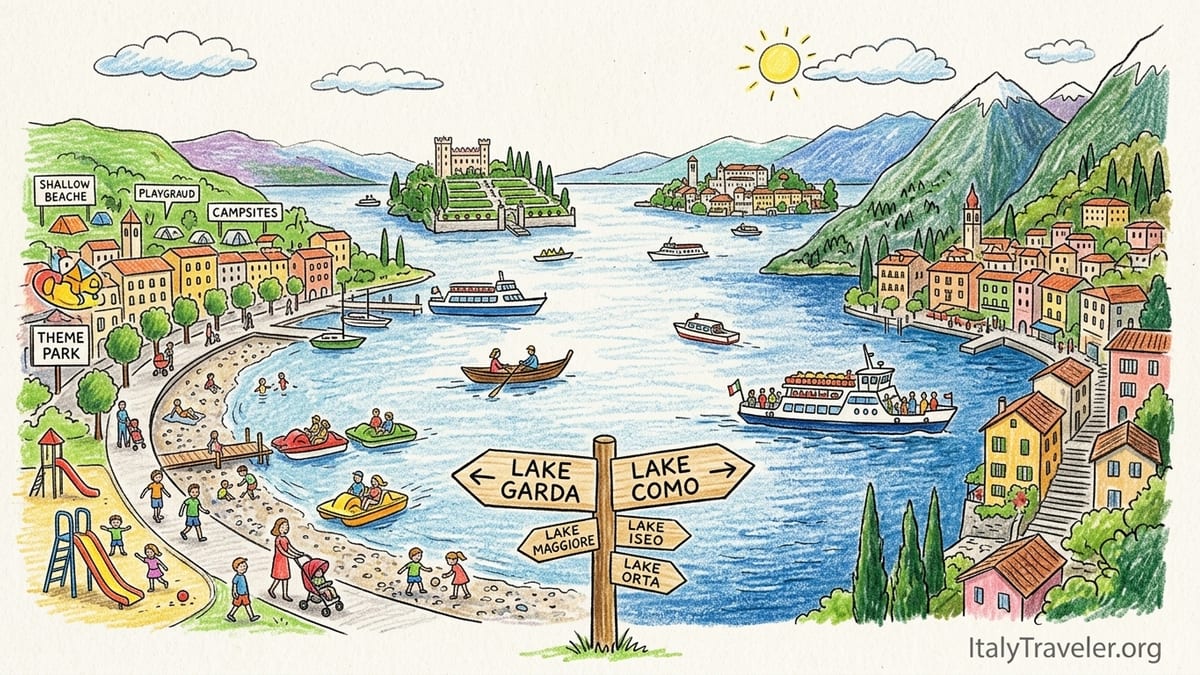
How the Italian Lakes Compare for Families
If you picture flat lakeside promenades, playgrounds next to beach cafés and straightforward ferries, you are mostly picturing Lake Garda. The southern shore around Peschiera, Lazise and Bardolino has become a major family hub, with shallow pebble beaches, stroller-friendly paths and the largest cluster of family hotels and campsites anywhere on the Italian lakes. Several current family travel guides note that this concentration of infrastructure makes Garda the most forgiving option with young children.
Lake Como feels very different. Its famous views are created by steep mountains dropping into deep water, so many towns are built on hillsides, with stepped lanes and smaller, often paid lidos for swimming rather than long public beaches. For a family that wants dramatic scenery and relaxed ferry days to pretty villages such as Bellagio, Varenna and Menaggio, Como is wonderful, but it does require more planning with strollers and car access.
Lake Maggiore sits between the two in character. The water is deep and the scenery grand, but bases like Stresa and Baveno are gentler than Como’s steepest villages and are well connected by ferries. Maggiore’s trump card with children is its trio of Borromean Islands, where you can mix short boat rides with castle-like palaces and terraced gardens that feel like real-life storybooks. Meanwhile, smaller Lake Iseo and tiny Lake Orta are quieter, with fewer formal attractions but very appealing if your vision is lakeside apartments, simple beaches and short, slow days with older children who do not need playgrounds on every corner.
In realistic driving terms, all five lakes sit within roughly 1 to 2 hours of Milan’s airports in good traffic. Garda’s southern shore is usually under 30 minutes from Verona’s airport. Como, Maggiore, Iseo and Orta work very well as legs on a wider northern Italy or Switzerland trip, but if this is your main family holiday and you want the easiest mix of sand, slides and sightseeing without long transfers, Garda generally comes out ahead.
Lake Garda: The Most Complete All-round Family Choice
South Lake Garda is effectively built around family holidays. Along the stretch between Peschiera del Garda and Lazise you will find Italy’s largest theme park, Gardaland, plus the combined CanevaWorld Resort, with Movieland and a major water park that has wave pools, lazy rivers and big slides for teens alongside shallow play areas for younger children. These parks sit within 10 to 20 minutes by car of many lakeside towns, so you can sleep by the water and still be through the gates when they open in the morning.
Swimming infrastructure is unusually good for an Alpine lake. In Peschiera, Lazise, Bardolino and Garda town, stony but shallow beaches run right off flat promenades. Many have small playgrounds, pedal-boat and SUP rentals and casual pizzeria-bars where a family can order a round of pizzas and a carafe of house wine without feeling out of place in swimwear. Visit in summer and you will see local families wheeling prams down to the water after dinner, children paddling until late because the lake keeps its warmth.
Accommodation choice is another reason Garda suits mixed-age groups. Classic family hotels such as Parc Hotel Gritti in Bardolino offer interconnecting or family rooms, big pools and kids’ menus. Upscale campsites and holiday villages on the south and west shores combine mobile homes or bungalows with on-site water parks, mini-clubs and evening shows. It is increasingly easy to find serviced apartments within walking distance of a beach, which helps with young children who need early bedtimes and simple meals cooked on-site.
Garda’s transport works in families’ favour too. Car seats are legally required for children under 12 or below the height limit if you are driving, and hiring a car at Verona or Bergamo airports is the simplest option if you expect to visit theme parks and explore multiple towns. However, many families happily manage without a car by basing in a ferry hub like Peschiera or Garda town, walking the promenades and using the lake’s regular boat services to reach towns like Sirmione, Bardolino and Desenzano. With luggage and strollers, it is often worth pre-booking a private transfer from the airport that can provide appropriate child seats rather than relying on taxis that may not be equipped.
Lake Como: Iconic Scenery and Classic Ferry Days
Lake Como excels at slow scenic days that combine boat rides, villa gardens and lakeside promenades. The central triangle between Varenna, Menaggio and Bellagio is especially suited to families because frequent car and passenger ferries link the three, so you can base in one town and take short 15 to 20 minute rides to the others. Children tend to love standing at the railings watching the ferries dock, and the travel time is short enough to fit around naps or low-energy afternoons.
Family-friendly swimming exists here, but it often means lidos rather than open, free beaches. Lido di Menaggio, for example, offers a lakeside pool, access to a small beach area, sun loungers and a children’s play section for a daily fee. In Bellagio and Varenna you will also find small playgrounds tucked beside the water and pay-on-entry lakeside clubs where you can secure shade, changing rooms and toilets. This set-up can be very comfortable with older kids, but it is less convenient if you are carrying lots of gear or want to come and go freely through the day.
Accommodation on Como skews more towards hotels and apartments in historic buildings. In Bellagio or Varenna it is common to find self-catering apartments up stepped lanes, sometimes without lifts. These are atmospheric but can be challenging with a buggy. If you need parking and easy stroller access, consider slightly flatter bases like Menaggio or towns along the western shore such as Tremezzina, where more modern lakeside hotels and apartment complexes come with pools and on-site parking.
Como’s train connections make it practical for families travelling by rail. Varenna-Esino station on the east side connects to Milan in around an hour, so you can avoid driving altogether. Car seats are still needed for any taxi rides, and some parents bring compact travel boosters for occasional transfers. For day trips, think in simple triangles: one day focusing on Varenna and a ferry hop to Bellagio, another looping Menaggio and a lakeside walk, rather than trying to see the whole lake in one long lap.
Lake Maggiore: Islands, Gardens and Gentle Lakeside Towns
Lake Maggiore feels spacious, with wide mid-lake views and a chain of family-friendly towns on its western shoreline. Stresa is the most popular base for families, and it works especially well because of its easy access to the Borromean Islands. From the waterfront, frequent motorboats and ferries shuttle visitors to Isola Bella, Isola dei Pescatori and Isola Madre, often on hop-on hop-off style tickets that allow you to decide how long to spend on each island.
With children, this setup creates a very manageable day out. You might spend the morning exploring the palace and formal terraces of Isola Bella, which feel like a film set of fountains, staircases and peacocks, then move on to Isola dei Pescatori for a simple lunch in a trattoria overlooking the water. In the afternoon, families who enjoy gardens can wander the shady paths and lakeside lawns of Isola Madre, where the botanical gardens and free-roaming birds hold children’s attention better than you might expect.
Back on the mainland, Stresa and Baveno offer flat promenades, small playgrounds and a mix of mid-range hotels and family-owned guesthouses. Many hotels here have lakeside pools, which are valuable because Maggiore’s beaches are more fragmented and tend to be pebbly. In summer, simple lake clubs with sunbeds and snack bars open along the shore, but you should not expect the continuous chain of beaches that Garda offers.
Getting around is straightforward by car or boat. Driving from Milan Malpensa airport to Stresa typically takes about an hour in reasonable traffic, and most hotels offer paid parking. Car seats are required by law for children, and local police do enforce this on the motorways. Once settled, you can largely rely on ferries and foot. For day trips, many families spend one full day on the islands, another taking a cable car into the hills for views, and perhaps a short drive up the shore for quieter beaches near Verbania.
Lake Iseo: A Quieter Alternative With Room to Breathe
Lake Iseo is smaller and quieter than Garda, and for some families that is the main appeal. The main town of Iseo has a pleasant lakeside promenade, a central piazza with cafés and regular ferries across to Monte Isola, the large, car-free island in the middle of the lake. A typical family day here might involve a morning ferry to the island, a gentle walk or short bike ride along its narrow lanes and a lakeside lunch, followed by swimming at one of the simple local beaches.
You will not find major theme parks or long strips of formal lidos here. Instead, the family experience revolves around lake access and village life. Many of the beaches around Iseo and nearby Sulzano are informal stretches of grass and pebbles with a bar and playground. Families often base themselves in self-catering apartments or small hotels that include access to a garden and pool, which allows children to swim safely even when the lake is choppy.
Iseo works particularly well if you combine the lake with the nearby Franciacorta wine region and the city of Brescia. Realistic day trips by car include an afternoon in Brescia’s historic centre or a loop through vineyard villages, with plenty of agriturismo restaurants that welcome children. Driving from Milan Bergamo airport to Iseo typically takes under an hour, making it a simple first stop on a wider itinerary.
Without big-ticket attractions on the doorstep, the lake naturally encourages slower days. This can be ideal with school-age children who are happy with a mix of swimming, paddleboarding, gelato runs and card games on the terrace. If you have teenagers who crave water slides and late-night buzz, you might find Garda better suited, but for younger children or families who travel regularly and want something low-key, Iseo is an attractive alternative.
Lake Orta: Compact, Calm and Ideal for Short Stays
Lake Orta is often described as Italy’s quietest major lake, and this scale works strongly in favour of families looking for a short, relaxed stay. The main village, Orta San Giulio, sits on a small peninsula with cobbled streets and a central square leading down to the water. The old town is mostly traffic-free, so older children can move more independently between the gelato shop, the square and the waterfront under a parent’s eye.
From the main quay, frequent small boats shuttle across to the tiny island of San Giulio, where families usually make a short loop on the encircling lane before returning. Above Orta San Giulio, the wooded hill of Sacro Monte offers a network of stroller-manageable paths between chapels, with views back over the lake and plenty of shaded spots for picnics during hot afternoons.
Swimming infrastructure on Orta is more modest than Garda’s but surprisingly varied for a small lake. On the shore near Orta San Giulio there are simple public lake access points, while along the western and northern sides you will find signed beaches with grassy banks, shallow entry and a bar or kiosk. Local apartments and villas often highlight direct lake access or a shared garden with a small beach, which can be a major plus with confident swimmers.
Because Orta is compact, day-trip distances are short. Driving from Milan Malpensa airport to Orta usually takes a little over an hour, and once you are parked on the edge of town you can comfortably manage on foot and by boat. Families often pair a three-night stay here with a longer base on Lake Maggiore or in the Alps. It is common to spend one day exploring Orta and San Giulio, another walking the lakeside paths and small beaches, and a final day visiting a nearby attraction such as a mountain cable car or a family-friendly spa with pools.
Accommodation, Beaches, Playgrounds and Practicalities
When choosing between the lakes, think first about the kind of accommodation that suits your family. Garda offers the broadest range of family hotels, lakeside resorts and serviced apartments, many with kids’ clubs, splash pools and evening entertainment. Maggiore and Como lean more heavily on traditional hotels and independent apartments, often without formal kids’ facilities but with strong locations and character buildings. Iseo and Orta have fewer large properties but a good number of self-catering apartments and small hotels where you get to know the owners personally.
Beaches and playgrounds vary just as much. The southern shore of Garda is almost continuous promenade, with regular public beaches, some paid lake clubs and playgrounds set back from the water. Como’s public access points are more scattered, so you may rely on lidos with entry fees, though many have slides, baby pools and snack bars that justify the cost for a full day. On Maggiore, expect a mix of pebble coves and small lakeside clubs. Iseo and Orta often have simple grassy areas by the water rather than developed lidos, which can be perfect for picnics but offer fewer built-in amusements.
Transport logistics are manageable if you keep distances realistic. Around Garda, driving between major family hubs like Peschiera, Lazise and Bardolino rarely takes more than 30 to 40 minutes, though traffic in July and August can double that. On Como, the lake’s shape means that driving from one arm to another can take over an hour, so it is usually more efficient to pick a base in the central area and rely on ferries for day trips. Maggiore, Iseo and Orta all benefit from compact clusters of villages within easy reach of one another, but mountain roads can be winding, so build in extra time.
Regarding car seats, Italian law requires appropriate child restraints based on age and height, and police do carry out checks on highways and at toll booths. When booking car hire, explicitly reserve the size of seat you need and confirm it on arrival, or consider bringing your own if that feels more secure. For shorter trips or if you prefer to skip driving, it is worth arranging private transfers in advance that commit to supplying suitable seats, particularly for airport runs with babies and toddlers.
The Takeaway
All five of these Italian lakes can deliver a memorable family holiday, but they serve different temperaments and stages of family life. Lake Garda stands out as the most complete all-round option, with beaches, promenades, theme parks and family-specific accommodation clustered within short drives. It tends to suit first-time visitors, families with children of mixed ages and anyone who wants the security of built-up infrastructure, from water parks to walk-in medical centres.
Lake Como is more about atmosphere and views than theme parks, rewarding families who enjoy wandering historic lanes and breaking up the day with short ferry hops. Lake Maggiore’s islands and gardens add a storybook layer of palaces and peacocks to otherwise relaxed lakeside days. Lake Iseo offers breathing space and a more local feel, while Lake Orta distils the lake experience into a compact, car-light base that works particularly well for shorter, slower stays.
Choosing the right lake is less about finding a single “best” option and more about matching your family’s energy levels, interests and travel style to the right setting. Consider whether you need playgrounds on the doorstep or are happy with a jetty and a stack of books, whether you want to tick off theme parks or islands, and how much time you are willing to spend in the car. Then build an itinerary that keeps day-trip distances short, sleep simple and the promise of gelato always just around the corner.
FAQ
Q1. Which Italian lake is best for a first family holiday?
Lake Garda is generally the strongest all-round choice for a first family holiday, thanks to its combination of shallow beaches, promenades, theme parks, frequent ferries and a dense range of family-focused hotels, campsites and apartments on the southern and eastern shores.
Q2. Is Lake Como suitable for families with toddlers and strollers?
Lake Como can work with toddlers, but you need to choose your base carefully. Towns like Menaggio and parts of Tremezzina are flatter and more stroller-friendly than steep villages such as Bellagio’s upper lanes or hillside hamlets, and you will likely rely on lidos with facilities rather than long public beaches.
Q3. Are there sandy beaches on the Italian lakes?
Most lake beaches are pebbly or grass rather than sandy. Lake Garda’s southern shore has the longest stretches of gently shelving beach, some with imported sand, while Como, Maggiore, Iseo and Orta tend to offer smaller pebble coves, grassy banks and managed lidos with pools and lake access.
Q4. Do I need a car for a family trip to the lakes?
A car gives maximum flexibility, especially on Lake Garda and Iseo, but it is not essential everywhere. On Como and Maggiore you can base yourself in well-connected towns such as Varenna, Bellagio or Stresa and rely largely on ferries and trains, using private transfers with car seats for airport journeys if needed.
Q5. How many days should we spend at Lake Garda with kids?
With children, 5 to 7 nights at Lake Garda works well. This allows time for two or three beach or pool days, one day at Gardaland or another park, a ferry-based sightseeing day to towns like Sirmione or Malcesine and some built-in flexibility for weather or tired legs.
Q6. Which lake is best for a quiet trip with school-age children?
Lake Iseo and Lake Orta are both strong choices for quieter trips. They have fewer big attractions and less nightlife, but offer relaxed villages, simple beaches, opportunities for easy hikes and bike rides, and a more local, small-scale atmosphere that suits families happy with low-key days.
Q7. Are the theme parks around Lake Garda suitable for younger kids?
The parks around Lake Garda are designed for a wide age range. Gardaland and Movieland include gentler rides, shows and themed areas for younger children, while Caneva’s water park offers shallow play zones and smaller slides alongside more intense attractions for teens and adults.
Q8. How easy is it to use ferries with children and strollers?
On all the major lakes, ferries are widely used by families. Most main docks have ramps suitable for strollers, crew are used to helping parents on and off, and sailings between nearby towns usually take between 10 and 45 minutes, which is manageable for most children.
Q9. Can we visit more than one lake in a single trip?
Yes, many families combine lakes, especially those close together such as Maggiore and Orta or Garda and Iseo. With children, it is usually best to limit yourself to two bases and plan transfers of 1 to 2 hours rather than trying to sample all five lakes in one itinerary.
Q10. What is the best time of year to visit the Italian lakes with kids?
Late May to June and September are often ideal, with warm weather for swimming and fewer crowds than peak summer. July and August bring reliably hot temperatures and full services, but also higher prices, busier beaches and heavier traffic, so advance booking is essential if you travel in school holidays.