


Puglia’s coastline stretches for more than 800 kilometers, but travelers usually end up facing a simple question with complicated implications: should you base yourself in Gargano or in Salento, and pick the Adriatic or Ionian side for your beach days? This guide looks past postcard photos to compare specific stretches of coast, beach by beach, focusing on sea conditions, access, facilities, costs and conservation rules so you can choose the coast that actually fits how you like to spend a day by the sea.
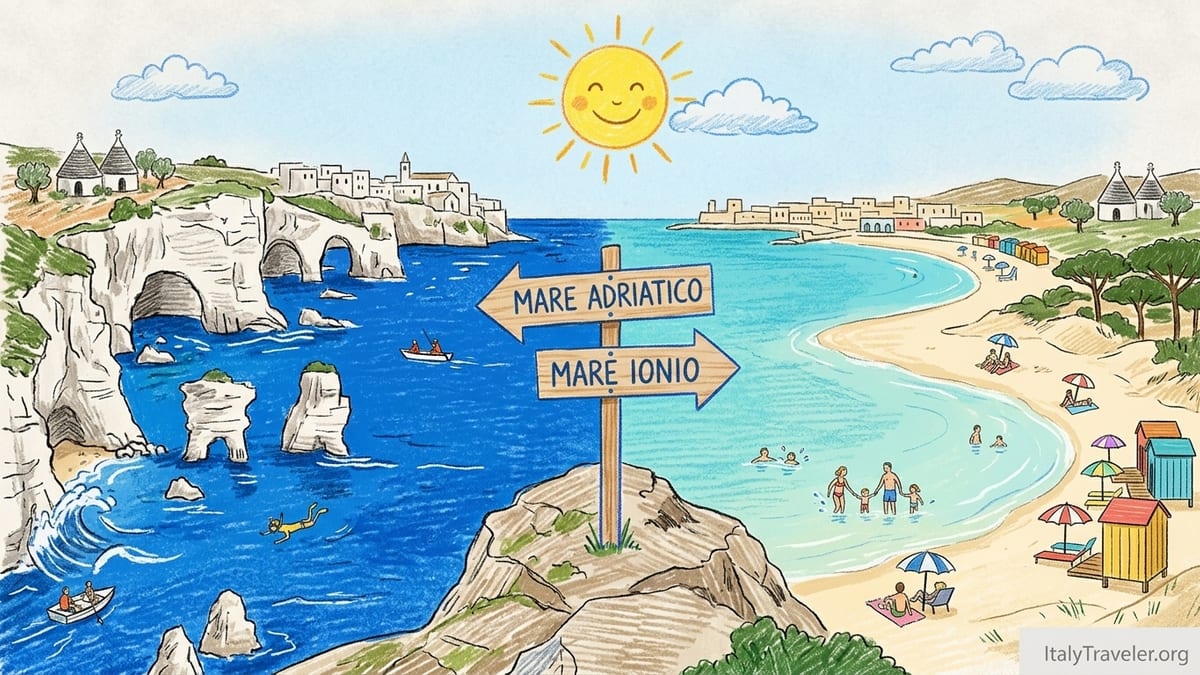
Adriatic vs Ionian: How the Two Seas Shape a Puglia Beach Holiday
The Adriatic and Ionian seas meet at the southern tip of Puglia, but they feel very different from a swimmer’s perspective. On the Adriatic side, especially north of Otranto and around Gargano, you see more cliffs, coves and pebble beaches, with deeper water close to shore and dramatic rock formations. The Ionian, particularly between Taranto and Gallipoli and around Porto Cesareo, is better known for broad sandy bays and a shallower entry that many families prefer.
Wind is one of the most practical differences. When the tramontana, a cool north wind, blows, it tends to roughen the Adriatic but can leave the Ionian much calmer and clearer. When the hot scirocco arrives from the south, the reverse often happens and the Adriatic can become the more comfortable choice. Locals in Salento commonly decide on the day whether to drive to the Adriatic or Ionian coast based on the morning forecast, and visitors who are mobile can do the same, without expecting guaranteed flat seas on either side.
Water quality is another shared strength. According to ARPA Puglia and national bathing-water monitoring data for 2024 and 2025, the region has over 95 percent of its monitored points classified as "excellent" for bathing, placing Puglia at the top of Italian rankings for several consecutive years. Throughout the summer season, results from microbiological testing are published within a few days of sampling, and municipalities can temporarily close stretches of coast when quality drops or when phenomena such as Ostreopsis ovata algae blooms pose a risk to swimmers.
For most travelers the real choice is not Adriatic versus Ionian in the abstract, but what kind of coastline suits them: the high limestone headlands of Gargano, the rocky pockets around Polignano and Monopoli, the protected dunes of Torre Guaceto, or the low, Caribbean-style sands of the Salento Ionian coast. The following sections walk you through each of these areas with concrete details on access, prices and on-the-ground experience.
Gargano’s Coast: From Cliffs and Stacks to Long Sandy Arcs
The Gargano promontory rises abruptly from the northern Adriatic and offers some of the most varied coastal scenery in Puglia, often within a short drive. South of Vieste and Mattinata you find small bays framed by white cliffs, while closer to Vieste, Peschici and Rodi Garganico long sandy beaches stretch for kilometers with dune systems and pine woods behind them. This mix means you can move from intimate coves to fully serviced family beaches in the same day.
Baia delle Zagare, near Mattinata, is one of Gargano’s emblematic coves. Framed by sheer white cliffs and famous for its offshore stacks, it combines coarse sand and pebbles underfoot, with fairly quick depth as you wade in. Sections of the bay are managed by adjacent hotels and beach clubs with paid access, while a public stretch is reached by a steep path or steps from the coastal road. Space is limited in the free section, and many visitors choose to arrive early in the morning or visit by small boat from Mattinata or Vieste to avoid crowding and difficult parking on peak August days.
Just along the coast, Vignanotica is a deep crescent of white pebbles backed by cliffs. Access typically involves leaving your car at paid car parks on the plateau above and walking down a footpath or using a shuttle service in peak season. The rounded pebbles make barefoot walking and entry a little uncomfortable for some people, but the water is exceptionally clear and quickly becomes deep enough for confident swimmers to enjoy long laps. There are a few lidos renting sunbeds and umbrellas at prices that in recent summers have often been in the range of 25 to 35 euros per day for an umbrella and two loungers, with simple bars and toilets attached, while a portion of the bay remains free.
At Vieste itself, Spiaggia del Castello, also known as Scialara or Pizzomunno, offers a very different setting: almost four kilometers of fine, golden sand with the famous Pizzomunno limestone monolith at one end. According to the Gargano National Park authority, the section closest to town is densely lined with lidos and hotels, while further out the establishments thin and small dune areas appear. Here the sea stays shallow for a long distance, which is ideal for families with small children and for people who prefer to stand and play in the surf rather than swim immediately in deep water.
North of Vieste, around Peschici and the coast toward Rodi Garganico, beaches again become mostly sandy, often with gently shelving seabeds and pine woods behind. Many lidos here target families and long-stay Italian visitors, offering seasonal packages as well as day rates. Local consumer groups and regional surveys for summer 2026 indicate that across Puglia the average price for renting an umbrella is now just under 18 euros, and around 15 euros per sunbed, with Gargano broadly in this range and a few premium waterfront clubs charging more. That means a typical couple might pay around 45 to 50 euros for an umbrella and two beds in high season, while those willing to sit in the free section need pay only for parking and any drinks or snacks.
Gargano Logistics: Access, Parking, Wind and Safety
Driving is still the main way to reach Gargano’s beaches. The coastal road between Mattinata and Vieste, however, is narrow and winding, and in July and August parking for small coves such as Baia delle Zagare and Vignanotica can fill early. In these places you should be prepared for a walk of 10 to 20 minutes between car and shore, often on paths or steps with some gradient. Larger sandy beaches near Vieste and Peschici usually have paid car parks directly behind the sand, where daily rates of about 5 to 8 euros are a realistic expectation based on recent surveys.
Facilities vary sharply across the promontory. The main town beaches at Vieste, Peschici and Mattinata offer showers, toilets, bars and lifeguard services throughout the core summer season, sometimes from mid-June to early September. Remote coves between Mattinata and Vieste have at most one or two small bars or lidos and may not have permanent lifeguards, so strong swimmers who like to explore along the cliffs should be conservative about conditions and currents. The combination of cliffs and deep water close to shore also means that children and less confident swimmers require closer supervision than they might on a flat sandy bay.
Wind exposure in Gargano tends to favor those coves that open to the south or are partly enclosed by headlands. When the north wind is strong, open north-facing beaches can become choppy and dusty, and families may prefer to tuck into more sheltered inlets or simply choose activities away from the surf. Forecasts are widely available on Italian weather portals and local radio, and it is worth checking not only wind direction and speed but also heat alerts if you plan steep walks to and from clifftop car parks in the middle of the day.
In terms of safety and water monitoring, Gargano benefits from the same regional framework as the rest of Puglia. ARPA Puglia and the regional health system publish classifications of each bathing-water stretch and update them annually, based on samples taken through the previous four seasons. When rare temporary pollution events occur, municipalities put up red flags and prohibitions on bathing, while the vast majority of monitored points along Gargano’s coast have recently been rated in the best quality class. Swimmers can also encounter jellyfish during heatwaves, so packing simple vinegar and following lifeguard advice is sensible.
Central Adriatic: Cliffs and Coves from Polignano to Torre Guaceto
South of Bari, the Adriatic shore becomes a string of rocky coves and small inlets between Polignano a Mare and Monopoli, before flattening into low dunes and longer beaches toward Torre Canne and the Brindisi province. This area is easy to combine with city stays in Bari or Ostuni and is reachable by train for some stretches, but the coastline is more broken up than in Salento, with alternate stone platforms, pebbly pockets and short sandy arcs.
Lama Monachile in Polignano a Mare is perhaps the most photographed cove on the Adriatic, a narrow slash of pale pebbles between cliffs topped by old stone houses. The beach itself is made of rounded stones rather than sand, and water becomes deep quickly. There are no lidos directly on the cove, so swimmers use towels, water shoes and drybags rather than rented loungers, and amenities consist mainly of public showers at street level and bars and restaurants in town. During summer the cove can feel extremely crowded, and many visitors stick to a short swim and then move on.
Just down the coast around Monopoli, inlets such as Cala Porta Vecchia and the Capitolo area offer a mix of sandy shallows and low rocks, with a series of moderately priced beach clubs alongside free stretches. Recent anecdotal reports and consumer association data suggest that at less glamorous lidos in this zone, daily rentals for an umbrella and two sunbeds can still be around 30 to 40 euros, particularly outside August weekends, although some chic clubs in Capitolo ask significantly more. Parking is often in private fields turned into seasonal car parks, at about 5 to 10 euros per day.
Further south, Torre Canne offers wide, gently shelving sandy beaches popular with families and guests of the local spa town. Many hotels have agreements with nearby lidos, but there are also public zones where you can plant your own umbrella at no cost. Water remains shallow a long way out, the seabed is mostly sand and lifeguards patrol much of the equipped stretch in summer, which makes this an easy choice for first-time visitors with young children or anyone who wants to float and paddle rather than snorkel around rocks.
Torre Guaceto, between Carovigno and Brindisi, is the most significant protected coastal area in this part of Puglia. The marine reserve and nature reserve include dunes, wetlands and seagrass meadows, and conservation rules tightly limit where vehicles can go, where umbrellas can be placed and what activities are allowed. You typically park at large car parks outside the reserve, paying a day fee in line with other regional parking, then use shuttle buses, bicycles or walking paths to reach the main beaches. There are basic services such as a small kiosk and toilets near the primary access point, but no dense line of lidos, loud music or motorized watersports.
Torre Guaceto: Conservation Rules and What to Expect
Torre Guaceto’s management plan divides the coast and offshore waters into zones with different levels of protection. In integral protection areas, access is limited to scientific staff and authorized personnel, while in partially protected zones visitors can swim and sunbathe but fishing, anchoring or using motorboats are restricted or banned. This zoning has helped keep seagrass beds and fish populations in good condition, and it means swimmers here often find particularly clear water and more marine life than on heavily developed shores.
For beachgoers, the most tangible effect is on logistics. Private cars are not allowed to drive right to the dunes or beaches. Visitors leave vehicles in car parks behind the main road and either walk 15 to 30 minutes along signposted tracks or take shuttle services that run on a loop in high season. The paths are exposed to sun, so carrying water, hats and simple beach carts for children or coolers is advisable. The upside is that once you arrive at the main coves the atmosphere is quieter than in built-up resorts, with natural dunes rather than hotels behind you.
Facilities at Torre Guaceto are deliberately limited. There are no rows of fixed sunbeds back-to-back across the sand, and in some zones rules restrict how close umbrellas can be placed to the dune line. Visitors should not expect showers, large restaurants or late-night events on the sand. Instead, a small number of concessions provide snacks, drinks and toilets near the principal access points, with prices closer to ordinary bars than luxury clubs. This is one of the best spots on the central Adriatic for travelers who value space, dunes and shallow, clear water over convenience and nightlife.
Because Torre Guaceto is a protected area, regulations and access times can change from season to season based on environmental conditions. Before driving out, it is worth checking municipal or reserve announcements for temporary closures, rules on dogs and updated maps of the zones. Lifeguards are present on the busiest sections in high summer, but swimmers exploring further along the shore should still pay attention to flags and information boards about currents, jellyfish and any temporary bathing bans linked to monitoring results.
Salento’s Adriatic: Rocky Arches, Pines and Clear, Deep Water
South of Brindisi and Lecce, the Adriatic coast of Salento becomes increasingly dramatic. Instead of flat sand, you find cliffs, rock arches and small sandy pockets, especially between San Foca and Otranto. This is a favorite stretch for snorkelers and couples who enjoy clear water and sculpted rocks, and for travelers who prefer natural scenery to rows of beach umbrellas.
Torre dell’Orso is a broad arc of pale sand framed by pine woods, with the famous sea stacks known as the “Due Sorelle” offshore. The beach has both free sections and many lidos, offering everything from basic loungers to beach clubs with music and full restaurant service. The sand is soft, the entry is gentle and children can play at the edge under supervision, though it becomes deep enough for proper swimming after a short distance. Prices for an umbrella and two loungers here in recent summers have often hovered in the 30 to 50 euro range in high season, with cheaper options midweek and in June or early September.
Just north of Otranto, Baia dei Turchi is a smaller bay under a pine forest, reached by walking paths from car parks on the inland side of the trees. The last ten to fifteen minutes are on sandy tracks and wooden walkways, which means you carry everything you need but also arrive on a beach where cars and buildings are out of sight. The sand is fine and the water quickly becomes deep and very clear. Some concessions offer sunbeds and simple food and drink, while much of the bay remains free and relatively wild compared with more urbanized resorts.
The nearby Alimini area consists of a series of long, open beaches backed by dunes and by the Alimini lakes. Here the sand is wide and fine, the seabed slopes gradually and wind and waves can be stronger than in enclosed coves. This is popular with kitesurfers and surfers when the Adriatic is agitated, and with families on calmer days. Facilities range from basic lidos renting umbrellas and sunbeds with toilets and showers, to more structured beach clubs with parking deals, restaurants and evening events.
Further south, Torre Sant’Andrea offers one of the most picturesque rocky coastal scenes in Puglia, with natural arches, stacks and small, rocky bathing spots. Swimmers usually access the water from flat rock platforms or small steps carved into the stone, so this is not an ideal location for toddlers, but it is excellent for strong swimmers and snorkelers who enjoy exploring underwater caves and ledges. The water here is deep and intensely blue, with little sand in suspension, and on calm days visibility can be excellent.
Salento’s Ionian: Shallow Sandy Bays and Porto Selvaggio’s Wild Feel
Cross to the Ionian side of Salento and the character of the coast changes again. Between Punta Prosciutto and Gallipoli you find wide, white-sand beaches and turquoise shallows that have made this area famous as “the Maldives of Salento.” These beaches often have long belts of very shallow water ideal for children, and they tend to be more sheltered than the open Adriatic when the tramontana blows from the north.
Punta Prosciutto and Torre Lapillo, near Porto Cesareo, are classic examples: large arcs of soft sand backed by low dunes and beach houses, with water that stays knee-deep for many meters. A dense row of lidos alternates with free sections, and this is one of the areas where beach-club prices have climbed fastest in recent years. A consumer association survey in 2026 found that around Porto Cesareo and neighboring municipalities the average price for an umbrella and two loungers was over 40 euros per day, significantly higher than the provincial average, with peak August weekends and front-row positions costing more. Budget-conscious travelers often base themselves here but use the free beach, buying only bar drinks and food.
Porto Cesareo itself combines town beaches with offshore islands that can be reached by small boat, and a mix of inexpensive, family-oriented lidos and more exclusive clubs. Moving down the coast, the Gallipoli area hosts Baia Verde and Punta della Suina, where low dunes, pines and shallow water attract a younger crowd and music-oriented beach clubs. Many lidos here offer daybed packages, aperitivi and evening events, with standard umbrella-and-lounger rentals in the 35 to 50 euro bracket in mid to high season and more for cabanas and front rows. Free segments remain between the clubs, so even budget travelers can enjoy this coastline with a bit of walking.
Further south, around Torre San Giovanni and the long beaches nicknamed “Maldive del Salento” near Pescoluse, the coast remains low, sandy and shallow, with clear water and small lidos scattered along the shore. Families appreciate the long shallows and easy entry, while couples and groups of friends often look for beach clubs that balance music and relaxation. Parking is usually in informal lots behind the dunes or along the coastal road, with daily rates often around 5 euros, though closer, shaded parking and private lots can cost more.
Porto Selvaggio, between Gallipoli and Nardò, is a notable exception to the heavily serviced Ionian pattern. This protected area combines pine forest, cliffs and a rocky cove reached by hiking paths. Visitors park in designated lots inland and then walk twenty to thirty minutes through the woods, descending to a stone and pebble shoreline where there are no fixed lidos, only occasional mobile kiosks in season. The seabed is mostly rocky and pebbly, with cool freshwater springs feeding into the sea and creating noticeable temperature gradients. This is a favorite spot for snorkelers who enjoy clear, deep water and fish-rich rocky habitats, but it is not well suited to small children or travelers wanting full-service comfort on the sand.
Porto Selvaggio: Access, Protection and Swimming Conditions
Porto Selvaggio’s protected status means development is tightly controlled. The pine forest behind the coast is criss-crossed by walking trails but is free of hotels, residential blocks and large parking areas. Cars are left in pay-and-display or attended car parks at the forest edge, and from there visitors follow marked paths downhill. The return walk is uphill and exposed to heat, so scheduling visits for morning or late afternoon is prudent in mid-summer.
On arrival at the sea, swimmers find rough stone platforms, pebble pockets and a small inlet where boats are limited and swimmers share space with kayaks and paddleboards. The seabed drops away relatively quickly from the rocks, and the presence of fresh water from inland springs makes the water cooler than at nearby sandy beaches, which can be a delight on very hot days but a surprise for small children. Because there are no continuous lifeguard posts and the entry is over rocks, this is better suited to confident swimmers who are comfortable with masks and fins and who wear water shoes.
Services at Porto Selvaggio are minimal by design. There are no fixed rows of loungers to rent, and visitors bring their own mats, chairs and umbrellas, taking care not to damage vegetation. Food and drink options are limited to what you carry or to small vendors away from the actual cove, so planning picnics and water supplies is important. The relative effort required to reach the bay helps keep numbers lower than at drive-up beaches, and the reward is a sense of being in a wild, green amphitheater of forest and limestone rather than a resort.
As at Torre Guaceto, regulations inside the protected area can change based on fire risk, erosion concerns and visitor impact. In recent years local authorities have periodically restricted access during peak heatwaves or adjusted parking zones. Swimmers should respect any temporary bathing prohibitions and avoid jumping from cliffs or arches, which may be popular on social media but are risky and can damage fragile rock formations.
Costs, Water Monitoring and Choosing Your Coast by Conditions
Puglia’s seaside has become one of Italy’s best-known summer destinations, and with that popularity prices have risen. Regional and local surveys for 2025 and 2026 indicate that across Puglia the average price for renting an umbrella is now a little under 18 euros, and around 15 euros per sunbed, meaning that an ordinary lido might charge about 30 to 35 euros for a basic umbrella and two loungers on a standard day. In high-demand areas such as Porto Cesareo, Baia Verde or front-row positions at iconic beaches, prices of 40 to 50 euros are common, and a limited number of luxury clubs advertise packages that reach or exceed 80 to 100 euros per day, especially in August. These premium examples, however, are not representative of every beach; many family-run lidos in Gargano, along the Monopoli coast or near Torre Canne remain closer to the regional averages.
Travelers who prefer to minimize costs can combine the many free stretches of beach with occasional lido days. Buying a foldable umbrella in a supermarket for about the price of a single high-season rental, then using it on public sections while paying only for parking and snacks, is a common strategy among Italians. Some lidos also offer afternoon-only rates or discounts outside weekends. The most expensive combination is usually a front-row umbrella at a fashionable club in late July or August, plus paid parking and full restaurant meals; the most economical is free beach, self-catering picnics and inland parking with a short walk.
Wind and daily sea conditions are another key factor in choosing between Gargano, the central Adriatic and Salento’s two coasts. On a day with strong north wind, the Adriatic around Otranto and along Gargano can be wavy and cooler, which some swimmers enjoy but small children may not. That same wind can flatten and clarify the Ionian, making Punta Prosciutto or Pescoluse feel like a lagoon. When a humid south wind dominates, the situation can invert, with the Adriatic offering fresher air and less suspended sand. None of these patterns is absolute, and local variations depend on headlands and bays, so asking hosts or checking real-time sea-state images can help you avoid surprises.
Behind the scenic photos, Puglia’s coasts are subject to systematic environmental monitoring. ARPA Puglia and the regional health agencies publish annual classifications and in-season bulletins for each bathing zone, and Puglia has in recent years achieved one of the highest proportions of "excellent" quality waters in Italy. Individual days can still see temporary bans after storms, sewage overflows or algal blooms, but these are publicized through municipal notices, flags on beaches and digital platforms. For families and cautious swimmers, this system means you can plan with reasonable confidence that widely used beaches such as Torre dell’Orso, Vieste’s Scialara or Gallipoli’s lidos are monitored and managed.
Safety extends beyond water quality. On all coasts, lifeguards are most consistently present on equipped beaches during the official bathing season, which typically runs from around June to September, though precise dates are set by local ordinances. Free coves, rocky platforms and remote stretches of coast are often unsupervised, so swimmers should adapt their behavior accordingly: staying close to shore, avoiding solo swims in rough conditions and resisting the temptation to dive from rocks without knowing depths. Heat, sun exposure on access paths and dehydration are more frequent risks than currents, especially at Torre Guaceto, Vignanotica and Porto Selvaggio where walking is required.
How to Decide: Matching Puglia’s Coasts to Your Travel Style
Families who prioritize shallow water, easy access and full facilities tend to do best along the sandy beaches of Gargano near Vieste and Peschici, at Torre Canne on the central Adriatic, or on the Ionian between Torre Lapillo and Pescoluse. These areas offer lifeguards, toilets, showers and nearby accommodation, and many hotels have arrangements with lidos so that guests have reserved spots without daily bargaining. Long, flat shorelines also make it simple for children to play while adults keep an eye on them from the shade of umbrellas.
Snorkelers and strong swimmers who care more about underwater rocks and caves than about sand between their toes often prefer Gargano’s coves around Baia delle Zagare and Vignanotica, the rocky Adriatic shore between San Foca and Otranto, and Porto Selvaggio on the Ionian. In these spots, water shoes, masks and fins are essential, and the reward is clear water, fish and interesting seabeds. Accommodation is typically in nearby villages or agriturismi rather than directly above the cove, which makes having a car or arranging transfers important.
Couples looking for scenery and atmosphere might split their time. A few days based in Polignano or Monopoli allow for cliffside aperitivi and swims at Lama Monachile and nearby coves, while a move south to Gallipoli or Otranto brings sunset views and access to beaches like Torre dell’Orso or Punta della Suina. Photographers, meanwhile, will find the most iconic Puglia panoramas at Gargano’s cliff-backed bays, at Lama Monachile’s stone bridge framing the cove, at Torre Sant’Andrea’s arches on the Adriatic and at the turquoise shallows of Punta Prosciutto and Pescoluse on the Ionian.
Budget travelers should be realistic about high-season costs but not discouraged. By traveling in June or early September instead of August, choosing accommodations a few kilometers inland and using free beach sections, you can enjoy the same sea as guests at premium lidos. Keeping an eye on daily wind forecasts allows you to switch between Adriatic and Ionian to find better conditions without paying for private pools. For some visitors, a mixed itinerary that samples both Gargano and Salento, and both seas, offers the richest understanding of Puglia’s coastline without committing entirely to one style of beach.
Sample Three-Day Beach Routes: Gargano and Salento
A three-day Gargano beach route might start in Mattinata. On day one, you could base yourself at Baia delle Zagare, arranging access through a hotel or planning an early arrival to secure a spot in the public section, with a late-afternoon drive along the panoramic coastal road and viewpoints. Day two could focus on Vignanotica in the morning for snorkeling among cliffs and white pebbles, followed by a more relaxed afternoon on Vieste’s long Scialara beach, where children can play in the shallows and adults can stroll into town for gelato. On day three, you might head north toward Peschici, stopping at one of the long sandy beaches backed by pinewoods, hiring a pedal boat where available and sampling simple seafood at a seaside trattoria before driving back inland.
For a three-day Salento route, you could base yourself near Lecce or split your stay between Adriatic and Ionian towns. Day one might take you to Torre dell’Orso for a classic sand-and-lido experience in the morning, with a late-afternoon walk to nearby Torre Sant’Andrea for photographs of the arches and a swim from the rocks. Day two could be devoted to Baia dei Turchi and the Alimini coast, starting with the shaded walk through pines to the bay, a swim in its clear, deep water and then moving along the coast to a more open, breezy Alimini beach where wind and waves can be livelier.
On day three you would cross to the Ionian side. If you prefer comfort and long, shallow water, Punta Prosciutto or Torre Lapillo near Porto Cesareo make a logical stop, with the option to rent loungers or stay on the free sections. Those drawn to wilder settings could instead drive to Porto Selvaggio, spending the morning hiking through the forest and swimming from the rocks, then finishing the day with a calm sunset swim at a sandy beach just north or south of the reserve. In both Gargano and Salento, leaving detailed lido choices until you arrive lets you compare prices and atmospheres on the ground.
Whichever route you choose, pairing some serviced, easy beaches with a couple of more effortful, protected coves gives you a better sense of what Puglia’s coasts have to offer beyond the postcard images. With a little planning around wind, access and costs, both Gargano and Salento can deliver memorable, varied days by the sea.
FAQ
Q1. Is the Adriatic or Ionian side of Puglia better for families with small children? For most families, the Ionian between Porto Cesareo and Pescoluse and the sandy stretches of Gargano around Vieste and Peschici work best, thanks to shallow, sandy seabeds and easy access to facilities, while the rockier Adriatic coves around Polignano and Otranto can be more challenging for very young children.
Q2. How expensive are beach clubs in Puglia in 2026? Regional surveys suggest an average of just under 18 euros for an umbrella and around 15 euros for a sunbed, so a typical umbrella plus two loungers costs about 30 to 35 euros, with higher prices of 40 to 50 euros in hotspots like Porto Cesareo and Baia Verde and only a minority of luxury clubs charging 80 euros or more per day.
Q3. Can I still find free beaches, or is everything run by lidos? Free sections exist along almost every stretch of Puglia’s coast, from parts of Vieste’s Scialara to areas of Torre dell’Orso, Punta Prosciutto and Gallipoli; you can usually set up your own umbrella at no charge and pay only for parking and any food or drinks you buy.
Q4. Do I need a car to enjoy Gargano and Salento beaches? A car is not strictly essential near some towns such as Polignano, Monopoli, Otranto or Gallipoli, where local buses and walking can cover nearby beaches, but to reach protected areas like Torre Guaceto and Porto Selvaggio or the most scenic Gargano coves between Mattinata and Vieste, having a car or arranging private transfers is highly practical.
Q5. How clean and safe is the bathing water in Puglia? According to regional environment and health agencies, over 95 percent of monitored bathing sites in recent seasons are rated in the top quality class, and regular monitoring means that any short-term problems trigger flags or temporary bans, which makes mainstream beaches in Gargano and Salento generally clean and safe for swimming.
Q6. What should I know about wind and waves when choosing where to go each day? When the north tramontana wind is strong, the Adriatic, especially the open stretches around Otranto and Gargano, can be choppy while the Ionian is often calmer, and when a warm south wind dominates, the opposite can be true, so checking wind forecasts in the morning and being ready to switch coasts gives you the best chance of comfortable conditions.
Q7. Are protected areas like Torre Guaceto and Porto Selvaggio suitable for young children? These reserves are wonderful for nature and relatively uncrowded beaches, but access often involves 15 to 30 minutes of walking with limited shade, and the shores can be rocky, so families with toddlers may find easier conditions at drive-up sandy beaches such as Torre Canne, Punta Prosciutto or Pescoluse.
Q8. Where should snorkelers base themselves in Puglia? Snorkelers usually favor Gargano’s cliff-backed coves like Baia delle Zagare and Vignanotica, the rocky Salento Adriatic between San Foca and Otranto including Torre Sant’Andrea, and the clear, spring-fed waters of Porto Selvaggio on the Ionian, where rocky seabeds support more marine life than flat sand.
Q9. Is August a bad time to visit Puglia’s beaches because of crowds and prices? August, and especially the weeks around the mid-month holiday, brings the largest crowds and the highest lido prices, so travelers on tighter budgets or seeking quieter beaches will have a more relaxed experience in June, early July or September, though with planning and early starts it is still possible to enjoy the coast in August.
Q10. If I have only three days, should I choose Gargano or Salento? If you enjoy dramatic cliffs, mixed sand and pebble coves and smaller seaside towns, three days in Gargano around Mattinata, Vieste and Peschici make sense; if you prefer a combination of rocky Adriatic landscapes and shallow, turquoise Ionian bays with more nightlife, three days split between the Otranto area and the Porto Cesareo or Gallipoli coasts in Salento will likely suit you better.