


Basilicata is usually a one-line afterthought in southern Italy itineraries, a quick detour to tick off Matera before heading back to Puglia or the Amalfi Coast. That is a mistake. For drivers willing to slow down, this compact region holds mountain hamlets anchored to sheer rock, extinct volcanoes wrapped in vineyards, Ionian and Tyrrhenian coastlines, and some of the most atmospheric archaeological sites in Magna Graecia. The following 5, 7 and 10 day road trip plans are designed to show how much more there is beyond Matera, with realistic mountain-road timings, up to date access notes and concrete daily budgets for couples and families.
Understanding Basilicata’s Geography: More Than Matera
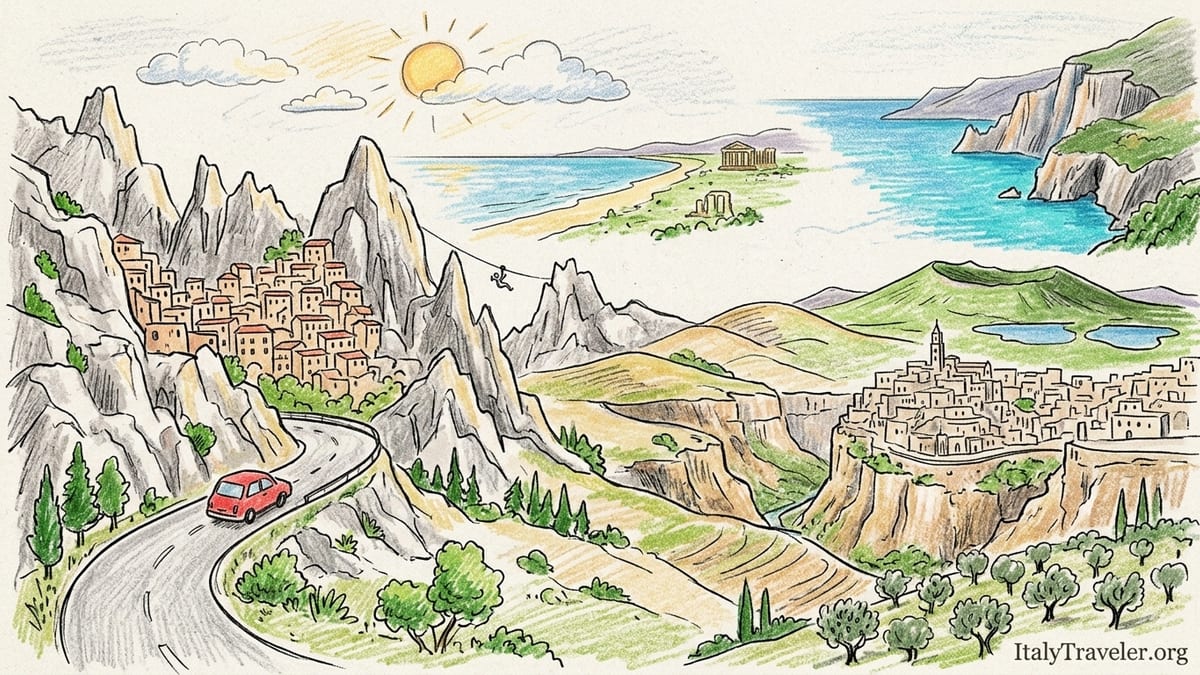
Before planning routes, it helps to understand how Basilicata fits together. The region has two provinces, Matera in the east and Potenza in the west, and two very different seas. The Ionian coast to the east around Metaponto and Policoro is low and sandy, while the Tyrrhenian shore at Maratea is a steep, cliffed coastline with coves squeezed between railway and sea. Between the two are interior landscapes that feel almost like separate small regions, from the canyon country around Matera to the high ridges of the Lucanian Dolomites and the extinct volcano of Vulture near Melfi and Venosa.
The Matera province centres on the city itself and the Murgia plateau. Around Matera you drive across open, softly rolling fields broken by ravines. The city’s famous Sassi cave districts cling to the edge of a deep canyon, the Gravina di Matera, looking across to the rocky Murgia Materana, now a national park. East and south, the land falls gradually toward the Ionian Sea, where Metaponto’s archaeological park and pine-backed beaches sit almost at sea level. Distances are short here: Matera to Metaponto is roughly 47 kilometres, usually just under an hour’s drive in light traffic.
Move west into Potenza province and the feel of the roads changes. The Basento and Agri valleys carry fast routes inland, but as soon as you turn off toward the Lucanian Dolomites the tarmac begins to climb and twist. Castelmezzano and Pietrapertosa are compact stone villages welded to knife-edge ridges, reached by narrow roads with frequent bends and sharp elevation gains. Further north, the Vulture area rises like a green island of forest and vineyards, an extinct volcanic massif punctuated by the twin Monticchio lakes and ringed by towns such as Melfi, Rionero in Vulture and Venosa.
Southwest again, Pollino and the Tyrrhenian coast belong to a different mood. Pollino National Park, shared with Calabria, brings high plateaus, beech forests, and, in good weather, views as far as both seas. Maratea, Basilicata’s only Tyrrhenian town, hangs between mountains and water. Reaching it has always meant hairpin roads, and autumn 2026 brings extra complications due to landslide damage and restrictions on the SS18 coastal road and the inland SP3, which affect how much you can realistically pack into a day that ends on this coast.
When to Go, Driving Conditions and Daily Budgets
Basilicata’s small size is deceptive. On the map, Matera to Maratea is only around 200 kilometres, but once you leave the main valleys you are driving mountain and hill roads, with slow sections behind trucks or buses and frequent curves. A day that looks like two and a half hours of driving in the navigation app can very easily stretch toward four hours once you add viewpoint stops and village traffic. These itineraries use realistic drive times: for example, Matera to Castelmezzano is usually about 1 hour 20 minutes, and Matera to Metaponto around 50 minutes to an hour.
Spring and autumn suit these routes best. May and early June bring wildflowers and mild temperatures on the Murgia and in the Dolomites, while late September and October combine grape harvest in the Vulture vineyards with still-swimmable water on the Ionian coast. July and August are hot and busy on the seaside and some villages, and the middle of winter can bring ice or snow in higher areas such as Pollino and the Dolomites. Those winter conditions matter when you plan activities like the Volo dell’Angelo zipline between Castelmezzano and Pietrapertosa, which in 2026 operates only on selected dates from 1 May to 8 December, with a more limited schedule in spring and autumn and no automatic availability in deep winter.
Costs in Basilicata are generally lower than in more famous Italian regions. A couple in 2026 can often find a mid-range guesthouse or agriturismo for about 80 to 120 euros per night, including breakfast. Simple trattoria dinners with local wine might come to 25 to 35 euros per person for two courses and a shared dessert, and lunches built around panini, focaccia or board-style snacks can be more modest at 8 to 15 euros per person. A family of four staying in family rooms or small apartments might plan on a daily accommodation budget from roughly 120 to 180 euros in most inland towns, with self-catering or pizza dinners keeping food around 80 to 120 euros per day, not counting special meals or paid activities.
Entrance tickets to key sights are modest compared with big cities. In Matera, a multi-site ticket for major rock churches and museums can cluster around 20 to 25 euros per adult, while single cave house museums and individual churches cost substantially less. Archaeological parks at Metaponto and nearby Magna Graecia sites usually charge a single-figure euro entrance per adult, with reductions for children. Wine tastings at Aglianico del Vulture producers around Venosa, Barile or Rionero often sit in the 15 to 30 euro per person range for a cellar tour with several wines and snacks, based on 2024 and 2025 tariff information from regional wine tourism brochures and winery lists.
5-Day Basilicata Road Trip: Matera, Murgia, Dolomites and Metaponto
The five-day plan keeps distances contained within Matera province and the nearby Lucanian Dolomites. It suits travellers who want to understand Matera in context, see the canyon countryside, hike a little, visit hill villages and spend a day in Magna Graecia ruins on the Ionian coast, without the extra detour north to Vulture or south to Maratea.
Day 1 starts and ends in Matera. Allow most of the day in the Sassi and on the canyon rim. Driving between sights is minimal; instead, park once near the centro storico and explore on foot. Spend four to six hours between the main cave churches, a house museum and the cathedral viewpoint, with a long lunch in a trattoria inside the Sassi. A couple might spend about 60 to 80 euros on entrance tickets and 60 to 70 euros on food and coffee, while a family of four can expect tickets closer to 90 to 110 euros in total with child discounts, plus 80 to 100 euros in meals if you mix restaurant plates with quick snacks. Overnight in a cave hotel or guesthouse in the Sassi, budgeting from 120 euros for a couple and 150 to 200 euros for a family room or apartment.
On Day 2 base again in Matera but cross to the Murgia Materana. Driving from the historic centre to the main viewpoint car park on the opposite side of the ravine is about 15 minutes, plus another 10 on foot to the main overlooks. Spend three to four hours walking signed trails along the canyon edge and down toward rock churches, then return for a quieter afternoon in upper Matera, perhaps visiting less crowded museums or shopping for food products like caciocavallo cheese and Lucanian dried peppers. Start and finish in Matera, with less than 30 kilometres of driving and perhaps one hour of engine time all day. A couple’s daily budget with simple lunch picnics might sit around 150 to 200 euros including accommodation and modest attraction fees; a family might allow 220 to 260 euros.
Day 3 takes you from Matera to Castelmezzano in the Lucanian Dolomites, with an overnight in one of the two mountain villages. The direct route is around 80 kilometres and, without stops, just under an hour and a half, but it is realistic to allow two and a half to three hours including a coffee break and photo stops in the valley. Plan to leave Matera by mid-morning, reach Castelmezzano for a late lunch, and then walk the village streets and viewpoints for two to three hours. Drivers should be comfortable with narrow, winding roads and occasional tight turns at the village entrance. In season, some travellers will add the Volo dell’Angelo ride, but it should be pre-booked on a date when you know it is operating, and avoided entirely in winter months when the line is closed. Dinner in a small osteria with local pasta dishes such as strascinati with cruschi peppers might cost a couple 50 to 70 euros including wine, with family meals at 80 to 110 euros depending on children’s orders.
On Day 4, walk or drive between Castelmezzano and neighbouring Pietrapertosa and then continue toward the Ionian coast. The two villages are only a few kilometres apart by road, around 20 to 25 minutes of careful driving, but if the weather is stable and you enjoy hiking you can follow the marked trail connecting the villages for two and a half to three hours. After lunch in Pietrapertosa, plan the drive toward the Metaponto area, about 120 to 140 kilometres depending on your chosen route, and around two and a half hours of mountain and valley roads. Overnight either in or near Metaponto, where family-run hotels and agriturismi a short drive inland can offer better value and calmer evenings than the main beach strip, especially outside peak summer.
Day 5 is devoted to Metaponto-area archaeology and the Ionian coast before you finish in Matera or continue your onward journey. The archaeological site of Metaponto, including the Tavole Palatine temple columns, sits only a short drive inland from the modern beach town. Expect to spend two to three hours between the park and on-site museum, with additional time if you visit other Magna Graecia sites along this stretch of coast. After a seafood lunch on the seafront or a simple panino from a bar, you can give children a couple of hours on the beach when the weather allows. The drive back to Matera is around 47 kilometres and generally under an hour, so even with a late afternoon swim you can reach Matera by early evening. For this final day, a couple might expect 40 to 50 euros in entrance fees and parking plus 60 to 90 euros in food, while families will see those totals rise to roughly 120 to 150 euros depending on the choice between restaurants and informal meals.
7-Day Basilicata Road Trip: Adding Vulture, Venosa and Melfi
With a week you can keep the full five-day route and add the Vulture area in Potenza province, combining medieval castles, literary history and volcanic landscapes with some of southern Italy’s most interesting red wines. The key difference is that you now shape the route into a wider loop, using Venosa or Melfi as inland bases to avoid repeating the same roads.
Days 1 to 4 mirror the five-day plan: Matera and the Murgia, then an overnight in Castelmezzano or Pietrapertosa, followed by a day that links the Dolomites to the Ionian coast and Metaponto. On the evening of Day 4, instead of returning to Matera after the beach, consider driving north into the Bradano valley and staying near Ferrandina or Tricarico to shorten the next day’s leg. That adds about an hour of driving from Metaponto but can cut your total drive on Day 5 by the same amount.
Day 5 aims from the Ionian inland hills toward Venosa and the Monticchio lakes. Starting from the Ferrandina area, expect roughly 120 to 150 kilometres and about two and a half to three hours of driving via interior roads. Venosa is a small town with Roman and Norman layers, plus a strong association with Latin poet Horace. Plan two to three hours for the archaeological area and abbey complex and a wander through the historic streets, followed by a late afternoon transfer of around 40 to 50 minutes to the Monticchio lakes area on the Vulture slopes. Base yourself for two nights at an agriturismo, countryside inn or small hotel along the wooded crater lakes or in nearby towns like Rionero in Vulture.
On Day 6, you can slow down and explore the Vulture heartland. The ring road around the lakes and up to the abbeys and viewpoints is short in distance but involves steep sections and narrow passing places, so mileage may stay under 60 kilometres while engine time reaches two to three hours across the day. Build the afternoon around an Aglianico del Vulture winery visit. Many estates near Venosa, Barile and Rionero ask for advance reservations and offer tasting sessions for around 20 to 30 euros per person, with more structured food pairings at higher prices. Allow two to three hours for a cellar tour and tasting, and arrange a simple early dinner at the winery or a nearby trattoria featuring local dishes like lamb, caciocavallo cheese and mushroom pastas that match the structured reds. Couples might expect to spend 80 to 120 euros on the tasting and dinner combined, with families focusing on food and non-alcoholic options while one adult participates in a pared-back tasting.
Day 7 closes the loop through Melfi, then returns you toward Matera or your onward connection. From the Monticchio lakes to Melfi is a short hop of roughly 20 kilometres, often under half an hour of driving. Melfi’s castle, which dominates the town, merits two to three hours including the museum exhibits and a stroll through the old centre. From there you can either head east toward the Autostrada junctions if your trip continues into Campania or Puglia, or back toward Matera for one final night, a drive of approximately 140 to 160 kilometres and two and a half to three hours. For cost planning, a couple might budget an overall weekly spend in the region of 1,400 to 1,800 euros including car hire, fuel, mid-range accommodation, meals and entrance tickets, with a family of four looking at roughly 2,100 to 2,700 euros depending on lodging category and restaurant choices.
10-Day Basilicata Road Trip: Pollino, Aliano and Maratea
A 10-day plan lets you embrace Basilicata as a standalone destination and reach both seas. The aim is to avoid excessive backtracking on mountain roads by choosing strategic overnight bases. You still begin in Matera and the Dolomites, then track north to Vulture before sweeping south into the badlands around Aliano, climbing to Pollino National Park and finally descending to Maratea on the Tyrrhenian coast.
Days 1 to 6 follow the shape of the seven-day itinerary, up to your second night in the Vulture area near the Monticchio lakes. You will have experienced Matera, the Murgia, Castelmezzano and Pietrapertosa, Metaponto’s ruins and beach, Venosa and its Roman past, and at least one Aglianico del Vulture winery visit. From here, resist the temptation to drive straight across to Maratea; doing so in a single day from Vulture would mean at least four to five hours of largely mountain or hill road driving, which is tiring and leaves little time to appreciate stops.
Instead, Day 7 takes you from Vulture to Aliano and the surrounding badlands, known locally as calanchi. Expect a journey of roughly 140 to 170 kilometres and three to four hours of driving, broken with a stop in a market town such as Potenza or Brienza if timing and appetite suggest it. Aliano is closely associated with writer Carlo Levi and offers a striking landscape of eroded clay gullies and ridges. You can spend two to three hours between the village, small museums and short viewpoints walks, then overnight in a local inn or agriturismo in the calanchi belt. This split keeps driving manageable and introduces a very different face of Basilicata, where agriculture and erosion define the scenery more than forest or sea.
Day 8 climbs into Pollino National Park, using an interior route from Aliano toward towns such as Terranova di Pollino or Rotonda on the Basilicata side of the massif. The distance is likely to be around 120 to 150 kilometres, but driving time can easily reach three and a half to four hours, depending on roadworks and weather. Plan only light sightseeing on the transfer day itself: a late lunch in a mountain town, followed by an easy afternoon walk in beech woods or to a viewpoint if conditions allow. Pollino offers more demanding hikes to high plateaus and the emblematic Bosnian pines, but these are better left to the next morning when you have more daylight and energy.
On Day 9, stay based in Pollino and choose between a half-day hike and a more relaxed program suitable for families with younger children. Many local guides offer guided walks of four to six hours at moderate altitude, which might cost 40 to 60 euros per adult and a lower fee for older children, though prices depend on group size and exact route. If you prefer softer activity, drive short distances between villages within the park, visiting local food producers for cheese, cured meats and honey, and picnic in signed picnic areas. At the end of the day, start the descent toward the Tyrrhenian side if you want a last overnight closer to the sea, or stay one more night in the same mountain base if you value cooler temperatures and quiet nights.
Day 10 focuses on reaching Maratea and understanding the current access issues. In October 2026, the main inland road SP3 between Maratea and Trecchina remains closed due to rockfall risk, and the SS18 coastal road near Maratea operates with time and lane restrictions because of landslide damage and a monitored bypass. Local notices in mid October confirm that access to Maratea is allowed via the SS18 from the south near Castrocucco only during certain daytime hours, with closures or stricter controls outside those windows, while the SP3 remains interdicted pending works. This means that your final day should not rely on quick in and out shuttles. Instead, plan a single, deliberate arrival into Maratea with one or two nights there at the end of the itinerary, with the understanding that reaching the town currently works better from the southern approach than from the inland north.
Once in Maratea, much depends on the season. In late spring to early autumn, you can split time between boat trips along the cliffed coast, small beaches reachable by stairs or short paths, and the sanctuary hill with the large Christ statue above town. Families may want to prioritise a half-day boat excursion and a calm beach suitable for children, while couples might plan sunset from the panoramic roads or terraces. Daily budgets on the Tyrrhenian can be slightly higher than inland: sea-view rooms often start closer to 120 to 150 euros for a couple, with restaurant dinners nudging upward by 10 to 20 percent compared with mountain towns, particularly on fresh fish menus. For a full 10-day loop including car hire, fuel, tolls, accommodation, food, entrance fees and some guided or paid activities, couples might forecast from roughly 2,000 to 2,700 euros, with families planning closer to 3,000 to 3,800 euros depending on comfort level and season.
Eastern vs Western Basilicata: When to Split the Trip
Trying to see Matera, the Dolomites, Vulture, Pollino and Maratea in a single short trip is often what leaves travellers feeling rushed. In practice, Basilicata works very well as two separate journeys: an eastern circuit centred on Matera, the Murgia, Metaponto and perhaps Vulture, and a western route focused on Pollino and the Tyrrhenian coast around Maratea combined with nearby parts of Campania or Calabria.
If you are flying in and out of Bari or Brindisi and already plan to explore Puglia, the eastern Basilicata half makes the most sense. Distances are short from Bari to Matera, the roads to Metaponto and the Ionian coast are mostly straightforward valley routes, and adding Vulture through Venosa and Melfi is an elegant way to loop back toward the Adriatic or inland autostrada junctions. This cluster is also well suited to visitors travelling in shoulder seasons such as March, April, late October and November, when the Tyrrhenian coast may be quieter, boat services limited and higher areas like Pollino recovering from winter weather.
The western half of Basilicata, involving Pollino and Maratea, can be folded into a broader Tyrrhenian or Calabrian road trip, using Naples, Salerno or Lamezia Terme as gateways. This route makes more sense in late spring through early autumn, when mountain hiking conditions are stable and coastal services are running, and when you can absorb the extra driving time between Pollino and Maratea without sacrificing daylight. In the specific context of autumn 2026, with the SP3 closed and SS18 under constraint near Maratea, it is wiser to treat Maratea as a deliberate end point for at least two nights rather than as an easy day trip, which might involve unexpectedly long detours if schedules or closures change.
Budget planning can also benefit from splitting the trips. An eastern circuit typically involves lower accommodation and food costs, as Matera, inland villages and Ionian agriturismi remain relatively affordable. The western Tyrrhenian, especially if paired with better-known seaside areas, often comes with higher per-night lodging rates and more temptation to spend on boat excursions and seafood meals. Families in particular may find it simpler to focus on one side at a time to reduce the number of hotel changes and manage driving time with children.
The Takeaway
Basilicata rewards travellers who slow down and accept that in a region of ravines, extinct volcanoes and cliffed coastline, the shortest line on the map is not always the best plan. Matera is only the beginning: within a few hours’ drive are the high-perched villages of Castelmezzano and Pietrapertosa, the open fields and Ionian beaches around Metaponto, the forested crater of Vulture wrapped in Aglianico vineyards, the lunar calanchi around Aliano, the beech woods of Pollino and the sudden blue of the Tyrrhenian at Maratea.
Whether you choose the five, seven or ten day itinerary, or split the region into eastern and western trips, the key is to respect local geography, current road conditions and the natural rhythms of small towns. Build in time for delays on mountain roads, check seasonal openings for experiences such as the Volo dell’Angelo rather than assuming they operate year-round, and stay at least two nights in strategic bases to reduce packing and unpacking. In return, you will find that Basilicata feels less like a checkbox and more like a region where daily life is still shaped by land and sea rather than by crowds.
For couples, these routes can offer a mix of cave hotels, vineyard evenings and quiet mountain walks far from the usual circuits of southern Italy. For families, they provide village squares for play, manageable archaeological sites with space to roam, and a variety of short drives and swims to break up the days. Above all, they prove that treating Basilicata as more than an overnight stop in Matera is not only possible but richly rewarding.
FAQ
Q1. Is it realistic to drive from Matera to Maratea in one day with sightseeing stops?
Driving directly from Matera to Maratea is technically possible in a single day, but if you add sightseeing stops in the Dolomites or Vulture it quickly becomes rushed and tiring, especially given current SS18 and SP3 restrictions near Maratea, so it is safer to break the route with at least one inland overnight.
Q2. How much should a couple budget per day for a Basilicata road trip?
A couple staying in mid-range guesthouses, eating one restaurant meal and one simpler meal per day, and visiting a few paid sights might plan on roughly 180 to 250 euros per day including accommodation, fuel, food and attraction fees, with winery visits or guided hikes added on top.
Q3. Is Basilicata safe for driving, especially in the mountains?
Most drivers find Basilicata safe if they are comfortable with narrow, winding roads, accept lower speeds and avoid night driving in more remote sections; the main challenges are sharp bends, occasional potholes and slow vehicles, not heavy traffic, so patience and conservative planning are important.
Q4. Can I visit Castelmezzano and Pietrapertosa as a day trip from Matera?
You can visit both villages in a long day from Matera, with around one hour and twenty minutes of driving each way in good conditions, but staying one night in one of the villages creates a far more relaxed experience and allows time for walks and views without watching the clock.
Q5. Do I need to book Aglianico del Vulture winery visits in advance?
Most Aglianico del Vulture wineries near Venosa, Barile and Rionero prefer or require advance reservations, especially for cellar tours and tastings that include food pairings, so contacting them by phone or email a few days ahead is strongly recommended.
Q6. Is the Volo dell’Angelo zipline open in winter?
In 2026 the Volo dell’Angelo between Castelmezzano and Pietrapertosa is scheduled to operate only on selected dates from 1 May to 8 December, with no automatic opening in deep winter and a detailed calendar that should be checked just before you travel.
Q7. How are current road conditions around Maratea in October 2026?
As of October 2026, the inland SP3 toward Maratea remains closed due to rockfall and the coastal SS18 runs with restrictions and supervised sections, so access is concentrated on controlled windows from the south and visitors should build in extra time and check local notices shortly before arrival.
Q8. When does it make sense to split Basilicata into two separate trips?
It makes sense to split Basilicata when you have fewer than seven full days, when you are already committed to Puglia or Campania and do not want long cross-country drives, or when you prefer to visit the eastern archaeological and cave landscapes in shoulder seasons and the western mountains and Tyrrhenian coast in warmer months.
Q9. Is Basilicata suitable for families with young children?
Basilicata works well for families who are happy with slower drives and village-based stays, offering manageable archaeological parks, beaches with gentle slopes on the Ionian coast, and small-town squares where children can play, provided you plan shorter driving legs and plenty of breaks.
Q10. Do I need a car for these itineraries or can I rely on public transport?
A private car or rental is effectively essential for the itineraries described here, since public transport between villages such as Castelmezzano, Pietrapertosa, Vulture towns, Pollino and Maratea is limited, slow and often not aligned with sightseeing schedules, making a flexible self-drive the practical choice.