


Choosing between the Amalfi Coast, Puglia and Sicily can feel like splitting hairs between three versions of Mediterranean perfection. Yet on the ground they deliver very different styles of holiday, from cliffside luxury and headline views to laid back farm stays and big, characterful cities. This guide compares the three destinations on the details that actually matter when you are planning and paying for a trip: beaches, towns, food, hotels, transport, crowds, nightlife and which region suits couples, families or road trippers best.
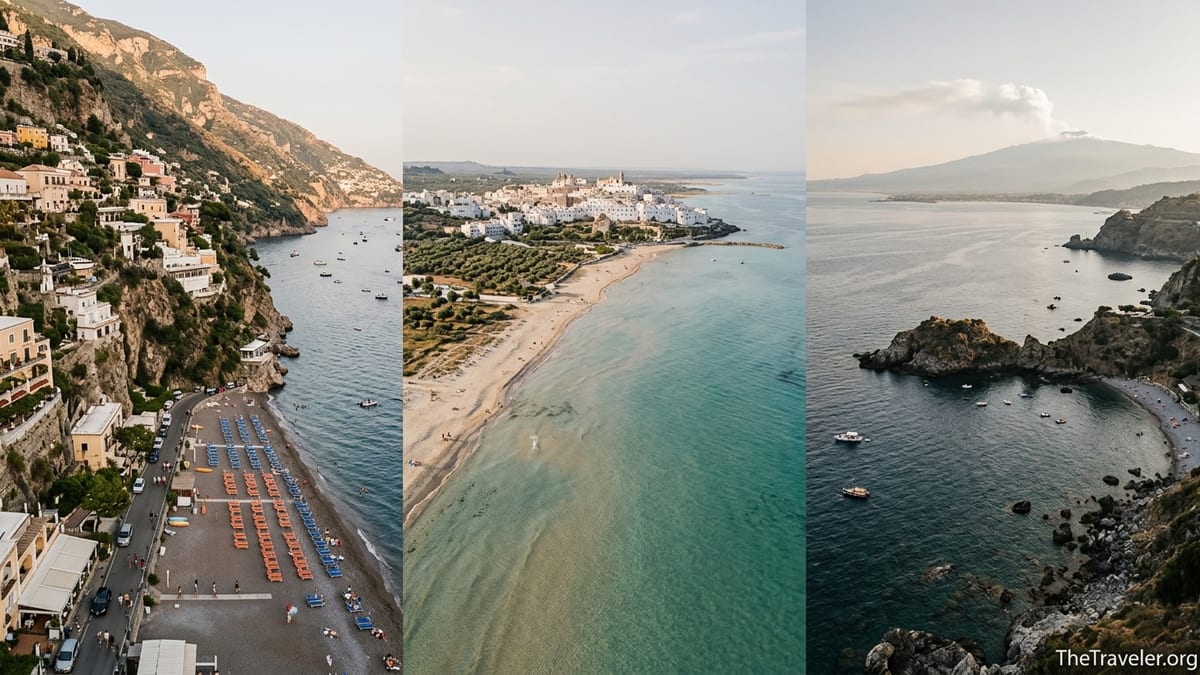
Overall Vibe: Three Very Different Southern Italies
The Amalfi Coast is the most famous and visually dramatic of the three. Towns like Positano, Amalfi and Ravello cling to sheer cliffs above a deep blue sea, with steep staircases instead of streets and hotels stacked one above another. The atmosphere in peak months feels closer to a high-end resort than a normal Italian town: sunset spritzes on terraces, designer boutiques and a constant flow of day trippers arriving by ferry and private boat.
Puglia, by contrast, is wide open and low-rise. This is Italy’s heel, a largely rural region of olive groves, whitewashed hill towns such as Ostuni and Locorotondo, and long strips of accessible coastline around Polignano a Mare, Monopoli and the Salento peninsula. The feel is slower and more local. Even in summer, many beach towns still cater primarily to Italian families on holiday, with promenade passeggiata in the evening and simple, excellent seafood restaurants rather than rooftop cocktail bars.
Sicily is the largest of the three and feels like a small country in itself. The island combines cosmopolitan cities such as Palermo and Catania, resort towns like Taormina and Cefalù, serious archaeology at Agrigento and Siracusa, plus volcano landscapes around Mount Etna. It has a grittier, more everyday energy than the Amalfi Coast and a more urban, varied feel than Puglia. Distances are bigger, driving is more intense, but the range of experiences is much broader if you have time.
Thinking in simple terms: Amalfi Coast is concentrated, glamorous and intense; Puglia is relaxed, spread out and good value; Sicily is diverse, slightly chaotic and endlessly rewarding for travelers who do not mind doing a bit of work to get around.
Beaches, Sea & Natural Scenery
The Amalfi Coast is visually spectacular but not a classic beach destination. Most beaches are narrow strips of dark pebbles at the base of cliffs, such as Spiaggia Grande in Positano or the lido in Amalfi town. Free public sections exist but are small; in season you will usually pay around 20 to 40 euros per day for a pair of sunbeds and umbrella at a stabilimento, and in the most famous clubs such as Arienzo or Da Ferdinando in Positano prices can be higher. Access often involves many steps or short shuttle boats from the main piers, and sun can disappear behind the cliffs by mid-afternoon in some coves.
Puglia delivers the opposite experience: long, mostly flat coastline with far more sand. Around the Salento peninsula you get Caribbean-style shallows at places such as Punta Prosciutto, Torre Lapillo and Pescoluse, with wide, family-friendly beaches and lidos that are busy in August but feel more relaxed at the shoulders of the season. On the Adriatic side, Polignano a Mare’s Lama Monachile is postcard-beautiful but tiny and pebbly; for space you head a few minutes down the coast towards Monopoli’s town beaches and the stretches near Capitolo. Many lidos charge in the region of 15 to 25 euros for two beds and an umbrella, typically a touch cheaper than the Amalfi Coast.
Sicily offers the widest variety of coastal scenery. Cefalù has a long arc of sandy beach at the foot of its medieval old town, while San Vito Lo Capo in the northwest and the beaches around Fontane Bianche and the Vendicari nature reserve in the southeast compete with Puglia for clear, shallow waters. In the north-east, Isola Bella at Taormina offers a classic shingle cove backed by dramatic cliffs and views of Mount Etna. Daily lounger rentals are often a little below top Amalfi levels but above the cheapest parts of Puglia, though this varies sharply between low-key local lidos and fashionable clubs near Taormina and Palermo.
For pure sea-and-sand holidays, Puglia or Sicily generally win over the Amalfi Coast. The Amalfi Coast is at its best for boat days, cliff views and coastal hikes like the Path of the Gods rather than long sandy beaches.
Towns, Culture & Accommodation Styles
On the Amalfi Coast, most visitors choose between Positano, Amalfi, Praiano, Ravello and neighboring villages like Atrani and Minori. Positano has the most iconic visuals and upscale boutique hotels, where standard doubles in high season for sea-view properties commonly start around 500 to 700 euros per night, with premier rooms running far higher. In Amalfi town you find a mix of mid-range hotels and historic properties in converted convents and palazzi, with more options between roughly 200 and 400 euros in shoulder months if you book early. Smaller towns like Minori and Maiori tend to be more affordable and have a more residential feel, with simple three-star hotels and apartment rentals.
Puglia’s character shows most strongly in its towns and rural stays. You can base yourself in a whitewashed hill town such as Ostuni or Martina Franca, a coastal town like Monopoli, or in the countryside at a masseria, a fortified farmhouse turned guesthouse. Masserie range from working farms with simple rooms that might start under 200 euros in shoulder season to polished retreats with pools and tasting menus at rates competing with good Amalfi hotels but with more space. In the Valle d’Itria, the trulli houses around Alberobello and Locorotondo are popular for short stays, though many travelers now prefer nearby towns that feel less overtly touristy.
Sicily’s accommodation spans chic design hotels in Ortigia or Palermo’s Kalsa district, family-run pensioni in small coastal towns, agriturismi in the countryside and villas scattered across the island. A mid-range hotel room in Palermo or Catania can still often be found in the 120 to 250 euro range in spring or autumn, noticeably below equivalent properties in Positano or Amalfi at the same time of year. Resorts in Taormina and exclusive countryside properties around Etna or Noto are priced higher, but the spread means Sicily can work for many budgets if you are flexible about location and willing to drive.
If your dream is waking up in a design hotel perched above the sea with room service breakfast on the terrace, the Amalfi Coast is unmatched. If you like the idea of stone farmhouses, olive groves and a pool a short drive from multiple towns and beaches, Puglia’s masserie are a strong fit. Sicily gives you the chance to mix city hotels, beach stays and rural nights on a single trip.
Food, Wine, Nightlife & Atmosphere After Dark
All three destinations serve classic southern Italian flavors, but the tone is different. On the Amalfi Coast the restaurant scene leans refined and romantic: lemon-infused seafood pastas, tasting menus on terraces in Positano, spritzes in chic hotel bars. Expect cover charges of 2 to 5 euros per person, mains often in the 20 to 35 euro bracket at mid-range restaurants in the main towns, and significantly more in fine dining spots or hotel restaurants. Beach clubs like Da Adolfo near Positano combine simple grilled fish lunches costing roughly 15 to 25 euros for a main course with relaxed cove settings that feel luxurious but informal.
Puglia’s cuisine is more rustic and vegetable-led, and the bill often feels gentler. In local trattorie you are likely to find orecchiette with cime di rapa, pureed fava beans with chicory, and fresh seafood served simply. A family could eat well in many inland towns for perhaps 15 to 20 euros per person for a main course and shared antipasti, plus house wine that is both good and inexpensive by international standards. In coastal towns like Monopoli or Gallipoli, evening life revolves around bar tables spilling onto the streets, gelato walks and busy pizzerias rather than nightclubs.
Sicilian food is the most distinctive, with strong Arabic and North African influences layered onto Italian foundations. In Palermo you might eat panelle fritters, sfincione-style pizza and sardines with pine nuts and raisins before finishing with cannoli or granita. Street food is a major part of the culture and can keep costs very manageable if you mix it with more formal restaurant meals. Along the east coast, especially near Catania and Taormina, seafood and Etna wines take center stage. Nightlife varies: Palermo has a lively bar scene that runs late, Taormina has more polished wine bars and hotel lounges, while smaller towns keep things simple with aperitivo and a passeggiata along the seafront.
In pure nightlife terms, none of the three competes with big clubbing destinations, but the Amalfi Coast and Taormina have the most overtly glamorous scenes, Puglia offers relaxed bar culture, and Sicily’s larger cities give you the liveliest late-night energy.
Getting Around, Road Trips & Practicalities
Transport is one of the biggest practical differences. On the Amalfi Coast, the main coastal road between Positano and Salerno is narrow, winding and often congested in high season. Parking is limited and can cost several euros per hour even where it exists. Public SITA buses and seasonal ferries connect the main towns, with bus tickets typically under 3 euros per ride and ferry journeys such as Amalfi to Positano roughly three to four times that amount depending on operator and season. Services are frequent in summer but can be crowded, and rough seas can cancel ferries at short notice. In recent years, alternating license plate restrictions have applied to non-resident cars on certain peak days, which means self-driving visitors sometimes cannot use the road every day in high season.
Puglia is far more car-friendly. The region’s main airports at Bari and Brindisi are connected to cities and some coastal towns by train, and there are regional buses, but many of the best beaches and rural stays are easiest to reach by car. Roads are generally wider and calmer than the Amalfi coastal road, with fewer dramatic cliff drops and more standard driving conditions, though you still need to be comfortable with Italian driving styles. Car rental pricing fluctuates sharply with season and demand but is often more reasonable in Puglia and Sicily than in the busiest corners of the Amalfi Coast once daily parking and ZTL fines are factored in. Many travelers structure a Puglia trip as a loop: a few nights near Polignano or Monopoli, then inland to the Valle d’Itria, finishing in the Salento near Otranto or Gallipoli.
In Sicily, distances are longer and the island’s size makes a car even more valuable if you want to see more than a single area. There are decent train and bus links along the main coasts and between cities like Palermo, Catania, Messina and Siracusa, but many inland villages, coastal nature reserves and wine regions are poorly served. A common itinerary might combine Palermo and nearby Monreale, then drive west to Trapani and the Egadi Islands, or go east towards Cefalù, Taormina and Etna. Expect a mix of modern highways and older local roads, plus city centers where you will want to park and walk.
For travelers who dislike driving, the Amalfi Coast works if you choose a well-connected base such as Amalfi or Sorrento and rely on ferries and buses, accepting some queues. Puglia without a car restricts you more to the main rail-accessible towns. Sicily without a car is most comfortable if you focus on one or two areas with good public transport, such as the Palermo region or the eastern corridor from Catania to Taormina and Siracusa.
Costs, Crowds & Best Time to Visit
In broad terms, the Amalfi Coast is the most expensive and crowded of the three, Puglia the best value, and Sicily somewhere in the middle but highly variable by area. In peak months from late June through early September, nightly rates in Positano and Capri can reach levels comparable with major global luxury destinations, and even modest three-star hotels in prime Amalfi Coast towns can command several hundred euros per night. Restaurant prices, beach club fees, private boat excursions and transfers all follow suit. Crowds remain heavy from May into October, with September now almost as busy as high summer in many towns.
Puglia has seen a strong rise in popularity, but average daily budgets still tend to be lower than on the Amalfi Coast. A mid-range traveler staying in a masseria or good local hotel, renting a car and eating in a mix of trattorie and one or two higher-end restaurants will usually find that their accommodation and food spend feels noticeably lighter than an equivalent standard on the Amalfi Coast. Inland towns and less-publicized stretches of coast in the Gargano or northern Salento remain good value, especially outside August when Italian holidaymakers concentrate on the sea.
Sicily’s costs depend heavily on where and when you go. Taormina in July, with its clifftop hotels and views to Etna, can approach Amalfi Coast pricing for prime properties and beach clubs. By contrast, spending a week in a smaller town like Castellammare del Golfo, Noto or Ragusa Ibla outside the absolute peak can feel far more affordable, with good hotels and apartments at rates closer to inland Puglia. Street food and casual dining help keep overall daily spend reasonable, even if you occasionally splurge on vineyard lunches or boat days.
For all three destinations, April to early June and late September to October usually offer the best compromise between weather and crowds. Sea temperatures are cooler at the start of the season but still swimmable for many visitors by late May in Puglia and Sicily and a little later on the Amalfi Coast. By late October, services such as ferries and beach clubs begin winding down, especially along the Amalfi Coast, while larger Sicilian cities remain lively for longer thanks to their resident populations.
Who Each Destination Suits Best
The Amalfi Coast is ideal for travelers who value drama and romance above all. Honeymooners who dream of balconies in Positano, couples willing to spend on boutique hotels and private boat days, and short-trip travelers looking to pack a lot of aesthetic impact into three or four days will get exceptional memories here. It can also work for families who base in slightly quieter, flatter towns like Maiori or Minori, where beaches are broader and prices more manageable, but you will still need to manage stairs, crowds and transport logistics.
Puglia suits travelers who want a slower, more local-feeling trip and are happy to explore by car. Couples who like a mix of countryside and sea, families who want sandy beaches without the price tag of the Amalfi Coast, and groups of friends looking for villa stays and long lunches under olive trees all tend to thrive here. It works particularly well for repeat visitors to Italy who have already ticked off Rome and Florence and now want somewhere to settle in for a week. The atmosphere is more low-key than the Amalfi Coast or Sicily’s big cities, with evenings focused on food and conversation rather than showy nightlife.
Sicily is strongest for travelers who want variety, culture and a sense of adventure. If you can spend at least 8 to 10 days and are comfortable driving, you can combine beach time, baroque towns like Noto and Modica, vineyard visits on Etna and serious archaeological sites like the Valley of the Temples. It is an excellent choice for curious couples, culture-focused families with older children, and food-motivated travelers who want to dive into regional specialties. Those who prefer to stay put in one place can still enjoy a more resort-style week in Taormina or Cefalù, but the island rewards those who move around.
If you are choosing one base for a quick southern Italy add-on to Rome, the Amalfi Coast gives you maximum “wow” per day at a premium price. For a value-conscious, beach-focused holiday with a strong sense of everyday Italian life, Puglia edges ahead. For a longer, richer itinerary with enough contrast to fill two weeks without boredom, Sicily is hard to beat.
The Takeaway
No single region is objectively better. The right choice depends on your priorities, budget, timeframe and appetite for crowds or logistics. The Amalfi Coast concentrates luxury hotels, famous views and high-end services into a short stretch of coastline; it delivers unforgettable romance and photogenic moments, but at the cost of higher prices, dense crowds and sometimes frustrating transport.
Puglia stretches its charms over a broad, easygoing landscape of beaches, hill towns and olive groves. It offers softer pricing, more space and a slower pace, especially beyond the most Instagrammed spots. The trade-offs are the need for a rental car in most itineraries and fewer blockbuster “sights” compared with Sicily’s great archaeological and urban highlights.
Sicily sits between them on price but ahead on depth. Its combination of cities, small towns, beaches, volcanoes and ruins makes it the most varied of the three, though also the most demanding in terms of planning. Distances are longer, driving can be intense around major cities, and you need to be realistic about how much ground you can cover.
If you picture cliffside cocktails, candlelit terraces and do not mind paying for the setting, choose the Amalfi Coast. If your dream is sandy beaches, white towns and long lunches on a farm terrace, choose Puglia. If you want an all-in-one island of cities, ruins, coast and wine with a slightly wild edge, choose Sicily. Any of the three can deliver a superb southern Italy trip as long as you match the destination to your own travel style rather than the most famous photograph.
FAQ
Q1. Which destination is best for a first-time visitor to Italy with only a few days?
For a short add-on of three to four nights, the Amalfi Coast usually makes the strongest impression, especially if you base in Amalfi or Positano and focus on views, boat trips and a couple of nearby towns rather than trying to see everything.
Q2. Where will my money go furthest: Amalfi Coast, Puglia or Sicily?
Puglia typically offers the best value overall, especially if you stay in inland towns or mid-range masserie and travel outside August. Smaller Sicilian towns can also feel very good value, while the Amalfi Coast is generally the most expensive across accommodation, dining and beach clubs.
Q3. Which region has the best beaches for children?
Puglia and Sicily both have more long, sandy, gently shelving beaches than the Amalfi Coast, which is better known for pebbly coves and steep access. Areas like Salento in Puglia and San Vito Lo Capo or the south-eastern coast in Sicily work particularly well for families.
Q4. Is it worth renting a car on the Amalfi Coast?
For most visitors the answer is no. Parking is limited and expensive, the road is narrow and busy, and in peak periods there can be driving restrictions for non-resident cars. Basing in a town with good ferry and bus links and using public transport or private transfers usually makes for a more relaxing stay.
Q5. Can I visit Puglia or Sicily without driving?
Yes, but your options are more limited. In Puglia you can connect Bari, Polignano a Mare, Monopoli and Lecce by train, then use local taxis and occasional buses. In Sicily, focusing on the corridor between Catania, Taormina and Siracusa or on Palermo and its surroundings works without a car, but more remote beaches and villages are hard to reach.
Q6. Which destination is best for nightlife?
The Amalfi Coast and Taormina in Sicily offer the most overtly glamorous nightlife, with cocktail bars and some clubs, though on a smaller scale than big party resorts. Puglia’s evenings are livelier in July and August, especially in coastal towns, but generally center on bars, street life and late dinners rather than dedicated clubbing.
Q7. Where should couples choose for a romantic trip or honeymoon?
For pure romance, the Amalfi Coast remains the classic choice thanks to its dramatic scenery, luxury hotels and sunset terraces. Puglia is a great alternative for couples wanting more privacy, space and countryside charm, while Sicily suits those who want romance plus culture, with evenings in cities like Ortigia or Palermo and day trips to ruins and vineyards.
Q8. Which region is better for a family road trip?
Puglia and Sicily are both well suited to family road trips. Puglia offers shorter driving distances between towns and many easy beaches, while Sicily rewards longer trips with greater variety, from archaeological sites to volcano landscapes. The Amalfi Coast is less ideal for self-drive family trips because of road conditions, parking and crowding.
Q9. How far in advance should I book accommodation in these regions?
For peak season stays on the Amalfi Coast and in hotspots like Taormina or Polignano a Mare, booking three to six months ahead is sensible, and even earlier for the most sought-after small hotels. In shoulder seasons and in less famous towns in Puglia or Sicily, you can often book closer to your travel dates, though choice narrows the longer you wait.
Q10. If I want both culture and beach time, which should I pick?
Sicily offers the richest combination of major cultural sites and good beaches on a single trip, especially if you combine areas like Siracusa, Noto or Agrigento with coastal bases such as Cefalù or the south-eastern shores. The Amalfi Coast and Puglia have beautiful historic towns, but Sicily’s scale and history make it stand out for travelers who want substantial sightseeing alongside the sea.