


Rome, Florence and Venice form Italy’s classic first-time route: three very different cities linked by fast, frequent trains. With a bit of planning around how many nights to spend in each place, which trains to book and which headline sights really need reservations, you can see a lot without turning your holiday into a frantic checklist.
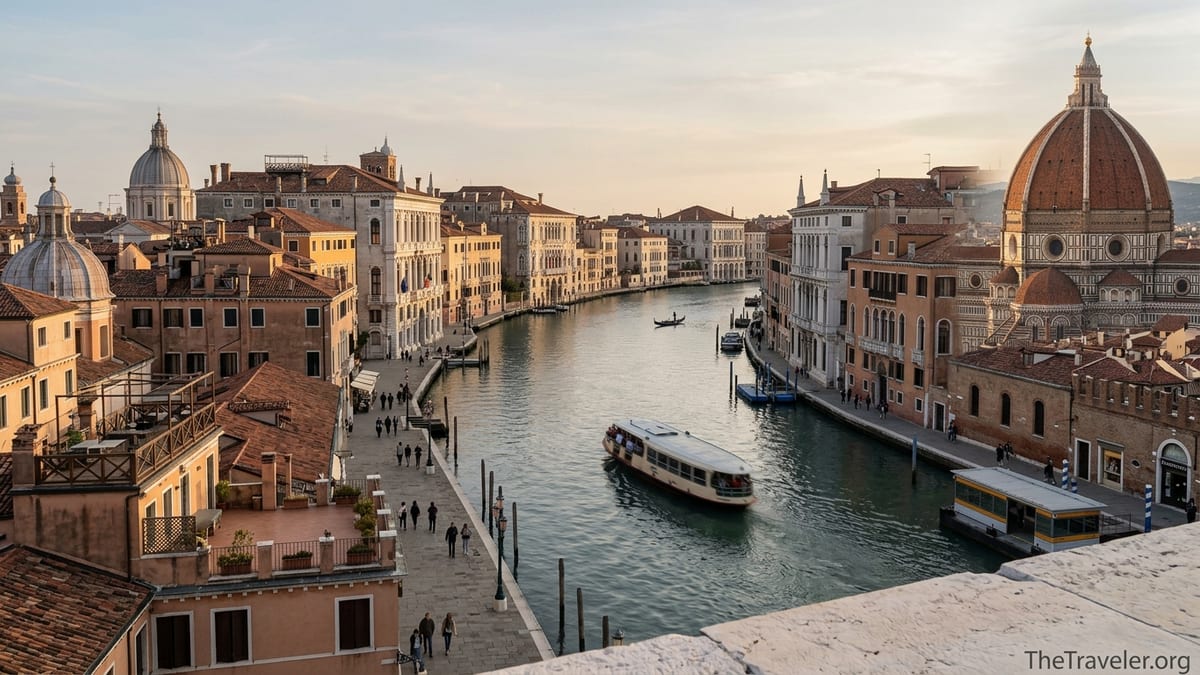
How Many Nights in Rome, Florence and Venice
For a first trip focused on the classic three-city route, a good baseline is 10 nights: 4 in Rome, 3 in Florence and 3 in Venice. This balance reflects how large and layered Rome is, gives Florence enough time for both city museums and a taste of Tuscany, and lets Venice breathe beyond a single crowded day. Many packaged rail itineraries built around these cities use a similar pattern, often 3 nights in Rome, 2–3 in Florence and 2–3 in Venice, which works as an absolute minimum if your time is tight.
Rome rewards extra days more than anywhere else on this route. With 4 nights you can dedicate full days to ancient Rome and the Colosseum area, the Vatican Museums and St Peter’s, plus a day for slower neighbourhood wandering through Trastevere, Testaccio or along the Appian Way. If you cut Rome to 3 nights, you will still see the major sights but will feel more rushed and have less flexibility if you hit a rainy day or a museum closure.
Florence is compact, so 2 full days can cover the essentials: the Duomo complex, Uffizi, Accademia and an evening across the Arno in the Oltrarno district. A third or fourth night lets you build in a day trip to the Tuscan countryside, Siena or Pisa without sacrificing time in the city itself. Many travellers who try to do Florence in a single overnight regret not having one more evening to enjoy the city once the day-trippers leave.
Venice is often underestimated. One full day is technically enough for a quick circuit of St Mark’s Basilica, Doge’s Palace and a vaporetto ride along the Grand Canal, but the magic of the city emerges in the quieter early mornings and late evenings. With 2 or 3 nights you can explore less crowded neighbourhoods like Cannaregio or Dorsoduro, visit one or two lagoon islands and still have time to get pleasantly lost around small campos and canals.
Where to Start and End: Choosing Airports and Route Direction
The most efficient version of this itinerary uses an open-jaw flight: arrive in Rome and depart from Venice, or the reverse. This avoids backtracking several hours by train at the end of the trip. On the Rome side, most international visitors land at Fiumicino Airport, which has a dedicated airport rail link into the city. The non-stop Leonardo Express train connects Fiumicino to Roma Termini station in around 32 minutes, with tickets typically around 14 to 15 euros per person. From Termini you can walk, taxi or take the metro to your hotel.
On the Venice side, Venice Marco Polo Airport is closest to the city. From Marco Polo you either take a bus to Piazzale Roma, where the road ends and the vaporetto network begins, or a boat transfer that brings you directly into the lagoon. An alternative is Venice Treviso Airport, used by some low-cost airlines, but it requires a longer coach ride of roughly an hour into Venice. If you are ending your trip there, it is worth checking flight options to Marco Polo first for convenience.
The natural geographic flow is Rome to Florence to Venice heading north, but the order can be reversed without difficulty. Some travellers choose to start in Venice because it is smaller and more pedestrian, allowing you to ease into Italy before tackling Rome’s intensity. Others prefer to finish in Venice so that the holiday slows down at the end, trading Rome’s traffic for canal views and quieter evenings. Either way, the train links between the three cities are straightforward, and you can select whichever direction offers better flight prices or schedules.
If you need to use a simple return flight instead of open-jaw, consider flying in and out of Rome and doing Rome, Florence, Venice and then a single long high-speed train from Venice back to Rome on your final full day. Trains between Venice and Rome can take around 3 hours 45 minutes on the fastest high-speed services, so you would not want to plan that journey on the same day as your long-haul international departure.
Train Route Overview: Rome, Florence and Venice by Rail
Italy’s high-speed rail network ties Rome, Florence and Venice together with fast, frequent services operated by Trenitalia and Italo. On the Rome to Florence corridor, Frecciarossa trains operated by Trenitalia typically take around 1 hour 25 to 1 hour 35 minutes between Roma Termini and Firenze Santa Maria Novella. Italo services cover the same route in similar times. When booked in advance, promotional fares can start under 20 euros for standard class; booking closer to departure can push prices into the 50 to 70 euro range on busy dates.
Between Florence and Venice, direct high-speed trains link Firenze Santa Maria Novella with Venezia Santa Lucia, the station on the Grand Canal. The fastest Frecciarossa and Italo trains take just over 2 hours for the roughly 260 kilometre journey, with typical journey times around 2 hours 5 minutes. Advance fares for this leg often start in the mid-20 euro range and rise toward 60 to 80 euros at peak times or on peak days when demand is high.
There are also direct high-speed trains between Rome and Venice, useful if you decide to skip Florence or reorder your trip. These typically take around 3 hours 45 minutes on the fastest services. Advance prices on Rome to Venice can start below 30 euros for a basic fare, but in summer or during holiday periods a last-minute first-class ticket can cost well over 100 euros. Because prices on Italy’s high-speed trains are dynamic, your booking strategy has a noticeable effect on the overall cost of the trip.
All three cities have central stations on the main high-speed network: Roma Termini in Rome, Firenze Santa Maria Novella in Florence and Venezia Santa Lucia in Venice. In Rome there is also Roma Tiburtina, another station served by some high-speed trains, but for a first trip it is simplest to focus on Termini. In Venice, avoid confusing Venezia Santa Lucia with Venezia Mestre, the mainland station; for the classic lagoon experience you want Santa Lucia, where you step directly out into the canals.
Buying and Riding Trains: Practical Tips and Seat Strategies
For the high-speed segments on this itinerary, buying tickets ahead of time is the single easiest way to save money and reduce stress. Fares are yield-managed, so Rome to Florence might be 19 euros if you buy a month or two in advance for a mid-morning departure, and closer to 60 euros if you wait until the same week for a popular Friday afternoon train. As a rough planning guide, expect to spend 60 to 90 euros total per person for second-class high-speed tickets on the three main legs if you book early and avoid the most popular departures.
Both Trenitalia and Italo sell e-tickets that you can store in their apps or as PDFs on your phone. For these high-speed services you are issued a specific train and reserved seat, and there is no need to validate the ticket in the small green or yellow machines on the platform. In contrast, if you buy a flexible paper ticket for a slower regional train, you must stamp it before boarding to avoid a fine. Staff on board do regular ticket checks, so keep your ID handy if your ticket notes a passenger name.
Seat classes vary by operator, but a typical Frecciarossa will offer Standard, Premium and Business, with Executive at the very top. For journeys under four hours, most travellers find Standard perfectly comfortable: seats are air-conditioned, there are power sockets and luggage racks at the ends of each carriage and above the seats, and a small bar car for coffee and snacks. If you are travelling with large suitcases, aim to board early so you can claim space in the larger racks rather than battling for overhead room.
When choosing departure times, try to avoid the tightest possible connections, especially in summer when small delays are more common. For example, if your hotel check-out in Florence is at 11:00, you might book a 12:30 or 13:00 train to Venice rather than something just after 11:00, allowing for a relaxed check-out and stroll or taxi to the station. If you plan your sightseeing days around early morning train departures, you can often gain additional half-days in each city; a 9:00 train from Rome to Florence will have you at Santa Maria Novella in time for a late-morning coffee in Piazza della Repubblica.
What to Pre-Book: Must-Reserve Sights and Experiences
On this route, certain headline attractions are either timed-entry or so popular that advance reservations are strongly recommended. In Rome, the Colosseum archaeological park uses dated tickets with time slots for entering the amphitheatre. Booking a few weeks ahead secures a morning entry when temperatures are lower and crowds slightly thinner. The Vatican Museums also operate a timed-entry system; reserving an early slot, for example 8:30 or 9:00, allows you to see the Sistine Chapel before the midday crush. For both, small-group guided tours that include skip-the-line access can be worth the extra cost if you are short on time.
In Florence, demand centres on the Uffizi Gallery and the Accademia, home of Michelangelo’s David. At busy times of year, walk-up tickets can sell out or involve substantial queues. Booking official timed-entry tickets in advance for at least one morning and one late afternoon during your stay will anchor your days. The Duomo complex now runs on a combined ticket system that covers the cathedral dome, bell tower, baptistery and museum; the dome climb in particular sells out, so slot that in early in your planning if it is a priority.
In Venice, St Mark’s Basilica and the Doge’s Palace are the main attractions that benefit from pre-booking. Timed-entry slots for the basilica and combined tickets that include access to the Doge’s Palace help avoid long waits in the exposed square, especially in summer heat or winter high water. If a gondola ride is on your wishlist, you do not need to book it months ahead, but you should know approximate prices so you can decide quickly on the spot. A standard private gondola ride of around 30 minutes near the main areas can easily run to 80 euros or more, with supplements in the evening.
Beyond museums, consider reserving a few key food experiences rather than over-structuring every meal. In Rome, a table at a traditional trattoria in Trastevere for your final night can be booked online or by phone. In Florence, a reservation at a wine bar with a view of the Arno at sunset can become a memorable anchor to your stay. In Venice, book ahead if you want a table at a popular bacaro or seafood restaurant in Cannaregio or Dorsoduro, where smaller dining rooms fill quickly.
Sample 10-Day Classic Itinerary with Train Times
To turn these elements into a concrete plan, imagine a 10-day itinerary arriving in Rome and departing from Venice. Day 1 is your arrival in Rome, often partially lost to jet lag. After taking the Leonardo Express or a taxi from Fiumicino to your hotel, you might spend the late afternoon stretching your legs around Piazza Navona and the Pantheon before an early dinner. Over Days 2 and 3 you focus on the Colosseum, Roman Forum and Palatine Hill one day, and the Vatican Museums and St Peter’s Basilica the next, both on pre-booked timed-entry tickets.
On Day 4 you take a morning high-speed train from Roma Termini to Firenze Santa Maria Novella, aiming for a departure around 9:00 or 10:00. About 90 minutes later you arrive in Florence, drop your bags at the hotel and spend the afternoon exploring the historic centre: the Duomo exterior, Piazza della Signoria and Ponte Vecchio. Day 5 is anchored by a morning visit to the Uffizi Gallery on a booked time slot, leaving the afternoon free for the Oltrarno neighbourhood and perhaps a climb to Piazzale Michelangelo for sunset views.
Day 6 in this example is your Tuscan extension from Florence. You might join a small-group day trip that combines Siena, San Gimignano and a winery lunch in the Chianti countryside, or you could take a direct regional train to Pisa, which typically takes under an hour, and then walk or take a local bus from Pisa Centrale station to the Piazza dei Miracoli to see the Leaning Tower and cathedral. Either way, you return to Florence in the evening for one last dinner near Santa Croce or in the San Lorenzo area.
On Day 7 you ride a high-speed train from Florence to Venice, booking a mid-morning departure so that you are stepping out of Venezia Santa Lucia onto the Grand Canal around lunchtime. After settling into your hotel in the historic centre, you spend the afternoon exploring around St Mark’s Square or simply riding the vaporetto up and down the Grand Canal to get oriented. Days 8 and 9 give you full days to explore Venice in depth: one day focused on St Mark’s Basilica, Doge’s Palace and the surrounding sestiere, and another for wandering quieter districts and perhaps visiting Murano or Burano by vaporetto. Day 10 is your departure day, with a boat or bus transfer back to the airport.
Tuscany Extensions from Florence: Day Trips and Overnights
Florence is the ideal base for a first taste of Tuscany. If you have only 2 or 3 nights, day trips by train or organised minibus are the simplest option. Pisa is one of the easiest: frequent regional trains run between Firenze Santa Maria Novella and Pisa Centrale in roughly 50 minutes to just over an hour, with ticket prices usually under 15 euros return per person. From Pisa Centrale, it is around 20 minutes on foot or a short local bus ride to the Leaning Tower and the other monuments of the Piazza dei Miracoli.
Siena offers a different side of Tuscany, with its medieval shell-shaped piazza and striped cathedral. The most direct connection from Florence is by bus rather than train, with journeys of about 1 hour 15 minutes depending on traffic. Many visitors opt for a small-group tour that combines Siena with San Gimignano and a winery in Chianti, which removes the logistics of rural bus schedules and country roads. Prices for these full-day tours vary, but it is common to see them around the 90 to 130 euro per person range, often including lunch and tastings.
If your schedule allows 12 or more nights in Italy, consider inserting a 2-night stay somewhere in the Tuscan countryside between Florence and Rome. A simple pattern is Rome, Florence, a small town such as Montepulciano or Pienza reached via Chiusi by train and taxi, then on to Venice. Another option is to stay in Lucca, easily reached by train from Florence in about 1 hour 20 minutes, where you can rent a bicycle and ride along the tree-lined Renaissance walls before continuing north by train toward Venice.
When adding these Tuscany extensions, watch that you do not compress your city time too much. If seeing Michelangelo’s David or walking through the Doge’s Palace is a lifelong dream, it is better to keep three nights in Florence and three in Venice and simply take one well-chosen countryside day trip than to chop your stays into a string of one-night hops that leave you constantly packing and unpacking.
The Takeaway
A classic Rome, Florence and Venice itinerary works best when you accept the limits of your time and resist the temptation to add too many extra stops. Ten days with 4 nights in Rome, 3 in Florence and 3 in Venice, linked by high-speed trains, offers a realistic blend of headline sights and quieter moments. You will have time to stand under the Sistine Chapel ceiling, cross the Ponte Vecchio at dusk and watch the Grand Canal wake up in the early morning without feeling that every hour is an appointment.
Using open-jaw flights where possible, booking the Rome to Florence and Florence to Venice trains a few weeks in advance, and securing timed-entry tickets for a handful of key attractions will remove most of the friction from the trip. From that base, you can layer on one or two Tuscan experiences such as a day in Siena or Pisa or a countryside winery visit without over-complicating your route. The details of hotels and restaurant reservations matter less than giving each city enough nights and keeping your travel days straightforward.
For many travellers, this first trip becomes a foundation: you see Italy’s greatest hits, learn how the trains work, get a feel for regional food and daily rhythms, and return home with a mental map that makes a second visit to smaller cities and rural areas far easier to plan. Rather than trying to see all of Italy in a single journey, focus on doing this classic three-city route well. The country will still be there, ready for you to explore further, when you come back.
FAQ
Q1. How many days do I really need for Rome, Florence and Venice?
For a first trip, aim for at least 9 to 10 nights total, with a common split of 4 nights in Rome, 3 in Florence and 2 or 3 in Venice.
Q2. Is it better to start in Rome or Venice?
Logistically it makes little difference; choose based on flights. Some travellers like starting in quieter Venice and ending in busy Rome, others prefer the reverse.
Q3. How far in advance should I book train tickets?
For high-speed trains between Rome, Florence and Venice, booking a few weeks to a couple of months ahead usually secures lower fares and better choice of times.
Q4. Do I need a rail pass for this itinerary?
For just Rome, Florence and Venice, individual high-speed tickets bought in advance are usually cheaper and simpler than a rail pass plus seat reservations.
Q5. Which attractions must I reserve in advance?
Priority reservations include the Colosseum and Vatican Museums in Rome, Uffizi and Accademia in Florence, and St Mark’s Basilica and Doge’s Palace in Venice.
Q6. Can I visit Tuscany as a day trip from Florence?
Yes. Popular day trips include Pisa by train, Siena by bus and organised small-group tours that combine hill towns with a Chianti winery visit.
Q7. Is first class on Italian trains worth it?
Second class on Frecciarossa and Italo is comfortable for these short journeys. First class adds more space and quieter carriages but is not essential.
Q8. Should I stay near the train station in each city?
In Rome and Florence, staying within a 10 to 20 minute walk of the station can be convenient. In Venice, prioritise a location you like in the historic centre.
Q9. Is a gondola ride in Venice necessary?
It is optional and relatively expensive, but many first-time visitors enjoy it. If you are unsure, ride the Grand Canal by vaporetto first to see how you feel.
Q10. Can I add Cinque Terre or the Amalfi Coast to this itinerary?
You can, but with only 10 to 12 days it often makes the trip rushed. Most people are happier saving coastal regions for a separate itinerary.