


Italy’s rail network is often the fastest, most relaxed way to move between its great cities. With competing high-speed operators, dense regional lines and stations that double as shopping malls, it can feel confusing at first glance. This guide breaks down how to plan rail journeys between Rome, Florence, Venice, Milan, Naples and Bologna, when to choose high-speed over regional trains, how to buy tickets, what to expect at major stations and when trains beat renting a car.
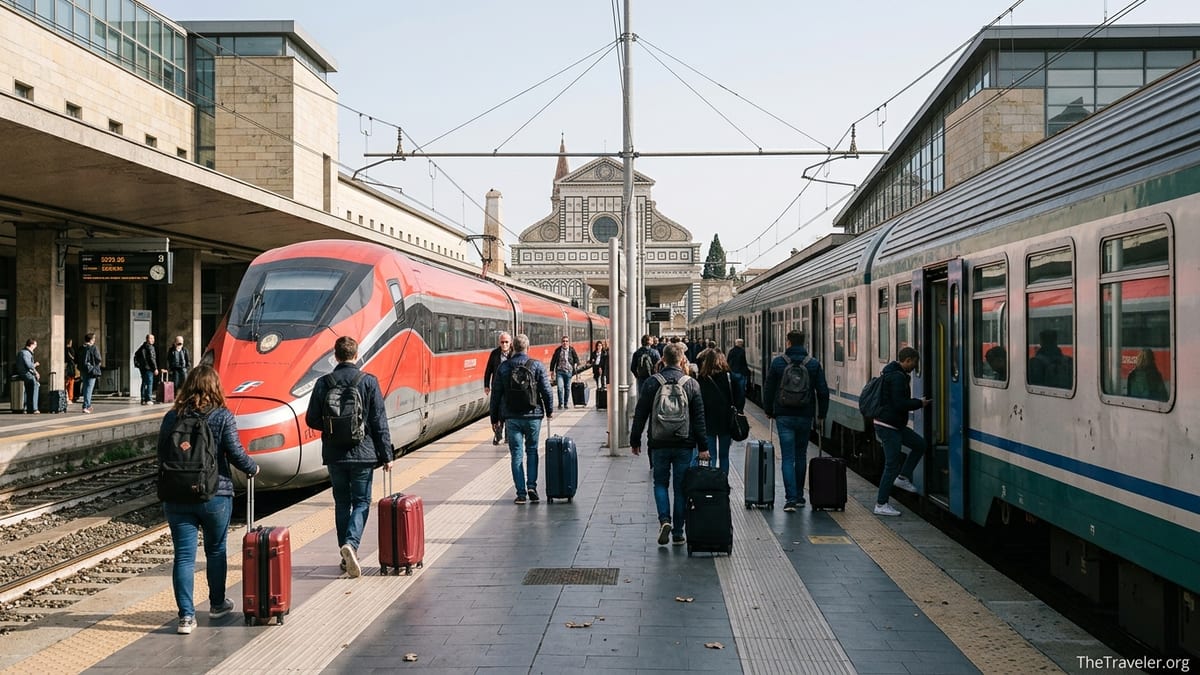
High-speed vs regional trains: how Italy’s network works
Italian trains fall into two broad families that most visitors will use. High-speed trains link major cities at up to around 300 km/h and require advance booking with an assigned seat. Regional trains are slower, cheaper and serve smaller towns, with simpler fares and more flexible tickets. Understanding which type fits your trip will keep costs down and connections smooth.
On the high-speed side there are two main brands: Trenitalia’s Frecciarossa, Frecciargento and Frecciabianca services, and private operator Italo. Both run sleek red trains on the main north-south spine between Naples, Rome, Florence, Bologna, Milan and up towards Turin or Venice. Typical non-discounted fares on a busy Rome to Florence Frecciarossa might sit around 50 to 70 euros in Standard class if bought just a few days ahead, but early promotional fares can drop to roughly 20 to 30 euros on less popular departures.
Regional trains, sold under names like Regionale and Regionale Veloce, connect cities with nearby towns and suburbs. They are the workhorses for journeys such as Florence to Pisa, Milan to Lake Como, or hopping between small Emilia-Romagna cities like Modena and Parma. Fares are generally flat by distance and far lower than high-speed options. A same-day regional ticket from Florence to Pisa, for example, commonly costs under 10 euros per person and has fixed rules rather than dynamic pricing.
A common strategy is to mix the two. For example, you might take a high-speed Frecciarossa from Rome to Florence, then switch to a regional train to reach a Tuscan hill town. Or ride Italo from Milan to Naples and finish with a short regional hop to Pompeii or Sorrento. Plan high-speed legs first, as those sell out at the cheapest prices, then plug in regional segments around them.
Key high-speed routes: Rome, Florence, Venice, Milan, Naples and Bologna
The backbone of most visitors’ rail plans is the high-speed corridor that runs north from Naples through Rome, Florence and Bologna to Milan, then branches towards Venice and Turin. On these routes high-speed trains are dramatically quicker than driving in typical conditions, especially once you factor in traffic and rental logistics.
Rome to Florence is one of the most heavily served corridors. Frecciarossa and Italo trains cover the roughly 270 kilometers in about 1 hour 30 minutes on the fastest runs, compared with closer to 3 hours by car in free-flowing traffic and potentially longer on busy weekends. Promotional tickets on early morning or mid-day departures can be good value if booked a few weeks ahead, making it realistic to day-trip between the two cities without feeling rushed.
Continuing north, Florence to Bologna can take as little as roughly 40 minutes on high-speed services. Many trains run through tunnels under the Apennines, so there is not much scenery, but the speed is unmatched. From Bologna to Milan, journey times often hover around 1 hour or slightly more, again far faster than the two to three hours it might take to drive between traffic, toll booths and city congestion.
Venice sits slightly off the main spine but is still easy to reach. High-speed trains from Milan to Venice typically take about 2 hours 30 minutes, while Venice to Florence is often around 2 hours. From Rome, a direct high-speed train to Venice commonly takes 3 hours 45 minutes to 4 hours. These services use Venice Santa Lucia station, right on the Grand Canal, so you step straight into the city without a transfer from the mainland.
Heading south, Rome to Naples is another corridor where high-speed trains shine. The fastest Frecciarossa services can cover the distance in roughly 1 hour 10 minutes under normal timetable conditions, while slower options and engineering works can push some trains beyond 1 hour 30 minutes. Once in Naples, frequent local trains and Circumvesuviana services connect onward to Pompeii, Sorrento and the Amalfi gateway town of Salerno, making Naples a practical base for coastal exploration without a car.
When high-speed trains beat renting a car
On the core city-to-city routes in central and northern Italy, high-speed trains almost always outcompete car rentals in time, stress level and often cost. Driving between Rome, Florence, Bologna, Milan, Venice and Naples means navigating limited traffic zones, toll highways, fuel costs and expensive city-center parking. Trains, by contrast, deliver you to central stations a short walk or quick taxi ride from major sights.
Consider a typical first-time itinerary: three nights in Rome, three in Florence and two in Venice. Renting a car for that entire stretch means paying for eight days, usually well over 300 euros before fuel and tolls, plus parking fees in or near each historic center that can easily reach 30 to 40 euros per day. A set of high-speed train tickets between those same cities, booked a few weeks out on mid-range fares, might land in a similar total price range or lower, especially if you travel in second class and avoid peak Friday or Sunday evenings.
Trains are also better matched to Italy’s dense urban cores. Rome Termini, Florence Santa Maria Novella and Venice Santa Lucia stations all sit inside or right next to the historic center. In Florence you can often roll your suitcase 10 minutes on foot from the station to many hotels near the Duomo. In Venice, you leave the train and walk directly to vaporetto piers to reach the Rialto or San Marco. With a car you would be parking outside the center and then transferring by taxi, tram or vaporetto anyway.
There are, however, cases where a car still makes sense. If you plan to stay in rural Tuscany or Umbria, visit wineries outside towns, or explore scattered hill villages like Montepulciano, Pienza and Montalcino in a single day, buses and regional trains become slower and less direct. In those scenarios a hybrid plan can work well: use high-speed trains between cities, then rent a car for just a couple of days from Florence, Bologna or Naples to explore surrounding countryside.
Tickets, seat reservations and how to save money
On Italian high-speed trains, a ticket always includes a specific train, departure time and seat reservation. When you buy a Rome to Florence Frecciarossa ticket, for example, you will see a coach number and seat number printed or in your app. Reservations are mandatory, and you cannot sit anywhere you like as on many regional trains. Italo follows the same logic, assigning seats automatically when you purchase.
Prices on these high-speed services are dynamic. Peak departures on weekdays and Sunday evenings can be the most expensive, while mid-morning or early afternoon trains tend to be cheaper. Saver or Super Economy style fares can be significantly lower than fully flexible options but usually come with restrictions such as no refunds or limited changes. For instance, you might see a mid-afternoon Naples to Milan ticket advertised for around 40 euros in Standard class in a promo fare, while a last-minute fully flexible ticket on the same day could run over 100 euros.
Regional trains are sold very differently. Fares are distance-based and generally fixed, with no seat reservations. You simply board any train that matches your ticket’s origin, destination and time conditions. Increasingly, digital regional tickets purchased through official apps carry a QR code and automatically register for a specific train or a validity window of a few hours, so you do not need to stamp them in the old green machines. Older paper tickets, still sold at some stations and tobacconists, typically must be timestamped before boarding using the small validation machines on platforms or in station halls to avoid fines.
To save money overall, book high-speed legs as soon as you know your dates, then allow some flexibility for regional segments. Many travelers buy their Frecciarossa or Italo tickets 2 to 6 weeks ahead for the best combination of price and choice of departure. For shorter regional hops, same-day or day-before purchase is often fine, since fares do not skyrocket close to departure. If you are traveling during peak holiday periods such as mid-August or Easter week, it can still be wise to buy popular regional routes a few days ahead so you are not standing for long stretches.
Booking platforms, validation and practical ticket tips
Most visitors will buy Italian train tickets through a mix of official operator apps, station ticket machines and, sometimes, international booking platforms. Using the official apps of the operator running your train is often the most straightforward. For example, if you are taking a Frecciarossa from Rome to Florence and then a regional train to Pisa, you can typically buy both legs in one transaction through Trenitalia’s channels. If you prefer Italo for the long leg, you might book that directly in its app and then purchase a separate regional ticket to your final destination.
At stations, large red or green self-service ticket machines offer language options in English and accept major credit cards and often contactless payments. A traveler arriving into Milan Malpensa Airport, for instance, could use a machine to buy a Malpensa Express regional ticket into Milan Centrale, then later that day purchase a separate high-speed ticket to Venice. Staffed ticket counters are available in big stations like Rome Termini or Naples Centrale but can have long lines at busy hours, so machines or apps are usually quicker.
Validation rules can be a source of anxiety. High-speed train tickets bought digitally do not need validation; your QR code and ID are enough. For regional travel, if your ticket is stored in an app with a QR code and a specific train or activation window, you usually just show it on your phone. If you are holding an old-style paper regional ticket without a date and time printed, remember to stamp it in the small machines before boarding, ideally a few minutes before your train arrives. If you forget and realize while on board, seek out the conductor as soon as possible and explain, as quietly fixing the mistake early is more likely to lead to a warning than a fine.
For peace of mind on a multi-city trip, keep all tickets and confirmations accessible offline. Screenshots of QR codes, or saving PDFs to your phone’s files app, help avoid problems if station signal drops. On days with crucial connections, such as reaching Venice in time for a cruise departure, avoid the last possible train and leave yourself an extra hour or two in case of delays, especially during summer heat or when track works are scheduled between hubs like Rome and Florence.
Luggage, onboard experience and finding your carriage
Italian trains are generally generous with luggage. On high-speed Frecciarossa and Italo trains you can bring standard suitcases, backpacks and cabin bags at no extra cost, as long as you can carry them yourself and they fit in the racks. Typical options include overhead shelves for smaller bags, vertical racks at the ends of each carriage for larger suitcases, and in some cases spaces between back-to-back seats where a medium suitcase can slide in. There is no checked luggage service in the airline sense; you keep your bags with you on board.
For a concrete example, a couple traveling Rome to Venice on a Frecciarossa with two 70-centimeter rolling suitcases and two cabin-size bags should have no difficulty. They might place the larger bags in the rack at the carriage entrance and keep the cabin bags above their seats. On busy Friday afternoon departures, overhead space can fill quickly, so boarding promptly when the platform is announced is helpful. Compare this with driving, where you are loading and unloading bags through traffic and parking garages multiple times.
On regional trains, layout varies more. Some have modern interiors with overhead shelves and low-level racks near doors, while older carriages may have only overhead racks. Families sometimes pile several suitcases in a corner near the door; this is common, but try not to block aisles or emergency exits. Keep valuables like passports and electronics in a small backpack at your feet or on your lap. While theft is not rampant, it is sensible to loop a bag strap around your leg or the seat frame on crowded services.
Platform and coach information is usually clear once you know what to look for. Electronic boards in stations list your train number, destination and platform. On high-speed routes, printed carriage diagrams often show where each coach will stop along the platform, sometimes labeled with letters like A, B or C corresponding to zones. If your ticket says “Coach 4, Seat 12A,” check the platform screen for a map that shows where coach 4 will roughly line up, then wait in that zone so you can board calmly instead of sprinting with luggage when the train arrives.
Major stations: Rome, Florence, Venice, Milan, Naples and Bologna
Italy’s big-city stations function as small urban centers, with supermarkets, cafes, pharmacies and luggage storage. Knowing a few details about the main hubs on a typical itinerary can smooth transfers and reduce stress.
Rome Termini is the capital’s main station and a crossroads for both high-speed and regional trains. Most Frecciarossa and Italo services between Milan, Florence, Naples and Venice pass through here. Inside the station you will find multi-level shopping galleries, food courts and clear signage to metro lines A and B. Luggage storage services operate on the ground level on the side of the station closest to Via Giolitti, useful if you have several hours before hotel check-in and want to explore on foot without bags.
In Florence, Santa Maria Novella station sits at the edge of the historic center, about a 10-minute walk from the Duomo. High-speed trains from Rome, Bologna and Milan typically arrive and depart here. The station has a compact, horizontal design with clear exits: one side opens towards the church of Santa Maria Novella and the city center, the other towards bus stops and some car rental offices. For an itinerary such as Rome to Florence to Pisa, you would arrive on a high-speed train at Santa Maria Novella, walk a short distance inside the station and transfer to a regional platform for trains to Pisa Centrale.
Venice Santa Lucia is unusual in that it is on the water. Almost all long-distance passenger trains terminate here rather than at the mainland Mestre station, which is useful for visitors. Once you exit the station doors, you step onto a broad set of steps dropping to the Grand Canal where water buses, water taxis and some gondolas await. Give yourself a little extra time here if you are traveling with heavy luggage, as there are bridges with steps to cross on the way to many hotels.
Milan Centrale, Naples Centrale and Bologna Centrale are large but manageable with good signage. Milan’s main station is monumental in scale but straightforward: high-speed trains to Venice, Florence, Rome and Naples typically depart from the high-numbered tracks at the rear. Naples Centrale sits above the lower-level Circumvesuviana platforms that serve Pompeii and Sorrento, so be sure to distinguish between them by following signage carefully. Bologna Centrale is a key junction where some high-speed trains run underground while regional services use surface tracks; leave a buffer of 15 to 20 minutes for transfers until you are familiar with its layout.
Planning connections and avoiding common pitfalls
When building a multi-city itinerary, allow realistic connection times, especially when switching between high-speed and regional trains. A 10-minute change in Bologna from a Frecciarossa arriving from Florence to a regional train towards Ravenna might be technically possible but stressful, particularly if your incoming train is a few minutes late. Many travelers find that 20 to 30 minutes is a comfortable minimum at busy hubs, giving time to check boards, walk between platforms and pick up a quick snack.
Be mindful of engineering works, which can temporarily alter journey times and routes. For example, if track maintenance is scheduled between Rome and Florence over a summer period, some high-speed trains may detour, adding significant time or skipping stops. Operators typically display alerts during booking that certain trains have extended travel times. If you are traveling on a fixed schedule, choose services with fewer warnings and avoid the last possible train that would still make your next commitment.
Another pitfall is underestimating how crowded trains can become at peak holiday times. On Friday afternoons in July, high-speed services between Milan, Bologna and the Adriatic coast or between Rome and Naples can sell out of cheaper fare buckets weeks ahead. In such periods, booking as soon as seats go on sale can both ensure you travel when you wish and secure a better price. For regional routes that do not require reservations, you can still end up standing in aisles if you board late on popular departures, so arriving on the platform 10 to 15 minutes early is wise.
Lastly, watch out for pickpockets and unofficial helpers in large stations. In Rome Termini or Milan Centrale, someone may offer to “help” you with a ticket machine or your bags, then demand a tip. Firmly decline and seek uniformed staff or official information points if you need assistance. Keep your wallet and passport zipped away, especially on escalators and while watching departure boards, which are common distraction zones.
The Takeaway
Used well, Italy’s trains turn a multi-city trip into a relaxed progression of short hops rather than a sequence of stressful drives. High-speed services stitch together Rome, Florence, Bologna, Milan, Venice and Naples in journey times that often beat flying once you account for airport transfers, while regional trains reach smaller cities and suburbs at modest cost. With a bit of planning around ticket types, seat reservations and station layouts, the system’s quirks become predictable rather than intimidating.
For most itineraries focused on major cities, trains will be more efficient and enjoyable than renting a car for the entire trip. You can always add a short car rental segment for rural stays or wine country exploration while relying on high-speed lines for longer jumps. Buying high-speed tickets early, using official apps, understanding when and how to validate regional tickets and allowing sensible connection times will cover most practical challenges.
Whether you are watching Tuscany flash by from a Frecciarossa, rolling your suitcase from Florence Santa Maria Novella into the historic center or stepping out of Venice Santa Lucia directly onto the Grand Canal, Italy’s rail network can become one of the highlights of your journey rather than just a way to get from A to B.
FAQ
Q1. Do I need to book Italian high-speed trains in advance?
It is not mandatory, but it is strongly recommended. High-speed trains use dynamic pricing and can sell out of the cheapest fares weeks ahead, especially on routes like Rome to Florence or Milan to Venice. Booking 2 to 6 weeks in advance usually gives better prices and a wider choice of departure times.
Q2. Do regional train tickets still need to be validated?
Digital regional tickets bought through official apps are often linked to a specific departure or time window and do not need physical validation. However, if you buy a paper regional ticket without a printed date and time, you should stamp it in the small validation machines at the station before boarding to avoid fines.
Q3. How much luggage can I bring on Italian trains?
There is no strict piece or weight limit like on airlines, as long as you can carry your bags yourself and they fit in the racks. On both high-speed and regional trains, standard suitcases and cabin bags are normally accepted without extra charges. Use overhead shelves, end-of-carriage racks and spaces between seat backs, and keep valuables with you.
Q4. Are seats assigned on all trains?
On high-speed trains such as Frecciarossa and Italo, seats are always assigned and printed on your ticket. On most regional trains, seats are unreserved and you can sit anywhere that is not marked as reserved for specific users. In busy times you may have to stand on regional services if all seats are taken.
Q5. Which station should I use in Venice, Mestre or Santa Lucia?
Visitors should aim for Venice Santa Lucia whenever possible. It is located on the Grand Canal in the historic center, so you walk directly to water buses or your hotel area. Venice Mestre is on the mainland and better suited only if you are staying in budget hotels outside the old city or making quick onward connections.
Q6. How early should I arrive at the station before my train?
Italian trains do not require airport-style check-in. For high-speed departures from major stations, arriving 20 to 30 minutes before departure gives time to find your platform and carriage comfortably. For regional trains on familiar routes, 10 to 15 minutes is usually enough, provided you already have a ticket.
Q7. Is first class worth it on Italian high-speed trains?
First or business class on high-speed trains offers wider seats, more legroom and often quieter cars, plus sometimes a welcome drink or snack. For short hops like Rome to Florence, many travelers are happy in second class. On longer legs such as Milan to Naples, upgrading can be worthwhile if the price difference is modest and you value extra comfort.
Q8. Can I eat and drink on board?
Yes. You can bring your own food and drinks on both high-speed and regional trains. Many high-speed services have a cafe car selling coffee, soft drinks, sandwiches and simple snacks. It is common for travelers to pick up panini or pastries from station bakeries and eat them at their seats.
Q9. Are Italian trains safe for solo travelers at night?
Major high-speed routes are generally considered safe, including evening services, with plenty of other passengers on board. As in any busy transport system, keep valuables secure and stay aware of your surroundings, particularly in large stations and on late-night regional trains where carriages may be quieter.
Q10. What happens if I miss my train?
If you miss a high-speed train on a restrictive fare, your ticket may not be changeable, or changes may incur a fee. More flexible fares allow modifications before departure. For regional trains, tickets are often valid within a set time window, so you can usually take the next service as long as your ticket is still valid. Always check the specific conditions on your fare type before travel.