


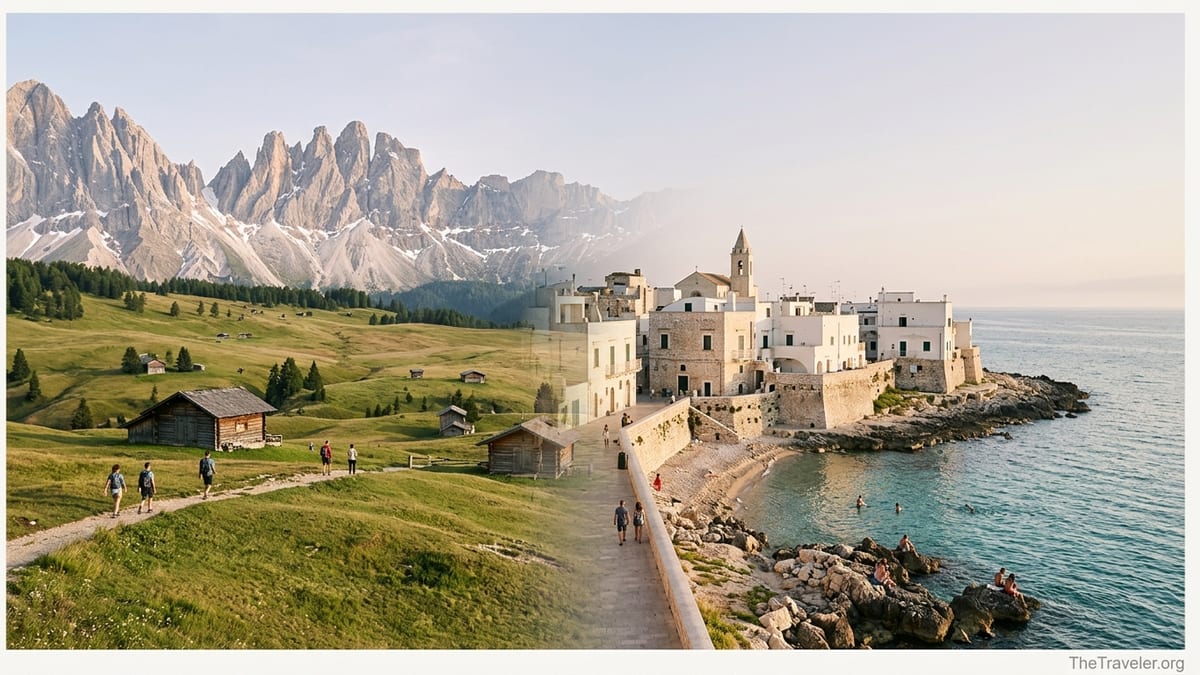
Ask ten Italy lovers whether to head north or south and you will hear ten passionate, conflicting answers. Snow capped Dolomites or sun baked Sicilian coast, Venice’s canals or Naples’ chaotic piazzas, Amarone in Verona or Primitivo in Puglia. The truth is that both halves of the country deliver unforgettable trips, but in very different ways. Understanding those differences will help you decide whether to prioritize northern icons like Venice and the Dolomites or southern stars such as Naples, Puglia and Sicily.
Overall Vibe: Refined North vs Laid Back South
Northern Italy generally feels more polished and “Central European,” with cities like Milan, Turin and Bologna running on efficient tram networks and businesslike rhythms. Venice and Verona are famous for romantic canal and piazza scenes, but prices and crowds tend to be higher, especially from May to September when visitor numbers surge across Europe. Coastal spots such as Portofino and the Cinque Terre, and lake destinations like Lake Como and Lake Garda, attract a strong luxury and weekend getaway crowd from Italy, the UK and Germany.
Southern Italy leans more Mediterranean and informal. Naples’ historic center can feel chaotic, with scooters weaving around laundry draped alleyways and late night street life that lasts well past midnight in summer. Puglia’s whitewashed old towns such as Ostuni and Monopoli, and Sicilian cities like Catania and Palermo, mix slower daily rhythms with lively evening passeggiate and outdoor dining. Visitors often describe the south as more “gritty” yet also warmer and more spontaneous in terms of interactions with locals, especially away from heavily touristed pockets of the Amalfi Coast.
For travelers who like order, punctual public transport and feeling they know exactly what to expect, the north usually feels more comfortable. Those who enjoy some unpredictability, louder streets and a stronger sense of everyday local life in progress often feel immediately at home in Naples, Bari or Palermo. Your comfort with that contrast is one of the strongest indicators of whether north or south will suit you better.
Season also matters. In high summer, when northern cities can feel crowded and hot, the relaxed holiday atmosphere of the south’s beach towns may be exactly what you want. In shoulder seasons like April, May, September and October, both halves of the country offer more balanced crowds and milder temperatures, so your personal style and interests should guide the choice.
Cities & Culture: Venice, Milan, Turin vs Naples, Palermo, Lecce
If your priority is art museums, design and grand architecture from the Middle Ages through the Renaissance and Baroque periods, northern Italy is hard to beat. Venice combines Gothic palazzi on the Grand Canal, St Mark’s Basilica and the Peggy Guggenheim Collection for modern art. Florence, often grouped with central Italy but logistically tied to the northern train grid, concentrates masterpieces in the Uffizi and Accademia. Milan adds contemporary culture, from La Scala opera to cutting edge fashion districts, along with historic highlights like the Duomo rooftop and Leonardo’s “Last Supper.”
Southern cities offer a different cultural mix. Naples’ Archaeological Museum houses one of the world’s richest collections of Roman mosaics and sculptures, much of it from Pompeii and Herculaneum. The city’s streets are dense with small churches and traditional workshops. In Sicily, Palermo’s Norman Palace and Monreale Cathedral showcase a rare blend of Arab, Byzantine and Norman influences. On the island’s east coast, Syracuse and its Ortigia island reveal layers of Greek, Roman and medieval history in a compact waterfront setting. In Puglia, baroque Lecce is sometimes called the “Florence of the South” for its ornate golden stone churches and palaces.
Urban comfort levels also differ. Northern hubs like Venice, Verona and Bologna tend to feel easier for first time visitors used to Western European capitals: most central areas are walkable, signage is good and English is widely spoken in tourism businesses. In Naples or Catania, you may encounter more uneven sidewalks, heavier traffic and fewer English speakers once you leave the main piazzas. That said, younger locals in the south are increasingly accustomed to foreign visitors and smartphone translation apps narrow the gap significantly.
If you want a concentrated hit of blockbuster museums and iconic architecture in a short time, routing through Venice, Florence and perhaps a day trip to Verona or Bologna is a logical northern choice. If you are more intrigued by layered, sometimes messy historic centers and street life, basing yourself in Naples with side trips to Pompeii and the Amalfi Coast, or in Palermo with excursions along the Sicilian coast, may deliver a richer experience.
Beaches & Mountains: Dolomites vs Amalfi, Puglia and Sicily
For dramatic mountains, the north is in a different league. The Dolomites, particularly around Cortina d’Ampezzo and Val Gardena, are among Europe’s most famous alpine landscapes, with jagged limestone peaks, green meadows and well marked hiking trails suited to a range of fitness levels. Summer cable cars let even non hikers access panoramic viewpoints, and in winter these same valleys transform into high quality ski resorts. Lakeside regions such as Lake Como and Lake Garda offer softer mountain views combined with water sports, ferry cruises and upscale lakefront villages.
Southern Italy is much stronger on beaches and warm water. Puglia’s Adriatic coast around Polignano a Mare and Monopoli offers rocky coves with clear turquoise water, while the Ionian coast near Gallipoli and the Salento peninsula has wide sandy strands that draw Italian families from June through early September. Sicily adds further variety: volcanic black sand beaches near Catania, pebbly coves around Taormina, and long golden stretches near Cefalù and the south coast. The Amalfi Coast between Sorrento and Salerno serves more as a scenic coastline with small pebble beaches reachable by stairs or boat shuttles.
That does not mean the south lacks mountains. The Apennines run down the peninsula, and regions like Basilicata and Calabria have wild, lesser known national parks. Mount Etna in Sicily offers crater hikes and cable car excursions when conditions allow, sometimes with snow still visible while coastal temperatures sit in the mid teens Celsius in spring and autumn. However, mountainous infrastructure in these southern areas is generally less developed for international tourists compared with the Dolomites, with fewer alpine style hotels and mountain huts that cater specifically to hikers.
If you picture yourself waking to views of limestone towers and spending days on well signed trails or road cycling through valleys, prioritize the Dolomites or Lake Garda. If your mental image of Italy is diving off rocks into translucent water followed by seafood dinners on a seaside promenade, consider focusing on Puglia’s Salento coast or Sicilian beach towns like Cefalù, with perhaps a short, scenic stop on the Amalfi Coast or Capri.
Food & Wine: Regional Flavors North and South
Italian food is profoundly regional, and the north south divide is one of the clearest examples. Northern cooking leans more on butter, cream, rice and polenta, with hearty alpine dishes in the Dolomites and refined risotti and pastas in cities. In Venice you will find cicchetti bars serving small plates such as baccalà mantecato (creamed salt cod) and sarde in saor (sweet sour sardines) alongside spritz cocktails. In the Dolomites, menus often feature canederli (bread dumplings), game stews and apple strudel that reflect Austro Hungarian influence, paired with wines from Alto Adige and Trentino.
Southern cuisine tilts toward olive oil, tomatoes, eggplant, seafood and bold flavors. Naples is the spiritual home of pizza, and you can still find classic margherita or marinara pizzas from around 6 to 8 euros in authentic neighborhood pizzerias, even as more touristy venues charge higher prices near the major sights. In Puglia, orecchiette pasta with cime di rapa (turnip greens) and burrata cheese from the countryside feature on most menus. Sicilian specialties include arancini, cannoli, granita with brioche for breakfast in summer and seafood couscous in western towns like Trapani.
Wine preferences also matter. If you favor crisp whites and structured reds, you may appreciate the north’s offerings from regions like Veneto and Alto Adige. Think Soave and Pinot Grigio with seafood in Venice or Amarone with meat dishes in Verona. The south showcases robust reds and sun ripened whites: primitivo and negroamaro in Puglia, aglianico near Naples and Etna rosso from vineyards that climb the slopes of Mount Etna. Winery visits are easy in both halves of the country, but in the north estates are often more geared to formal tastings with reservations, while in the south you may encounter more rustic, family run experiences.
Vegetarians and vegans will find options in both regions, though traditional menus in smaller northern mountain towns can be meat heavy. Coastal and rural southern areas rely heavily on vegetables and legumes, and many pasta dishes are naturally meat free, though you will need to ask about cheese if you avoid dairy. In practice, travelers often report that eating out feels slightly cheaper in the south, especially if you focus on simple trattorie away from main squares in Bari, Lecce, Catania or Palermo.
Costs, Weather & When to Go
On average, northern Italy is somewhat more expensive than the south for accommodation, restaurant meals and everyday purchases, especially in headline destinations like Venice, Lake Como and the Dolomites. A midrange double room near Venice’s main sights in June can easily run from around 180 to 260 euros per night, while equivalent rooms in central Palermo or Bari may start closer to 110 to 160 euros in the same period, depending on demand and how early you book. There are always exceptions: the Amalfi Coast and upscale resort towns in Puglia or Sicily can match or exceed northern prices at peak times.
Weather should strongly influence your choice. The north has a more continental climate, with colder winters and more changeable spring and autumn weather. In January, average temperatures in Venice and Milan often hover in the low single digits Celsius, and the Po Valley can feel damp and foggy. In summer, cities like Bologna and Verona can be hot and humid, with frequent 30 degree days. The south, including Naples, Puglia and Sicily, tends to enjoy milder winters and hotter, drier summers. Average January temperatures in Naples are several degrees warmer than northern cities, and Puglia and southern Sicily are among Italy’s sunniest regions.
For city sightseeing and cultural touring, late April to early June and late September to October usually offer the best compromise between pleasant temperatures and manageable crowds throughout Italy. Hikers heading to the Dolomites typically aim for late June to September for snow free high trails and full operation of cable cars and refuges. Beach focused trips to Puglia or Sicily work well from late May to early October, though August can be extremely busy and hot when many Italians take their annual holidays.
If you are traveling on a tighter budget in mid season, a southern itinerary can help your money stretch farther, especially if you choose cities like Naples, Bari or Catania as bases and avoid the most exclusive coastal strips. If your dates are fixed in winter and you are not interested in skiing, southern Italy around Naples, the Amalfi Coast, Puglia or western Sicily often provides more comfortable temperatures and a less seasonal shutdown compared with some northern lake and mountain resorts.
Transport & Road Trips: Trains vs Car Keys
Transport infrastructure is one of the clearest differences between north and south. The north is laced with high speed and regional train lines that make it simple to visit multiple destinations without a car. Fast Frecciarossa and Italo trains connect Venice, Verona, Bologna, Milan, Turin and Florence in a matter of hours, often with departures every one to two hours. From Milan, frequent regional trains run to Lake Como towns such as Varenna and Como city, and from Verona or Brescia it is straightforward to reach Lake Garda. Many travelers design one or two week trips that chain together Venice, the lakes and the Dolomites entirely by rail and bus.
In the south, long distance train lines cover the main spine down to Naples and along parts of the Adriatic and Tyrrhenian coasts, but services can be less frequent and slower once you move off those corridors. Reaching smaller Puglian towns like Ostuni or Alberobello by public transport is possible but requires planning and sometimes awkward bus connections, especially on Sundays and holidays. On Sicily, most visitors either rent a car or base themselves in a couple of hubs such as Catania, Palermo or Taormina and join local tours, since trains and buses between smaller towns can be infrequent outside rush hour.
Road trips feel different too. Driving in northern regions like Trentino Alto Adige, Friuli Venezia Giulia or around the Dolomites offers scenic, well maintained roads and generally orderly traffic, though mountain passes demand confident driving. In the south, driving the Amalfi Coast or inner Sicily can be exhilarating but stressful for some, with narrow lanes, assertive local drivers and limited parking in historic centers. That said, a car unlocks rural Puglia’s olive groves and masseria stays, little visited corners of Basilicata and remote Sicilian beaches in ways that public transport cannot match.
If you do not want to drive at all, a northern route that strings together Venice, Verona or Bologna and a lake destination makes logistics smoother. If you like the idea of slow road trip days through olive fields, trulli dotted countryside and coastal villages, a southern loop by rental car starting in Naples or Bari can be the highlight of your trip, as long as you are comfortable with local driving styles and parking challenges.
Which Should You Prioritize: Venice & Dolomites or Naples, Puglia & Sicily?
For a first or short trip, you probably cannot cover both halves in depth without spending a large share of your time in transit. As a broad rule of thumb, travelers who value dramatic mountain scenery, dense clusters of museums and historic sites and easy point to point train connections tend to come away thrilled with a primarily northern itinerary. Those who dream of long summer evenings by the sea, lively street life and food driven exploration often remember their time in the south as the most compelling part of Italy.
If you have about one week and want to focus on the north, a practical route might pair Venice with the Dolomites. For example, fly into Venice, spend two or three days exploring the canals and quieter neighborhoods such as Cannaregio, then rent a car or take a transfer to a Dolomites base like Ortisei or Cortina for four to five nights of hiking or mountain scenery. In shoulder season, this balances city culture with outdoor time and avoids overpacking your schedule with too many moves.
For a week leaning south, combine Naples with either Puglia or Sicily rather than trying to do everything. One option is to base in Naples for three or four nights, visiting Pompeii or Herculaneum and perhaps taking a ferry to Capri or a bus along part of the Amalfi Coast, then fly or train to Bari or Brindisi to spend the remaining days exploring Puglia’s hill towns and coastline by car. Alternatively, fly into Catania, split your time between Taormina or nearby coastal towns and the baroque southeast around Noto and Modica, then finish with a couple of nights in Palermo before flying home.
With ten days to two weeks, it becomes realistic to taste both halves without rushing. For instance, you could start in Venice, take a few days in the Dolomites, then fly from Venice or Verona to Naples and continue on to Puglia or western Sicily. In this case, accept that you are getting a sampler rather than an in depth exploration and limit yourself to two major regions in each half, prioritizing slower travel days over ticking extra names off a list.
The Takeaway
Northern and southern Italy are less a question of “better” or “worse” than of fit. The north offers alpine drama, polished lakeside towns and compact, museum rich cities tied together by efficient trains. The south serves up sun splashed coasts, layered ancient history and a more informal, intensely lived street culture that unfolds around you in Naples’ alleyways, Puglia’s whitewashed centers and Sicily’s waterfront promenades.
If you thrive on structured days, cooler temperatures for walking and frequent public transport that minimizes planning, tilt toward Venice, the Dolomites and perhaps a northern lake. If your ideal holiday centers on late dinners, beach time, bold flavors and an atmosphere where life spills onto the streets, lean into Naples, Puglia and Sicily. Many travelers eventually discover that their perfect Italian journey combines both halves across multiple trips, saving one region for a future return rather than trying to force everything into a single itinerary.
When you decide, build your route around just three or four bases rather than constantly changing hotels, and match your season to your priorities. Whether your camera roll ends up dominated by pink Dolomite sunsets or Sicilian fishing boats at golden hour, choosing the half of Italy that matches your travel style will matter far more than any abstract argument about which side of the country is “better.”
FAQ
Q1. Is northern Italy or southern Italy cheaper for travelers?
Southern Italy is usually a bit cheaper for accommodation and dining, especially in cities like Naples, Bari or Palermo, while northern hotspots such as Venice, Lake Como and the Dolomites often command higher prices. However, very popular southern areas like the Amalfi Coast and upscale Puglia or Sicilian resorts can match northern prices in peak summer.
Q2. Where has better beaches, the north or the south?
The strongest beach options are in the south, particularly Puglia’s Adriatic and Ionian coasts and many parts of Sicily. Northern Italy has some pleasant Adriatic and Ligurian beaches, but its star natural attractions are lakes and mountains rather than long sandy strands with warm, turquoise water.
Q3. Is Venice worth visiting even if I mainly want to see the south?
For many travelers, Venice is unique enough to justify a detour, even on a mostly southern itinerary. If time is tight, you might fly into Venice, spend one or two nights exploring the canals and quieter neighborhoods, then continue by train or plane toward Naples, Puglia or Sicily rather than trying to see several additional northern cities.
Q4. Do I need a car more in northern Italy or in southern Italy?
You can comfortably explore much of northern Italy by train and bus, especially between cities and major lake destinations. In the south, a car becomes more useful once you leave main hubs like Naples, Bari or Catania, particularly for reaching small Puglian hill towns, rural masserie or less developed Sicilian beaches where public transport is infrequent.
Q5. Which side is better for hiking, the Dolomites or the southern regions?
The Dolomites in the north offer the most developed hiking infrastructure, with well marked trails, mountain refuges and cable cars. Southern regions like Sicily and Basilicata have appealing hikes too, including Mount Etna and coastal routes, but trails and services are generally less structured for international visitors.
Q6. Is southern Italy really “grittier” and less safe than the north?
Southern cities such as Naples and Palermo can feel more chaotic, with louder streets and more visible graffiti or litter in some areas, which some visitors describe as gritty. In practical terms, most travelers experience both north and south as broadly safe if they use normal big city precautions, watch for petty theft in crowds and avoid poorly lit backstreets late at night.
Q7. When is the best time of year to visit the Dolomites compared with Puglia or Sicily?
For hiking in the Dolomites, late June to September is ideal, when higher trails are mostly snow free and cable cars run full schedules. Beach focused trips to Puglia or Sicily work best from late May through early October, with July and August bringing the hottest weather and largest crowds, especially in resort towns.
Q8. Which region is better for a short first trip to Italy?
If you want classic art cities, easier logistics and cooler sightseeing weather, focusing on Venice and the Dolomites or pairing Venice with another northern city can be a great first trip. If you are more drawn to food, everyday street life and coastal scenery, starting with Naples and either Puglia or Sicily will give you a strong sense of Italy’s southern character in a similar amount of time.
Q9. Is public transport reliable in southern Italy?
Mainline trains between Rome, Naples and along parts of the Adriatic coast are generally reliable, but regional services and buses in southern regions can be less frequent and more affected by strikes or schedule changes. It is wise to build some flexibility into your plans, check timetables close to departure and consider renting a car if you want to visit smaller towns on a tight schedule.
Q10. Can I reasonably combine Venice, the Dolomites, Naples and Sicily in one trip?
It is technically possible, especially with internal flights, but you risk spending a large share of your time in transit. Unless you have at least two to three weeks, it is usually better to choose either a mostly northern trip centered on Venice and the Dolomites, or a mostly southern itinerary around Naples, Puglia and Sicily, and save the other half of the country for a future visit.