


Driving in Italy can turn a good trip into a great one. With a car you can slip between Tuscan hill towns, pull over at a Dolomite viewpoint, or follow a coastal road in Puglia at your own pace. It also comes with quirks: limited traffic zones, toll booths, confusing parking rules and the need for the right paperwork. This guide walks you through when renting a car makes sense, how to handle the practicalities, and which scenic routes are truly worth your time in Tuscany, the Dolomites, Puglia, Sicily, Sardinia and northern Italy.
Should You Drive in Italy at All?
Before booking a rental car, decide where driving will actually improve your trip. In dense historic cities such as Florence, Rome or Naples, a car is often a liability. Streets are narrow, parking is scarce and expensive, and large swaths of the center are off limits because of limited traffic zones. For stays focused on art, museums and nightlife inside major cities, trains and taxis are usually more convenient.
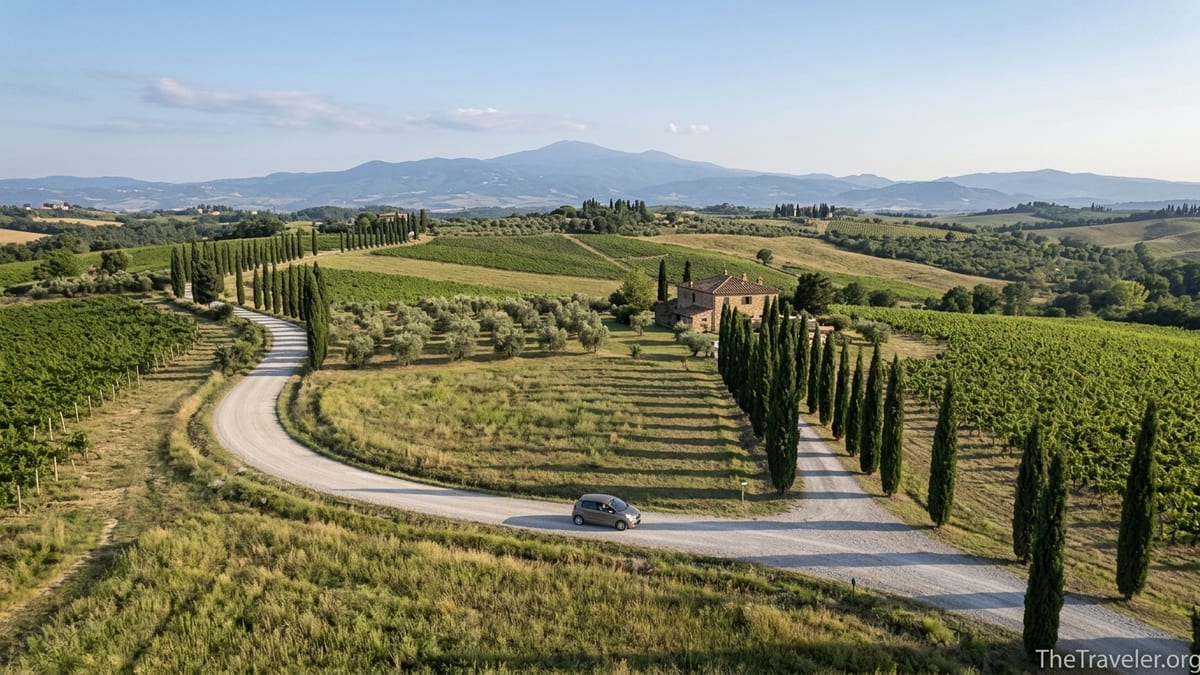
Driving starts to shine once you leave those urban cores. A classic example is Tuscany’s Val d’Orcia, where the most famous viewpoints, like the cypress-lined road near Pienza or the rolling fields outside San Quirico d’Orcia, are easiest to reach by car. Similarly, in the Dolomites, having your own vehicle lets you link together high mountain passes such as Gardena and Sella in a single day, stopping wherever the light and weather look best.
Consider trip structure. A common strategy is to start in a big city without a car, then pick one up at the outskirts or at the airport when you move on. For instance, spend three days in Florence car-free, then collect a compact car at Florence Airport and drive the SR222 Chiantigiana road toward Siena. At the end, drop the car in a smaller city with easy rail links, such as Verona or Bologna, to avoid driving back into a congested center.
Budget also plays a role. Car rental, fuel and tolls add up, especially on a longer itinerary. If two people are traveling carry-on only and sticking mostly to big cities, high-speed trains will likely be cheaper than renting. For a family of four moving between rural locations, though, a mid-size rental can be better value than four separate rail tickets on every leg.
Renting a Car in Italy: Documents, Costs and Insurance
Most international visitors rent from familiar brands at airports or large rail hubs. In practice, many local companies operate under global logos, so experiences can vary from one office to another. Expect base prices for a compact manual car in high season to start around the equivalent of 40 to 60 euros per day at major airports, often higher on the Amalfi Coast, in Sicily and in Sardinia. Automatic transmissions usually cost noticeably more, and one-way rentals between distant regions can carry drop-off fees.
For documents, you will need a valid driver’s license in the name of the main driver and a credit card with enough available limit for the security deposit. Non-EU visitors are increasingly asked to show an International Driving Permit alongside their home license. U.S. travelers routinely report that some desks still hand over keys without checking the permit, while others refuse to release the car without it, and Italian rental contracts commonly mention it in the fine print. Given that Italian police can treat the absence of a permit as driving without a valid license, it is safer to obtain one before departure.
Insurance is where costs can climb. Basic mandatory coverage is included, but it often comes with a high excess. At the counter you will be offered extra packages that reduce or eliminate that excess, which can double the daily rate. Third-party policies bought in advance, or credit cards that include rental coverage, can reduce what you need from the rental company, but you must read terms carefully. Italian cities have tight parking spaces and scooters weaving through traffic, so small dings and scratches are common; photographing the car from all sides at pickup and drop-off is a practical way to protect yourself from disputes.
Optional extras such as GPS units and child seats also increase costs. Since many modern rental cars include built-in navigation and most travelers carry smartphones, using offline maps on your own device is usually more convenient than renting a separate unit. For child seats, some families prefer to bring their own to guarantee fit and cleanliness, especially on longer trips.
Understanding Tolls, Fuel and Parking
On long-distance routes in northern and central Italy you will often use toll motorways, marked as "Autostrada" with green signs. When you enter, you collect a ticket from an automated machine. On exit, you insert the ticket and pay based on distance, either by card or cash. Official operator information notes that tolls are calculated per kilometer and vary by road type. In practical terms, travelers commonly find that a two-hour motorway leg of around 200 kilometers can cost in the range of 15 to 25 euros in tolls, with higher totals on very long drives.
Fuel is sold in liters, and prices fluctuate by region and over time. As of mid-2026, typical prices for gasoline at service stations along major routes often sit a bit above the average for western Europe, with small savings possible if you fill up at large supermarket stations away from the motorway. Self-service pumps can be cheaper than full-service lanes at the same station. When budgeting, assume that a week of moderate driving in a compact petrol car might consume the equivalent of roughly 50 to 80 euros of fuel, depending on how many long stretches you cover.
Parking rules change from town to town, but color lines on the ground are a useful guide. In many places, white-lined spaces indicate free parking, blue lines signal paid parking, and yellow is reserved. Coastal resort towns and historic centers often add time limits even in paid zones, enforced by ticket machines or parking discs. For example, in a Tuscan town like Montepulciano you park in a paid lot outside the walls and walk in, while in Puglia’s Ostuni the historical center is ringed by blue-line parking that fills quickly in summer evenings. Using public, municipal car parks rather than trying to squeeze into tiny historic lanes reduces the risk of scratches and tickets.
Overnight parking can be particularly tricky in seaside resorts and on islands at the height of summer. Private lots near beaches in places like San Vito Lo Capo in Sicily or Chia in southern Sardinia sometimes charge flat daily rates. Checking in advance where your accommodation expects you to leave the car is critical; some agriturismi or masserie in the countryside include free parking, while city guesthouses might rely on nearby garages that require leaving your keys with an attendant.
ZTL Zones and Emission Restrictions
Limited traffic zones, known as ZTL, are one of the biggest pitfalls for visitors. These are restricted areas, usually around historic centers, where only authorized vehicles can enter during certain hours. Signs at the boundary mention "Zona a Traffico Limitato" and cameras record every plate that passes. Even a brief wrong turn into a ZTL can result in fines typically reported in the range of tens to a few hundred euros, often arriving by post months later via the rental company, which may also add an administrative charge.
Cities like Florence, Pisa, Siena, Bologna and many others operate these zones. In Florence, for example, almost the entire central area around the Duomo and Piazza della Signoria is within a ZTL, with access only for residents, permitted deliveries and registered hotel guests during specific time windows. Visitors staying at hotels inside these zones must coordinate with the property so their plate is registered; otherwise, simply relying on a navigation app can lead straight through cameras and multiple fines.
In addition to classic ZTLs, some northern cities are introducing low-emission areas that restrict older vehicles at certain times, especially in winter when air quality is worse. While rental cars are generally new enough to be allowed, visitors driving their own vehicles, campervans or older cars from neighboring countries need to pay attention to local rules. A conservative strategy is to avoid driving into any historic center at all. Instead, follow signs to large car parks on the outskirts, then walk or use local buses or trams.
For road trippers, this means planning entry and exit points to towns carefully. For example, when visiting Siena by car from the Chianti region, it is wiser to aim for the main parking structures such as those near Porta Romana or in multi-level garages outside the walls, rather than trying to drive toward Piazza del Campo. In many small towns of Tuscany, Puglia or Sicily, you will see signs alerting you to a ZTL before the center; treating those as a hard stop and looking for nearby parking often saves money and stress.
Scenic Routes in Tuscany and Northern Italy
Tuscany is one of Italy’s best regions for leisurely driving. The SR222, known as the Chiantigiana, runs between Florence and Siena through the Chianti wine hills. Travel and regional tourism sources highlight this road as among the most scenic in Tuscany, with rolling vineyards, olive groves and stone farmhouses along the way. Small towns like Greve in Chianti, Panzano and Castellina make natural pauses for coffee or wine tasting, with parking on the edge of their compact centers.
South of Siena lies the Val d’Orcia, famous for its postcard views. Roads like the Via Cassia (SS2) and provincial routes such as the SP146 between Pienza and San Quirico d’Orcia offer wide vistas of gently folded hills, cypress-lined lanes and isolated farmhouses. Local guides and recent road trip reports emphasize that having a car here allows you to stop at unsigned viewpoints or follow minor lanes toward vineyards that are not served by public transport. A typical day might loop from Montepulciano through Pienza, San Quirico and Montalcino, with time for a long lunch and short walks.
In northern Italy, the Dolomites provide a very different kind of scenic drive. The classic Great Dolomites Road runs roughly between Bolzano and Cortina d’Ampezzo, crossing mountain passes and threading through dramatic limestone peaks. Accounts describe it as approximately 110 kilometers long and passing through several high passes and valleys, with highlights including viewpoints of famous rock formations and side trips up smaller passes. This drive is ideal in late June, September or early October, when snow is less likely and crowds thinner than in August.
The Italian Lakes also reward drivers, although roads can be narrow and busy. On Lake Como, the western shore road between Menaggio and Tremezzo passes grand villas and lakeside villages, while the eastern side near Varenna has tighter curves and tunnels. Lake Garda’s eastern shore, particularly between Malcesine and Garda town, offers frequent glimpses of the lake with steep cliffs on the inland side. Parking in lakeside towns like Sirmione or Bellagio can be challenging at weekends, so arriving early in the morning or later in the evening helps.
Driving Puglia, Sicily and Sardinia
In Puglia, public transport along the coast and between smaller towns can be patchy, so a car often transforms the experience. The coastal road from Polignano a Mare to Monopoli, for example, lets you detour down to beach clubs or rocky coves that are not directly served by trains. Inland, a loop between Ostuni, Cisternino, Locorotondo and Alberobello passes through the Valle d’Itria’s whitewashed villages and trulli-studded countryside. Many travelers base themselves in a countryside masseria, where parking is usually free and easy, then drive into town for dinners, using paid lots or blue-line street spaces.
Sicily’s size and topography make driving especially useful. Routes like the coastal road between Palermo and Cefalù, or the drive around the southern baroque towns of Ragusa, Modica and Noto, are easier and more flexible with your own vehicle. You can, for instance, leave Taormina in the morning, drive to the slopes of Mount Etna for a cable car ride or guided hike, then continue to a winery on the lower slopes before reaching Siracusa by evening. Be prepared, though, for assertive local driving in cities and tight alleyways in older quarters. Using guarded private parking near city centers in places like Palermo or Catania often feels more secure than searching for street spots.
On Sardinia, a car is almost essential outside the largest towns. Coastal drives such as the stretch between Alghero and Bosa on the island’s west coast are frequently cited in travel guides as among Italy’s most beautiful, with a ribbon of asphalt curled above the sea. In the northeast, the Costa Smeralda’s beaches are spread out, so having a car means you can visit several coves in a day, adjusting plans for wind direction and crowd levels. Inland, quiet roads link small stone villages and cork oak forests, and it is common to drive for many kilometers without seeing another car.
Across these southern regions, navigation apps can be less reliable on very minor rural roads, and local signage may point to destinations by neighborhood or hamlet name, not town. Allow time for missed turns and be wary of small roads that appear shorter on the map but may be unpaved or very rough. If your rental agreement forbids unpaved driving, stick to paved provincial and regional roads even when the map shows tempting shortcuts.
Seasonal Conditions and Safety
Season affects both enjoyment and logistics. In summer, especially in July and August, coastal roads in Puglia, Sicily and Sardinia can be congested near major resort areas, with roadside parking overflowing by mid-morning. In contrast, some rural roads in Tuscany and the Dolomites feel relatively calm early in the day or later in the evening. Heat is also a factor; on long stretches through inland Puglia or Sicily, it is worth checking that your rental car’s air conditioning works well before leaving the lot.
Winter brings different challenges. In the Dolomites, snow and ice are common from late autumn through early spring. Italian regulations require winter tires or snow chains on certain routes and during specific periods, especially in mountainous provinces. Rental companies in northern regions typically equip cars accordingly in season, but you should confirm at booking and again at pickup. Even on clear days, shaded corners of high passes can hold ice, so conservative speeds and extra stopping distance are wise.
General safety rules mirror those in many European countries: seat belts for all occupants, strict drink-driving limits, and mobile phone use restricted to hands-free systems. Speed cameras are widespread on motorways and on some local roads near towns. Fines for violations, like ZTL entries, are commonly processed through the rental company months after the trip. Keeping to posted limits, especially when transitioning from fast rural stretches into villages, is the simplest way to avoid unpleasant surprises later.
At the practical level, it helps to refuel before returning the car, as rental company refueling fees can be significantly higher than pump prices. Keeping coins or small notes handy for smaller, unmanned parking lots or village pay machines is also useful, since not all accept foreign cards. Where possible, park under shade in summer and avoid leaving luggage visible inside the car when sightseeing, particularly in busy parking areas near major sights.
The Takeaway
Driving in Italy is neither as intimidating nor as effortless as some stories suggest. It rewards thoughtful planning. If your itinerary includes rural Tuscany, the high passes of the Dolomites, Puglia’s white towns, or the scattered beaches of Sicily and Sardinia, a car can unlock much more flexible days and quieter corners. If you are focused on big cities and mainline train routes, it may be unnecessary.
The key decisions are when and where to pick up your vehicle, understanding ZTL zones and parking habits, and budgeting realistically for tolls, fuel and insurance. With an International Driving Permit where required, a compact car suitable for narrow streets, and a willingness to park outside historic centers and walk, you can approach Italian roads with confidence.
Combine that practical foundation with some of the country’s most scenic routes, from the Chiantigiana in Tuscany to the Great Dolomites Road and the coasts of Puglia, Sicily and Sardinia, and your rental car becomes more than transport. It becomes a front-row seat on some of Europe’s finest landscapes.
FAQ
Q1. Do I need an International Driving Permit to drive in Italy?
Many rental companies and Italian regulations expect non-EU drivers to carry an International Driving Permit together with their home license. While some travelers report being allowed to rent without it, others have been refused a car or warned that police can treat the absence of a permit as driving without a valid license, so obtaining one before your trip is the safest option.
Q2. Is it worth renting a car just for Tuscany?
For itineraries focused on hill towns and countryside, especially in areas like Chianti and the Val d’Orcia, a car is often worth the cost. It allows you to stop at viewpoints, visit wineries and reach small villages that are not practical by train or bus. If you are staying only in Florence or Pisa, however, you can usually skip the car and rely on public transport.
Q3. How expensive are tolls on Italian motorways?
Tolls vary by distance and route, but on many major autostrade a typical two-hour drive of around 200 kilometers might cost in the region of 15 to 25 euros. Longer trips and certain routes can be more expensive. To reduce toll costs, some travelers choose slower state roads for shorter legs, using motorways mainly for long, direct transfers.
Q4. What should I do to avoid ZTL fines?
The simplest strategy is to avoid driving into any historic center. Follow signs to edge-of-town car parks and walk or use public transport. If your hotel is inside a ZTL, confirm in writing how they will register your license plate and which route you should follow. Never rely solely on navigation apps, which may route you directly through restricted streets without warning.
Q5. Is driving in the Dolomites dangerous for first-time visitors?
The Dolomites involve mountain roads with hairpin bends and steep gradients, but surfaces are generally good and well maintained. If you are comfortable driving on curvy rural roads and keep your speed conservative, it is manageable. Choosing daylight hours, avoiding heavy snow conditions and allowing extra time for stops all make the experience more relaxed.
Q6. Are automatic rental cars easy to find in Italy?
Automatic cars are widely available from major rental companies, especially at airports and big city locations, but they often cost more and can sell out in peak season. If you require an automatic, booking well in advance and choosing a larger pickup location, such as Rome Fiumicino or Milan Malpensa, improves your chances of getting the class you reserved.
Q7. How do I handle fuel stations and payment?
Most fuel stations offer self-service pumps where you pay at a machine or inside the shop. Some also have full-service lanes that cost more. On motorways, almost all stations accept major bank cards, but smaller rural stations may prefer chip-and-PIN cards or cash. It is wise to refuel before entering remote mountain or rural areas, where stations are further apart.
Q8. When is the best time of year for an Italy road trip?
Late spring and early autumn, typically May to June and September to early October, are ideal for most regions. Roads and popular sights are usually less crowded than in July and August, and temperatures are milder. In the Dolomites, shoulder seasons often offer clearer roads and good hiking conditions, while in southern regions the sea is still warm enough for swimming.
Q9. Can I take a rental car on ferries to Sicily or Sardinia?
Many rental companies allow their vehicles on domestic ferries, but conditions vary and some charge extra or restrict certain vehicle categories. If you plan to ferry a car to Sicily or Sardinia, confirm the terms in advance and ensure the rental contract explicitly permits travel to those islands and use of ferries, to avoid issues in case of damage or delays.
Q10. What type of car is best for Italian roads?
A small or mid-size car is usually the best compromise. Compact models are easier to thread through narrow village streets and to park in tight spaces, yet still comfortable for two to four people on longer drives. Unless you have specific needs, large SUVs and vans can make driving and parking in historic areas unnecessarily difficult.