


The Italian lakes are made for slow travel, but that does not have to mean staying put in one resort. With a bit of planning you can link Milan, Lakes Maggiore, Como, Iseo and Garda, plus romantic Verona, into one coherent road trip that feels relaxed rather than rushed. The key is to treat your car as one tool among many rather than the only way of moving around. On these lakes the official Navigazione Laghi ferries can also carry vehicles on certain crossings, so the most rewarding itineraries blend scenic drives with strategic hops by boat.
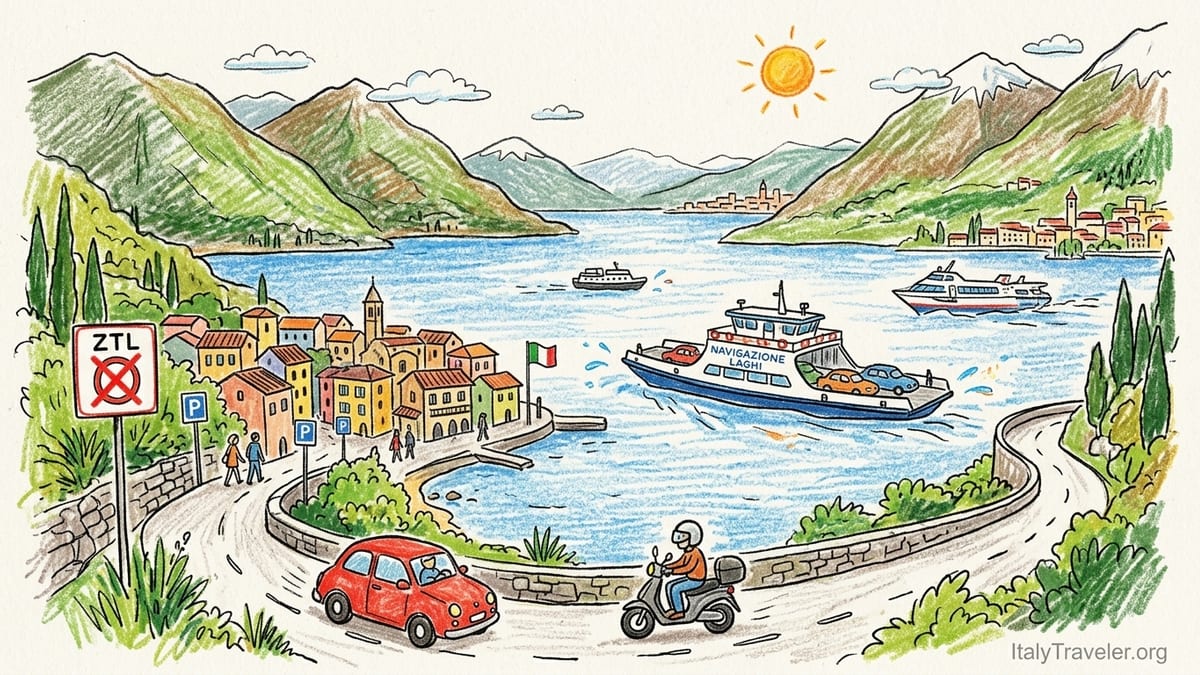
How Driving Really Works Around the Italian Lakes
On a map, the northern Italian lakes look close together and neatly aligned. On the ground they are separated by mountains, narrow corniche roads and historic centers criss-crossed by ZTLs, the limited-traffic zones that quietly generate a large share of foreign rental-car fines. Milan, Verona and many lakeside towns restrict central access with cameras, so driving directly to a cathedral square hotel door is rarely a good idea. In Milan, for example, entering the central Area C without registering and paying the congestion fee can trigger fines that are often passed to you by the rental company months later.
The good news is that the main road network that connects Milan with Maggiore, Como and Garda is modern and straightforward. From Milan Malpensa Airport to Stresa on Lake Maggiore is typically around one hour on the A8/A26 motorways, while Milan to Varenna on Lake Como is about 90 minutes via the SS36. Around Lake Garda, the A4 and A22 motorways make it easy to reach Desenzano, Peschiera or Rovereto before dropping down to the lake on well-maintained local roads. Tolls are common on these main routes, and rental cars usually come with a ticket-based system rather than an electronic pass, so you simply collect a ticket and pay by card or cash on exit.
Where driving becomes stressful is on the older lakeside roads and inside compact historic villages. Sections of the western shore of Como between Cernobbio and Menaggio, parts of the Gardesana road around Garda and Malcesine, and the narrower stretches along upper Lake Iseo were built long before modern SUVs. It is entirely possible to drive them, and local buses and delivery vans do it daily, but expect tight bends, stone walls, scooters overtaking and few places to pull over. This is where you need to decide whether to keep your car moving, put it on a ferry, or park it and switch to boats or buses.
Smart Circuits: Milan → Maggiore → Orta → Como
One of the most logical lake road trips begins and ends in Milan. After arriving in the city, many travelers spend the first nights car-free, using trams and the metro to avoid Milan’s ZTL. Pick up the rental car only on the day you leave, ideally from a location just outside the center or at Milano Centrale station, then follow the A8 north-west to Lake Maggiore. Stresa makes a classic base, with large lakeside hotels that offer on-site parking and private jetties for the frequent passenger ferries to the Borromean Islands operated by Navigazione Laghi.
From Stresa, it is an easy and scenic drive north to Verbania and Intra, where one of Italy’s classic vehicle ferries runs across to Laveno on the Lombardy shore. The Intra–Laveno service accepts cars and motorcycles, which means you can avoid driving all the way around the long gulf and instead enjoy a short crossing with views of the Alpine foothills. A typical car plus two adults is often roughly comparable to the cost of 2 or 3 individual passenger tickets combined, which is a reasonable trade-off for saving up to an hour of mountain driving.
Lake Orta fits naturally into this circuit on the way between Maggiore and Como. From Stresa you drive just 30–40 minutes inland on local roads, climbing through woodland to reach Orta San Giulio. The village itself is compact and partly pedestrian, with small public car parks on the edge of the old center. A practical pattern is to check into a lakeside hotel with parking, leave the car there for a full day, and explore on foot and by local boats to the island of San Giulio. Many visitors underestimate how restful this car-free interlude can feel in the middle of a road trip, especially after a few days of busy driving.
From Orta it is around 90 minutes to the eastern shore of Lake Como. Continuing via Borgomanero and Lecco you reach Varenna or Bellano without having to tangle with central Como’s traffic. At this point you can either park for your entire Lake Como stay and move exclusively by ferry, or take the car on the car ferry between Varenna, Bellagio, Menaggio and Cadenabbia to sample different villages without re-packing luggage every night.
Como → Iseo → Garda → Verona: A Southward Lake Chain
Another attractive itinerary links the lakes in a gentle arc heading east. Starting on Lake Como, base yourself in one of the mid-lake towns with good ferry connections, such as Menaggio on the west shore or Varenna on the east. These centers have regular car ferries across the lake, operated by Navigazione Laghi, that carry vehicles in addition to foot passengers. Taking the car from Menaggio to Varenna, for example, lets you skip the winding northern road and still enjoy views of the Grigne mountains while you cross.
After two or three nights on Como, drive south on the SS36 and then across the Po plain towards Lake Iseo. Compared with Como or Garda, Iseo is more low-key, with smaller towns like Iseo itself and Lovere. The lakeside road on the eastern shore has a few tight tunnels and bends, but traffic is calmer than on the main Garda circuit. Many agriturismo properties around Iseo offer free parking and are within a short drive of the pier in Sulzano for passenger boats to Monte Isola. Because Monte Isola is car-free for visitors, this is a perfect example of when leaving the car at your accommodation is the only sensible option.
From Iseo, you reach Lake Garda in just under an hour, usually via the A4 or local roads through Brescia. Here it pays to think in terms of “lower lake” and “upper lake.” For a first visit, basing yourself in Desenzano, Sirmione, Peschiera or Bardolino keeps drives short and ferry routes simple, while still allowing day trips to the northern towns by fast passenger boat. Many travelers check into a lakeside hotel in Bardolino with secure underground parking, then leave the car for several days while they move along the shore by ferry to Garda, Lazise or Sirmione.
Finishing in Verona makes logistical sense thanks to its rail and air connections. From the southern or eastern shores of Garda, Verona is generally a 45 to 60 minute drive along good roads. Once you enter Verona’s orbit, however, ZTL rules return. Parking at a modern multi-story just outside the center, then walking to Piazza Bra or the Arena in 10 to 15 minutes, allows you to avoid fines and the anxiety of threading a rental car through medieval alleys.
One-Way Rentals, ZTLs and Parking Strategy
Many travelers are tempted by one-way rentals, such as picking up a car in Milan and dropping it in Verona or even Venice. This certainly saves time if your broader itinerary continues into another region, but it usually comes with a noticeable surcharge. On compact hatchbacks, a one-way drop between Milan and Verona can add the equivalent of a couple of hundred dollars to the bill. For some itineraries it makes more sense to loop back to your original pick-up point, especially if you are already returning to Milan for an international flight.
Whatever route you choose, understanding ZTLs is critical. These restricted-traffic zones are typically found in the most historic cores of Milan, Como city, Bergamo, Brescia, Verona and smaller lakeside towns. They are not physically gated; rather, your license plate is filmed by cameras as you cross the boundary. Signs are in Italian, with a red circle and the letters ZTL, sometimes accompanied by operating hours. Rental companies may not warn you proactively, and fines can take months to reach you, often with an additional processing fee. In practice, using park-and-ride facilities, edge-of-center car parks or hotel garages outside the ZTL is the safest strategy.
Parking around the lakes varies from easy to competitive depending on the town and month. In high summer, spaces near popular ferry piers in Bellagio, Sirmione or Garda can fill by mid-morning. Several resorts have multi-story car parks a short walk from the waterfront, typically charging by the hour with a daily maximum that is still modest compared with big-city rates. Booking hotels that explicitly mention on-site or reserved parking is worth the slight price premium, especially if you are driving a larger vehicle and do not want to tackle tight parallel parking beside stone walls.
One underused tactic is to combine paid parking with intensive ferry use. For example, you might leave your car for two full days in the long-stay car park above Menaggio on Lake Como and rely on the regular passenger ferries to reach Bellagio and Varenna. The daily parking cost is often comparable to a couple of coffee stops, yet you avoid having to re-park every time you move, and you remove the stress of narrow waterfront roads from your holiday entirely.
Using Ferries With or Without a Car
The lakes of Como, Maggiore and Garda share a common feature: all are served by the state-operated Navigazione Laghi network, which runs passenger boats of different speeds plus specific car ferries on selected routes. On Lake Como, for example, there is a busy car ferry circuit linking Bellagio, Varenna, Menaggio and Cadenabbia. On Lake Garda, a classic car ferry crosses between Maderno and Torri del Benaco, allowing you to move a vehicle quickly between the western and eastern shores. On Lake Maggiore, vehicle ferries operate on routes such as Intra–Laveno, providing a convenient shortcut across the central basin.
Deciding whether to load your car onto these ferries or leave it parked and travel as a foot passenger is largely a question of what you plan to do on the other side. If you are simply repositioning between bases, such as driving from Stresa to a hotel near Luino and want to avoid a long detour, putting the car on the Maggiore ferry is entirely logical. If, on the other hand, you are staying in Bellagio and planning a leisurely day in Varenna with no onward driving, it rarely makes sense to bring a vehicle too. You would pay a higher fare, only to park the car near the pier while you explore on foot anyway.
Ticket offices at the main piers generally sell both passenger and vehicle tickets on the day, although in midsummer queues can form before popular departures, especially on weekends. Prices are typically based on distance and ticket type, with supplements for fast hydrofoils or larger vehicles. A short middle-lake crossing with a small car on Como or Maggiore is a modest extra compared with individual foot-passenger tickets, while longer routes can be priced more significantly. Because schedules and tariffs change each season, it is wise to check the latest timetables a few weeks before travel and build some flexibility into your road trip so you can adapt if wind, storms or special events alter the ferry patterns.
One important detail is that not all boats carry vehicles. High-speed hydrofoils on Garda and Como are foot-passenger only, and some routes are deliberately designed for commuters and tourists without cars. When planning, look for references to “traghetto” or “ferry boat” services and for timetable symbols that indicate vehicle transport. If in doubt, staff at the piers are used to explaining in English which vessels accept cars, how early you should arrive to secure a place, and whether advance booking is possible or necessary for your intended crossing.
When Leaving the Car at the Hotel Is Smarter
Although this is a road trip guide, there are several situations where the best decision is to walk away from the keys for a day or more. The first is when exploring compact, historic peninsulas and islands. Sirmione on Lake Garda is a textbook example: the old town sits on a long, narrow tongue of land with tight streets and pedestrian promenades. Most hotels here either lie inside a ZTL or rely on small private garages approached via crowded lanes. For a relaxing stay, many visitors book accommodation slightly outside the old gates where parking is easy, then stroll or take a local shuttle into the center.
Another case is when visiting car-free or car-light islands such as Monte Isola on Lake Iseo or the Borromean Islands on Lake Maggiore. Here the car has no real use once you reach the nearest mainland pier. Parking lots in Sulzano for Monte Isola or in Stresa and Baveno for the Borromean Islands are geared to this pattern, with day and multi-day rates. A realistic plan is to arrive by mid-morning, park for the entire day, and return on a late-afternoon or early-evening boat, rather than worrying about hourly costs.
Weather can also tip the balance in favor of going car-free. On hot summer afternoons, crawling along congested stretches of lakeside road with the sun beating through the windscreen is far less pleasant than sitting on an open-deck ferry with a breeze. Similarly, if your accommodation is directly on a busy road, getting back into the car during peak hours can be stressful, whereas walking down to the pier and hopping on a boat may feel like a holiday in itself. Many repeat visitors to Como and Garda end up using their cars mainly for the transfers between regions and then defaulting to ferries and buses for day-to-day activities.
Finally, consider the practicalities of wine tasting, lakeside aperitivi and long lunches. Around Garda and in the hills between Iseo and Franciacorta, local wines are a highlight of any visit. Rather than arguing over who drives or sipping half measures, it often makes more sense to plan a day on foot, by bike or using local buses and ferries so everyone can enjoy tasting rooms and waterfront bars without worrying about the blood-alcohol limit.
The Takeaway
A road trip that links Milan with the great northern lakes can be one of Europe’s most rewarding journeys, provided you respect the constraints of the landscape and the rhythm of local transport. Treat your rental car as a way to move between basins rather than as the default mode for every outing. Use it confidently on the motorways and larger regional roads between Milan, Maggiore, Orta, Como, Iseo, Garda and Verona, but be prepared to park it for days at a time once you reach a particularly scenic or compact base.
Integrating the official Navigazione Laghi ferries into your plans opens up more flexible circuits. Short vehicle ferries such as Intra–Laveno on Maggiore, the Bellagio–Varenna–Menaggio loop on Como, and Maderno–Torri on Garda all allow you to reposition the car without long detours. Fast passenger services, meanwhile, turn day trips across the water into part of the holiday rather than a mere transfer. By mixing these elements, you can enjoy grand mountain panoramas from the driver’s seat one day and relaxed deckchair views from the middle of the lake the next.
Most importantly, build in time. With five to ten days you can follow a satisfying arc from Milan to Maggiore and Orta, then east to Como, Iseo and Garda before finishing in Verona. Shorter stays might focus on just two lakes and a single city. However long you have, a thoughtful balance of driving, boating and walking will let you experience the Italian lakes as their landscapes demand: at a human pace, with the water itself at the heart of the journey.
FAQ
Q1. Is it better to start an Italian lakes road trip in Milan or Verona?
Both work, but Milan is usually more convenient for linking Maggiore, Orta and Como, while Verona is a natural gateway if your focus is mainly Lake Garda and the eastern lakes.
Q2. Do I need a car to enjoy Lake Como?
No. If you stay in ferry hubs like Como city, Bellagio, Varenna or Menaggio, you can move easily by boat and train, using a car only for wider regional touring.
Q3. Can I take my rental car on the ferries?
Yes, but only on designated car ferry routes, such as Bellagio–Varenna–Menaggio on Como, Intra–Laveno on Maggiore and Maderno–Torri on Garda, subject to space and current rules.
Q4. How far in advance should I book ferry tickets?
For most standard crossings you can buy tickets on the day. In peak summer, arrive early for busy departures, and check updated timetables a few weeks before your trip.
Q5. Are ZTL fines around the lakes really that common?
Yes. Many visitors accidentally drive into restricted zones in Milan, Verona and historic lake towns. Planning parking on the edge of centers is the safest approach.
Q6. Is driving the lakeside roads dangerous for inexperienced drivers?
The roads are not inherently dangerous, but they can be narrow and busy, with tight bends and tunnels. Taking your time and avoiding rush hours makes a big difference.
Q7. How long should I plan for a multi-lake road trip?
About seven to ten days allows a relaxed circuit from Milan through Maggiore, Orta, Como, Iseo and Garda, plus a night or two in Verona at the end.
Q8. Are one-way car rentals between Milan and Verona worth the extra cost?
They can be if your wider itinerary continues east, but the surcharge is significant. If you are flying in and out of the same city, a loop is usually better value.
Q9. What is the best season for driving around the Italian lakes?
Late spring and early autumn offer the best balance of pleasant weather, lighter traffic and regular ferry services, while July and August are much busier and hotter.
Q10. Can I visit car-free islands like Monte Isola with a vehicle?
No. Visitors must leave cars on the mainland in signed parking areas and continue by passenger ferry, which is part of the charm of these quieter, slower-paced islands.