


Leaving the car behind is often the smartest way to explore Italy’s islands. On Capri, Procida, Ischia and the Aeolian islands, ferries, local buses, taxis, water‑taxis and your own two feet can take you almost everywhere you want to go. This guide compares the key destinations where a car is unnecessary or even restricted, with practical details and real examples to help you choose the right island and plan a smooth, car‑free trip.
Why Italian Islands Often Work Better Without a Car
On many Italian islands, arriving with a rental car does not give you more freedom, it gives you more problems. Roads are narrow and often carved into cliffs; parking is limited, expensive, or reserved for residents; and in high season, local authorities routinely restrict the arrival and circulation of nonresident vehicles to control congestion. On Procida, for example, regional decrees limit car access in peak months, which means that taking a vehicle across by ferry may simply not be allowed on your travel dates.
By contrast, the infrastructure for visitors on foot is surprisingly good. Ferries and hydrofoils connect major mainland ports such as Naples and Milazzo with islands large and small. Once ashore, you typically find a compact port area with a bus station, taxi stand and luggage storage or porters. On Capri, buses and the funicular meet ferries at Marina Grande and whisk visitors uphill to Capri town in a matter of minutes, while mini‑buses and open‑top taxis run frequent shuttles to Anacapri, the Blue Grotto and Punta Carena lighthouse.
Budget is another reason to avoid driving. A small rental car in summer can easily cost over one hundred euros per day before you have paid for fuel, island ferry tickets for the vehicle and steep parking fees. Single bus tickets on islands such as Procida and Ischia are usually only a few euros, and frequent users can buy day or multi‑day passes. A short taxi hop might cost the same as one hour of parking in a crowded resort, but with none of the stress.
Perhaps the strongest argument for leaving the car behind is the quality of the experience. Walking along pedestrian lanes in Capri town, wandering up to Terra Murata on Procida or strolling between vineyards in Salina simply feels more relaxed without worrying about where you left the car or whether you can navigate back through traffic. Choosing an island that matches your walking tolerance and using local transport smartly lets you enjoy the scenery instead of fighting it.
Capri: Iconic, Compact and Perfectly Set Up for Foot Travelers
Capri is one of the easiest islands in Italy to visit without a car, partly because bringing a car is heavily discouraged and in some periods banned for nonresidents. The main arrival point is Marina Grande, a busy harbor where hydrofoils from Naples and Sorrento dock throughout the day. From here, a short funicular ride carries you up the steep slope to Capri town, avoiding a sweaty climb and the traffic on the only main road. The funicular station sits just behind the harbor, with ticket booths well signposted and trains leaving every few minutes in high season.
Once in Capri town, almost everything is pedestrian. From the famous Piazzetta, you can walk out to viewpoints like Belvedere Tragara or along the Pizzolungo path in normal walking shoes. Hotels are used to guests arriving on foot, and many upscale properties provide luggage porters who collect bags at the port while you stroll up unencumbered. Typical distances within the town center are measured in minutes rather than kilometers, though you should expect some hills and stone steps.
To explore further, Capri has a dense network of mini‑buses and taxis rather than full‑size coaches. Buses connect Marina Grande, Capri town, Anacapri, Marina Piccola, the Blue Grotto and Punta Carena lighthouse. Vehicles are small, with limited seats, so queues can build up in July and August, but departures are frequent, often every 15 to 20 minutes on main routes. Open‑top taxis line up at Capri town and Anacapri, offering fixed‑rate rides; a typical fare between Capri and Anacapri is higher than the bus but worthwhile for groups of three or four, especially if you value time over budget.
Capri also rewards strong walkers. For example, you might combine a morning boat excursion from Marina Grande around the island with a drop‑off at Marina Piccola, then walk uphill through quiet lanes back to Capri town in about 25 to 35 minutes. From Anacapri, a short walk brings you to the chairlift for Monte Solaro, which you reach by local bus from Capri. In practice, most visitors who plan sensibly and avoid peak midday bus lines find Capri very manageable without a car, provided they pack light luggage and accept that public transport and walking are central parts of the experience.
Procida: Pocket‑Sized Island With Buses, Micro‑Taxis and Easy Walks
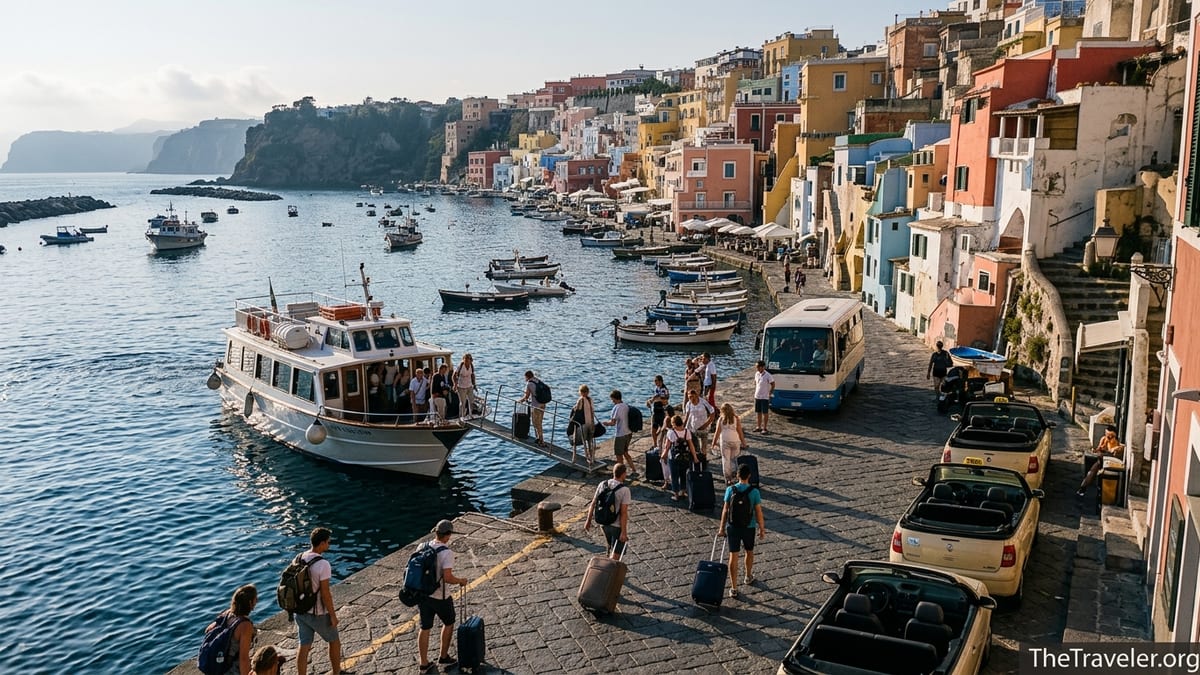
Procida, between Naples and Ischia, is one of the most rewarding islands for truly car‑free travel. It is tiny, about 4 square kilometers, with a compact port at Marina Grande and short distances between the main neighborhoods. From the ferry, you can walk into the pastel‑colored streets of the center in a few minutes. Many guesthouses and small hotels cluster around the harbor and in the charming Corricella area, reducing the need for any motor transport at all.
Public buses on Procida are run by the regional operator and cover the key points of interest, including Marina Grande, Terra Murata and the island’s main beaches. Services are frequent enough for visitors, typically with buses every 15 to 30 minutes on the busiest routes in summer. Single tickets usually cost only a couple of euros and can often be purchased at kiosks or from the driver. Given the small size of the island, ride times are short; crossing from the port to the far side of Procida rarely takes more than 15 minutes.
One feature that stands out on Procida is the use of micro‑taxis, small vehicles especially suited to narrow lanes and restricted‑traffic areas. Local tourism information highlights these as a comfortable way to tour the island if you do not want to brave the hills on foot. A typical micro‑taxi ride from Marina Grande to Corricella or Terra Murata might cost more than the bus, perhaps in the range you would expect for a short city taxi ride on the mainland, but the driver’s commentary and ability to navigate tight corners can be worth the premium.
For walkers, Procida is close to ideal. You can stroll from Marina Grande up to Terra Murata in about 20 minutes, with several viewpoints overlooking the bay and colorful fishing harbor. The lanes dropping down to Corricella are steep but atmospheric, lined with houses in faded pinks and yellows. Because the island is small, you can plan days that alternate short bus rides with gentle coastal walks. Combined with seasonal vehicle restrictions for nonresidents, this makes Procida one of the clearest examples where a rental car would be not just unnecessary but genuinely inconvenient.
Ischia: Larger Island Where Buses and Taxis Replace the Need for a Car
Ischia is often described as the island where a car might help, simply because it is much larger than Capri or Procida and ringed by a main road with several distinct towns. In reality, for many travelers the mix of buses, taxis, water‑taxis and careful choice of base makes a car optional rather than essential. Assessing whether you can comfortably go car‑free on Ischia depends on where you stay and how intensively you want to explore.
The island’s public buses are operated by the regional company EAV and run on a circular route around the coast, plus additional lines into hill villages and beach areas. There are clockwise and counter‑clockwise “CS” and “CD” circular buses that link Ischia Porto, Ischia Ponte, Casamicciola, Lacco Ameno, Forio and Barano, with services that can be frequent in the day. Tickets are inexpensive by European standards, usually only a few euros for a single ride, and day passes are often available at newsstands and ticket offices. Travelers report that these buses are the most cost‑effective way to move around Ischia, though in July and August they can be crowded and subject to delays.
Taxis on Ischia are widely available, especially around Ischia Porto and Forio. While fares will be significantly higher than buses, splitting a taxi from the port to a hotel in Sant’Angelo or on the slopes of Monte Epomeo can be reasonable for a small group, particularly if you have heavy luggage. Some hotels arrange private transfers that combine the ferry from Naples with a shuttle minivan and luggage handling all the way to your room, which removes the complexity of public buses at the beginning and end of your trip.
Choosing your base is crucial for car‑free travel on Ischia. Ischia Porto and Ischia Ponte suit visitors who want to walk to restaurants, shops and the Aragonese Castle, relying on buses or taxis for day trips to thermal parks like Poseidon in Forio or Negombo in Lacco Ameno. Lacco Ameno itself is compact and walkable, ideal for a calmer stay with easy access to the bus route. Sant’Angelo, a pedestrian hamlet on the south coast, is beautiful but less flexible without a vehicle, since it is reached by bus or taxi and has steeper lanes; it is perfect for a slow spa‑focused break rather than constant island‑hopping.
In practice, many visitors manage a week in Ischia without driving by combining walking with strategic use of buses and boat services. For example, you might take a bus from Ischia Porto to Barano, then a shorter bus or taxi boat to Maronti Beach; or stay in Forio and walk to the Poseidon thermal park while using buses to reach Ischia Ponte or Lacco Ameno for the evening passeggiata. If you are traveling in shoulder seasons like May, June or September, buses are usually less crowded than in peak August, making car‑free travel even more attractive.
Aeolian Islands: Salina, Stromboli, Panarea and the Smaller Car‑Light Havens
North of Sicily, the Aeolian archipelago is a cluster of volcanic islands that range from relatively busy Lipari to almost car‑free outposts such as Alicudi and Filicudi. Ferries and hydrofoils run from the mainland via Naples and from Sicilian ports such as Milazzo, Messina and Palermo, with routes operated by companies including Caronte & Tourist and Siremar. Long overnight ferries from Naples to the chain typically take around 16 to 18 hours, while fast hydrofoils from Milazzo to nearer islands can take less than two hours.
Among the Aeolians, Salina is a particularly good choice for travelers without a car. It has two main ports, Santa Marina and Rinella, both served by ferries and hydrofoils, and a local bus system that links the villages around the island. The buses make it possible to stay in one village and reach others for hikes, wine tastings and dinners. Because the island is compact, ride times are generally short, and visitors can supplement buses with walking on country lanes between vineyards and caper farms.
Stromboli and Panarea are even more oriented to travelers on foot. On Stromboli, most of the settlement around the main village is entirely navigated by walking; narrow lanes, black‑sand beaches and the looming volcano create a setting where cars would feel out of place. Many accommodations arrange luggage transport from the port using small electric carts. Panarea is known for its chic but tiny town and limited road network; visitors mostly move around on foot or by small electric vehicles and boats, with water‑taxis taking people to offshore swimming spots and neighboring islets.
The most extreme examples of car‑light islands in the Aeolians are Alicudi and Filicudi. Alicudi, in particular, has almost no roads at all; steep stone mule tracks connect houses that climb the slopes above the harbor. Luggage is moved by mules or porters, and staying here without a car is not just viable but the only realistic option. Filicudi has a small road serving the port and main settlement, but visitors rely heavily on walking and boat excursions. These islands are more suitable for seasoned travelers who enjoy remoteness and simple infrastructure rather than those needing frequent bus services.
Other Car‑Optional Islands to Consider
Beyond the big names, several smaller Italian islands offer similar advantages for visitors without cars. In the Bay of Naples, tiny Vivara is connected to Procida by a pedestrian bridge and visited on guided walks, with no need or option for vehicles. In Sicily’s surrounding seas, islands like Ustica and the Aegadian islands off Trapani operate with a mix of small buses, bicycles, scooters and boats, and often impose restrictions on nonresident cars in summer to protect their limited road networks.
On many of these islands, distances are short enough that walking and cycling can comfortably replace driving. For example, on Favignana in the Aegadian group, bike rentals are common near the port, and most beaches can be reached within 20 to 30 minutes of pedaling on relatively flat terrain. While scooters are also available, first‑time riders should be cautious, as island roads can still be busy in high season and helmets are compulsory.
The common thread is that infrastructure has evolved around visitors who arrive on foot. Ports typically feature a bus terminus, a cluster of rental agencies for bicycles and scooters, and rows of taxis or micro‑taxis waiting for each ferry arrival. Hotels often time their check‑in and luggage‑transfer services to coincide with midday and late‑afternoon ferries. As a result, organizing a trip where your main long‑distance transport is the ferry and everything else happens by walking, bus or taxi is straightforward, provided you research seasonal timetables in advance.
Travelers who have special mobility needs should still plan carefully, as steep lanes and staircases are common across Italian islands. In such cases, choosing accommodations close to the port or main piazza and pre‑arranging taxi or porter services is more important than having your own car, which may still face access restrictions or parking challenges near historic centers.
Ferries, Tickets and Practical Tips for Car‑Free Island Hopping
Ferries and hydrofoils are the backbone of car‑free travel between Italian islands and the mainland. On the Tyrrhenian side, Naples acts as the primary hub for Capri, Ischia and Procida, while Milazzo in northeastern Sicily is the main jumping‑off point for the Aeolian islands. Services run year‑round on the main routes, though winter schedules are less frequent and weather‑related cancellations are more common in stormy periods, particularly between November and March.
Ticket prices vary by route and season, but as a general guideline, short crossings in the Bay of Naples can often be found for a few tens of euros per person each way on fast hydrofoils, with conventional ferries sometimes slightly cheaper and slower. Longer routes from Naples to Milazzo or to the Aeolians cost more because of the duration and cabin options, with overnight ferries taking roughly 16 to 18 hours. For these, booking well ahead for summer departures is advisable, especially if you need a specific date.
On arrival at island ports, you typically find bus stops, taxi ranks and information boards close to the ferry docks. In Capri’s Marina Grande, for instance, the bus and taxi stands sit immediately to the right as you exit the pier, while the funicular entrance is a short walk inland. On Ischia, buses line up outside the port terminal in Ischia Porto, and ticket kiosks are located nearby. In Milazzo, buses and taxis connect the ferry port to the town center and train station, useful if you are continuing to other parts of Sicily without a car.
Travelers can make island hopping more efficient by grouping destinations served by the same ferry lines. One realistic car‑free itinerary might involve flying into Naples, spending a few days on Procida and Ischia using local buses, then returning to Naples before taking a long ferry to the Aeolian islands from the same harbor on a different day. Keeping your luggage light, storing valuables in a small daypack on ferry decks and checking port departure boards on arrival all contribute to a smoother, more relaxed journey.
Choosing the Right Island if You Do Not Want to Drive
Picking the best Italian island without a car comes down to how much walking you enjoy, how complex you want your days to be and whether you prefer nightlife or quiet evenings. Capri suits travelers who like stylish towns, short but sometimes crowded bus and funicular rides, and a certain level of bustle. Procida is ideal if you want a small, authentic island where you can walk almost everywhere and use buses or micro‑taxis mainly to save your legs on hot afternoons.
Ischia is more versatile but requires clearer planning. If you stay near Ischia Porto, Forio or Lacco Ameno, you can reach beaches, restaurants and thermal parks mostly by bus and on foot, treating taxis as backups for late‑night returns or luggage transfers. Pick Sant’Angelo or hilltop hamlets only if you are comfortable with steeper walks and are happy to rely on scheduled buses or pre‑booked taxis. The Aeolian islands, meanwhile, are best if you seek a mix of hiking, boat excursions and tranquil villages where driving is either impossible or unnecessary.
Another dimension is how sensitive you are to crowds. If squeezing into buses in July and August sounds uncomfortable, consider traveling in shoulder seasons such as late May, June or September, when sea temperatures are pleasant but visitor numbers are lower. At these times, you will still find buses running, ferries operating regular timetables and restaurants open, just with fewer queues. For particularly quiet experiences, smaller Aeolian islands like Filicudi or offbeat times on Procida can feel delightfully sleepy without requiring a car.
For travelers who like to mix city stays with island time, the logistics of moving between mainland train networks and ferry ports are generally straightforward. Major railway hubs like Naples Centrale are linked by local transport to ferry terminals, so you can step off a train from Rome or Florence and, within an hour or so, be boarding a hydrofoil to Capri or Ischia without ever needing to drive. In Sicily, trains and buses link Palermo, Catania and Messina with Milazzo, opening the Aeolian islands to those relying entirely on public transport.
The Takeaway
For most visitors, Italian islands are more enjoyable, not less, when explored without a car. Capri’s funicular and mini‑buses, Procida’s micro‑taxis and compact size, Ischia’s circular bus network and the Aeolian islands’ walking paths and boat services together form a web of options that make rental cars optional at best and a hindrance at worst. By choosing your base carefully, traveling outside the absolute peak weeks where possible, and embracing a slower pace, you can move between beaches, villages and viewpoints with little more than a ferry ticket and a pair of comfortable shoes.
When planning, think in terms of ferry connections rather than highways, bus timetables rather than parking lots, and scenic walks rather than traffic jams. Budget for occasional taxi rides, especially on arrival and departure days or in the heat of midday, and keep your luggage manageable for short uphill walks. With these strategies, Italian islands transform from intimidating logistics puzzles into some of the easiest and most rewarding places in the country to visit car‑free.
FAQ
Q1. Is it realistic to visit Capri, Procida and Ischia in one trip without a car?
Yes. Ferries connect all three islands with Naples, and there are also direct sailings between Ischia and Procida. Many travelers base in Naples or Ischia and add day trips to Capri or Procida using hydrofoils, buses and walking instead of driving.
Q2. Will I save money by not renting a car on the islands?
Often yes. A small rental car can cost over one hundred euros per day in high season, plus fuel, insurance, ferry fees for the vehicle and expensive parking. In comparison, bus tickets are only a few euros and taxis become an occasional rather than constant expense.
Q3. Are island buses reliable enough in summer?
They generally run regularly but can be crowded and sometimes delayed in July and August. If you are traveling at peak times, allow extra time, travel early or late in the day when possible and be prepared to stand on busy routes.
Q4. How should I choose where to stay on Ischia without a car?
Pick a town with good bus connections and amenities within walking distance. Ischia Porto, Forio and Lacco Ameno are strong options, as you can walk to many restaurants and beaches and use buses or taxis only when you go further afield.
Q5. Are the Aeolian islands suitable for travelers with limited mobility?
Some are, but many have steep lanes and numerous steps. Salina and parts of Lipari offer relatively level areas near the ports with bus access, while Alicudi and Stromboli can be challenging. In all cases, choosing accommodation close to the port and arranging taxis or porters helps more than having a car.
Q6. Do I need to book ferries in advance if I am traveling without a vehicle?
For short routes in shoulder season, same‑day tickets are often available. In July and August, and for long overnight crossings such as Naples to the Aeolian islands, advance booking is strongly recommended, especially if you are tied to specific dates and times.
Q7. Is it easy to find taxis on the islands?
Yes, around ports and main squares taxis usually queue to meet ferries. At night or in smaller villages, you may need your hotel to call one. Fares are higher than on the mainland, but journeys are short, and you can often agree a price before departing.
Q8. Can I rely on Google Maps for bus routes on Italian islands?
Coverage is improving but not always perfect. On islands like Capri and Ischia, some routes appear but timetables may be inaccurate. It is best to double‑check at local bus stops, tourist offices or printed schedules in the port when you arrive.
Q9. What kind of luggage is best for car‑free island travel?
A medium suitcase or travel backpack you can comfortably roll or carry uphill is ideal. Many island streets are paved with cobbles or involve steps, so very large or heavy bags make walking to your accommodation more difficult.
Q10. Are there any situations where bringing a car to the islands makes sense?
It can make sense for longer winter stays in larger islands like Ischia or for travelers with specific mobility needs who are staying outside main towns. Even then, you must check seasonal restrictions, parking availability and whether your accommodation actually has space for a vehicle.