


Planning ferries between Italy’s islands can feel surprisingly complex. Ports are scattered from Naples to Sicily and Tuscany, schedules change with the seasons, and rules for vehicles or luggage are not always clear in English. This guide pulls together the essentials for traveling by sea around southern Italy, including the busy Gulf of Naples, the Aeolian and Egadi islands off Sicily, and the Tuscan Archipelago, with clear advice on inter-island routes, when to book, what it costs in practice, and when it makes more sense to fly.
Key Ferry Hubs and Operators to Know
Most Italian island trips involve a handful of big mainland hubs. In the south, Naples and nearby ports like Sorrento and Salerno feed the islands of Capri, Ischia and Procida. In Sicily, Milazzo near Messina is the main departure point for the Aeolian Islands, while Trapani and Marsala serve the Egadi Islands and Palermo offers additional seasonal links. Further north, Piombino, Livorno and Porto Santo Stefano are the primary gateways to the Tuscan Archipelago, especially Elba, Capraia and Giglio.
A few large companies dominate these seas. Around Naples, operators such as Caremar, SNAV, NLG and Alilauro run a mix of slow ferries and fast hydrofoils between the city and Capri, Ischia and Procida, with extra summer services to the Amalfi Coast. In Sicily, Liberty Lines runs most high speed services to smaller islands like the Aeolian and Egadi groups, while Siremar and other conventional ferry companies carry vehicles on longer crossings. In Tuscany, Toremar provides year round lifeline routes from Piombino, Livorno and Porto Santo Stefano to Elba, Capraia and Giglio, supplemented by other private lines in peak season.
Because timetables and ship assignments change frequently, especially between April and October, it is wise to treat any printed schedule as indicative. A route that runs twice a day in April between Naples and Capri might have eight or more daily sailings in August, then reduce to only a few in January. The same is true for Milazzo to Lipari or Piombino to Portoferraio. Always recheck times during the week of travel, and keep an eye on weather forecasts, as hydrofoils are more easily canceled in rough seas than conventional ferries.
For planning and booking, many travelers now use aggregator sites that display multiple operators on one screen, particularly helpful when comparing a Caremar car ferry to a faster SNAV hydrofoil or choosing between Liberty Lines crossings to the various Aeolian islands. However, if you need to transport a vehicle, it is still worth checking the specific ferry company’s website or ticket office, because rules and availability for cars, motorbikes and campervans differ from passenger-only services.
From Naples: Capri, Ischia, Procida and Inter-Island Hops
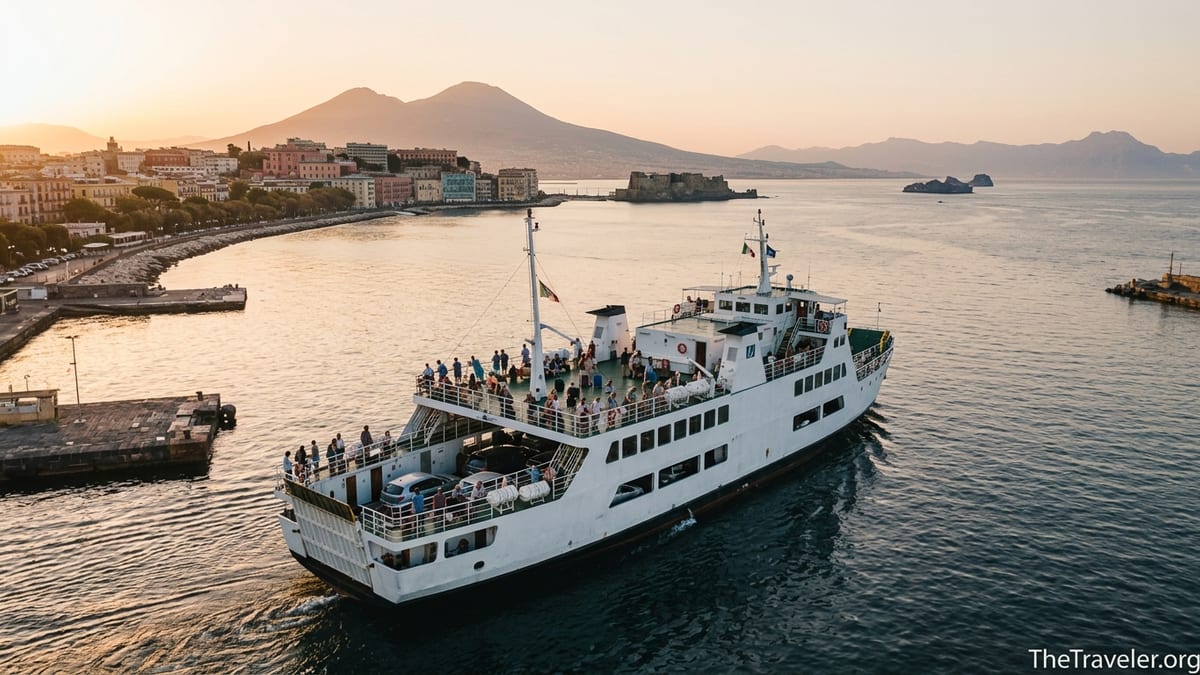
The Gulf of Naples is Italy’s busiest island ferry playground. From Naples Beverello and Calata Porta di Massa, you can reach Capri in roughly 45 to 80 minutes depending on the vessel. A typical high speed crossing in peak season costs in the region of 25 to 40 euros one way for an adult foot passenger, while slower ferries can be slightly cheaper and are usually the only option if you are bringing a car. Ischia and Procida sit slightly closer to the mainland, with frequent mixed ferries and hydrofoils that take around 40 to 70 minutes depending on the route and operator.
Concrete examples bring this to life. On a summer Saturday, you might find an early morning Caremar ferry from Naples to Procida with a journey time of about 1 hour 15 minutes and a mid morning fast hydrofoil from another operator that makes the trip in around 40 minutes. For Capri, high speed boats often depart every 30 to 60 minutes in midsummer from Naples Beverello, while slower ferries and some vehicle services use Calata Porta di Massa. Tickets can often be purchased on the same day in June, but for August weekends and Italian holidays such as Ferragosto, advance booking is strongly recommended.
Inter-island connections in the Gulf of Naples make short island hopping trips possible without returning to the mainland. Seasonal routes link Capri with Ischia and Procida, and there are summer services from Capri or the islands to Amalfi and Positano on the Amalfi Coast. For example, on a spring or summer weekend you may see a morning sailing from Amalfi via Positano to Capri and then onward to Ischia or Procida, with one way fares between roughly 23 and 35 euros depending on the leg. These links do not always run daily outside high season and are particularly weather dependent, so if you are planning to wake up on Capri and sleep on Ischia the same night, build in time for a backup plan via Naples in case the direct boat is canceled.
When it comes to practicalities, Naples island ferries handle luggage quite flexibly. On most hydrofoils you carry your own bags on board, with a small cabin bag included in the fare and a surcharge for very large suitcases. On conventional ferries, travelers with cars can usually leave luggage in the vehicle during the crossing, while foot passengers either carry bags to the passenger decks or use designated luggage racks. Arriving 30 to 45 minutes before departure is usually sufficient out of peak season, but in August it is sensible to arrive at least an hour early, especially if you have a car and a family’s worth of luggage.
Sicily and the Aeolian, Egadi and Southern Islands
Sicily has a more dispersed ferry network than the Gulf of Naples, but it is the gateway to some of Italy’s most dramatic islands. To reach the Aeolian Islands, Milazzo on Sicily’s north coast is the workhorse port. High speed boats from operators such as Liberty Lines connect Milazzo with Lipari, Vulcano, Salina and onward to smaller islands including Panarea, Stromboli, Filicudi and Alicudi, with trips to Lipari typically taking around 1 hour. Conventional ferries that can carry vehicles run less frequently and take longer, sometimes over 2 hours to Lipari, but they are essential for anyone needing to travel with a car or motorcycle.
From the mainland, there are longer crossings from ports such as Naples and Reggio Calabria to the Aeolian Islands, generally used by travelers planning a week or more on the islands. These sailings can take anywhere from 4 and a half hours upward depending on the route and stops. Prices vary widely by season, but as a rough guide, a one way high speed ticket from Milazzo to Lipari might cost from about 25 euros in shoulder season, while a car plus two passengers on a conventional ferry for the same route can easily run to more than 100 euros once seasonal supplements and port fees are added.
On Sicily’s west coast, Trapani is the main springboard to the Egadi Islands of Favignana, Levanzo and Marettimo, again primarily served by Liberty Lines hydrofoils, with summer crossings sometimes every 30 to 60 minutes to Favignana and journey times under an hour. A typical high season fare for a Trapani to Favignana return ticket may be in the range of 30 to 50 euros per person depending on timing and flexibility. Vehicles are heavily restricted on smaller islands during the busiest months, and in some cases non residents are not permitted to bring cars at all, so check current regulations before planning to drive onto these ferries.
Further south, long haul routes link Sicily with Pantelleria and the Pelagie Islands of Lampedusa and Linosa, usually from ports like Trapani or Porto Empedocle. These crossings can easily take 6 to 9 hours or more, so many travelers choose overnight ferries with cabin accommodation. Because these are lifeline services for island residents, they run year round, but schedules can be sparse in winter and you should always factor in potential weather delays, especially in January and February when seas are rougher. Booking cabins well in advance for July and August is prudent, as they can sell out even when deck space remains available.
Tuscany and the Tuscan Archipelago from the Mainland
The Tuscan Archipelago is served by a tight network of ferries from the Tuscan coast, making it one of the easiest areas for flexible, last minute island trips. Elba is the star attraction, with very frequent ferries from Piombino to Portoferraio and additional routes to Cavo and Rio Marina. Conventional ferries carry both passengers and vehicles and typically take around 40 to 60 minutes to reach Portoferraio. In high season it is common to see multiple departures per hour at busy times of day. Fares for a foot passenger can be comparatively modest, while bringing a car, especially on peak summer dates or weekends, can more than double the cost of a crossing.
Livorno is the main point of departure for Capraia, a smaller, wilder island popular with hikers and boaters. Schedules here are far less frequent than to Elba, with usually one daily sailing outside summer and perhaps more in July and August. The crossing takes several hours, and because capacity is limited, travelers with vehicles or who are traveling on key Italian holidays should book ahead. Similarly, ferries from Porto Santo Stefano on the Monte Argentario peninsula to Giglio are vital lifelines for residents and summer visitors. These are shorter crossings, often in the range of 50 minutes to an hour, but again vehicle space is finite.
A key point in Tuscany is that several routes operate under public service contracts with the regional government, ensuring year round continuity even when tourist numbers drop. Companies such as Toremar typically maintain at least a basic daily service between the mainland and islands like Elba, Capraia and Giglio in winter, then layer on more sailings in summer either through their own additional runs or competing private operators. For travelers, this means it is usually possible to reach Elba or Giglio even in January, although you might have only one or two departure times to choose from on a given day.
Practical details matter here too. In Piombino and Livorno, car passengers are usually asked to check in at least one hour before departure in summer to allow time for queuing and loading, while foot passengers can sometimes check in closer to departure, especially on quiet midweek crossings in May or September. Luggage rules are generally relaxed on these short domestic ferries: most people simply wheel suitcases onboard and leave them near their seats or in luggage spaces. Because crossings are short, there is rarely formal cabin accommodation, but indoor lounges, cafes and outdoor decks are standard.
Inter-Island Routes and Hopping Strategies
Beyond simple mainland to island trips, many travelers want to string together multiple islands within the same region. In the Gulf of Naples, as noted, seasonal routes can link Capri, Ischia, Procida and Amalfi Coast towns, making a three or four night hop quite manageable. A common pattern is to spend two nights on Ischia, then take a mid morning boat to Capri for another night or two, and finally continue to Positano or back to Naples. When these direct links are running, you avoid the need to change piers in Naples, saving both time and stress.
In the Aeolian Islands, inter-island ferries are an integral part of daily life. Fast boats in summer connect Lipari and Vulcano with Salina, Panarea, Stromboli, Filicudi and Alicudi multiple times per day, so travelers can realistically base on Lipari and take day trips to other islands. For example, you might catch an early hydrofoil from Lipari to Stromboli for a late morning arrival, hike or swim, then return on an evening boat, all within daylight hours in June or July. Outside the main season, frequencies drop, and some smaller islands may see only one or two daily connections, making careful timetable checks essential if you plan a tight day trip.
Inter-island routes in the Tuscan Archipelago are more limited. While some seasonal connections exist, such as occasional summer sailings that link Elba with other islands or with coastal towns beyond Piombino, the network is not as dense as in the Aeolian group. As a result, most travelers route via the mainland: for instance, traveling from Elba to Giglio often means taking a ferry from Portoferraio to Piombino, driving or taking a train and bus down the coast to Porto Santo Stefano, then boarding a separate ferry to Giglio. This can take most of a day, so it is worth planning one way itineraries rather than frequent backtracking if you hope to visit multiple Tuscan islands.
South of Sicily, inter-island hops between the Egadi, Pelagie or other minor islands are generally less common than connections via the Sicilian mainland, though there can be seasonal services linking nearby islands. In practice, if you dream of combining Favignana with Pantelleria and Lampedusa on one trip, expect to transit through Trapani or other Sicilian ports rather than a simple island to island link. The reality is that Italian island networks are often designed around their mainland hub ports, so most complex itineraries resemble spokes on a wheel rather than a neat loop.
Vehicles, Luggage and Seasonal Rules
Vehicle ferries are essential if you intend to take a car, motorbike or campervan to an Italian island. Not every route accepts vehicles, and those that do often have strict capacity limits and additional booking rules. Around Naples, only conventional ferries, not hydrofoils, carry cars. That means if you want to drive to Ischia or Procida, you must choose operators and departures that specifically indicate vehicle transport, then book a space in advance, especially on summer weekends. On Capri, cars are heavily restricted: non resident vehicles are often banned altogether during high season, so most visitors leave their car in a garage in Naples or Sorrento and travel as foot passengers.
In Sicily and the smaller islands, rules can be even tighter. Many minor islands restrict or temporarily ban non resident cars in peak months to reduce congestion. This is typical on islands like Favignana or in parts of the Aeolian group. Even where cars are allowed, streets can be narrow, parking scarce and fuel more expensive than on the mainland. Renting a scooter or small car locally for a day or two is often more practical than bringing your own vehicle across on a ferry, particularly when the cost for a vehicle ticket can be several times that of a passenger ticket.
Luggage policies on Italian ferries are generally more forgiving than on airlines, but there are still limits. High speed hydrofoils, which have less space, often include a single small suitcase or backpack in the basic fare and charge extra for additional or oversized bags. Conventional ferries, especially on short routes like Piombino to Elba or Naples to Ischia, tend to be more casual: passengers wheel standard sized cases on board without weighing them, and extra bags rarely attract attention unless they are unusually large. For overnight or long distance crossings, such as Sicily to Lampedusa, people commonly bring more luggage, and it is sensible to pack a smaller overnight bag to take to your cabin while leaving bulky items in your vehicle or in dedicated luggage areas.
Seasonality shapes everything. From roughly late June through early September, and during spring holidays like Easter, ferries fill up quickly with Italian and international tourists. On a July Saturday, a car space from Piombino to Elba or a cabin on a Sicily to Lampedusa ferry can sell out weeks ahead. Conversely, in November you may find only one or two sailings per day on some routes but with plenty of empty seats. Shoulder months such as May, June, September and early October often offer the best balance of frequency, price and comfort, with enough boats running but fewer crowds and milder seas.
Booking Tickets, Prices and When Flying Is More Practical
For popular routes like Naples to Capri or Piombino to Elba, you can often purchase tickets on the day of travel, especially as a foot passenger outside the busiest weeks. However, there are clear situations when advance booking is worth the effort. These include traveling with a vehicle, needing a specific sailing time before a hotel check in or flight, traveling over Italian national holidays, or using longer overnight routes to Sicily’s outer islands where cabins are limited. In such cases, pre booking online directly with the operator or via a reputable ticketing platform gives you a confirmed spot and can sometimes lock in a slightly lower fare than a last minute purchase at the port.
Approximate costs help with budgeting. A straightforward high speed ticket from Naples to Capri in summer might fall somewhere between 25 and 40 euros one way per adult, depending on operator and time of day. A short ferry crossing from Piombino to Elba for a foot passenger could be under 20 euros, while adding a car can easily bring a one way price into the 70 to 150 euro range at peak times. Trips from Milazzo to Lipari or other Aeolian islands typically sit in the 20 to 40 euro band for foot passengers, again higher in August than in May. Long overnight crossings with cabins from Sicily to more remote islands or from mainland Italy to Sicily’s ports cost more, with total fares varying significantly depending on cabin class and vehicle size.
There are times when flying is simply more efficient than adding another long ferry. If you are traveling, for example, from Rome or Milan to eastern Sicily and plan to continue to the Aeolian Islands, it can make sense to fly to Catania or Palermo first and then take a relatively short train or bus ride to Milazzo for the final ferry. Similarly, if you want to visit both Sardinia and Sicily in a single trip, flying between the two islands is often faster, cheaper and less tiring than taking a very long ferry route or backtracking via the mainland. Domestic flights within Italy are frequent between major cities and islands, and when booked in advance can be competitively priced compared to long distance ferry cabins.
You should also consider flying when seas are likely to be rough or when you have tight time constraints. In winter, storms can cancel fast ferries for days in exposed areas like the Tyrrhenian or Strait of Sicily, while airports can sometimes return to operation more quickly than ports. Travelers prone to seasickness might prefer a one hour flight to Palermo over a 9 hour overnight crossing from the mainland. However, for short hops such as Naples to Capri or Piombino to Elba, ferries remain the most practical choice; flying would involve detours through airports that actually add time and hassle.
The Takeaway
Italian island ferries offer some of the most scenic journeys in the Mediterranean, but they reward a bit of advance planning. Understanding the major hubs in Naples, Sicily and Tuscany, the difference between high speed hydrofoils and conventional vehicle ferries, and the seasonal rhythm of schedules will help you build reliable itineraries. Where possible, keep your plans flexible by avoiding last minute tight connections and by allowing time for port transfers or weather related delays, especially when traveling in winter or to smaller, more remote islands.
Use ferries where they shine for short and medium distance sea journeys, island hopping experiences and trips that are as much about the journey as the destination. Combine them intelligently with trains, buses and occasional flights when covering larger distances or linking distant island groups. Above all, double check the latest schedules close to your travel dates, book vehicles and cabins early at peak times, and treat each crossing as part of the adventure rather than a purely functional transfer. With the right expectations, ferries around Naples, Sicily and Tuscany can become some of the highlight memories of your Italian trip.
FAQ
Q1. Do I need to book Italian island ferries in advance?
In summer and on holidays, advance booking is strongly recommended, especially for vehicles and longer routes. In shoulder seasons, foot passengers on short routes like Naples to Capri or Piombino to Elba can often buy tickets on the day, though popular time slots can still sell out.
Q2. Can I take a rental car on ferries to Capri, Ischia or Elba?
Capri heavily restricts non resident vehicles in high season, so most visitors leave cars on the mainland. Ischia and Elba accept vehicles on conventional ferries, but you must book a space in advance and check local regulations, as temporary bans on non resident cars sometimes apply during peak months.
Q3. How early should I arrive at the port before departure?
For short routes as a foot passenger outside peak season, arriving 30 to 45 minutes before departure is usually enough. In high season or when traveling with a vehicle, plan to be at the port at least one hour in advance, and even earlier on busy Saturdays in July and August.
Q4. What is the difference between a hydrofoil and a ferry?
Hydrofoils are faster passenger only boats with airplane style seating and limited outdoor space, often used on routes like Naples to Capri or Milazzo to Lipari. Conventional ferries are slower but larger, with open decks, cafes and the ability to carry vehicles; they are usually more stable in rough seas.
Q5. Are ferries reliable in winter?
Main lifeline routes generally operate year round, but winter storms can disrupt service, especially high speed hydrofoils. If you are traveling between November and March, keep plans flexible, monitor forecasts, and favor conventional ferries where possible, as they are less likely to be canceled than fast boats.
Q6. How much does a typical Italian island ferry ticket cost?
Prices vary by route and season, but a one way adult ticket on a short high speed route such as Naples to Capri or Milazzo to Lipari often ranges from roughly 20 to 40 euros. Adding a car or booking a cabin on a long crossing can increase the total to well over 100 euros.
Q7. Can I island hop without returning to the mainland?
In some regions, yes. The Aeolian Islands have dense inter-island services in summer, and the Gulf of Naples offers seasonal routes between Capri, Ischia, Procida and Amalfi Coast towns. In the Tuscan Archipelago and between many Sicilian island groups, inter-island links are more limited, so routes often pass back through a mainland or Sicilian hub.
Q8. What are the luggage limits on ferries?
Most ferries allow at least one standard suitcase or backpack without strict weight checks, especially on short domestic routes. High speed hydrofoils can charge extra for large or multiple bags, and overnight services may have specific baggage guidelines, so check details at booking if you are traveling with bulky equipment.
Q9. When is it better to fly instead of taking a ferry?
Flying is often more practical for long distances or when time is tight, such as traveling between major mainland cities and Sicily or linking distant island groups like Sardinia and Sicily. For short hops like Naples to Capri, Piombino to Elba or Milazzo to Lipari, ferries remain the simplest and most direct option.
Q10. Are pets allowed on Italian ferries?
Many Italian ferries accept pets, usually requiring them to be leashed and sometimes muzzled on deck, with small animals in carriers. Some operators offer pet friendly cabins on longer routes, but availability is limited and an extra fee is common, so always check and reserve in advance if you are traveling with an animal.