


The Italian lakes look made for driving: winding shore roads, hilltop villages and vineyards rolling away from the water. Yet around Milan, Como, Garda and the eastern lakes, trains and ferries are often faster and less stressful than a rental car. This guide focuses on the most useful question for 2026 trip planning: which Italian lakes actually need a car, and when are you better off relying on public transport instead?
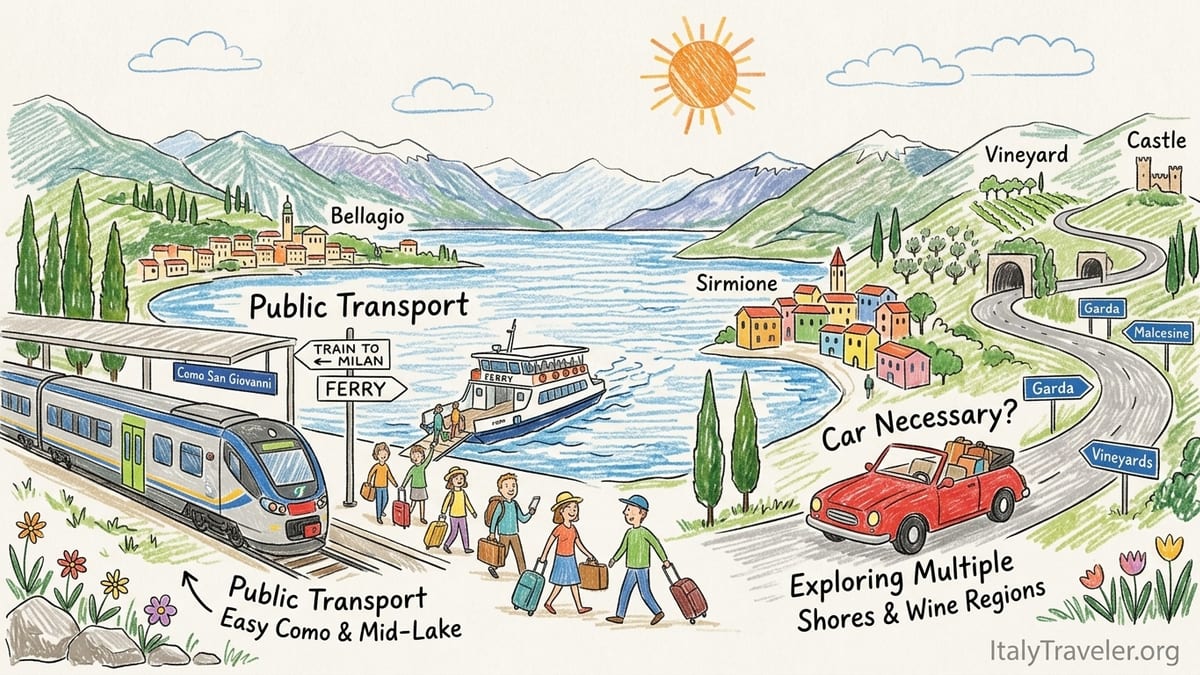
Do You Need a Car for the Italian Lakes at All?
For many visitors, the surprise is that you can reach the major Italian lakes from Milan by train in roughly an hour, then move around using ferries and local buses. Regional operator Trenord runs direct trains from Milano Centrale to Como San Giovanni in about 40 minutes, with frequent departures throughout the day, and services from Milano Cadorna to Como Lago in about an hour. These stations drop you within walking distance of ferry piers serving the main mid-lake towns, so you can be on a boat without ever touching a car.
Lake Garda and Lake Iseo are also well linked by rail. High-speed and regional trains from Milan to Desenzano del Garda and Peschiera del Garda take roughly 1 hour to 1 hour 20 minutes depending on the service. From Verona Porta Nuova, regional trains to Peschiera and Desenzano typically take under 30 minutes. Once there, ferries connect the main towns like Sirmione, Garda, Bardolino and Malcesine, and you can combine them with lakefront promenades or local buses for a fairly car-free holiday focused on one shore.
So where does a car genuinely add value? Mostly in three situations. First, if you want to explore multiple shores of Lake Garda or hop between small villages away from the main train stations. Second, if you plan to combine several smaller lakes in a single trip, such as Orta, Iseo, and the Varese area. Third, if you are targeting rural wine regions like Franciacorta between Brescia and Lake Iseo, the Valpolicella hills above Verona, or the Oltrepò Pavese south of Milan, where buses are sparse and taxis expensive or unreliable.
If your plan is to base in a well-linked town like Como, Varenna, Bellagio, Desenzano, Peschiera or Sirmione, and explore mainly by ferry with one or two organized day tours, you can comfortably skip the rental car. If your dream itinerary reads more like a road trip, stitching together lakes, castles and vineyards, then a car starts to make logistical and financial sense, especially for families or small groups.
Lake by Lake: Where a Car Helps and Where It Does Not
Lake Como is the clearest example of a lake that works beautifully without a car. Fast trains from Milan deposit you at Como or Lecco, both with ferry connections up the lake. Many classic itineraries simply take a morning train to Varenna, stroll up to the historic center in about 10 minutes, and then use the frequent ferries to reach Bellagio and Menaggio. With regular passenger boats zigzagging the central lake, a car quickly becomes a burden here: parking in Bellagio and Varenna is limited, streets are tight, and summer weekends see long tailbacks along the narrow shore roads.
Lake Garda sits at the other end of the spectrum. You can certainly do a relaxed, car-free stay by choosing a base like Desenzano, Peschiera or Sirmione and relying on ferries. But if you want to drive the eastern "wine shore" from Garda to Bardolino and Lazise, detour up into the Valpolicella vineyards near Verona, explore mountain roads above Malcesine, or loop the entire lake in a day, a car is transformative. The ring road around Garda gives access to viewpoints and small villages that are simply awkward by bus, and families often find that the cost of a rental compares favorably to multiple taxi transfers.
For Lake Maggiore and Lake Orta, a car becomes more useful as soon as you move away from the main towns. Trains reach Stresa and Verbania from Milan, and ferries connect the Borromean Islands and lakeside villages perfectly well. Many visitors stay in Stresa without a car and take day boats to Isola Bella and Isola dei Pescatori. But if you want to stitch Maggiore with Orta San Giulio, the Sacro Monte hills, or smaller lakes and rural agriturismi, public transport slows everything down. In this scenario, picking up a car at Milan Malpensa and heading straight out towards Arona or Borgomanero can save hours over a multi-connection journey by bus and train.
Smaller lakes and wine regions almost always reward having your own wheels. Franciacorta’s cellars, scattered between Brescia and Lake Iseo, rarely sit beside a rail station. Tasting rooms like those around Erbusco or Adro expect visitors to arrive by car or private driver, and evening returns by taxi to a train-linked town can be both pricey and uncertain. Similarly, combining Lake Iseo with the Camonica Valley, or adding Oltrepò Pavese hills to a northern lakes trip, becomes vastly easier with a rental, letting you adapt to weather and energy levels day by day.
Where to Pick Up: Milan Malpensa, Milan City, Bergamo or Verona
Milan Malpensa Airport is the most common pickup point for Italian lakes road trips, especially for North American and long-haul travelers. Major brands operate in dedicated rental areas linked to Terminals 1 and 2, and you can drive out towards the lakes without entering central Milan traffic. From Malpensa, the drive to Como via the A9 motorway often takes about 50 minutes in light traffic, while reaching the southern shores of Lake Maggiore can be as little as 40 minutes. The trade-off is that airport desks tend to be busy on weekend mornings, and queues of 45 minutes to an hour are not unusual at peak times.
Collecting a car in Milan city itself makes sense if you are spending a couple of days in town first and only want a vehicle for the lake portion. Offices around Milano Centrale station and Porta Garibaldi allow you to escape more easily than if you tried to cross the historic center. However, city pickups demand more awareness of Milan’s traffic restrictions, including the Area C congestion zone and wider emission-controlled Area B. If you accidentally drive through a camera-controlled gate into one of these zones without permission, fines are automatic and commonly reported by visitors several months after their trip.
Bergamo Airport, officially Orio al Serio, has become a key base for low-cost flights into northern Italy and offers straightforward car rental for both Lake Iseo and Lake Garda. From the airport, it is roughly an hour’s drive to Sirmione on Lake Garda using the A4 motorway, and around 45 minutes to the southern shore of Lake Iseo. If you are arriving with a budget airline that lands late at night, Bergamo can be an efficient pickup, letting you stay nearby and reach the lakes first thing in the morning without backtracking into Milan.
Verona is the smartest pickup if your itinerary leans towards Lake Garda’s eastern shore or the Valpolicella wine region. Verona Airport has several international rental brands lined up just outside the terminal, and the drive to Peschiera del Garda or Lazise is usually under 30 minutes. Collecting the car at Verona Porta Nuova station is another workable option if you arrive by train and want to avoid airport transfers. For example, you can take a morning high-speed train from Milan to Verona in about 1 hour 15 minutes, pick up a car at the station, spend the afternoon in the Valpolicella hills, and then overnight in Bardolino or Garda without ever navigating Milan’s ZTL rules.
Automatic vs Manual: What to Expect in Northern Italy
In northern Italy, manual transmission still dominates the rental fleets, especially in the economy and compact categories. Prices you see in search results that look exceptionally low usually refer to a manual car. Automatics are widely available at main hubs like Milan Malpensa, Bergamo, Verona and Milan city, but they tend to be grouped in intermediate or SUV categories, often at a noticeable daily premium. For example, in peak summer you might see a manual Fiat 500 or similar class at a headline rate, while an automatic compact SUV from the same supplier can be significantly higher per day.
If you are not fully comfortable driving stick on hilly, narrow roads, paying extra for an automatic is almost always worth it at the lakes. Towns like Bellagio, Malcesine or Limone have steep approaches, tight switchbacks and frequent stop-start traffic around ferry ramps. An automatic simplifies hill starts and lets you focus on positioning and signage instead of gear changes. It also reduces arguments in the car if only one person can confidently drive manual and they are expected to handle every leg of the journey.
The key practical step is to filter specifically for “automatic transmission” when you search, and to double-check the wording on your voucher. Suppliers in Italy normally guarantee the transmission type, not the exact model, so if your booking states automatic and you are offered a manual at pickup, you can insist on an automatic or an upgrade without extra charge. Arriving early in the day, especially before lunchtime on Saturdays in summer, increases your chances of getting the booked category before the lot empties of automatics.
Remember you will be driving on the right, with many local drivers used to aggressive lane changes around Milan, Brescia and Verona. If you are adjusting to both traffic patterns and unfamiliar signage, the fewer things you must think about inside the car, the more energy you can devote to safe navigation, watching for ZTL cameras and reading toll information at motorway exits.
Insurance, Deposits and One-Way Rentals
In 2026, Italian rental companies still rely heavily on credit card holds as security. At the desk you are typically asked for a physical credit card in the main driver’s name, with enough available limit to cover both the fuel and damage deposit. For a small car at Milan Malpensa or Verona, that hold can easily run into several hundred euros, while larger vehicles or premium brands can require well over a thousand euros of available credit. The hold is not a charge, but it reduces your usable credit until the car is returned and the hold is released.
Most basic Italian rental rates include collision damage waiver and theft protection with an excess. The excess is the maximum amount you could be charged if the vehicle is damaged or stolen, often in the mid to high hundreds of euros for mainstream categories. At the counter you will almost always be offered an additional package marketed under names like Super Cover, Zero Excess or Full Protection, which lowers or removes that excess and sometimes includes glass and tire coverage. Buying this cover directly from the rental company usually reduces the deposit significantly, but can double the daily rate compared with a bare-bones online booking.
Third-party excess insurance, often bought through comparison sites or standalone insurers, can be good value but does not change the deposit the rental company blocks on your card. In practice this means that even if you have a separate policy, the supplier will still hold the standard excess amount on your card and charge you for any damage, after which you claim reimbursement from your third-party insurer. Travelers with lower credit limits or debit-only cards often find that opting for a supplier’s own top-coverage product is the only way to reduce the required deposit to a manageable level.
One-way rentals between key northern Italian airports and cities are generally possible but involve a drop fee. For instance, picking up at Milan Malpensa and dropping at Verona or Bergamo commonly attracts an extra charge built into the quote. The fee is usually not prohibitive for week-long rentals, but for very short hires of one or two days it can feel steep relative to the base price. Always run your search specifically with your intended pickup and drop-off locations rather than assuming a domestic one-way will be free, and consider whether a round-trip route back to your original airport may be simpler and cheaper overall.
Driving Realities: ZTLs, Tolls and Parking Around the Lakes
Italian cities, including Milan, Bergamo and Verona, operate extensive ZTLs, or limited traffic zones, with camera enforcement. Central Milan’s Area C is both a congestion charge and a restricted area that covers much of the historic center, while the wider Area B imposes emissions-based entry rules on older vehicles entering the city. Visitors in rental cars usually do not need to worry about emissions compliance, since modern fleets meet the required standards, but you do need to avoid driving into the central ZTL unless you have explicit permission from your hotel and have arranged number-plate registration in advance.
At the lakes, ZTLs often appear in the historic cores of towns like Sirmione, Garda, Desenzano, Como and Bellagio. The cameras are easy to miss among other signage, and fines for unauthorized entry are routinely sent abroad via rental companies, sometimes months after the trip. A common real-world pattern is the traveler who follows their navigation system straight through a camera gate to reach a hotel door, unaware that the final few meters are restricted. The safest approach is to park in signposted public lots on the edge of town and walk in unless you have very clear, up-to-date instructions from your accommodation about access and plate registration.
The Italian motorway network around the lakes uses tolls calculated by distance traveled. Driving from Milan towards Lake Garda along the A4, or from Malpensa towards Brescia, you will usually take a ticket when entering the autostrada and pay at a staffed or automated booth when exiting. For a typical run from Milan to Desenzano or Peschiera, the cost is modest compared with the time saved over local roads. Keep some cash or a widely accepted card ready, and remember to choose the correct lane: look for symbols indicating cash, card, or Telepass, the electronic system used by regular Italian drivers.
Parking is one of the main practical frustrations around the lakes, particularly on sunny weekends between May and September. Towns like Bellagio, Varenna, Desenzano and Sirmione have a limited number of central spaces, many of them paid, with color-coded lines indicating the rules. Blue-painted spaces usually require payment at a nearby meter or via app, white spaces are often free but time-limited in busy zones, and yellow markings denote reserved spots. In summer, it is realistic to expect to park 10 to 15 minutes’ walk from the historic heart and ferry pier, so build that into your timing, especially if you have a specific ferry to catch or a dinner booking.
When a Car Is Clearly Worth It: Itinerary Examples
Consider a week-long trip that combines Lake Garda, the Valpolicella wine region and Lake Iseo. Without a car, you would likely base in Desenzano or Peschiera, use ferries to move along the southern Garda shore, perhaps book a single organized wine tour from Verona, and then take trains via Brescia to reach Iseo. Each leg is feasible, but schedules limit your flexibility and you may have to skip hilltop villages or wineries not served by buses. With a rental car picked up in Verona or Bergamo, you could spend two nights around Garda, two in the Valpolicella hills, and two at Lake Iseo, adjusting your days around weather, vineyard opening times and your own energy.
Another situation where a car shines is when you are stitching several smaller lakes together on a single loop. For example, flying into Milan Malpensa, spending a night near Lake Orta, then two nights at Lake Maggiore before finishing at Lake Como. Public transport does connect these areas, but you would be stringing together regional trains and local buses, each connection eating into sightseeing time. A modest rental car lets you detour to viewpoints, historic monasteries and little-known villages between the lakes, and you can still park up and explore Como or Stresa largely on foot while leaving the car at your hotel or in a long-stay lot.
Finally, families and small groups often find that the economics favor a rental when they are moving between rural accommodations. A couple with two children staying at an agriturismo above Bardolino, then shifting to a farmhouse near Franciacorta, would face high taxi costs for each transfer, with limited availability if moving on Sundays or late evenings. In practice, a five-day rental from Verona Airport or Bergamo, even with tolls and parking, can work out comparable in cost and far more convenient, particularly when you factor in grocery runs, swims at quieter public beaches, and spur-of-the-moment side trips.
By contrast, if your plan is simply “three nights in Como town, day trips by ferry, then high-speed train to Venice,” a car adds complexity without real benefit. In that case, stick with trains and boats, and channel the money you would have spent on rental and parking into lakeside dining or a private boat tour.
The Takeaway
The Italian lakes do not automatically require a rental car, and in several cases a car makes your life harder, not easier. Lake Como in particular works exceptionally well with a combination of train and ferry, and even on Lake Garda you can enjoy a relaxing week by basing in a well-connected town and moving mostly on the water. The key is to match your transport to your itinerary rather than renting "just in case."
Think carefully about whether you plan to stick to one shore or jump between lakes, whether you are targeting rural wine regions with scattered wineries, and how comfortable you feel driving on narrow lakeside roads, dealing with toll booths, and navigating ZTL rules in Italian towns. Compare pickup points realistically: Milan Malpensa, Bergamo and Verona airports simplify exits towards the lakes, while Milan city pickups suit travelers who are already downtown but demand more attention to traffic regulations.
If in doubt, design your route so that a car is optional, not mandatory. Start with train-accessible hubs like Como, Desenzano, Peschiera or Stresa, and only add a rental for the specific days when you need extra reach into the countryside. That way your Italian lakes trip stays flexible without turning into a battle with parking machines and traffic cameras.
FAQ
Q1. Do I need a car for Lake Como?
For most visitors, no. Fast trains from Milan reach Como and Varenna quickly, ferries link the main towns, and parking is limited, so a car often becomes a burden.
Q2. Is Lake Garda better with a rental car?
Yes if you want to explore multiple shores, drive into the hills or visit nearby wine regions like Valpolicella. If you stay put in Desenzano, Peschiera or Sirmione, you can manage with trains and ferries.
Q3. Which airport is best to pick up a car for the Italian lakes?
Milan Malpensa works well for Lake Como, Maggiore and Orta, Bergamo suits Lake Iseo and eastern Garda, and Verona Airport is ideal for Garda’s eastern shore and Valpolicella.
Q4. Are automatic cars easy to find in northern Italy?
They are available at major hubs but in smaller numbers and at higher prices than manuals. Book early and filter specifically for automatic transmission when searching.
Q5. How big a deposit will the rental company block on my card?
It varies by supplier and car class, but expect several hundred euros as a hold for a small car, and more for larger or premium vehicles, unless you buy their top-tier insurance.
Q6. Can I rely on third-party excess insurance to reduce my deposit?
No. Third-party policies can reimburse you for damage charges later, but the rental company will still take the standard deposit hold on your credit card at pickup.
Q7. How do I avoid ZTL fines in Milan, Bergamo and Verona?
Study your route before driving, avoid following navigation straight into historic centers, watch for ZTL signs and cameras, and park in public lots on the edge of town unless your hotel has arranged access.
Q8. Are tolls expensive when driving to the lakes from Milan?
Toll costs are moderate relative to the time saved. A typical run from Milan to the Lake Garda area via the motorway costs only a few euros compared with slower local roads.
Q9. Is parking around the lakes really difficult in summer?
It can be. In popular towns like Bellagio, Varenna, Sirmione and Desenzano, spaces fill quickly on sunny weekends, so arrive early, be prepared to park further out and allow extra walking time.
Q10. Should I rent a car if I am only visiting one lake town?
Usually not. If you are basing in a single, well-connected town and mainly using ferries for day trips, trains and boats are easier and cheaper than renting a car.